Behind Christopher: Alan Turing’s Revolutionary Codebreaker
In the chaos of World War II, one man’s invention didn’t just change the tide of war — it changed the entire future of technology. Alan…
Behind Christopher: Alan Turing’s Revolutionary Codebreaker
In the chaos of World War II, one man’s invention didn’t just change the tide of war — it changed the entire future of technology. Alan Turing, a brilliant mathematician, didn’t win the war with weapons or brute force. Instead, he created a machine that could break the seemingly unbreakable Nazi Enigma code. But The Imitation Game (2014) isn’t just a historical drama about a genius mathematician — it’s a film about identity, secrecy, and the complexities of what it means to be human. So, let’s take a step back and look at the bigger picture. The Imitation Game doesn’t just tell the story of how Turing cracked a code — it opens up some really interesting questions about technology, personal identity, and the way we’ve always connected with (and sometimes distanced ourselves from) machines.

1.Alan Turing: The Man Who Saw Patterns Where Others Saw Noise The movie starts with Turing’s challenge: breaking the Enigma machine, the encryption system that the Nazis used to send coded messages. To put it simply, Enigma was like a secret language that kept shifting, changing, and adapting. It seemed completely impossible to break. Thousands of people tried. But Turing’s brilliance wasn’t just in his knowledge; it was in his vision. He didn’t just try to decode each message manually. Instead, he imagined a machine — a machine that could do the work of deciphering the codes for him.
That machine, which came to be known as the “Bombe,” was the foundation for the computers we use today. Turing saw that machines weren’t just tools — they could think, solve problems, and even process language in ways that humans couldn’t. And in a time when war was a matter of life and death, it was his machine that made all the difference.
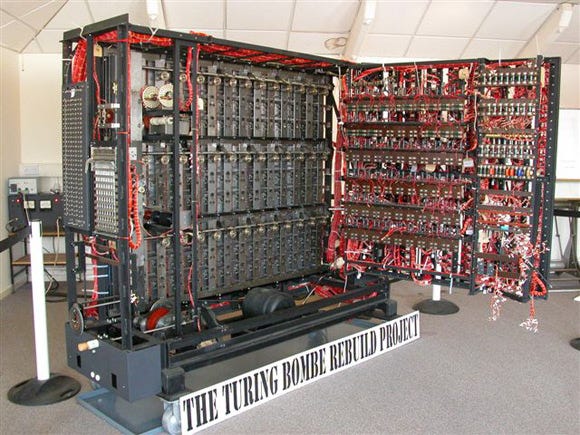
Image Source: The Imitation Game — Alan Turing & Defeat Enigma Machine in World War II via One Time Code
- “Christopher”: A Machine with a Personal Connection Now, here’s where it gets really interesting. In the film, Turing names his machine “Christopher.” While this is a fictionalized part of the story, it holds some deep emotional weight. “Christopher” isn’t just a machine to Turing. It’s a symbol of his personal struggles. It’s named after his childhood friend, but more than that, it represents the parts of Turing’s life he couldn’t openly talk about.
You see, Turing was gay in a time when homosexuality was not only frowned upon — it was illegal. He had to hide who he was, even as he worked on one of the most important projects in history. So, naming his machine after someone he loved but couldn’t openly be with is both a personal tribute and a way to express his own loneliness and isolation. It’s a metaphor for the emotional distance he felt in a world that didn’t understand him.
Creating a machine that could think and solve problems wasn’t just about war strategy for Turing — it was about creating something that could bridge the gaps between his personal feelings and the rest of the world. The machine became a way to communicate parts of his identity that had to remain hidden.
- The Quest for a “Universal Language” Turing wasn’t just trying to break one code; he was building something bigger. He wanted to create a machine that could decode any encrypted message, regardless of the language or code. This is where the concept of a “universal language” comes in. For Turing, the Bombe wasn’t just a tool to break Enigma — it was a way to make sense of a chaotic world.
This idea of universal understanding is something that feels incredibly relevant today, especially in the field of artificial intelligence. We’re constantly trying to build systems — machines — that can understand and process human language, no matter how complicated or unpredictable it gets. Turing’s work was, in a way, the first step toward that goal: machines that could “understand” us, think like us, and communicate in a language that bridges the gap between humans and technology.
But even more than just being a technological breakthrough, Turing’s work was about solving a fundamental human problem: how do we communicate with each other, across boundaries, languages, and even time? And today, when we think about AI and the machines that are getting smarter by the day, that question remains just as relevant.
- Identity, Secrecy, and Technology: Turing’s Struggle One of the most powerful themes in The Imitation Game is how Turing’s work intersects with his personal life. While he’s cracking codes and building machines, he’s also hiding a huge part of himself. His sexuality — something he could never fully express — was a source of immense struggle. The movie captures the tension between Turing’s intellectual achievements and the painful reality of being a gay man in a society that wouldn’t accept him.
The creation of the Bombe, and the way he names it “Christopher,” speaks to this inner conflict. Turing needed to create something that could both solve the world’s problems and serve as an outlet for his own emotions. The film shows us that his work wasn’t just about cracking codes — it was about breaking down the walls between him and the world he couldn’t fully participate in.
And the sad irony is that after everything Turing did for the war effort, the world didn’t recognize him as the genius he was. Instead, he was persecuted, not for his brilliance, but for his sexuality. It wasn’t until much later that he was given the recognition and respect he deserved.
- Ethical Questions: The Role of Machines in Our Lives While Turing was creating a machine that could think for itself, he was also challenging the very idea of what it means to be human. If machines can process information and think like we do, what happens to our place in the world? Do we lose our uniqueness? And if we give machines the power to solve problems, who controls that power?
The movie doesn’t just explore Turing’s genius — it raises important ethical questions about how we use technology. The Bombe wasn’t just a tool in wartime; it was a symbol of the growing relationship between humans and machines. And that relationship is only becoming more complex today. As AI continues to develop, we have to ask ourselves: what role should machines play in our lives? And how do we balance the power of technology with the responsibility that comes with it?
Turing’s work wasn’t just about making life easier — it was about changing the way we think about machines. And that’s something we’re still grappling with today.
- Conclusion: Turing’s Legacy and What It Means for Us Alan Turing’s legacy goes far beyond breaking the Enigma code. He laid the foundation for modern computing, artificial intelligence, and cryptography. But more than that, his story is a reminder of the profound connection between technology and identity.
In The Imitation Game, Turing doesn’t just build a machine — he builds a bridge between his intellectual genius and his personal pain. And in doing so, he changed the world in ways that we’re still feeling today.
As we look to the future of AI and technology, it’s important to remember that behind every machine, every code, and every algorithm is a human being trying to make sense of the world. Turing’s story shows us that technology isn’t just about innovation — it’s also about understanding who we are and how we connect with each other.
메타데이터
- post_id
- 438d0ecbd4fa
- slug
- behind-christopher-alan-turings-revolutionary-codebreaker-438d0ecbd4fa
- url
- https://medium.com/@thisishowsheis/behind-christopher-alan-turings-revolutionary-codebreaker-438d0ecbd4fa
- canonical_url
- https://medium.com/@thisishowsheis/behind-christopher-alan-turings-revolutionary-codebreaker-438d0ecbd4fa
- author_url
- https://medium.com/@thisishowsheis
- status
- ok
- fetched_at
- 2026-06-27 18:37:17




