Before Fidelity: “This Land Is Your Land” as an Audio Snapshot of a Nation in Motion
Through a broadcast ribbon microphone — where the space matters as much as the voice
Before Fidelity: “This Land Is Your Land” as an Audio Snapshot of a Nation in Motion
Through a broadcast ribbon microphone — where the space matters as much as the voice
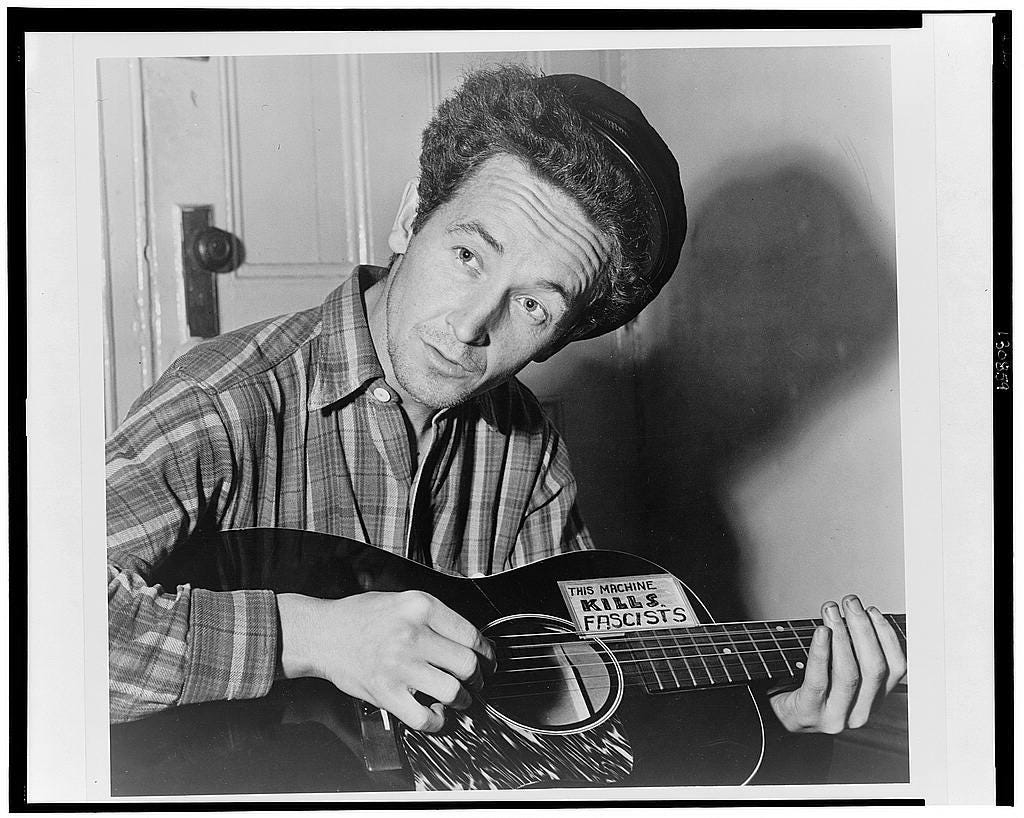
Woody Guthrie, 1943 — Photo by Al Aumuller / New York World-Telegram & Sun Collection, Library of Congress (public domain)
I didn’t come to Woody Guthrie through history books. I came to him the way a lot of people do — through a song I already knew.
This Land Is Your Land was just…there. Familiar. Almost too familiar to question. One of those songs that feels less like something you learn and more like something you absorb. And somewhere along the way — through Bob Dylan, through following the lineage backward — it stopped being background noise and started sounding like something else.
Not simpler. More complicated.
For a lot of people, Dylan begins with a single question:
“How many roads must a man walk down…”
It’s a gateway song. The kind you don’t just hear — you inherit. But Dylan didn’t come out of nowhere. His voice, his simplicity, even the way his songs ask more than they answer, trace back to someone else — someone from an earlier America.
Guthrie grew up in the Dust Bowl, watching entire communities collapse under forces they couldn’t control. He saw what it meant to be displaced, to be shut out, to be treated as less than. And instead of turning that into something polished, he turned it into something direct. From a man who would scrawl “This Machine Kills Fascists” across his guitar — long before anyone thought to call that attitude punk — you get one of the most recognizable folk songs ever written. Not as an anthem. As an answer.
The version of the song most of us know isn’t the whole thing. It’s the version that’s easiest to sing.
The song itself was written as a response — almost an answer — to something that, at the time, was everywhere. God Bless America, written by Irving Berlin and popularized by Kate Smith, had become something close to a second national anthem. It was polished, reverent, unified — the kind of song that tells you what a country is supposed to be.
Guthrie didn’t reject that. He answered it. Originally, he even titled his version “God Blessed America for Me.” Which sounds similar — until you sit with it.
Because This Land Is Your Land doesn’t describe a country. It questions one.
That tension is part of what you can hear in the earliest recordings. Not polished, not isolated — just voice, guitar, and whatever space happens to exist around them. A broadcast ribbon microphone doesn’t separate the performer from the room; it pulls everything in together: the air, the distance, the slight imperfections. You don’t just hear the song — you hear where it exists.
And that matters. Because it doesn’t sound like something constructed. It sounds like something happening.
From a man who wrote “This Machine Kills Fascists” on his guitar, the song isn’t meant to feel distant or untouchable. It’s meant to feel usable, immediate — like something you could pick up and carry forward without needing permission. Which is exactly what the structure allows.
The chords are simple — almost deceptively so. The kind of progression you can pick up in minutes, even if you’re not a musician. A complicated song belongs to the person performing it. This one was meant to belong to whoever needed it next.
That simplicity is part of why the song spread. It’s also part of why it changed. Because the easier something is to repeat, the easier it is to simplify — to trim, to smooth out the parts that don’t fit as cleanly into a shared moment.
That’s where the missing verses come in. The ones that don’t always get sung — the ones about private property, relief lines, people waiting and being turned away. They don’t disrupt the song. They complete it.
There’s a moment in one of those verses — standing in a relief line, looking around, realizing something doesn’t quite add up. It doesn’t shout. It doesn’t accuse. It just…notices. And that’s what makes it harder to ignore.
Over time, the version that stuck became the one that feels good to sing — unified, complete. Even if it isn’t.
And that’s the tension sitting inside the song. Not between patriotism and criticism, but between what we’re told the song is and what it actually contains.
The man who gave America one of its most enduring songs about belonging also wrote something else — something harder, more specific, and easier to forget.
We kept the one we could sing.
But even that version was never as simple as we made it.
메타데이터
- post_id
- 438d46fe7a05
- slug
- before-fidelity-this-land-is-your-land-as-an-audio-snapshot-of-a-nation-in-motion-438d46fe7a05
- url
- https://medium.com/this-machine-press-sixteen-tons-a-guitar/before-fidelity-this-land-is-your-land-as-an-audio-snapshot-of-a-nation-in-motion-438d46fe7a05
- canonical_url
- https://medium.com/this-machine-press-sixteen-tons-a-guitar/before-fidelity-this-land-is-your-land-as-an-audio-snapshot-of-a-nation-in-motion-438d46fe7a05
- author_url
- https://medium.com/@annalkuyperbellettiere
- status
- ok
- fetched_at
- 2026-07-09 01:30:37