LiveBOOK: A diary of what you never tried
This Monday, June 8, we release a new LiveBook. It doesn’t ask what you achieved — it asks what you never tried, and turns it into a…
LiveBOOK: A diary of what you never tried
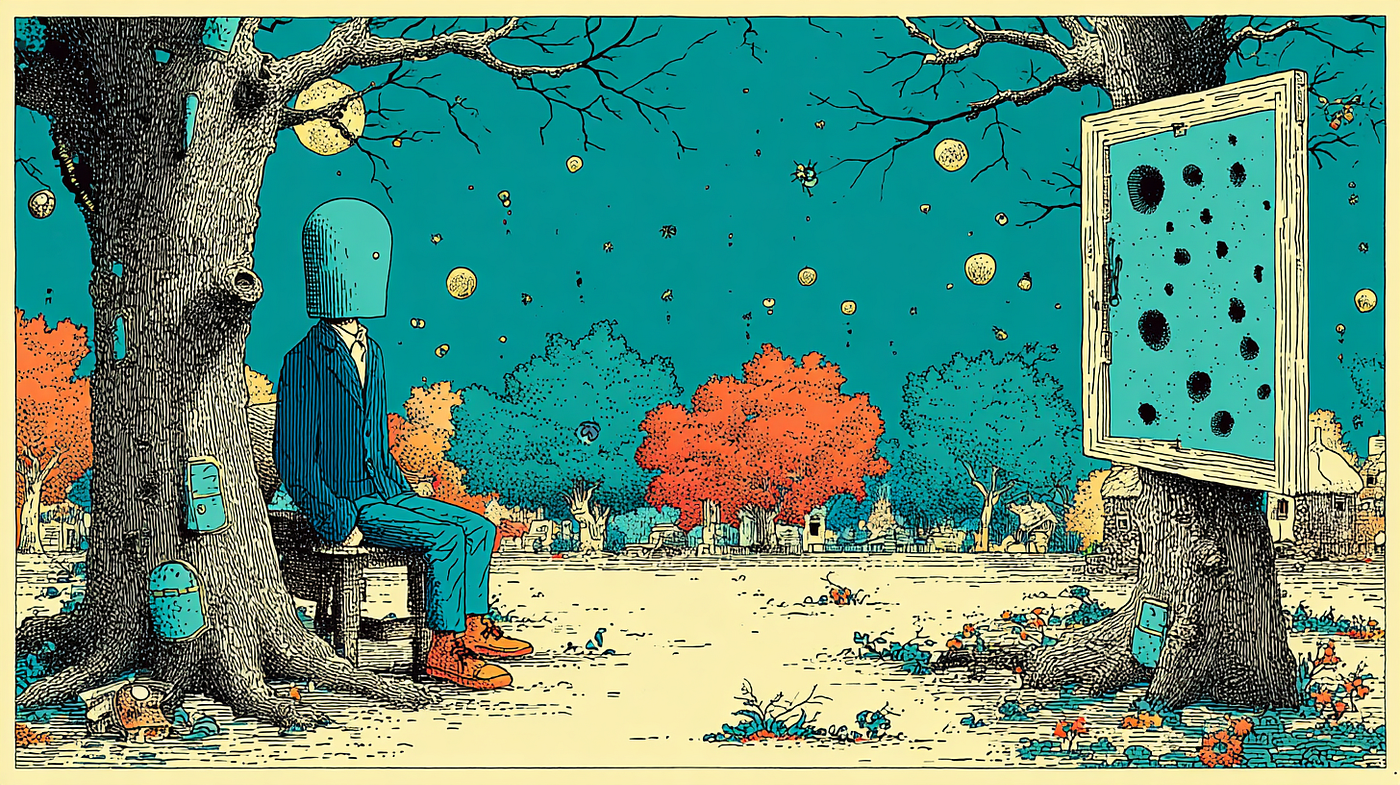
Midjourney
This Monday, June 8, we release a new LiveBook. It doesn’t ask what you achieved — it asks what you never tried, and turns it into a seven-day experiment. It is also the first one we have built from a method rather than a book, and it quietly rewrote our own playbook. Here is what it is, why it matters, and how it pushed our creation protocol to version 1.2.
Most people keep, somewhere in their heads, a running list of what they did. The new LiveBook is built on the opposite list — the one no one keeps: what you never tried.
Not the things you attempted and failed. The things you never reached the edge of. The text you didn’t publish, the offer you didn’t send, the project you didn’t start, the person you didn’t call, the idea you didn’t test, the book you keep planning, the change you keep postponing. A failure is loud; you remember it. A non-attempt is silent — and that silence is exactly where the fear lives.
The Laboratory of Non-Attempts is a method, turned into a workspace, built on one double move.
First, you diagnose. A diary of non-attempts records the moments you stepped back without quite admitting it. Most people cannot answer “what are you afraid of?” — but almost anyone can answer “what did you avoid this week, even though you knew it mattered?” You read the fear backwards, from its footprint.
Then, you cure. Every entry in that diary is immediately turned into a small seven-day experiment — small enough that the part of you that guards against risk never sounds the alarm. Not write the book, but write 300 words a day for seven days, no editing. Not launch the business, but send one small offer a day. The smallness is not a concession to weakness. It is the whole engineering trick.
The diary diagnoses the fear. The experiments cure the paralysis. Apart, each one fails in its own way — the diary alone becomes endless self-analysis; the experiments alone become random thrashing. Together they close a loop: notice what you avoid, shrink it, run it for seven days, write down what you learned, find the next thing you avoided.
What a LiveBook is, briefly
If this is your first one: a LiveBook is not a book you read from front to back. It is an interactive workspace inside a Claude Project. You explore by asking and clicking, not by turning pages. It argues the opposite side when you want to test a belief. It runs tools on your own life. It searches for fresh examples so it never goes stale. And it speaks your language — written in English, it answers in whatever language you write to it.
Written in English. Speaks your language. That one line is the whole distribution strategy: one book, sold anywhere, that meets each reader where they are.
And each LiveBook is its own creation, not a template with a new cover. Which is exactly why this one matters more than its modest size suggests.
The thing that makes this one different
Every strong LiveBook we have made shares a structural irony — the subject and the medium quietly rhyme. We read How to Read a Book through a machine that reads for us. We explored a book about false memory through an AI that, by that book’s own research, makes false memories worse.
This one has the sharpest version yet.
You are using an AI to stop over-thinking — and an AI is the most powerful over-thinking machine ever built. A long, brilliant, clarifying conversation about why you avoid sending the offer can become the most sophisticated way of not sending it. You feel productive the entire time. The offer still sits unsent.
So the workspace was built to refuse that. The guide watches the conversation itself, and when talking has started to replace doing, it says so — kindly — turns the discussion into a concrete seven-day experiment, and ends the session to send you off to act. A useful exchange ends with you leaving to do something. A seductive one keeps you in the chat. This LiveBook is designed to be the first kind, even at the cost of its own engagement.
That single decision — a guide willing to show you the door — is why it matters. It is also what taught us the most.
Not motivation, not guilt, not another productivity lecture
It would be easy to mistake this for one more productivity manual. It is the opposite.
It does not run on motivation, because motivation is unreliable and the method is built to work without it. It does not run on guilt — and this part is not soft, it is mechanical. The research is unambiguous: forgiving yourself for past avoidance reduces future avoidance, while criticizing yourself reinforces it. A diary of shortcomings written in a punishing voice produces more of the behavior it records. So the guide never tells you that you are lazy, weak, or undisciplined. It shows you the mechanism of avoidance and refuses to pass a verdict on you. “This is a trace of fear — let’s turn it into a small experiment,” never “you failed again.”
What you actually get works on three levels. First, a mirror: it shows you what you never tried, not through blame but by mapping the negative space. Then a translator: it turns “I always delay” into “there is one concrete action I haven’t started — let’s see why, and what the smallest safe step is.” Then a laboratory: you don’t have to change your life today; you just have to run one seven-day experiment. That is far easier, safer, and more honest than a grand resolution — and it is the only thing that actually moves.
From v1.0 to v1.2: where we started and where we arrived
We build these books on a protocol — an internal playbook for turning any text into a LiveBook. Every book we make quietly teaches us how to make the next one, so the protocol carries a version number, and it moves.
We started simply. v1.0 was the core idea: break a source into thematic nodes, give each a paradox and a live tool, wire them into a network, and let the reader explore.
v1.1 came from building a book on a sensitive subject. It taught us that a LiveBook must be international by design — one English master that speaks every reader’s language at runtime, not a pile of translations — and that some sources demand a careful voice that describes a mechanism without pronouncing a verdict.
v1.2 is the version this Monday’s release pushed us to write. The Laboratory of Non-Attempts surfaced four lessons at once.
That the kind of source changes everything — a self-authored method is built differently from a novel or a published book. There is no scene to quote and no famous author to lean on; the nodes are built around the method’s own principle. We now name that source type explicitly.
That fewer, deeper nodes beat more, shallower ones. A single idea pulled into nine nodes becomes nine restatements. Held in six, it stays sharp.
That the self-forgiving voice is part of the mechanism, not a nicety — a rule now, not a suggestion.
And the biggest one: the forward bias. For any book about doing, the system must convert understanding into a small action, and must refuse to let the conversation become the new avoidance. Instead of “let’s analyze your delay even more deeply,” the book says “we understand the pattern well enough — now let’s pick the smallest experiment for the next seven days.” We even added tests to prove a finished book actually does this, including feeding it a self-critical sentence to confirm it reframes gently instead of agreeing.
We also gave a name to the pattern behind our strongest titles: the subject is the medium. Naming it means we can now look for it on purpose.
Put simply: v1.0 proved a book could become interactive. v1.1 proved a LiveBook could be a serious, ethically careful product. v1.2 proves it can become a tool for changing what you actually do. We started with a way to make a book interactive; we arrived at a discipline that knows the difference between a book that informs you and a book that changes your Monday morning.
The whole idea, in five cards
Five cards, one path.
The whole idea in five cards — from avoidance to a seven-day experiment. Then close the tab and go run one.
A note on how these were made: the cards distill the LiveBook itself. The illustrations were generated from our own prompts in Midjourney and finalized in ChatGPT — three tools working together: the Claude Project LiveBook, Midjourney, and ChatGPT. Fitting, for a book about using AI without letting it do your thinking for you.

The premise: a diary not of what you did, but of what you never tried.

You can’t always name the fear — but you can always name what you avoided.

The most dangerous procrastination doesn’t look lazy. It looks like deep analysis.

Not “write the book” — “write 300 words a day for seven days.” Shrink the step.

A good guide knows when to stop talking and open the door.
This Monday
The Laboratory of Non-Attempts goes live on Gumroad on Monday, June 8.
If you recognize yourself in any of this — the list of things you keep meaning to start, the comfort of planning instead of doing, the quiet conviction that you are simply “someone who delays” — this one was built for you. Not to make you feel worse about it, but to turn one of those silent non-attempts into something small enough that you actually run it this week.
A book that doesn’t ask what you achieved. It asks what you never tried — and turns it into a seven-day experiment.
Strange as it sounds, the most useful thing a book about action can do is, at the right moment, end the conversation and let you go.
For further exploration
If this is the first LiveBook you’ve met, it isn’t the only one. Each title below is its own workspace — built from the ground up for the text it explores, with its own nodes, tools, and paradoxes. And several share the same signature as Monday’s release: the subject and the medium quietly rhyme.
- 1984 — surveillance, Newspeak, and your phone as a telescreen
- The Little Prince — attention, relationships, and what we’ve forgotten to see
- Kafka’s The Trial — algorithmic decisions and bureaucracy behind the interface
- When Memory Lies — how memory is rewritten, and how AI rewrites it
- Before You Write (bonus) — a writer’s philosophy, built from a single article
They live together in one collection — **The LiveBook Method — Turn Any Static Text into a Living Claude Workspace**— where a single purchase brings the whole library, and a new LiveBook arrives every Monday
메타데이터
- post_id
- 43c1b855dbaa
- slug
- livebook-a-diary-of-what-you-never-tried-43c1b855dbaa
- url
- https://medium.com/@kombib/livebook-a-diary-of-what-you-never-tried-43c1b855dbaa
- canonical_url
- https://medium.com/@kombib/livebook-a-diary-of-what-you-never-tried-43c1b855dbaa
- author_url
- https://medium.com/@kombib
- status
- ok
- fetched_at
- 2026-06-23 17:05:31