Girls Like Girls (2026) — The Long Boxd Review
Girls Like Girls? Nothing New.
Girls Like Girls (2026) — The Long Boxd Review
Girls Like Girls? Nothing New.
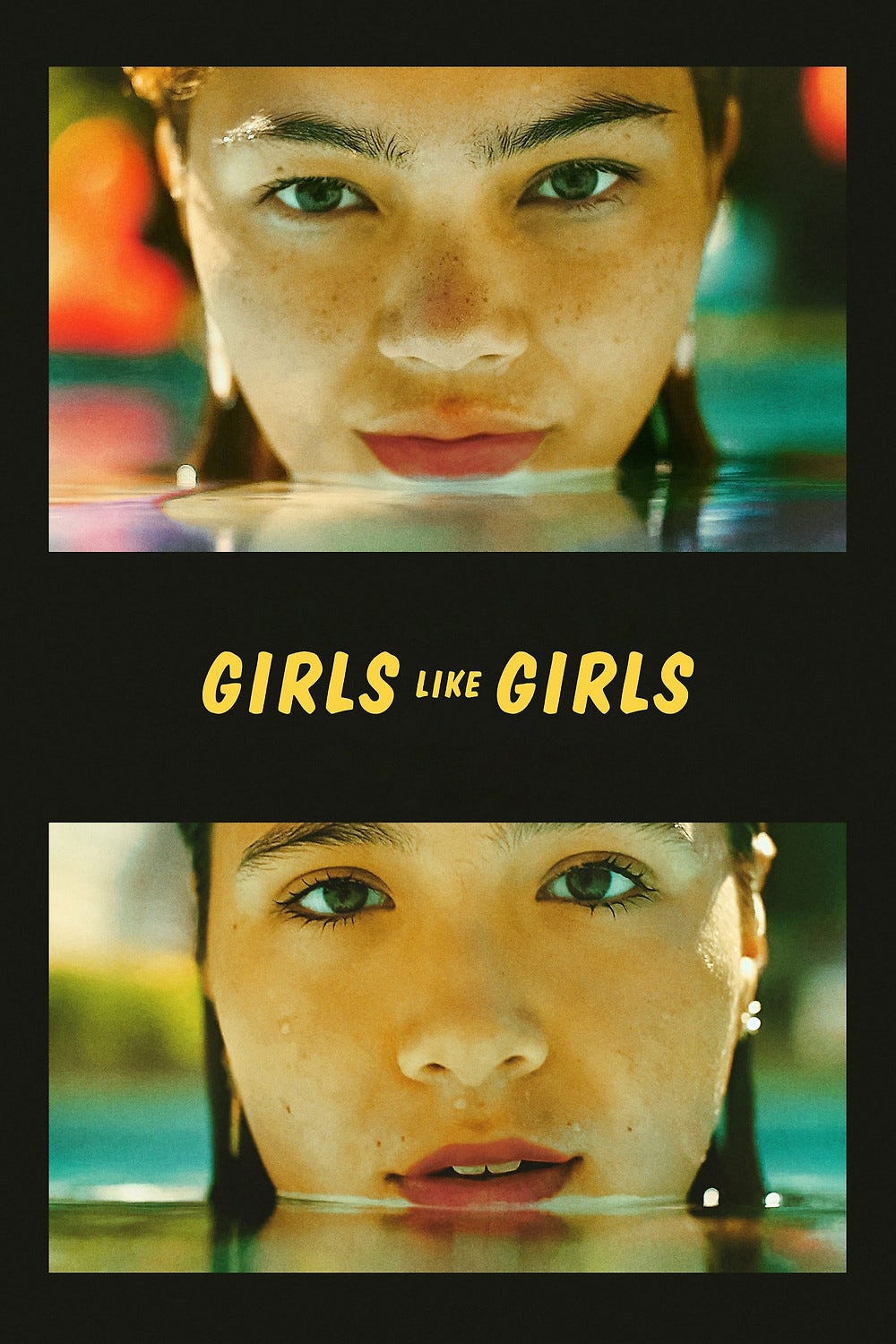
Source: Letterboxd
“…Now join me in saying, “Thank you Hayley Kiyoko” and fuck the Trents of the world.” — My Letterboxd
And right in the midst of pride month we get a film about a budding lesbian romance for teenagers and beyond by esteemed musical artist and known member of the community, Hayley Kiyoko. And that’s the draw, because, like the song and book before it, the film capitalizes on the known history and reputation that the song and its artist have created. Kiyoko knows lesbianism, so a movie by her should be proper in its presentation of it too, right? Now before you read this whole thing, I have to say — I didn’t listen to the song, nor watch the music video or read the book. I know they exist. But unfortunately, I wasn’t aware of this entire world of existence because of how much blocked out the LGBTQ+ community back when the song came out. Not because I dislike the community, but because it was the monster in the closet I refused to look at for the fear of what it would make me realize, at least back then. Anyways…my thoughts:
Well, yes. I really can’t fault the teenage angst and drama that the film portrays. In all its cringey portrayal, it is mostly accurate in how a teenager in the mid-2000s would’ve probably navigated their sexuality. I think, while this film is specifically about lesbians, the overall notes and story points can be empathetically understood by everyone in the queer community. It’s how I could sit there, watch these two youths make stupid decisions, say the wrong thing, do the wrong thing, and bite my hoodie’s collar knowing that this is their story and I can’t do anything to help them. While I wasn’t in the know back in 2006, heck, I was younger than both characters back then, seeing it now as my grown-up self — I can empathize so hard with their experience.
That’s why this film is important. It’s not just about lesbians or gays or queers. It’s about how representation & acceptance allows these stories to end happily. It’s also about communication and honestly, and I’ll always say this to anyone who seeks my help in person, please please communicate! Say what you feel! Every story that has this much tension is always because of a miscommunication or a misunderstanding that the characters feel so pressed to say out loud. But, again, it’s a story about teenagers and teenagers are going to teenage.
More than just the lesbian romance, I was happy to see the movie tackle some other sensitive topics. Here’s the list of what I saw:
- CompHet, or the implicit social norm/expectation that a woman must attend to a man in a romantic and emotional basis (read more about this if you don’t know, I’m not the best at explaining it). Oh god Sonya’s entire character was so muddled up in this.
- Abusive Heterosexuality. Going in line with CompHet, it’s how needing to be heterosexual in society is so expected that it becomes abusive to a queer individual. Again, Sonya’s character dynamic with Trent.
- Love and Rejection. Yes, this is a teenage romance, and every teenage romance film will cover this, but I think this being queer does change that feeling in a significant way.
- Grief. Very important. Coley’s entire character is about her grief. More than her romance with Sonya, it was how she was in a state of being misfit for romance in the first place. Her heart was not ready for this.
- Being open in a world that has no space for you. Since this takes place in 2006, this theme was very important to the conflict. Sonya’s main reasoning for being so back and forth with her emotions comes mostly from the expectations placed on her to be straight and perfect. And yet, she’s not, as most of us aren’t. And this definitely hurts the both of them because there’s no public knowledge on how this sort of relationship works. There was no Girls Like Girls for them to watch or a I Saw The TV Glow to help them understand. The queers of today need this, because the queers of the past know what it’s like to do this without help.
- Rebound and Drugs. This was probably a little on the lighter side but it was definitely present in Coley’s story. The rebound girl having a physical connection with Coley even though Coley herself was probably not looking for it. Her eventual breakdown where she’s so unhappy with the fact that she has a rebound girl in the first place. And how the use of alcohol and weed was a way for her to forget her sorrows. As a teenager, this is deep (lol.) But to be serious, you have to be able to empathize with how she ends up taking up behaviors she’s not happy with to deal with the fact that she’s not happy in the first place. I’m sure there are people in the community who would understand this way more than I could explain but I sat there in the theater feeling pretty awful about this sequence.
I do think the film has a few faults here and there. First, while the small aspects such as the set design, costuming, and OST really help with the setting — the cinematography isn’t much. I mentioned this in my Letterboxd review, but it’s a very simple film. It isn’t trying to do much more than what’s said on the box — and even though I did write out those bullet points above, the film itself is can be light on those points too.
The performances of Coley (Maya da Costa) and Sonya (Myro Molloy) were definitely spot on. They sell this entire thing. Up until the two are open about their attraction for each other, the film is dependent on the the subtle expressions and micro (or not so micro) touches between the characters. Seeing da Costa squirm with just her face relayed how much lesbian panic was going on in that head. And later, we see Molloy go from this flawless beauty who’s the center of attention to someone much more fragile who’s unable to actually voice themselves properly. I have to applaud that. But it’s the other performers that were not so good. Putting aside Zach Braff, who did a reasonable job as Coley’s father, everyone else was a lot more rigid. I wasn’t impressed with anyone else who had a speaking role. And that hurts because I also felt the dialogue to be rather bleh. Even the lead characters’ dialogues weren’t awfully strong. There’s an attempt to make it look like it’s because they are fledgling lesbians and don’t know how to do this, but even in moments where that’s not the focus, it feels like they don’t really say much in terms of substance. Coley’s dialogue is the biggest offender of this because it makes her look like she’s not really trying to be there in any of the scenes.
The biggest fault I felt were how much is left behind in the writer’s room. I needed more from them. Namely two sequences in particular.
- The rebound into growth montage. Apart from the heart to heart scene between Coley and her father, that scene was too quick. We’re able to piece together that she’s so awful because of the rebound, the rejection, her mother’s death, and the feeling of being unwanted; but the growth montage goes by too quickly. I would’ve preferred to see more about how Coley makes her new friends at work, how she feels supported there, and how her father is trying to get her to understand her past better. This is extremely important because in the following scene Coley is presented as the mature one. The person who has more power in the relationship due to her ability to emotionally understand herself and what she wants. And yet, we are left out of seeing how that growth occurs in just one month.
- The following scene is between Sonya and Coley after Sonya returns from her camp. This scene by itself was good because it presented two points clearly. One, Coley is over it and is emotionally mature enough to put herself first and remove herself from this wishy-washy individual. Two, it shows that Sonya does love her but is unable to reciprocate that emotionally maturity needed to convey herself to Coley properly. But, the film falls apart from there because Coley’s return to Sonya’s life isn’t due to a proper conversation or conveyance of the romance. It’s because a side character clears up a miscommunication and because Coley sees Sonya put aside Trent like a big girl. I’m sorry, but that’s not enough. Sure, there’s a lot that can be said in the spaces between words — but this was something that the two of them definitely needed to talk about especially since that was the major gripe that Coley had before the rejection, Sonya was so hesitant to speak. Even the post-credit scene doesn’t solve this, it just shows that they are happy with their romance but doesn’t show Sonya actually being emotionally mature enough to understand the relationship between them beyond a huge kissy time (lol.)
But that is not a reason to put this film aside. I saw a review on Letterboxd that mentioned how this film is better than Honey Don’t and Drive Away Dolls, but worse than Love Lies Bleeding and Portrait of a Lady on Fire. First of all, comparing this to Portrait of a Lady on Fire is rather unfair. That film is much stronger in every way. It’s a diamond in a cave where there aren’t any diamonds to be found. We should strive for more films like that but not put down films that aren’t as good. Secondly, the two Cohen films here were never meant to be good. He said it himself, these are two (soon to be three) lesbian films that are meant to be silly, low quality, popcorn pieces. I think Girls Like Girls falls into the same category as Portrait of a Lady on Fire in that they both highlight the emotional strife of being a lesbian. This film simply knows it’s going to be a lot simpler and straightforward, and that’s sort of the point. Sometimes the representation has to be easier to digest. And it shows because while this film was pretty clear to me, there are still people who will watch this and go home thinking it was boring or unneeded. And to them I say, you got to start watching film with an empathetic heart. Even if you’re not the target audience, like I’m not, you can still sit there and feel the tension, the drama, the youth-led mishaps, and the collective “nooooooooo” when one of them says the wrong thing that will eventually lead to a misunderstanding that will add one month of strife and torment. But, maybe that’s also a good thing. While I will never gatekeep being queer, I also understand that sometimes you do need to keep a watchful eye on who’s entering to make sure they either get it or don’t.
Girls Like Girls is easily a necessary film. It may not be the best queer film, it may not be the best representation of lesbian love, or the best performance of it. But, it needs to be here. Because there were plenty of women and femmes in the past who had to navigate this society without any help, and they know how hard that is on a person’s mind, soul, and sanity. We owe it to the next people to make the path easier, to move the branches, to build the pavement, and to light it up. All of this is to make it safe to exist as a minority. I keep referring to the fact that the film takes place in 2006, where even a 17 year old girl has no idea what this means for them. The kiss they shared shows how delicate that wall is. How horrific it all must feel to do something more ‘illegal’ than shoplifting. To leave mainstream society but enter a world that is blank and unknowable. But no, now it is knowable. It’s rainbow colored, it’s loud, and it’s present. So if you need it, it’s there. Thus, this film can be that gateway for those who need it.
7/10
메타데이터
- post_id
- 43cd626b1c75
- slug
- girls-like-girls-2026-the-long-boxd-review-43cd626b1c75
- url
- https://medium.com/@mani_d/girls-like-girls-2026-the-long-boxd-review-43cd626b1c75
- canonical_url
- https://medium.com/@mani_d/girls-like-girls-2026-the-long-boxd-review-43cd626b1c75
- author_url
- https://medium.com/@mani_d
- status
- ok
- fetched_at
- 2026-07-13 16:47:38