The Man Who Escaped a Russian Prison and Became King of Madagascar
The extraordinary true story of eighteenth-century adventurer Maurice-Auguste Beniowski
The Man Who Escaped a Russian Prison and Became King of Madagascar
The extraordinary true story of eighteenth-century adventurer Maurice-Auguste Beniowski
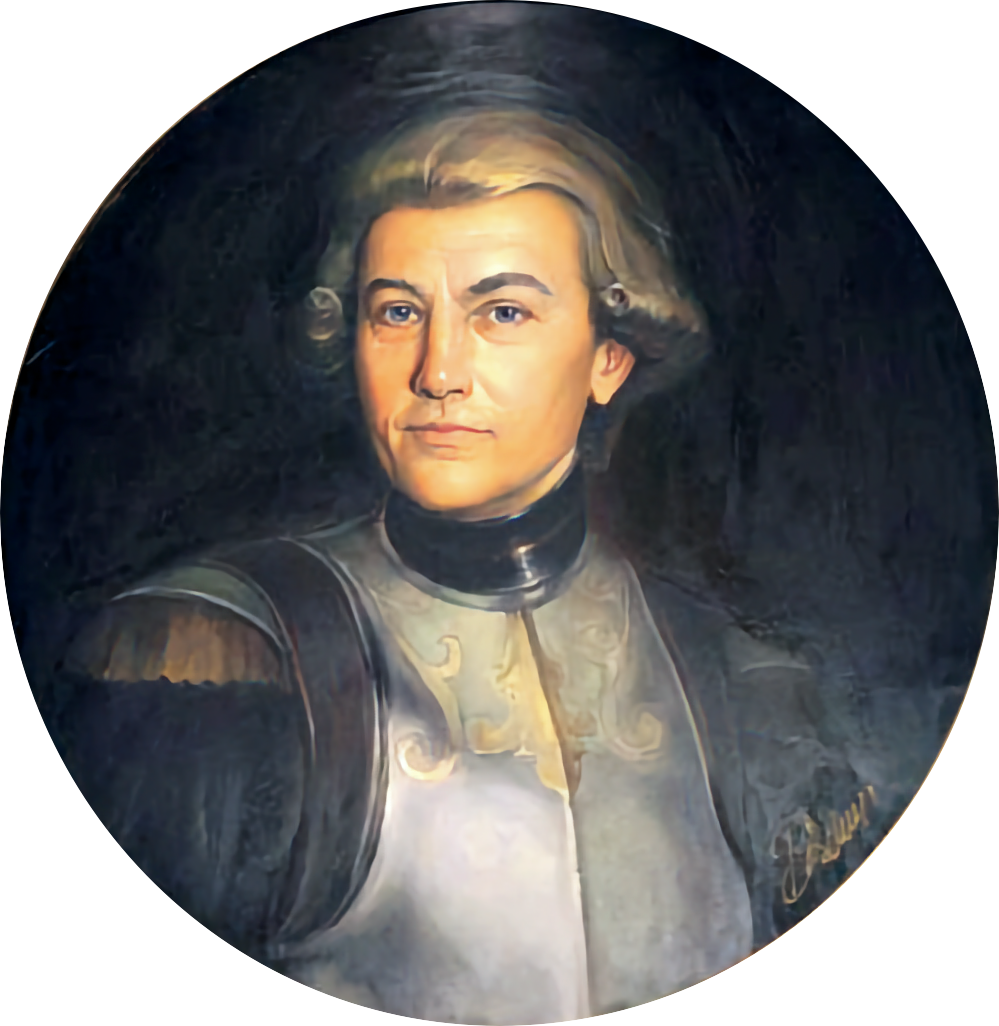
Maurice-Auguste Beniowski (1746–1786). Public domain
You’re locked up in a fortress lost at the end of the world. Not just any prison, but a fortress in Kamchatka. It’s a vast peninsula stretching far to the east of Russia, facing the Pacific Ocean.
The wind cuts through your clothes and you feel it in your bones. You’ve lost the ability to distinguish colors, as everything just looks like different shades of gray: the sky, the land, the ocean. Before you lies the endless Pacific. Behind you lies all of Siberia, in other words, thousands of kilometers of frozen tundra and emptiness. Silence and cold in every direction.
There is no escaping this place. Where would you go, anyway? One man, however, managed to find a way out.
His name is Maurice-Auguste Beniowski.
He didn’t just escape on his own. He rallied the prisoners, disarmed the Russian garrison, stole a ship, crossed the Pacific, landed in China, became a guest of King Louis XV in France, founded a colony in Madagascar… and eventually had himself proclaimed king there.
It feels like reading an adventure novel. In fact, an excellent French novel, Le tour du monde du roi Zibeline, was written by Jean-Christophe Rufin based on this story.
A true story.
Well… for the most part, let’s say. With Beniowski, the line between history and legend is always a bit blurred. That’s to be expected when you write your own story. His memoirs, written in French and published at the end of the 18th century, were a huge success throughout Europe, but then they were forgotten.
And yet, what a remarkable character and a story worth being told.
The Golden Youth
So before we set off on a trip around the world, let’s start with a little debate.
Is Beniowski Hungarian, Slovak, or Polish?
The three countries are still disputing his legacy today. He was born in 1746 in a town that is now in Slovakia. But his family belonged to the Hungarian nobility. Later, he fought for Poland and even became one of the leaders of the Confederation of Bar, an alliance opposing Russia. In short, each country has a good reason to lay claim to him.
Even the spelling can be a choice with significant consequences. “Beniowski” is the Polish spelling. In Slovak, it’s “Beňovský,” and in Hungarian, “Benyovszky.” In this article, I’ve taken the easy way out and I’m not taking sides in this dispute.
One thing is certain: he grew up in privileged circumstances. His father was a colonel in the hussars, and he received the education typical of a young European nobleman in the 18th century. In Le tour du monde du roi Zibeline, Jean-Christophe Rufin writes that a French tutor introduced him to Diderot, Voltaire, and the philosophers of the Enlightenment.
Beniowski the Soldier
His entire youth was that of a military officer.
Very early on, he fought in the Seven Years’ War as part of the Austrian army. Then fate led him to Poland, where the political situation was highly complex and explosive.
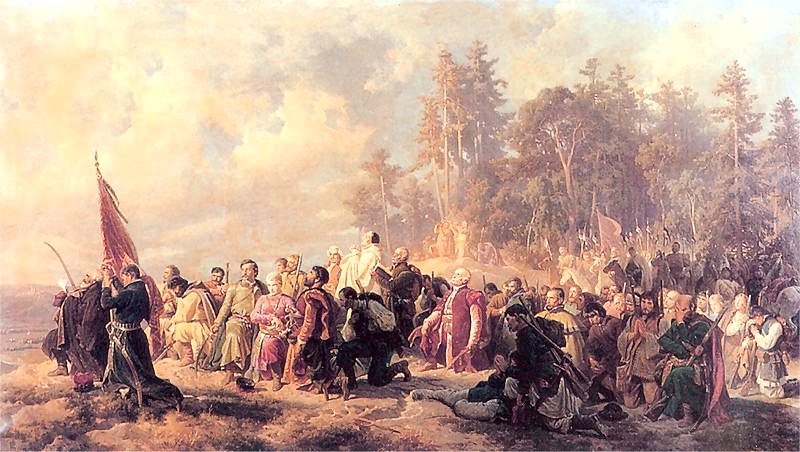
Bar Confederates pray before a battle, painting by Artur Grottger (1863). Public domain
At that time, the Tsar of Russia had a very strong influence over the Kingdom of Poland. A group of nobles rejected this control and founded the Confederation of Bar, an armed league of opponents whose goal was to defend the country’s independence.
Beniowski threw himself entirely into this struggle and became one of the movement’s military leaders.
But it was dangerous at that time to oppose the Tsar, and Beniowski was eventually captured in 1769.
A Prisoner of Russia
And he wasn’t imprisoned in Moscow. First, he was transferred to Kazan. But when he tried to escape, the Russian authorities took a more drastic measure: they sent him to the other side of the country, to Kamchatka.
You have to look at a map to get an idea. Kamchatka is farther from Saint Petersburg than Saint Petersburg is from Paris. And not just a little, the difference is actually huge.
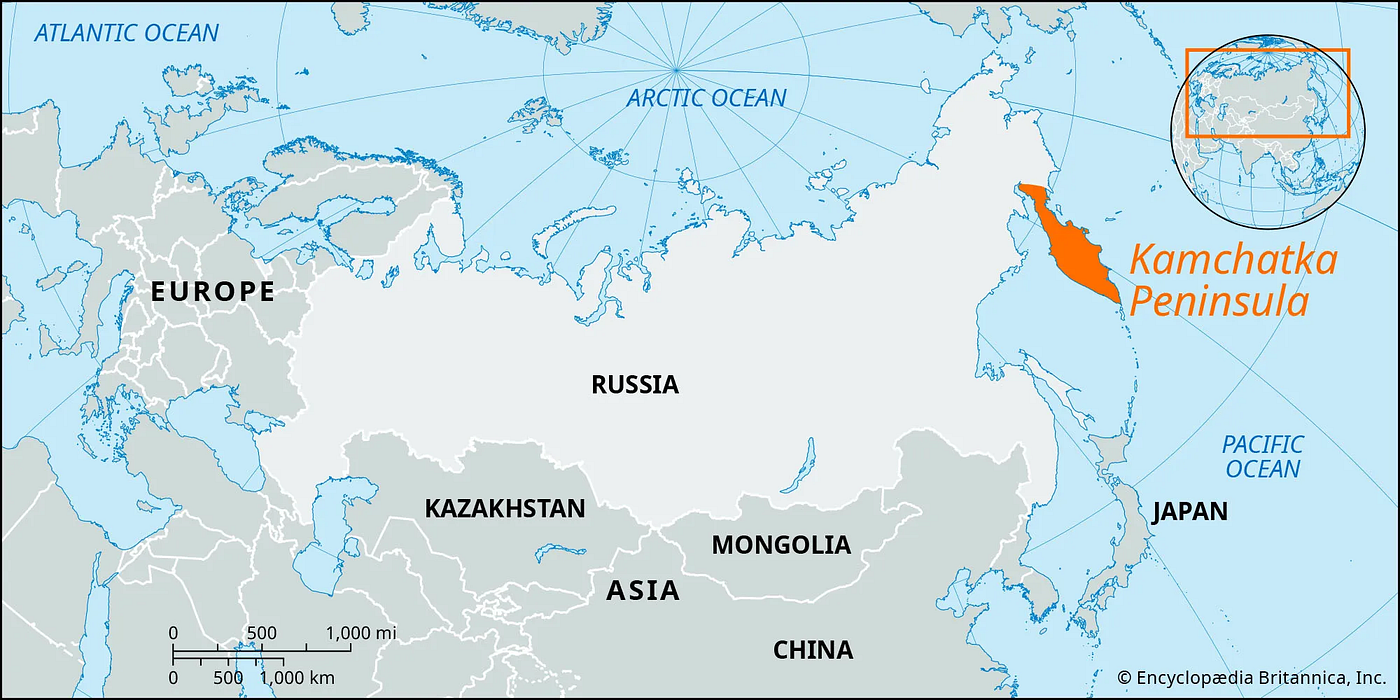
Kamtchatka Peninsula, Russia. Encyclopædia Britannica
It’s in the far east of Russia. In Rufin’s novel, the journey across Siberia to get there is one of the passages that left the deepest impression on me. You can physically feel the immensity of Russia and the vast emptiness you have to cross to reach Kamchatka.
It’s hard to imagine that anyone sent into exile there could ever return.
The Escape
Imagine you could escape from the fortress (which is already complicated enough). Where would you go next? Would you travel back the way you came? Impossible.
The only way out is the ocean. And it’s at least as vast as Siberia.
Most men would have given up any thought of escape. And indeed, that’s what the prisoners did. But not Beniowski. Even as a prisoner in a prison camp, he remained an officer.
So he set about doing what he did best and what he’d been trained to do as a soldier. He studied the fort’s operations, rallied his future troops, and organized an attack. He gradually forged alliances with the other prisoners and even with residents of Kamchatka, and he waited for the right moment.
The right moment came in 1771. A ship, the St Peter and St Paul, was docked after spending the winter in the harbor. The prisoners revolted, the Russian garrison was overpowered, and the fortress commander was even killed during the uprising. The rebels seized weapons, food supplies, and furs (the region is known for its animal furs). They loaded everything onto the ship and set sail.
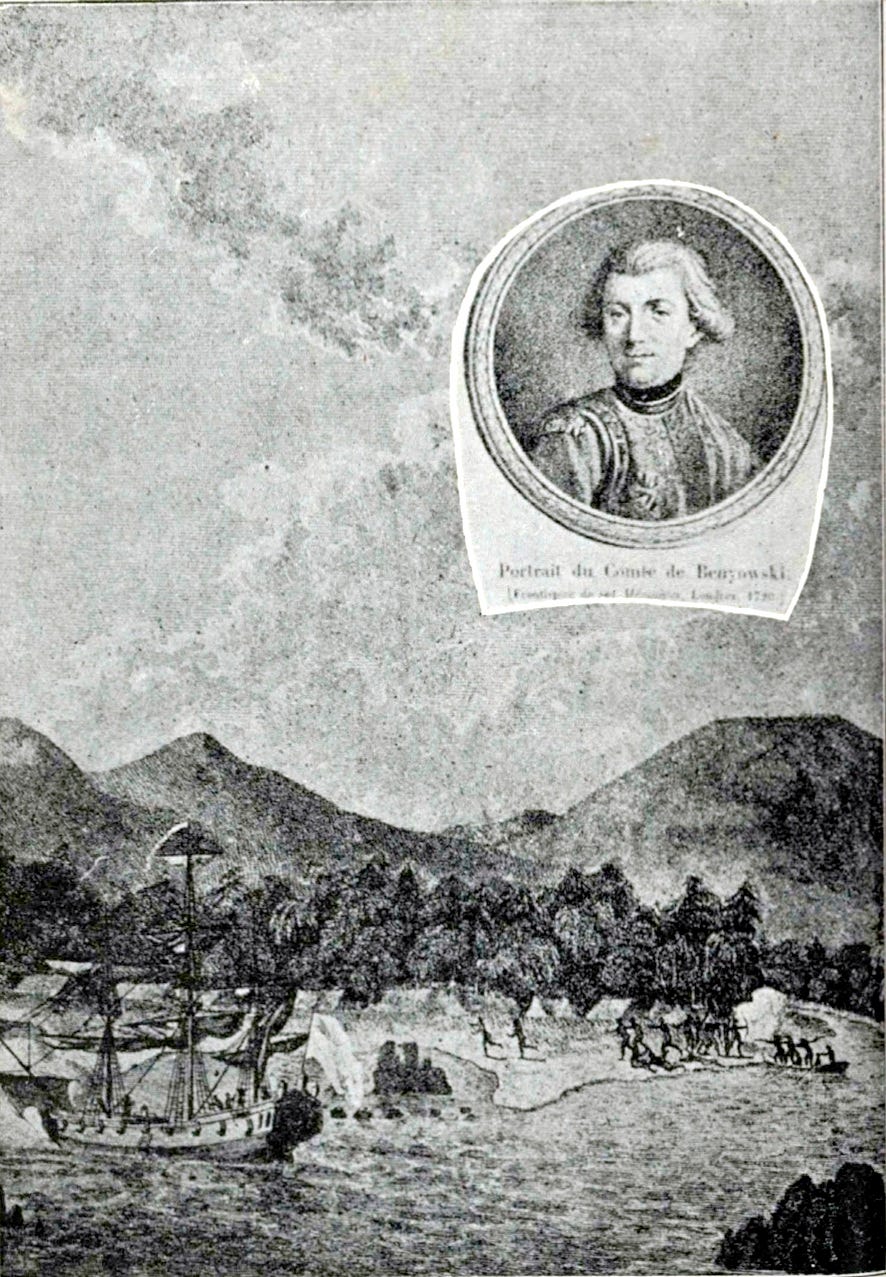
Illustration from Beniowski’s memoirs. We can see the stolen ship in the lower left. Public domain
When the ship left Kamchatka, it was carrying about eighty people. Prisoners in exile, of course, but also locals, and even women and children. It was a small society of its own, with Beniowski as its leader.
Exploring the North Pacific
Once at sea, the fugitives had only one thing on their minds: putting as much distance as possible between themselves and Russia. They would figure out the rest as they went along.
It’s important to understand what it meant to set sail on a ship like that in 1771. At that time, James Cook was just embarking on his first major expeditions and had not yet explored the North Pacific. La Pérouse, another great navigator, hadn’t even left France yet.
This part of the world was therefore a vast blank spot on European maps. So here you have a Hungarian/Slovak/Polish prisoner, leading a rather unimpressive group who sets out into this unknown world aboard a stolen ship. Put that way, prison life might not have been so bad after all.
The ship first sailed along the coast of Kamchatka before heading north toward the Aleutian Islands and Alaska. Every new bay was a discovery. Every encounter with a local population was an unknown and a potential risk. Beniowski recorded everything. He observed the currents, described the coastlines, and noted other maritime information. He also took an interest in the people he met along the way.
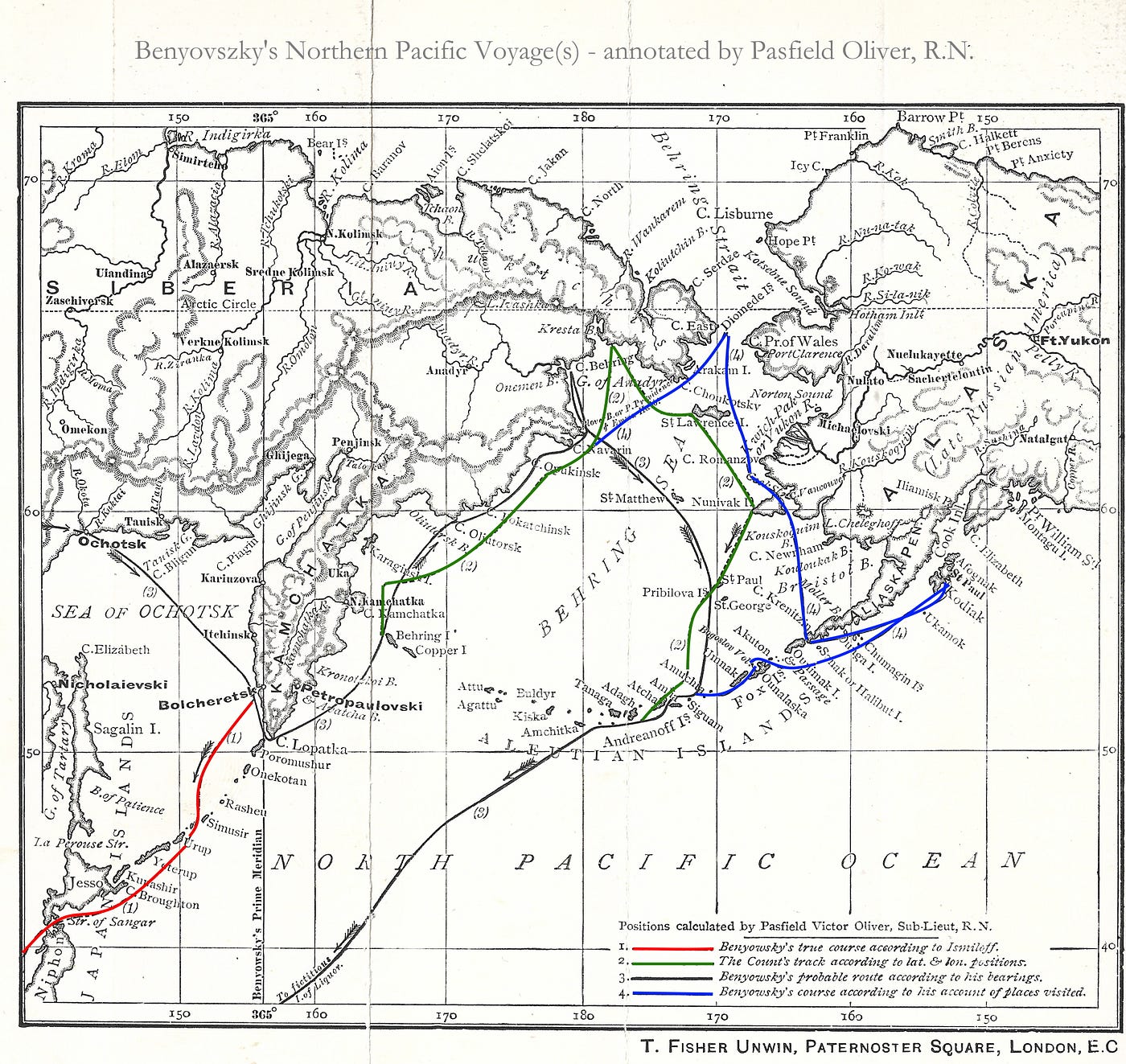
Captain Oliver’s 1893 map of Beniowski’s journey in the North Pacific. Public domain
The ship then continued southward and reached Japan.
At that time, Japan was virtually isolated from the rest of the world. For over a century, the shogunate had enforced a strict policy of isolation. Aside from a few Dutch traders at a small trading post, foreigners were forbidden to stay.
So arriving there by chance and unannounced aboard a stolen ship was not the best way to be welcomed. The stopover was very brief, and the fugitives set sail again for Formosa (present-day Taiwan), then Canton in southern China.
For prisoners who had left a Siberian prison camp just a few months earlier, this was already enough material to write a great adventure novel. They had crossed the North Pacific and survived. And on top of that, they had gathered knowledge about unknown regions at a time when geographical rivalry was raging among the great powers.
Beniowski then realized that this wealth of information was worth its weight in gold and that he could capitalize on it.
An Adventurer in Paris
After Canton, Beniowski traveled to Macau, a Portuguese colony in China. It was the first time in a long while that he found himself in a true European trading post.
And so, in modern terms, Beniowski realized he had an impressive resume and a packed portfolio. First, he had explored the North Pacific before anyone else and documented his observations. Then, he spent several years in the Russian Empire, and his information could be of interest to the Western powers.
He wanted to return to Europe and finally chose France to share his adventures there and capitalize on all the information he had gathered over the past few years.
When he arrived in Paris, he made quite an impression, and it’s easy to see why. He had everything going for him. He spoke French; he was brave, noble, a military officer, an escaped prisoner from Siberia, and he had crossed the Pacific. On top of that, he was a great storyteller. I’d even go so far as to say (and this is just my opinion) that he knew how to tell his own story.
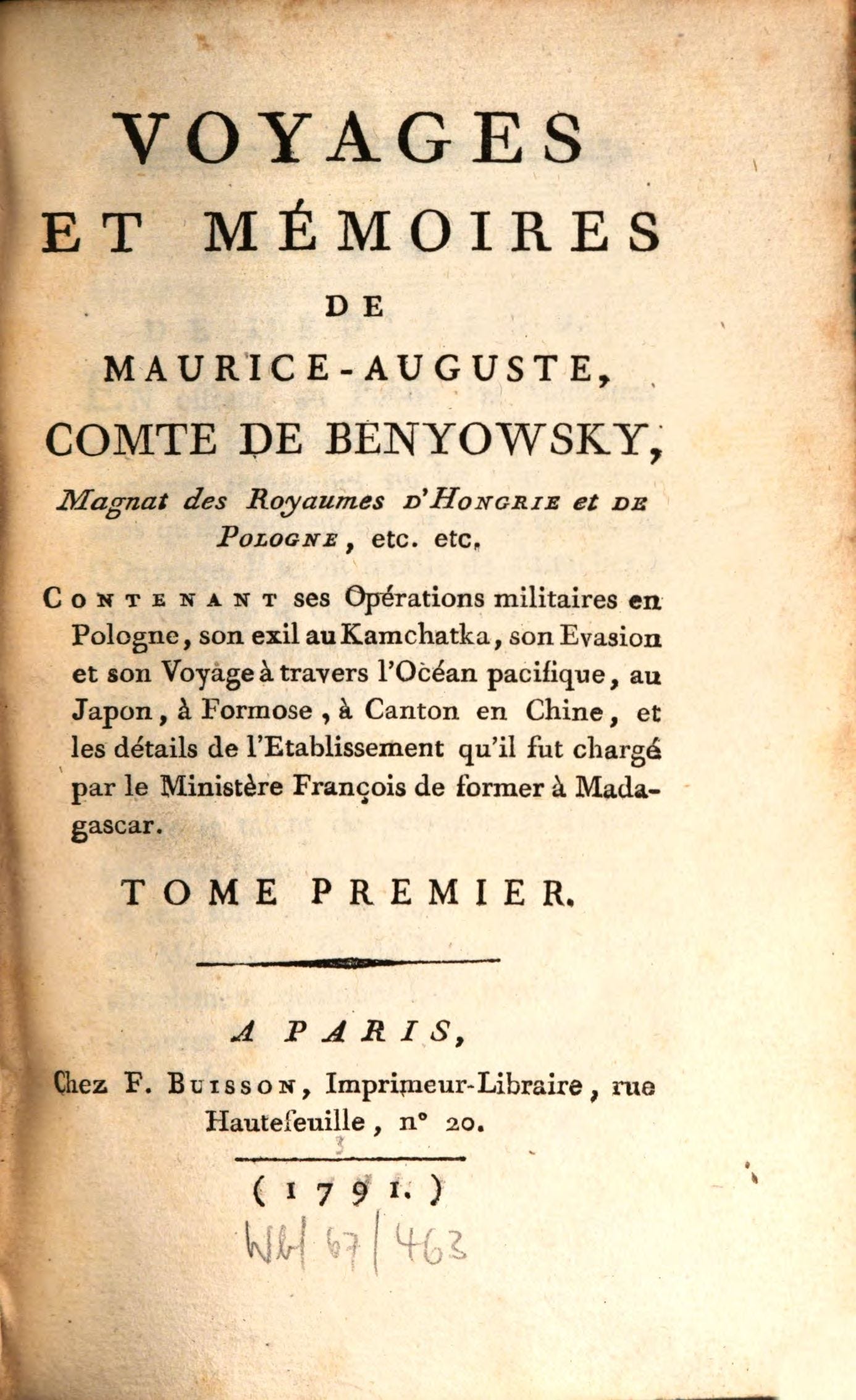
Beniowski’s memoirs in French. Bavarian State Library
In Versailles, people listened to him carefully. He was still hungry for adventure and exploration. He wanted more. His plan was to conquer Formosa (Taiwan), and he even proposed a conquest strategy to the Minister of the Navy at the time, the Count de Boynes.
France was willing to reward him for his loyalty (after all, he had come to reveal major secrets to them), and above all, they wanted to keep him and prevent him from turning elsewhere. But they didn’t want to send him to Formosa. I wonder if the fact that he wasn’t French played a role in their unwillingness to trust a foreign adventurer with a conquest expedition.
So they offered him something else: to establish a trading post in Madagascar.
The King of Madagascar
To that end, he was given considerable resources. He landed in Madagascar with 200 men, the Beniowski Volunteers. Officially, their mission was to establish a trading post. But Beniowski had bigger plans. He, who had once dreamed of conquering Formosa, now wanted to establish a proper colony in Madagascar.
His base of operations for this project was the Île de France (present-day Mauritius), which was already a French colony.
The conquest progressed very quickly. Within a few months, he formed alliances with several local chiefs. Madagascar was then divided among a multitude of tribes that were already fighting their own wars.
He founded a city on swamp land that was drained. Now, I have no idea how they drained swamps in the 18th century, but apparently they managed to do it. The city was named Louisbourg, in honor of the King of France.
Beniowski also raised indigenous troops and had them pledge allegiance to the King of France. From then on, they fought for him and recognized him as their sovereign.
In a short time, the island seemed almost conquered. Beniowski ordered the construction of a fort, hospitals, and numerous other buildings. And he carefully documented all of this in the letters he sent to France: detailed accounts of the work, building plans, progress reports on the construction…
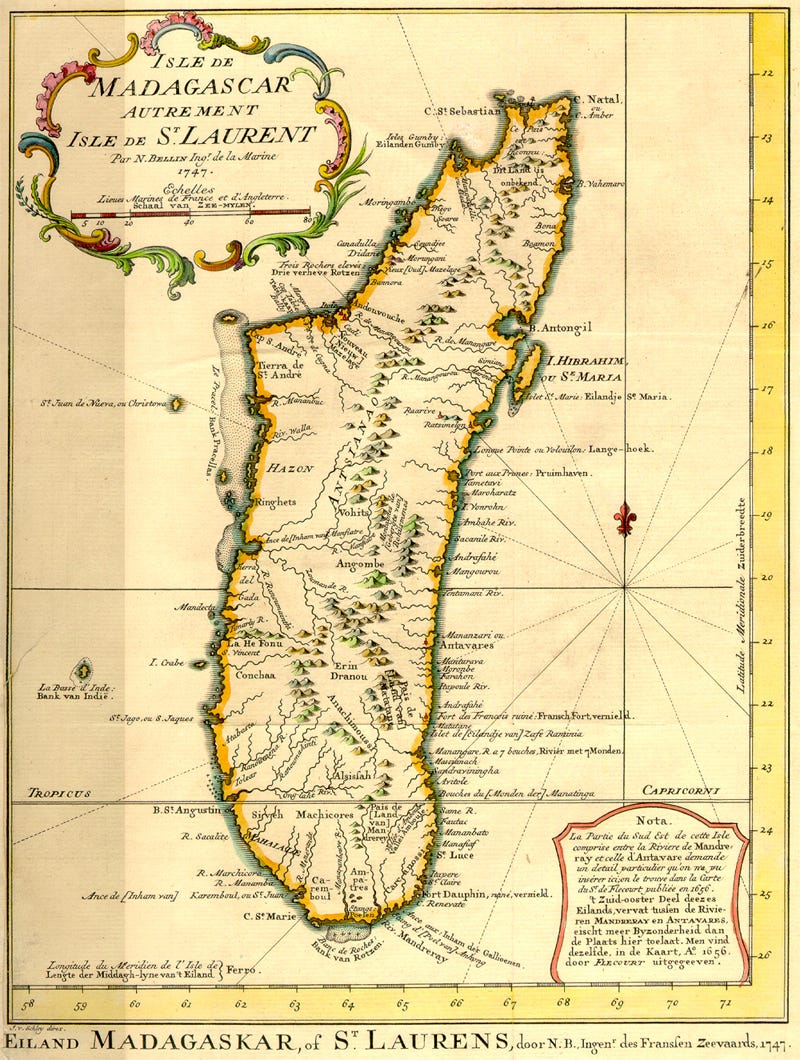
Map of Madagascar (between 1746 and 1759). Public domain
His personal journal went even further. In it, he described his military successes against the populations resisting him and claimed that they eventually proclaimed him Ampansacabe, meaning supreme chief or king.
But he kept asking his support base, the Île de France, for more resources. And the intendant refused because, in his view, the expenses were not justified.
Beniowski then accused him of putting obstacles in his way for petty political reasons. He even tried to bypass the local administration by writing directly to the Minister of the Navy. But his letters went unanswered.
Disgrace
Two years after Beniowski arrived in Madagascar, the new Minister of the Navy, Antoine de Sartine, finally decided he wanted to know what was really going on on the island. He ordered a commission of inquiry.
And that’s when the drama started.
The buildings described by Beniowski in his letters had never actually existed. The fort turned out to be nothing more than a few huts protected by a rotten palisade. The volunteers had been decimated by disease. Madagascar is a vast island, and its interior had never really been explored. The indigenous people had fled the coast and no longer wished to trade with the foreigners who had come to disrupt their way of life.
Even Louisbourg (remember the swamps…) was a poor choice of location. The town was literally built in the constant dampness of the marshes. Nowadays the city is called Maroantsetra.
In short, the outcome was catastrophic: nearly 300 men dead and two million French livres spent.
Just to give you an idea of the scale: at the end of the 18th century, two million French livres represented a huge fortune. It was the equivalent of tens of millions of euros today. Such a sum could, for example, finance several warships.
The End of the Adventure
Beniowski left Madagascar right after the inspection and returned to France. To get a good scolding, right? Not at all!
He was awarded the Order of Saint Louis and also received a substantial sum in back pay!
But Beniowski had only one thing on his mind: returning to Madagascar.
He moved heaven and earth to find funding. First, he tried his luck again with France. Well… they didn’t go that far, but since they’d given him a medal, why not try it?
He tried with Great Britain and submitted a new proposal for a colony in Madagascar to the British government, but it came to nothing.
Finally, he managed to organize an entirely private expedition, that is, without the blessing of any crown or government. At this point, we’re no longer really dealing with geopolitics but with pure business.
He struck a deal with two businessmen from Baltimore: they would finance his expedition, and in exchange, he promised them a constant supply of slaves. Yes… Even when you’re an adventurer raised on the ideas of the Enlightenment philosophers, you’re still a man of the 18th century.
He landed on the west coast of Madagascar in 1785, where his expedition was immediately attacked by the local people. Many of his men were killed, and for a time, he himself was believed to be dead. The survivors set sail for Mozambique, sold the ship, and went their separate ways.
End of the story? Not yet. But almost…
In 1786, he reappeared… alive. And this time on the east coast of Madagascar. He really was a tough guy, but the French weren’t thrilled by the news.
The last time he came, he caused quite a mess. They had no desire to see him disrupt the trade they’d managed, with great difficulty, to reestablish.
The governor of the Île de France therefore decided to put an end to it once and for all. He organized an expedition and sent it to Madagascar with a very simple mission: to deal with Beniowski.
On May 23 or 24, 1786 (sources do not entirely agree on the exact date), Beniowski fell into an ambush set by French troops and was killed. It is said that he was buried at his campsite, and many people are still searching for his grave today.
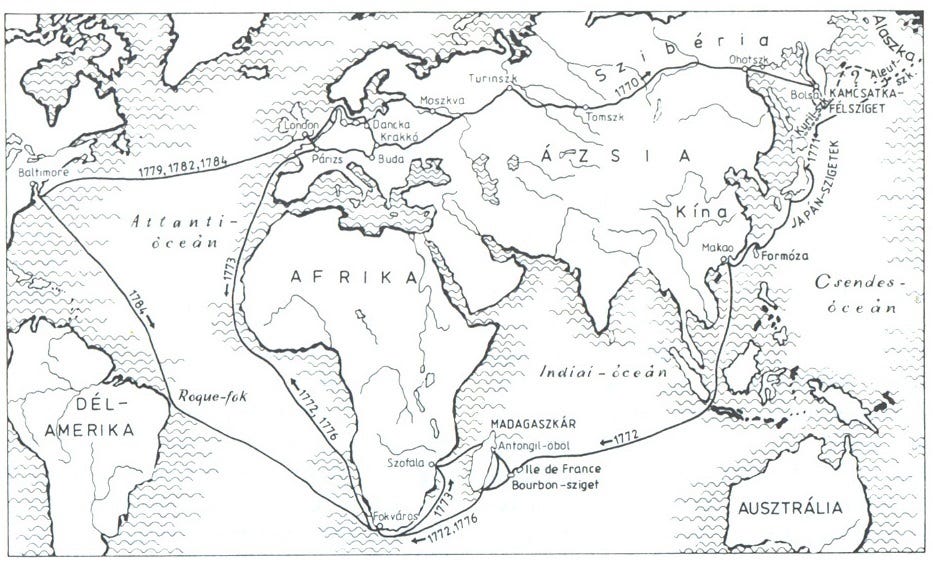
Beniowski’s journeys around the world. Image by Popik on Wikimedia Commons
He was, in turn, a Hungarian nobleman, an officer in Austria, a Polish insurgent, a prisoner of the Russians, an escapee from Kamchatka, a Pacific explorer, a French colonist… and even, according to his own account and local traditions, the king of Madagascar.
So, what are we to make of Beniowski? Was he a hero, a mythomaniac, a colonizer, an explorer, or a master con artist? Perhaps a little of all of these at once…
In any case, we must acknowledge that even if we strip away everything that belongs to legend, what remains is still an absolutely extraordinary life.
Thank you for reading! I’m Kamel Lahssini, and I share stories about how humans observe and map the world. If you want to read more, don’t hesitate to follow me. I’m always happy to reply to a thoughtful comment and start a conversation!
메타데이터
- post_id
- 43dd9a730cbc
- slug
- the-man-who-escaped-a-russian-prison-and-became-king-of-madagascar-43dd9a730cbc
- url
- https://medium.com/southern-winds/the-man-who-escaped-a-russian-prison-and-became-king-of-madagascar-43dd9a730cbc
- canonical_url
- https://medium.com/southern-winds/the-man-who-escaped-a-russian-prison-and-became-king-of-madagascar-43dd9a730cbc
- author_url
- https://medium.com/@kamel.lahssini
- status
- ok
- fetched_at
- 2026-07-16 04:05:14