PewDiePie Released His “Trillion-Dollar” AI Project for Free
PewDiePie’s Odysseus is a free, open-source AI workspace running better than ChatGPT-style tools on your own PC. Here’s what it does.
PewDiePie Released His “Trillion-Dollar” AI Project for Free
PewDiePie’s Odysseus is a free, open-source AI workspace running better than ChatGPT-style tools on your own PC. Here’s what it does.
When I first saw the post claiming a YouTuber had released a “free version of ChatGPT,” I assumed it was nonsense, because that phrase is usually a tell: it tends to mean someone reskinned a chat window, slapped a logo on it, and hoped nobody would look too closely. The YouTuber angle made it worse, since a guy famous for screaming at horror games does not sound like the person who ships serious AI software.
If you can’t read the article further for free than please click here
So I went in expecting a toy, and I came out thinking the skeptics, including past me, are missing the point. The thing is real, though it is rough in places, and the privacy story has a big asterisk that almost nobody mentions. But the core idea is solid, and it solves a problem most people don’t even realize they have.
What actually got released
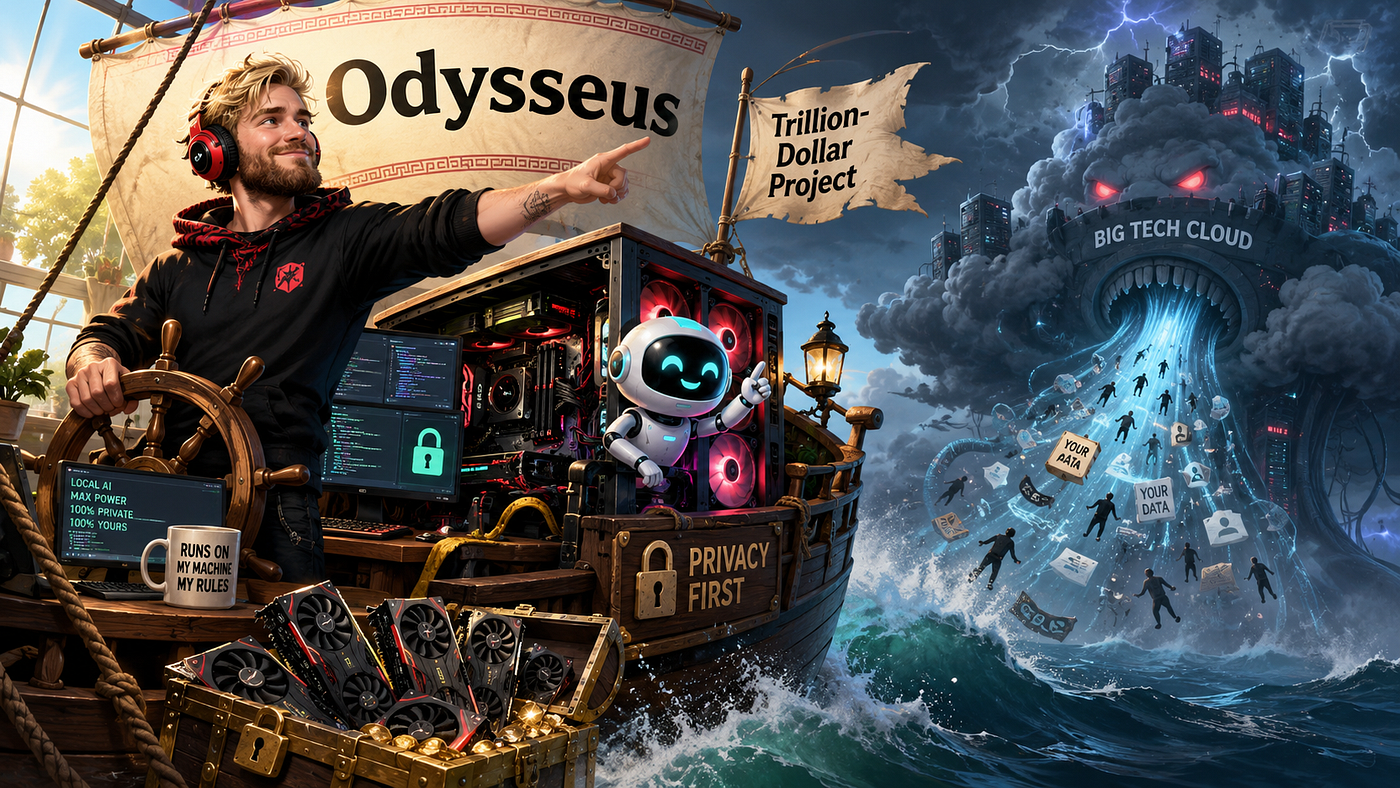
The person is Felix Kjellberg, the YouTuber you know as PewDiePie, the most-subscribed individual creator on the platform with around 110 million subscribers. On May 31, 2026, he released a free piece of software called Odysseus, announcing it in a video he cheekily titled “MY trillion $ Dollar Project is finally OUT!” The name is a joke at the expense of the big AI firms, the ones valued in the hundreds of billions whose cloud assistants you rent by the month. His point: they spent a fortune building AI you pay to borrow, and he is giving away a version you own, for nothing. The full source code is on GitHub under the MIT license, which is about as permissive as licenses get: anyone can download it, change it, run it, or even sell their own version.
[embed]
Odysseus is what people call a “self-hosted AI workspace.” That is a mouthful, so here is the plain version. It is a program you install on your own computer that gives you a chat window like ChatGPT, plus a bunch of extra tools, and the AI brain behind it can live on your machine instead of in some company’s data center.
Kjellberg built it after spending his own money on a serious home computer packed with graphics cards. He used that rig to run the same kind of AI models that power the big commercial chatbots, except on hardware he owns. The existing apps for doing this annoyed him, so he wrote his own. Then he gave the whole thing away.
His pitch on the official site is blunt: “No sales team, no demo request, no Trojan horse.” In the launch video he went further, framing the release as the opening shot in a “war with big tech” and saying users would no longer be the target of abuse. His reasoning is the part that stuck with me. As he put it, the more you share with an AI, the better it works for you, but the more you do that, the bigger the piece of yourself you hand to a giant tech company. Odysseus is his attempt to get the benefit without the trade.
Why “runs on your computer” is the whole point
Here is the thing the headline buries: the interesting part of Odysseus is not the chat window, because chat windows are easy. The interesting part is where your words go after you hit enter.
Picture two restaurants to see the difference. At the first one, you write your order on a card, hand it to a waiter, and that card disappears into a back kitchen you never see. The food comes out great, but the restaurant keeps every card you ever wrote, studies them, and uses them to plan future menus. That is a commercial chatbot: when you type into ChatGPT, Claude, or Gemini, your text travels to the company’s servers, gets processed there, and is often kept around to help train the next model.
The second restaurant hands you the ingredients and a stove and lets you cook in your own kitchen, where nobody sees your order and nothing leaves the room. That is Odysseus running a local model: your conversations, your files, and your settings stay on your own disk, with no account, no tracking, and no monthly fee.
For some people this is a privacy nicety. For others it is the difference between using AI at all and not. A lawyer with confidential case files, a doctor with patient notes, a company with trade secrets: these are people who genuinely cannot paste their work into a cloud chatbot. Local AI is the only door open to them.
What you actually get
Odysseus is not a single feature. It bundles a small suite of tools into one interface. Here is the lineup, in plain terms.

Two of these deserve a closer look, because they solve real headaches.
The first is Cookbook. If you have ever tried to run a local AI model yourself, you know the pain. There are hundreds of models, they come in confusing formats with names like GGUF and FP8, and if you pick the wrong one it either crashes or runs so slowly it is useless. Matching a model to your hardware is fiddly, technical, and discouraging. Cookbook does the matching for you: it scans your processor and graphics card, scores how capable your machine is, then points you at models from a library of more than 270 that will actually run, and serves them with one click. For a beginner, this is the difference between “I gave up after an hour” and “it just worked.”
The second is blind model comparison. You ask one question, two different AI models answer it, and you don’t know which is which until after you pick the better answer. This kills a real bias: people tend to trust the answer from the brand they already like, and hiding the labels forces you to judge the actual output. It is a small feature, but it is the kind of thing that comes from someone who actually uses this stuff, not someone optimizing a sales funnel.
How it works under the hood, briefly
You do not need to understand the plumbing to use Odysseus, but a quick look helps you judge whether it is serious software or a weekend hack.
Odysseus is built in Python and ships ready to run inside Docker, which is a tool that packages software so it runs the same way on any computer. It works on Windows, Mac (including the newer Apple Silicon machines), and Linux. To actually run an AI model locally, it leans on existing, well-respected engines: Ollama, llama.cpp, and vLLM. Think of those as the actual motors. Odysseus is the dashboard and the body around them. It did not reinvent the engine; it built a nicer car around engines that already work.
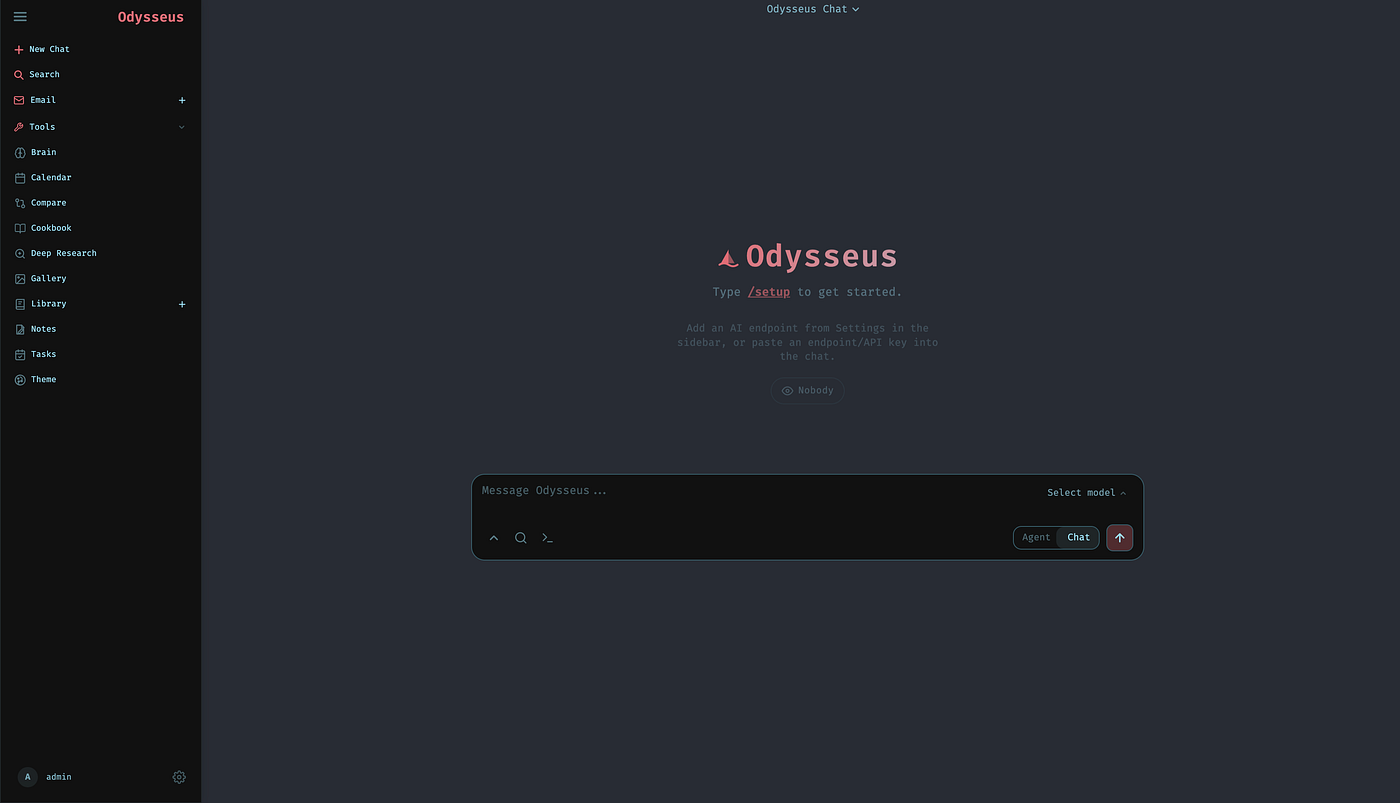
In first go it looks amazing, and has everything it promissed.
It can also connect to cloud models from OpenAI and others if you want. That flexibility matters, and it also creates the big catch I’ll get to in a minute. The reception backs up the “serious” read. The project crossed 30,000 stars on GitHub within two days of launch. Stars are GitHub’s version of a like, and 30,000 in 48 hours is the kind of number most open-source projects never reach in their lifetime. A lot of that is PewDiePie’s reach, of course. But people don’t keep using software just because a famous person made it.
Now my take
This is where I have to slow down, because the breathless posts skip it entirely.
- The privacy promise only holds if you use local models. This is the asterisk nobody mentions. Odysseus is private when the AI brain is running on your machine. The moment you connect it to a cloud service like OpenAI to get a smarter model, your data goes right back to a big tech server, exactly like it would with ChatGPT. The privacy is a property of how you set it up, not a magic feature of the app itself. Plenty of people will connect the cloud models because they are more capable, and then wonder why they aren’t getting the privacy they were promised. The honest framing: Odysseus gives you the option of full privacy.
- You need a capable computer to get the good version. Running a strong AI model locally is demanding. A model that rivals the commercial chatbots needs a lot of graphics memory, the kind you find in expensive gaming PCs or workstations, not in a typical laptop. Kjellberg ran his on a multi-GPU machine he paid for himself. If your computer is modest, Cookbook will steer you to smaller models, and smaller models are noticeably weaker. So “free ChatGPT for everyone” comes with a quiet hardware tax, because the software costs nothing but the quality you get depends entirely on what you can afford to run it on.
- It was built fast, with AI, and it shows. Kjellberg has been open that a large part of Odysseus was written with the help of AI models, including Claude and others. Critics have used the word “vibecoded,” meaning built quickly by leaning on AI rather than careful hand-engineering. That is not automatically bad, but it raises real questions. Some security researchers have flagged that the agent feature, the part that can run commands on your computer, could be risky if it has flaws. An AI that can execute terminal commands is powerful and also a sharp tool to hand a young, fast-built program. Treat the agent with caution until the project matures.
- It is not the only one, and not the most mature. A tool called Open WebUI already does much of this and has been polished over a longer period. Odysseus overlaps with it heavily. What Odysseus has that the others don’t is a megaphone: 110 million subscribers. Its real contribution may be less about being the best local-AI tool and more about being the one that drags millions of normal people into even knowing local AI exists.
Here is the head-to-head, fair version:

So, should you care?
I started out thinking this was a celebrity stunt, and I don’t anymore. The reason is simple: it points at a genuine shift, and it lowers the barrier to that shift more than anything before it.
For most of the AI era so far, using a capable assistant meant renting access to someone else’s computer and paying for it with both money and data. That felt like the only option, and Odysseus is proof that it isn’t: you can own the whole stack. The catch is that owning it takes a decent machine and a bit of patience, and the privacy only holds if you keep the AI at home.
If you are a casual user with an old laptop who just wants to ask questions, stick with the commercial chatbots. They are easier and, right now, smarter. If you handle sensitive work, or you simply dislike the idea of feeding your private life to a handful of giant companies, Odysseus is worth a real look. Go in expecting some rough edges, don’t connect the cloud models if privacy is your whole reason for being there, and keep an eye on the agent feature until it has been hardened.
The most interesting thing here is not the software but the message attached to it. A creator with one of the largest audiences on the planet just told 110 million people that they can keep their AI on their own machine, for free, and that the trade-off so many of us accepted without thinking is, in fact, a choice. That message will outlast whatever bugs ship in version one.
References
- Open Source For You. “PewDiePie Launches Open Source AI Alternative To ChatGPT And Claude.” opensourceforu.com, June 2026.
- Dhaka Tribune. “PewDiePie launches free, open-source AI platform ‘Odysseus’.” dhakatribune.com, June 2026.
- The Business Standard. “PewDiePie launches Odysseus, a free self-hosted AI workspace to challenge big tech subscriptions.” tbsnews.net, June 2026.
- Pasquale Pillitteri. “Odysseus: PewDiePie’s Local AI Workspace Taking On ChatGPT (2026).” pasqualepillitteri.it, June 2026.
- NerdZap. “PewDiePie Launches ‘Odysseus’, a Fully Self-Hosted AI Workspace.” nerdzap.com, June 2026.
Disclosure: I used AI tools to help with spellcheck and editing (Grammarly), and image generation (ChatGPT Image 2). The ideas, final writing, fact-checking, and publishing decisions are my own. :)
메타데이터
- post_id
- 442573dedd43
- slug
- pewdiepie-released-his-trillion-dollar-ai-project-for-free-442573dedd43
- url
- https://www.towardsdeeplearning.com/pewdiepie-released-his-trillion-dollar-ai-project-for-free-442573dedd43
- canonical_url
- https://www.towardsdeeplearning.com/pewdiepie-released-his-trillion-dollar-ai-project-for-free-442573dedd43
- author_url
- https://medium.com/@sumit.ai
- status
- ok
- fetched_at
- 2026-06-09 15:37:30