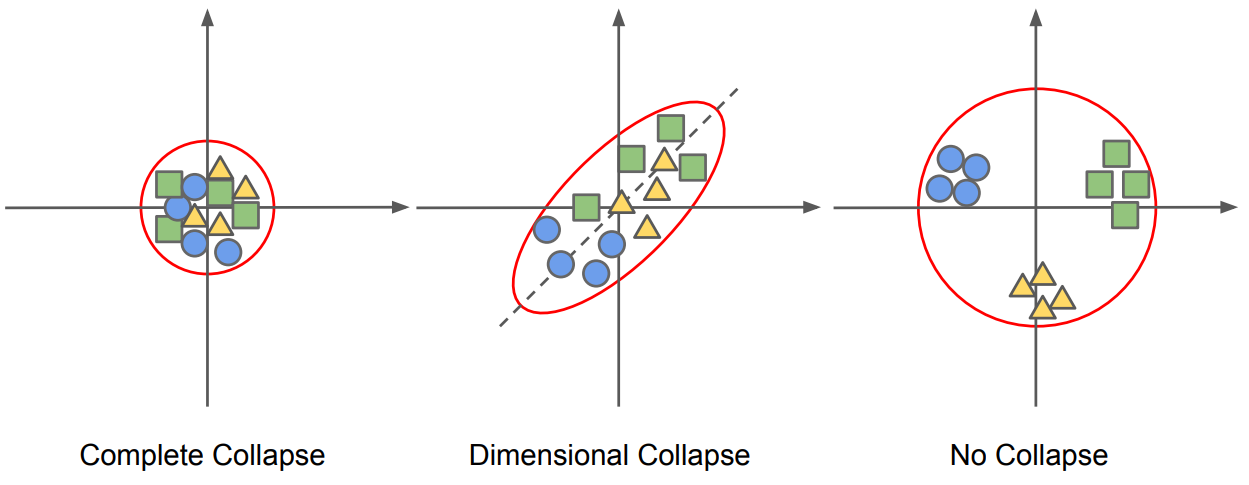
Understanding Latent Variables & Latent Space
A latent variable: compressed semantic representation learned automatically by the neural network.
Understanding Latent Variables & Latent Space
A latent variable: compressed semantic representation learned automatically by the neural network.
Is not directly observed but explains hidden structure in the data.
Examples:

For face images:
Latent variables may encode:
- Hair style
- Pose
- Lighting
- Facial expression
- Age
observed : x = (pixel) latent : z = (Hair style, Age, Pose, Lighting, Facial expression) different z → different pixels || same z → similar pixels latent varabile explain variation Mathematically:
z~ p(z) latent while x ~ p(x/z) observed so p(x) = ∫p(x/z)p(z)dx ; You can nerver observe z but without it p(x) would be imposible and complex

Summary: latent variable is an observed variable introduces to explain and organize the variability
Latent ≠ noise: noise is typically random and unstructured, while a latent variable represents structured hidden factors that explain the data.
Latent space: The collection of all latent variables forms the latent space.
Mathematically:
z € Z , z~ p(z) while mapping x = f(z)

which means:
- Standard Gaussian distribution
- Mean = 0
- Variance = 1
Neural Network as a compression machine
Input:
Image: 256 × 256 × 3 = 196,608 numbersand the network gradually compresses that information into a much smaller representation:
z = [y1, y2] OR z ∈ R^128This compressed representation is called a: “Latent Variable / Latent Vector”
The network learns:
- what information matters,
- what can be discarded,
- and how to represent the essence of the image in fewer numbers.
How Neural Networks Create Latent Variables
Suppose input is:
64 × 64 grayscale image
Flattened :
4096 number
The encoder neural network might look like:
4096 → 1024 → 256 → 64 → 2Each layer compresses information.
Input Image
     ↓
Neural Network Layers
     ↓
Compressed Representation
     ↓
Latent Vector z
CNN Example for Images
For images, encoders are usually CNNs.
Example:
Image
  ↓
Conv Layer
  ↓
Conv Layer
  ↓
Pooling
  ↓
Flatten
  ↓
Dense Layer
  ↓
Latent Vector z
CNNs progressively extract: edges, textures, shapes, objects, semantic meaning. Then compress them into latent dimensions.
Transformer Example for Text
For text:
Sentence
   ↓
Tokenizer
   ↓
Embedding
   ↓
Transformer Layers
   ↓
Hidden State
   ↓
Latent Representation
The latent vector may encode: topic, sentiment, syntax, semantics, writing style.
Why Different Latent Sizes Exist
Small Latent Size (2, 8, 16)
Pros:
- strong compression
- interpretable
- visualization possible
Cons:
- information loss
Large Latent Size (256, 512, 1024)
Pros:
- preserves detail
- better generation quality
Cons:
- harder to interpret
- more computation
메타데이터
- post_id
- 442b96f87f47
- slug
- understanding-latent-variables-latent-space-442b96f87f47
- url
- https://medium.com/@iaamshayan/understanding-latent-variables-latent-space-442b96f87f47
- canonical_url
- https://medium.com/@iaamshayan/understanding-latent-variables-latent-space-442b96f87f47
- author_url
- https://medium.com/@iaamshayan
- status
- ok
- fetched_at
- 2026-08-12 20:31:36