On The Future of DUSK
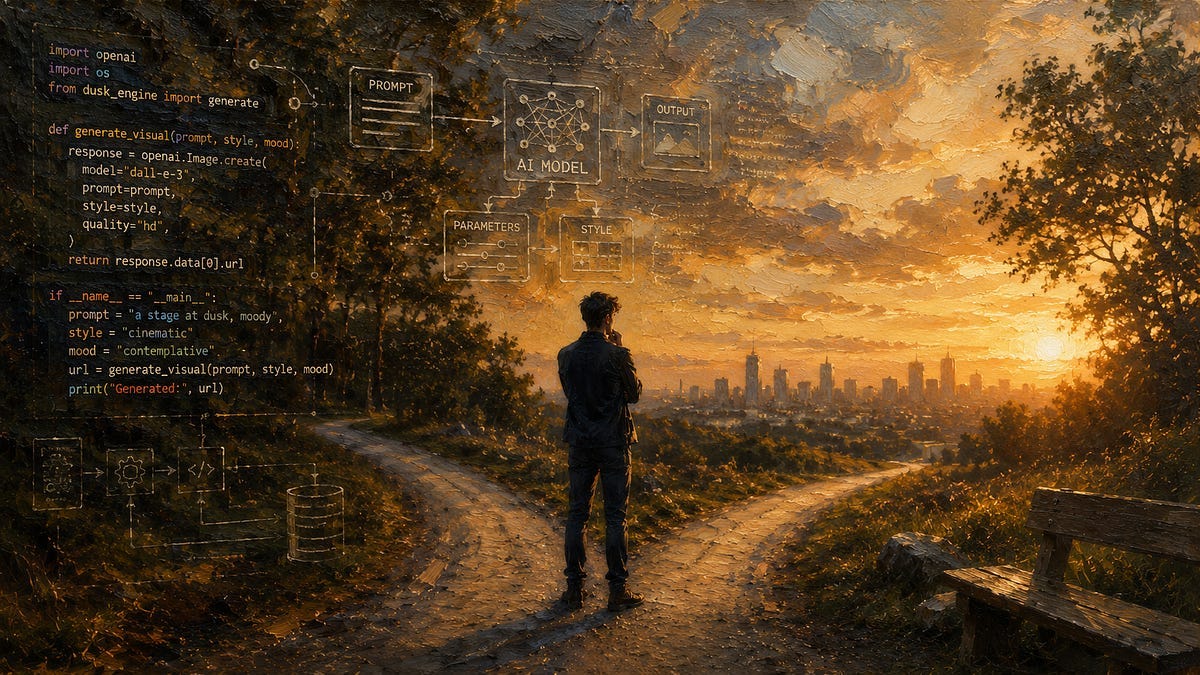
I’m at a bit of a moral crossroads.
On The Future of DUSK
I’m at a bit of a moral crossroads.
[DUSK GPT is now freely and publicly available in the ChatGPT agent store!]
Since creating DUSK, and then recently rebuilding it as a ChatGPT Agent, I’m no longer sure whether the original version is the right direction anymore.
Part of that is for practical reasons. The ChatGPT architecture solves a lot of the things I was wrestling with before: logins, user accounts, API handling, friction, maintenance. All the unglamorous machinery that sits behind a tool and quietly eats your time.
But there’s something deeper nagging at me too.
Energy usage. Digital waste. The speed at which these tools allow us to make things we may never use.
The original DUSK tool could generate images very quickly, which made it brilliant for iterative ideation. You could try something, tweak it, try again, chase an idea through ten different visual directions in a matter of minutes. In theory, that’s wonderful. It feels expansive. Creative. Liberating.
But I also started noticing a different kind of user behaviour around it.
Daily credits disappeared quickly. The tool became a potential crutch rather than a companion. People could burn through generation after generation, not because they had a clearer idea, but because the next version was always just one click away. Many of the results were never saved, never used, barely even considered before the next prompt took their place.
And I found myself wondering: is that really creativity, or is it just momentum?
There’s something about the more methodical pace of ChatGPT that changes the relationship. It subconsciously encourages more thought. You pause a little longer. You explain yourself more clearly. You consider the prompt before sending it, because the process doesn’t feel quite so disposable.
That slowness might seem like a limitation, but perhaps it’s also a kind of guardrail.
A tool that makes creation too fast can accidentally make it feel weightless. And maybe not every creative process should be optimised for speed?
DUSK was built to help people imagine, but I’d rather not encourage wasteful imagination. I don’t want it to become another little machine for producing endless unused fragments, another place where attention goes to scatter.
So I’m left asking myself a question…
Should the better tool be the faster one, or the one that asks more of us before it gives us something back?
Should DUSK be designed around speed, or around intention? I’m leaning ever more to the latter.
There’s also the matter of running costs, both financial and environmental.
Behind every image generation is infrastructure. Servers. Data centres. Cooling systems. Electricity. None of it is abstract, even if the interface makes it feel that way. We type a prompt into a clean little box, press return, and an image appears. It feels almost weightless. But somewhere, something has done the work.
As lighting designers, sustainability and efficiency are not optional extras in our world. We talk about efficacy, lamp life, heat, waste, responsible specification. We make decisions based not only on aesthetics, but on what is proportionate, necessary, and justifiable.
So it feels slightly uncomfortable to build a tool that might encourage the opposite habit elsewhere.
If we’re asking designers to be thoughtful about energy on site, in a venue, or across a production, then surely I need to apply the same thinking to a digital tool I put into their hands. Not in a performative way, and not with some grand claim that one small tool will solve anything. But simply because the principle should travel.
One possible direction is to explore open source or local models.
A local model could reduce some dependence on large platforms, give more control over how the tool behaves, and perhaps make the process feel less like feeding an endless cloud-based machine.
But I don’t want to pretend that “local” means harmless.
The impact does not disappear just because the processing happens on a machine in your own room. The electricity is still being used. The hardware still exists. The model still had to be trained somewhere, on systems far larger than my laptop. There is still a chain of energy, materials, maintenance, and eventual waste behind it.
So perhaps the better question is not whether one version has no impact. None of them do.
The better question is whether the tool encourages a more responsible kind of use.
Could DUSK be slower by design? Could it ask for more intention before generating? Could it limit throwaway outputs, or encourage saving, comparing, and refining rather than endlessly rolling the dice? Could it become less of a slot machine and more of a sketchbook?
That is the part I’m now more interested in.
Not just where the model runs, but what kind of creative behaviour the tool quietly teaches.

Dan | BloqDigital is a lighting designer and digital artist based in the UK, who writes about Art, Technology, Web3 and Culture.
Have any thoughts on this article? I’d love to hear them! Drop them in the post’s comments section and let’s talk about it.
Thanks so much for reading! If you really enjoyed this post, please consider sharing it with friends as this really helps us grow! Or you can subscribe to receive future posts.
Originally published at https://curativbloq.substack.com.
메타데이터
- post_id
- 442f191a0b34
- slug
- on-the-future-of-dusk-442f191a0b34
- url
- https://medium.com/@bloqdigital/on-the-future-of-dusk-442f191a0b34
- canonical_url
- https://medium.com/@bloqdigital/on-the-future-of-dusk-442f191a0b34
- author_url
- https://medium.com/@bloqdigital
- status
- ok
- fetched_at
- 2026-06-25 16:53:31






