The Ghost Town Paradox: Satellite Reconnaissance, Thermal Intercepts, and the War for the…
What exactly does the DNA blueprint reveal about our permanent biological infrastructure?
The Ghost Town Paradox: Satellite Reconnaissance, Thermal Intercepts, and the War for the Microbiome
What exactly does the DNA blueprint reveal about our permanent biological infrastructure?
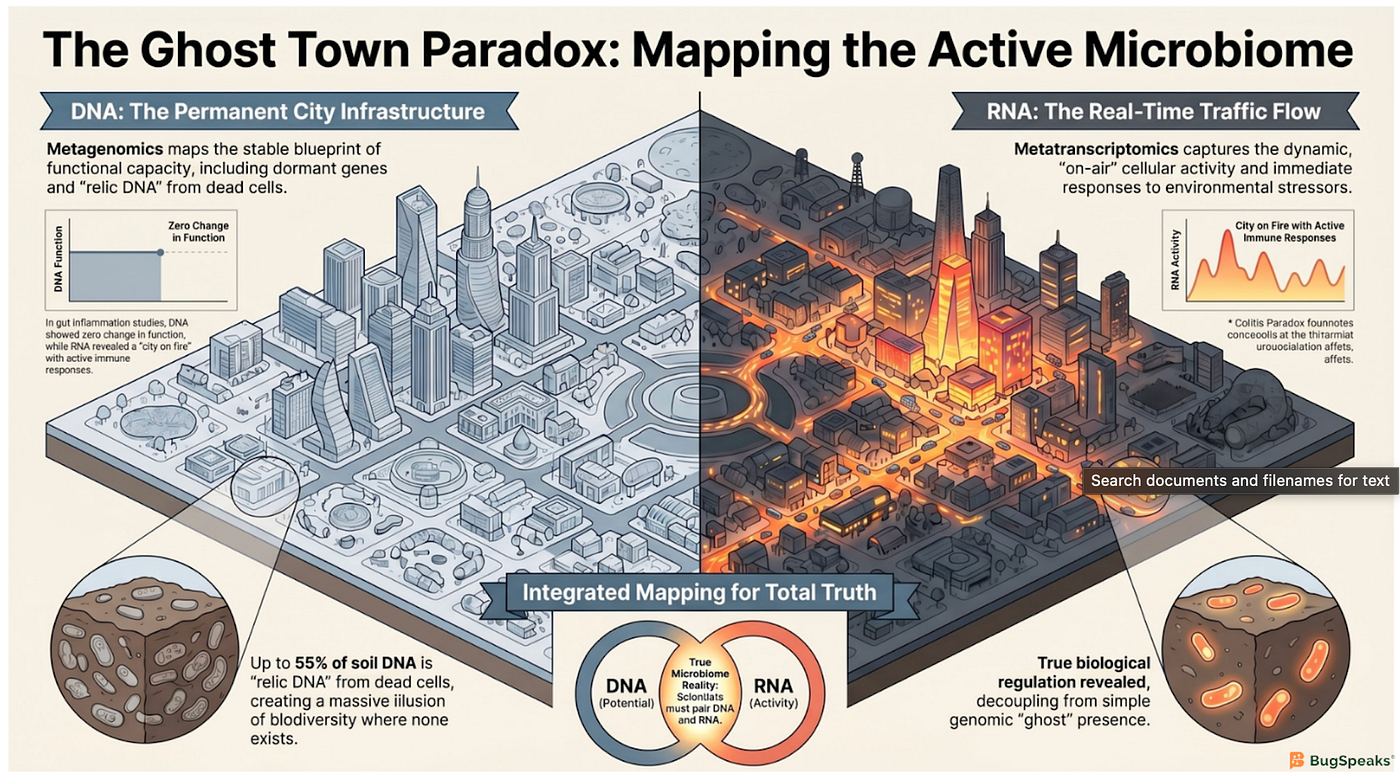
The DNA blueprint reveals the stable, enduring functional architecture of a microbial community, acting as a permanent structural satellite image of encoded capability. Shotgun metagenomics provides this foundational map of what an ecosystem is physically capable of achieving, meticulously cataloging every possible biological road and structural asset within the microbiome. Because a microbial community simply cannot express genes it does not natively possess, DNA sequencing provides a chemically stable, highly reproducible measure of absolute physical potential, allowing researchers to escape the transient, volatile noise of any single momentary biological snapshot. Massive population datasets such as the Hunt study and the Swedish cohorts comprising over 28,000 individuals demonstrate that this DNA metagenome represents a highly robust, heritable blueprint deeply intertwined with the foundational genetics of the host. By laying out the genetic blueprints of thousands of species, researchers can build a comprehensive understanding of the structural limits and long-term evolutionary layout of a specific biological terrain.
The DNA blueprint also reveals specific, durable associations between host genetics and this permanent microbial infrastructure, demonstrating exactly how underlying host traits lay the concrete bedrock for microbial cities. For example, the LCT locus, which natively dictates the ability of a human to digest dietary milk sugar, profoundly and consistently controls the structural abundance of Bifidobacterium across the gastrointestinal landscape. Similarly, the ABO blood group locus physically shapes the foundational environment for mucin-degrading bacteria by altering the mucosal terrain they colonize, while highly specific HLA-DQB1 variants tie microbial abundance modules directly to the enduring risk of developing type 1 diabetes. By isolating these foundational constraints, the DNA blueprint maps the permanent infrastructure upon which all active biological traffic must eventually flow, essentially drawing the unmoving concrete pathways that govern potential interactions.
Why does relying solely on the genomic blueprint result in mapping a ghost town?
Relying solely on the genomic blueprint results in mapping a ghost town because traditional metagenomics indiscriminately extracts the genetic material of dead organisms alongside the living, blinding researchers to the reality of active biological execution. This catastrophic structural flaw is glaringly apparent in environments like agricultural soil matrices, where up to 55% of the total extracted DNA is actually relic DNA (necromass). This inert genetic debris originates from dead, lysed microbial cells and becomes physically shielded from chemical degradation by local soil mineralogy. Consequently, this DNA simply binds to the dirt and sits completely inert for months or even years, only to be indiscriminately picked up by sequencing technology as if it were a thriving metropolitan center. The sequencers see the structural blueprint of the cells, yet they remain entirely blind to the fact that the genetic residents have long since perished.
This ghost town reality falsely inflates biodiversity estimates because sequencers cannot distinguish between active microbial workers and lifeless genetic ruins, fundamentally misrepresenting the ecosystem’s actual behavior. When sequencing captures this dead genetic material, researchers are effectively swimming in a sea of inert relics, leading to severe miscalculations of key biogeochemical processes. For instance, the LAMPs trials studying nitrogen fertilization revealed that RNA libraries captured a sevenfold higher active nitrogen-cycling community than what was mapped by the DNA libraries. This phenomenon is not merely an artifact of dense soil matrices; it is actively mirrored in human biology, where transcriptionally dormant bacteria like Dialister invisus or passive oral microbes that survive gastric acid arrive in the lower gastrointestinal tract as nonfunctional genetic relics. These remnants appear perfectly viable on a metagenomic satellite map, yet they are completely inert, existing merely as dormant infrastructure without interacting with the host at all.

How does capturing active RNA transcripts expose the live thermal reality of disease?
Capturing active RNA transcripts exposes the live thermal reality of disease by isolating the real-time, dynamic cellular execution that actually drives pathology and environmental adaptation. While DNA provides a static list of encoded capabilities, mRNA metatranscriptomics acts as a highly sensitive thermal imaging heat map, ignoring dead concrete to isolate the precise biological response of the community at the exact moment of physiological relevance. This captures the 59% of gene expression variation that is completely decoupled from sheer genomic abundance, isolating the pure active cellular regulation, host-microbe signaling, and immediate metabolic adaptation driven by dietary shifts, inflammation, and xenobiotics. Instead of simply cataloging which microbial workers are present, RNA sequencing tracks the headlights on the road, mapping exactly what the community is actively doing under the immense pressure of its immediate environment.
Capturing this live thermal signature completely resolves the Colitis Paradox (dextran sodium sulfate model), where traditional sequencing remains utterly blind to massive tissue destruction. In this acute intestinal inflammation model, a chemical induces severe tissue damage, yet the total metagenomic DNA profiles remain completely static due to the phenomenon of functional redundancy. Because different bacteria possess overlapping, redundant metabolic pathways, the sudden death of one bacterial population under stress is offset by the rise of another, allowing the DNA copy number for those shared pathways to balance out mathematically. Consequently, the DNA satellite image insists the microbial capacity is perfectly preserved and stable, remaining utterly blind to the severe, active pathophysiology tearing through the host.
The thermal RNA map further exposes this reality by capturing the massive, live pathophysiological explosions happening precisely at the moment of relevant biological stress. Where the DNA blueprint shows a quiet, unchanged ecosystem, the RNA transcripts reveal that the host tissue is quite literally on fire, actively mapping out exactly which microbes are fighting the flames or accelerating the damage. The metatranscriptomic data captures the active upregulation of GTP-binding proteins that mechanically amplify immune cascades in the gut, the immediate activation of signal peptidase 2 to drive cellular virulence, and the desperate deployment of L-asparaginase, an anti-inflammatory enzyme used by bacteria to actively suppress host immune cell activation. None of these critical survival mechanisms are visible in the static DNA, making the RNA intercept the only way to observe the system’s actual struggle for survival.
Why is deploying a thermal RNA intercept without a structural DNA map a fatal tactical error?
Deploying a thermal RNA intercept without a structural DNA map is a fatal tactical error because transcription is entirely transient, leaving researchers completely blind to unexpressed genetic capabilities. Biology is fundamentally constrained by encoded capacity; transcription only highlights what is actively firing at the exact microsecond the physical sample is drawn. Working exclusively with RNA acts like reading a town’s library records to see what books are currently checked out, completely ignoring the thousands of dangerous manuals sitting dormant on the shelves. Because of this transient nature, RNA consistently fails to capture rare but clinically vital biological elements simply because the organism has not yet encountered the specific environmental stressor required to trigger their expression.
Relying solely on this transient intercept creates a latent trap where deadly biological weapons remain functionally invisible until the exact moment they are triggered. If a clinical researcher only analyzes the thermal RNA signature, dangerous assets like dormant antibiotic resistance genes, latent virulence factors, and lethal prophages hiding inside bacterial genomes will register as entirely nonexistent. Without the permanent satellite map provided by DNA metagenomics to identify these encoded capabilities, clinicians might mistakenly classify a pathogen as harmless, remaining entirely unaware of the biological threat until a slight environmental shift detonates the hidden time bombs and the patient crashes. DNA is strictly mandatory to map these time bombs, establishing the absolute hard boundaries of what the system could potentially unleash in the future.

How do physical fragility and mathematical illusions corrupt the RNA signal?
Physical fragility and mathematical illusions corrupt the RNA signal through the immediate degradation of biological transcripts and the highly distorted data ratios forced by laboratory extraction methods. Unlike the chemically stable DNA blueprint, RNA is inherently fragile, operating like a self-destructing message that native cellular enzymes begin to tear apart within minutes of its deployment. Because up to 90% of a captured sample consists of structurally useless ribosomal RNA (rRNA) rather than actionable messenger RNA, laboratories must physically deplete this material using rigorous enzymatic digestion protocols. This depletion inadvertently pulls out functional messenger RNA, introducing massive chemical biases and transforming the final sequenced data into a heavily distorted reflection of the true biological reality.
The mathematical illusion of compositionality further corrupts the signal because sequencing percentages artificially alter the perceived abundance of microbes within a closed dataset. Next-generation sequencing is permanently trapped in a simplex constraint, meaning every dataset must mathematically sum to exactly 100%. If one specific bacterium rapidly multiplies in an environment, its percentage of the total naturally goes up, which mathematically forces the relative percentage of every other bacteria in the sample to artificially drop, even if their physical numbers have not changed at all. To escape these massive spurious correlations and the technical dropouts inherent to fragile sampling, bioinformaticians must deploy center log-ratio (CLR) transformations to pull the compositional data into standard Euclidean space, alongside Tweedie distributions specifically engineered to handle the severe zero-inflation of the datasets.
How does multi-omics integration merge the satellite map and the thermal camera?
Multi-omics integration merges the satellite map and the thermal camera by statistically decoupling true transcriptional regulation from simple structural genomic variation. In complex biological ecosystems, physical abundance heavily dictates baseline transcription; the Men’s Lifestyle Validation Study proved that 41% of the variation in microbial gene expression is dictated purely by the physical DNA copy number. If a specific bacterium duplicates its population, it creates double the DNA for its metabolic pathways, inherently producing more baseline RNA transcripts even if the per-cell rate of transcription remains completely static. If researchers evaluate RNA in complete isolation without referencing this physical blueprint, they will mistakenly identify these basic physical abundance shifts as differentially expressed genes, generating an astronomically high false positive rate.
This integrated multi-omics resolution finalizes the merger by explicitly modeling observed RNA counts as a direct mathematical function of the paired metagenomic DNA. The definitive future of this combined intelligence relies on iMEC joint conditional modeling — the integration of metatranscriptomics into community genome-scale metabolic models. By sequencing physically matched DNA and RNA from the exact same sample, bioinformaticians can calculate a precise ratio of how much RNA is produced per unit of DNA. Subtracting this structural DNA baseline from the total RNA counts allows scientists to isolate true RNA regulatory action.
Can the scientific community finally abandon its reliance on solitary maps and isolated intercepts to embrace a paradigm where the structural blueprint and the live thermal signal are perfectly intertwined?
Listen to the podcast on Spotify: https://open.spotify.com/episode/1d2eHgU4qK7YdyVavfizk3?si=mqFbRiuxTI2ZfrhTusvV-w
메타데이터
- post_id
- 4444169a2a76
- slug
- the-ghost-town-paradox-satellite-reconnaissance-thermal-intercepts-and-the-war-for-the-4444169a2a76
- url
- https://medium.com/@bugspeaks/the-ghost-town-paradox-satellite-reconnaissance-thermal-intercepts-and-the-war-for-the-4444169a2a76
- canonical_url
- https://medium.com/@bugspeaks/the-ghost-town-paradox-satellite-reconnaissance-thermal-intercepts-and-the-war-for-the-4444169a2a76
- author_url
- https://medium.com/@bugspeaks
- status
- ok
- fetched_at
- 2026-06-09 15:37:30