Reducing Vendor Approval Time Through Contract Automation
How Contract Verse Helps Businesses Accelerate Vendor Onboarding and Procurement Processes
Reducing Vendor Approval Time Through Contract Automation
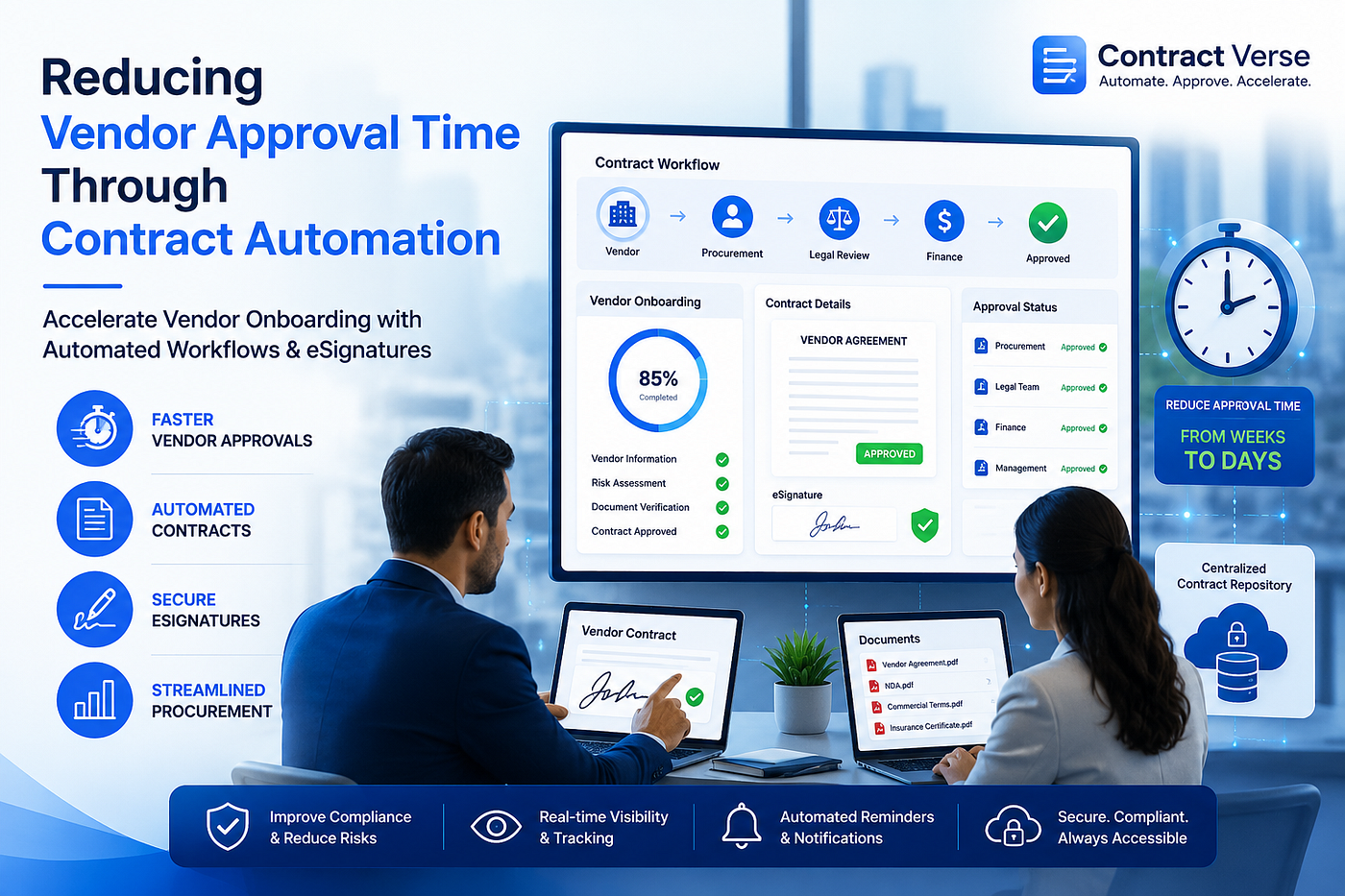
How Contract Verse Helps Businesses Accelerate Vendor Onboarding and Procurement Processes
In today’s fast-paced business environment, organizations rely heavily on vendors, suppliers, consultants, and service providers to maintain smooth operations. Whether you’re onboarding a new technology partner, approving a logistics provider, or engaging a marketing agency, every vendor relationship begins with one critical step: contract approval.
Unfortunately, vendor approval processes are often slow, manual, and filled with bottlenecks. Procurement teams chase signatures through emails, legal departments review multiple versions of the same document, and stakeholders struggle to track approval status. These delays can impact project timelines, increase operational costs, and create frustration for everyone involved.
This is where contract automation becomes a game-changer.
By automating contract creation, review, approval, signing, and storage, organizations can dramatically reduce vendor approval times while improving compliance and visibility. Contract Verse empowers businesses to streamline vendor contract workflows, eliminate manual tasks, and accelerate supplier onboarding from days or weeks to just hours.
In this article, we’ll explore the challenges of traditional vendor approval processes, the benefits of contract automation, and how Contract Verse helps organizations achieve faster, smarter vendor management.
Understanding the Vendor Approval Process
Vendor approval is the process organizations use to evaluate, approve, and onboard third-party suppliers before conducting business with them.
A typical vendor approval workflow may include:
- Vendor information collection
- Risk assessment
- Legal review
- Contract drafting
- Internal approvals
- Contract negotiation
- Electronic signing
- Document storage and compliance tracking
While each step is essential, managing them manually often creates delays that affect procurement efficiency and business growth.
For example, if a company needs a software vendor urgently, waiting several weeks for contract approvals can postpone implementation, delay project launches, and impact revenue generation.
Common Causes of Vendor Approval Delays
1. Manual Contract Creation
Many organizations still draft contracts from scratch or copy content from old documents.
This approach leads to:
- Inconsistent language
- Increased legal risks
- Longer preparation times
- Frequent formatting errors
Legal teams often spend valuable time correcting basic mistakes instead of focusing on strategic reviews.
2. Multiple Email Chains
Vendor contracts frequently move through long email threads involving procurement teams, managers, legal departments, finance teams, and executives.
Common issues include:
- Lost email attachments
- Version confusion
- Missed approvals
- Delayed responses
Tracking the latest contract version becomes a challenge.
3. Lack of Approval Visibility
Without centralized contract management, stakeholders often don’t know:
- Who currently has the document
- Which approvals are pending
- Where bottlenecks exist
- Expected completion timelines
This lack of transparency slows decision-making.
4. Manual Signature Collection
Printing, signing, scanning, and emailing documents remains a surprisingly common practice.
Manual signature collection can add days or even weeks to vendor onboarding timelines.
5. Compliance and Risk Reviews
Legal and compliance teams need to ensure contracts meet organizational requirements.
Without automation, these reviews become repetitive and time-consuming.
What Is Contract Automation?
Contract automation refers to the use of technology to streamline and automate the contract lifecycle.
Instead of relying on manual processes, businesses use software to:
- Generate contracts automatically
- Route documents for approval
- Track review progress
- Manage negotiations
- Collect electronic signatures
- Store contracts securely
- Monitor obligations and renewals
Contract automation transforms contract management from a reactive administrative task into a proactive business process.
Why Faster Vendor Approvals Matter
Reducing vendor approval time provides benefits across the organization.
Accelerated Vendor Onboarding
Faster approvals allow vendors to start delivering services sooner.
This enables organizations to:
- Launch projects faster
- Meet business deadlines
- Improve operational efficiency
Better Vendor Relationships
Suppliers appreciate efficient onboarding experiences.
When vendors encounter fewer delays, organizations build stronger business relationships from the start.
Reduced Procurement Costs
Manual contract processing consumes valuable employee time.
Automation reduces administrative workloads and lowers operational expenses.
Improved Compliance
Automated workflows ensure contracts follow approved processes and regulatory requirements.
Increased Business Agility
Organizations can quickly engage new suppliers and adapt to changing market conditions.
How Contract Verse Reduces Vendor Approval Time
Contract Verse is designed to simplify contract lifecycle management and accelerate approval workflows.
Let’s explore how its automation capabilities help organizations reduce delays.
1. Automated Contract Generation
Creating contracts manually is one of the biggest causes of procurement delays.
Contract Verse allows teams to generate standardized vendor agreements using pre-approved templates.
Benefits include:
- Consistent contract language
- Reduced drafting time
- Lower legal risk
- Faster document preparation
Instead of spending hours creating contracts, teams can generate compliant agreements within minutes.
2. Centralized Contract Repository
One of the biggest challenges in vendor approval workflows is locating documents and tracking versions.
Contract Verse provides a centralized repository where all contracts are securely stored.
Teams can:
- Access current versions instantly
- Search documents quickly
- Eliminate duplicate files
- Maintain a complete audit trail
This significantly reduces administrative delays.
3. Automated Approval Workflows
Traditional approval processes often depend on email communication.
Contract Verse automates approval routing based on predefined rules.
For example:
- Procurement review first
- Legal review second
- Finance approval third
- Executive sign-off last
Documents are automatically sent to the appropriate stakeholders, eliminating manual follow-ups.
Benefits include:
- Faster approvals
- Reduced human error
- Greater accountability
- Consistent workflows
4. Real-Time Contract Tracking
One of the most frustrating aspects of vendor approval is uncertainty.
Stakeholders often ask:
- Has legal reviewed the contract?
- Is finance approval complete?
- Who is holding up the process?
Contract Verse provides real-time visibility into contract status.
Users can instantly see:
- Current stage
- Pending approvers
- Completed reviews
- Approval history
This transparency helps identify and resolve bottlenecks quickly.
5. Electronic Signatures
Waiting for physical signatures can significantly delay vendor onboarding.
Contract Verse integrates secure electronic signature capabilities that allow contracts to be signed from anywhere.
Benefits include:
- Faster contract execution
- Remote signing support
- Improved user experience
- Legally enforceable agreements
What previously took days can now be completed in minutes.
6. Automated Notifications and Reminders
Approvers often forget to review contracts because they are busy with other responsibilities.
Contract Verse automatically sends:
- Approval requests
- Reminder notifications
- Escalation alerts
- Status updates
This keeps contracts moving through the approval pipeline without manual intervention.
7. Version Control and Collaboration
Vendor negotiations frequently involve multiple revisions.
Without proper version control, organizations risk:
- Reviewing outdated documents
- Losing changes
- Creating compliance issues
Contract Verse maintains version history and tracks all modifications.
Teams can collaborate efficiently while ensuring everyone works from the latest version.
8. Compliance and Risk Management
Contract automation isn’t just about speed — it also improves compliance.
Contract Verse helps organizations:
- Enforce approved contract clauses
- Maintain audit trails
- Monitor regulatory requirements
- Reduce contract risks
This minimizes delays caused by compliance concerns while maintaining governance standards.
Real-World Example: Vendor Approval Before and After Automation
Before Contract Automation
A procurement team needs to onboard a new supplier.
Process:
- Draft contract manually
- Email legal department
- Wait for review
- Send revisions
- Obtain management approval
- Print contract
- Collect signatures
- Scan and archive documents
Average timeline:
2–4 weeks
After Implementing Contract Verse
Process:
- Generate contract from template
- Automatic approval routing
- Real-time tracking
- Electronic signature collection
- Automatic storage
Average timeline:
1–3 days
The result is dramatically faster vendor onboarding and improved business efficiency.
Industries Benefiting from Vendor Contract Automation
Manufacturing
Manufacturers frequently work with multiple suppliers.
Contract automation helps:
- Accelerate procurement
- Manage supplier agreements
- Reduce production delays
Healthcare
Healthcare organizations must comply with strict regulations.
Contract Verse improves:
- Vendor compliance
- Audit readiness
- Contract visibility
Information Technology
IT departments regularly engage software vendors and service providers.
Automation enables:
- Faster technology adoption
- Improved contract governance
- Reduced procurement bottlenecks
Financial Services
Banks and financial institutions require extensive contract oversight.
Contract automation provides:
- Compliance controls
- Risk management
- Approval transparency
Retail and E-Commerce
Retail businesses depend on supplier relationships.
Faster vendor approvals help maintain inventory levels and improve customer satisfaction.
Key Metrics to Measure Success
Organizations implementing contract automation should track:
Contract Cycle Time
Measure how long contracts take from creation to execution.
Vendor Onboarding Time
Track the total time required to approve and activate vendors.
Approval Delays
Identify workflow bottlenecks and monitor improvements.
Compliance Rates
Ensure contracts follow approved processes.
Cost Savings
Calculate reductions in administrative and legal expenses.
Best Practices for Vendor Contract Automation
To maximize results, organizations should:
Standardize Contract Templates
Use approved templates to reduce drafting time.
Define Approval Rules
Create automated workflows based on contract type and value.
Enable Electronic Signatures
Remove physical signing delays.
Maintain Centralized Records
Store all contracts in a secure repository.
Monitor Performance
Track contract metrics and continuously optimize workflows.
The Future of Vendor Approval Processes
As businesses continue digital transformation initiatives, contract automation will become a standard requirement rather than a competitive advantage.
Emerging technologies such as:
- Artificial Intelligence
- Predictive Analytics
- Smart Contracts
- Automated Risk Assessment
will further reduce approval timelines and improve decision-making.
Organizations that adopt contract automation today position themselves for greater agility, efficiency, and scalability tomorrow.
Conclusion
Vendor approval delays can slow business growth, disrupt operations, and create unnecessary administrative burdens. Traditional contract management processes often rely on manual tasks, email communication, and paper-based approvals that consume valuable time and resources.
Contract automation offers a smarter approach.
By automating contract creation, approval routing, tracking, collaboration, compliance management, and electronic signing, businesses can significantly reduce vendor approval times while improving accuracy and governance.
Contract Verse empowers organizations to streamline vendor onboarding, eliminate bottlenecks, and accelerate procurement workflows with a centralized, automated contract management solution.
As companies continue seeking faster, more efficient ways to engage suppliers and partners, contract automation will play a critical role in driving operational excellence and business success.
Frequently Asked Questions (FAQs)
1. What is vendor contract automation?
Vendor contract automation is the use of software to automate contract creation, approval, review, signing, and storage processes, reducing manual work and accelerating vendor onboarding.
2. How does contract automation reduce vendor approval time?
Automation eliminates manual tasks such as drafting, email routing, follow-ups, and physical signatures, allowing contracts to move through approval workflows much faster.
3. What is Contract Verse?
Contract Verse is a contract lifecycle management platform that helps organizations automate contract creation, approval workflows, document tracking, electronic signatures, and compliance management.
4. Can contract automation improve compliance?
Yes. Automated workflows ensure contracts follow predefined approval processes, maintain audit trails, and comply with organizational policies and regulatory requirements.
5. Are electronic signatures legally valid?
In most countries, electronic signatures are legally recognized and enforceable when implemented according to applicable laws and regulations.
6. Which departments benefit from contract automation?
Procurement, legal, finance, operations, HR, compliance, and executive management teams all benefit from faster and more transparent contract workflows.
7. How much time can businesses save with contract automation?
Organizations often reduce contract approval timelines from several weeks to just a few days, depending on workflow complexity.
8. Does Contract Verse support contract tracking?
Yes. Contract Verse provides real-time visibility into contract status, approval stages, pending actions, and complete audit histories.
9. Is contract automation suitable for small businesses?
Absolutely. Small businesses can improve efficiency, reduce paperwork, and accelerate vendor onboarding without requiring large administrative teams.
10. What is the biggest advantage of automating vendor contracts?
The biggest advantage is faster vendor onboarding, enabling businesses to engage suppliers quickly while improving compliance, transparency, and operational efficiency.
메타데이터
- post_id
- 44827f394f99
- slug
- reducing-vendor-approval-time-through-contract-automation-44827f394f99
- url
- https://medium.com/@TRUESignerONE/reducing-vendor-approval-time-through-contract-automation-44827f394f99
- canonical_url
- https://medium.com/@TRUESignerONE/reducing-vendor-approval-time-through-contract-automation-44827f394f99
- author_url
- https://medium.com/@TRUESignerONE
- status
- ok
- fetched_at
- 2026-07-14 01:40:41