🛢️ Gas, Tariffs and the Labyrinth: Mozambique Between Global Capital and Functional…
Bad Explanations, Broken Systems, and the Possibility of Progress
🛢️ Gas, Tariffs and the Labyrinth: Mozambique Between Global Capital and Functional Underdevelopment — Part 01
Bad Explanations, Broken Systems, and the Possibility of Progress
(Series: Dilemmas and Challenges of the Mozambique LNG Project)

📘 Prefer to read this article from the series “50 Questions for 50 Years of Independence” in PORTUGUESE? 👉 Click here: O Gás, a Tarifa e o Labirinto: Moçambique entre o Capital Global e o Subdesenvolvimento Funcional — Parte 01
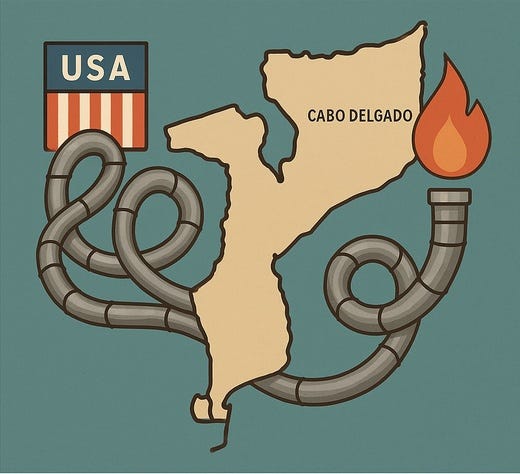
Figure 01. Image generated via DALL-E 3: Between Gas and Steel — A stylized map of Mozambique, with spiraling metallic pipes linking Cabo Delgado to US customs barriers — a visual metaphor for tariffs and dependency.
1. Introduction
The Mozambique LNG project is more than a stalled energy venture — it is a labyrinth. Inside it, millions of dollars, the sovereignty of a state, and the future of an entire region risk getting lost. The recent statement by **TotalEnergies** regarding US steel tariffs is merely the latest wall to appear in this maze, diverting attention away from the real exit: the institutional fragility at its core.
In October 2025, TotalEnergies CEO Patrick Pouyanné declared that the new US-imposed tariffs on steel[1] would compromise the construction costs of the Mozambique LNG project — an initiative valued at over 20 billion dollars and regarded as crucial to Mozambique’s economy and to global energy security (Souza, 2025).
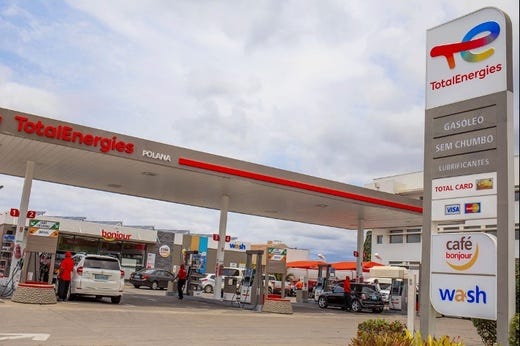
Figure 02. View of a TotalEnergies fuel station in Polana, Maputo — a symbol of the company’s multifaceted presence in the country, combining liquefied natural gas operations with retail activity and localized community initiatives (de Souza. 2025).
The announcement reverberated through international forums and, predictably, in Maputo, where the government has for years attempted to unlock the restart of the project suspended since 2021, following armed attacks in Cabo Delgado province.
However, the reference to US tariffs as a new obstacle strikes many observers as a belated pretext — or even a rhetorical maneuver to conceal deeper, more persistent vulnerabilities: ongoing insecurity, endemic corruption, and institutional misalignment (Souza, 2025).
The debate has reignited a central question:
Is the project hostage to external barriers, or to internal fragility?
This article approaches the issue from multiple viewpoints — governmental, corporate, technical, and independent; orthodox and heterodox critics; local and environmental perspectives; cynical, humorous, and systemic lenses — in an attempt to reconstruct the labyrinth of causes, narratives, and interests surrounding the uncertain future of Mozambique’s natural gas ambitions.
It also seeks to assess the role of international actors, the (ir)responsibility of local elites, and the structural patterns that consistently turn promises into pitfalls, and opportunities into dependencies. [2]
Throughout this series — published in digestible installments for a smoother reading experience — we ask whether Mozambique is truly on the brink of a development cycle anchored in its natural resources, or whether it remains trapped in a functional path of underdevelopment,[3] where even crises become integrated components of a system that adapts without ever transforming (Francisco, 2025a, 2025b; Hanlon, 2025).
This series argues that the Mozambique LNG impasse is the most telling expression of a system of functional underdevelopment — a dysfunctional equilibrium in which crisis (be it of security, commerce, or governance) becomes a stable and even productive feature for the reproduction of power.
Through a multifaceted analysis, it contends that escaping this labyrinth demands more than just restarting the project; it requires a radical epistemic reform — a break with the “bad explanations” that sustain the system, and the adoption of good explanations, testable and accountable, as the only foundation capable of enabling genuine progress.
In this first part, the Independent Analyst[4] lens reveals the tariff justification as a convenient rationalization. But this is merely the opening move in a much broader debate. In the following installments, the labyrinth will be populated by new voices and contradictions:
- The Mozambican Government, which sees the delay as a blow to its economic sovereignty.
- The US Government, whose protectionist trade policy disregards its impact on fragile global economies.
- The Critical Left, for whom the project embodies extractive neocolonialism.
- The Cynic, who exposes the hypocrisy on all sides.
These and other voices — from the Environmentalist to the Skeptical Economist — may disagree on the root of the problem, but it is precisely their collision that will unveil the true portrait of Mozambique’s functional underdevelopment.
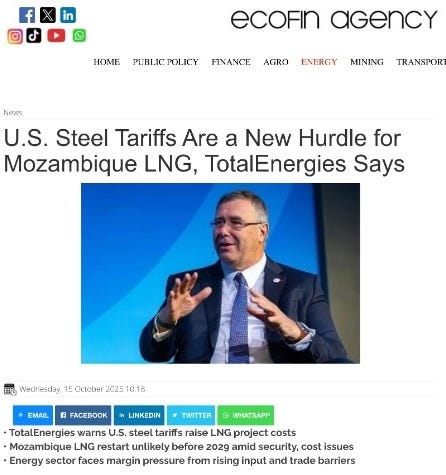
Figure 03 — Statement by the TotalEnergies CEO on US Steel Tariffs. On October 14, 2025, Patrick Pouyanné, CEO of TotalEnergies, warned that the new US steel tariffs could significantly raise the construction costs of major natural gas projects — including Mozambique LNG. Source: Ecofin Agency (October 15, 2025). U.S. Steel Tariffs Are a New Hurdle for Mozambique LNG, TotalEnergies Says.
Summary
TotalEnergies has warned that the new US import tariffs on steel will drive up the construction costs of liquefied natural gas (LNG) [5] projects, including the $20 billion Mozambique LNG development, which has been suspended since 2021. [6]
According to Ernst & Young Global Limited (EY), costs for metal-based inputs are expected to rise by an average of 5.6%, affecting logistics and equipment.
Despite improvements in security, a restart before 2029 is unlikely — rising costs and the need for renewed alignment with the Mozambican government continue to delay the project.
Other industry leaders, such as Baker Hughes, also anticipate growing financial pressures.
As such, the tariffs further squeeze project margins and underscore the tension between US domestic economic policy and global energy aspirations.
2. The Mozambique LNG Project Crisis
The liquefied natural gas (LNG) project, located in the Rovuma Basin, was announced as a game-changer for Mozambique’s economy.
With the involvement of TotalEnergies, ExxonMobil, and Mitsui, it promised to position the country among the world’s leading gas exporters.
However, since April 2021, the project has been suspended following insurgent attacks in Palma and neighboring districts (ICG, 2021).
Stabilization efforts — supported militarily by Rwanda and the Southern African Development Community (SADC) — have reduced violence, but have not eliminated Mozambique’s dependence on external actors (ASA, 2025).
TotalEnergies’ CEO himself admitted:
“Even with improvements in security, a restart before 2029 is not planned” .(Souza, 2025).
The US decision to impose 50% tariffs on steel and aluminum added an unexpected hurdle.
The direct impact on operational costs is real, but the discursive effect was even greater: for some, a legitimate reason; for others, a rhetorical diversion meant to obscure internal challenges.
Mozambique LNG has become a laboratory of intersecting forces — geopolitics, security, energy, and international trade.
A meeting of these interests resembles a family Christmas dinner: everyone at the same table, each with their own hidden agenda.
No single factor explains the paralysis; rather, it is the interweaving of local risks with global shocks that calls for a multifaceted reading.
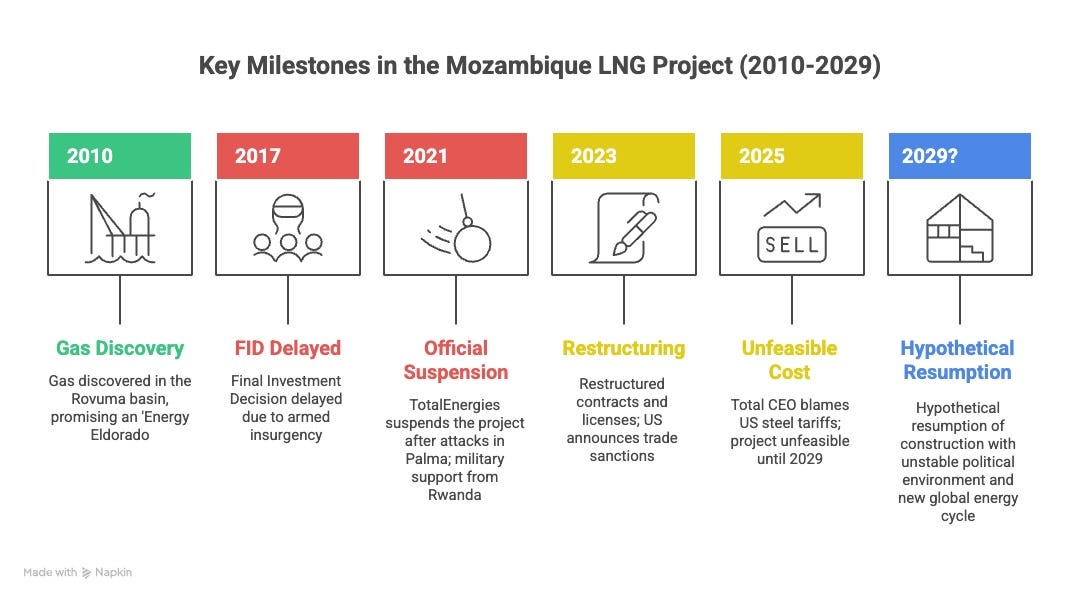
Figure 04. Timeline showing the chronology of the Moz LNG project from 2010 to 2029.The infographic presents four parallel layers: decisions by TotalEnergies and its partners, the internal Mozambican context, external interferences (such as US tariffs), and associated public narratives. Each layer is marked by critical events — such as the project’s suspension, military interventions, and trade shocks — reinforcing the notion that local and global factors are deeply entangled in the blockade of Mozambique’s energy development.
3.1 The Independent Analyst
Through the lens of an independent economic analyst, TotalEnergies’ justification has technical grounding — but limited strategic weight.
A sudden 50% increase in steel prices would indeed disrupt the financial planning of any megaproject. According to EY estimates, costs for equipment and metal structures in the energy sector could rise by an average of 5.6%, leading to delays, contract revisions, and supply chain restructuring (Kirsch, 2025).
However, the true cause of the suspension lies in Mozambique’s internal conditions — in the insecurity and institutional fragility that render the investment environment highly volatile. In other words, the justification emerges as a circumstantial factor that obscures much more serious and persistent structural issues.
The suspension of the project in 2021 was not caused by commercial costs or trade tariffs, but by the Mozambican state’s inability to ensure security and stability in a critical resource extraction zone. As a TotalEnergies diplomat, who preferred to remain anonymous, confided:
“You handle the attacks; we’ll handle the steel… maybe we’ll meet again in 2029 to cut the ribbon.”
This statement, although informal and somewhat sarcastic, accurately captures the asymmetry of responsibilities and expectations surrounding the project.
The independent analyst — more concerned with realism and professionalism — notes that Rwanda’s external military intervention helped to calm the immediate crisis but did not resolve Mozambique’s structural governance deficit (ACLED, 2025).
The country’s state institutions remain firmly in place — not in the sense of resilience, but in terms of chronic administrative immobility.
Moreover, TotalEnergies, as a multinational corporation, operates in numerous complex geopolitical environments and is well-versed in managing a wide range of risks.[7]
Thus, invoking US trade policy as the decisive barrier can be read, from the independent analyst’s perspective, as a strategic rationalization for delay — a way to justify the prolonged impasse to shareholders and stakeholders, when in fact the roots of the problem lie within Mozambique, not in Washington.
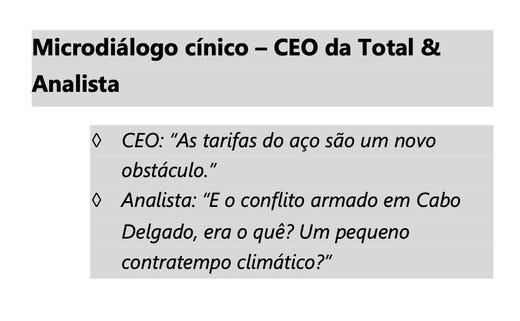
The project has become a geopolitical escape room: everyone is looking for the exit, but no one seems to have read the instructions.
TotalEnergies’ justification is reminiscent of that student who blames the printer for not handing in their assignment: technically plausible, but pedagogically unconvincing.
In short, the problem is not the price of steel — it’s the rust corroding the iron of Mozambican institutions.
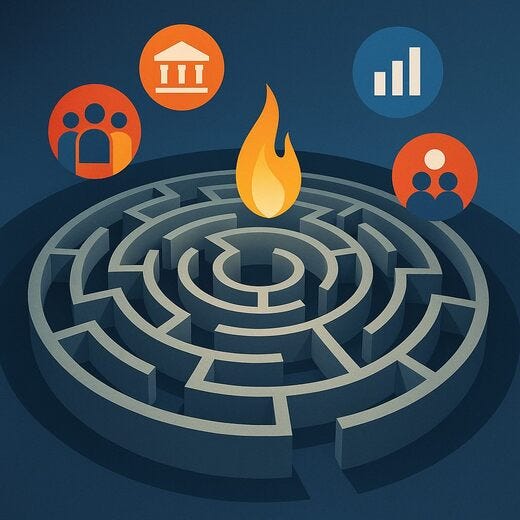
Figure 05. Image generated via DALL-E 3: A three-dimensional maze with symbols representing governments, corporations, and communities orbiting a central gas flame — a visual metaphor for the complexity surrounding the Mozambique LNG project.
🟨 Glossary of Technical Terms
A brief glossary explaining technical terms in simple language:
- LNG (Liquefied Natural Gas): natural gas cooled to -162°C for transport by ship.
- Tariffs: import taxes imposed on foreign goods.
- Rovuma Basin: a gas-rich geological region in northern Mozambique.
- Institutional fragility: the state’s inability to provide security, justice, and basic services.
- Stakeholders: individuals or groups with an interest in or affected by a project, such as investors, governments, and local communities.
Is “institutional rust,” as defined by the Independent Analyst, a fair diagnosis in your view?
In the next installment, we’ll compare this interpretation with that of the Mozambican Government — which views the delay as a geopolitical cost — and the US Government, for whom this story is little more than a distant side effect.
In your opinion, what is the first obstacle Mozambique must resolve?
📚 References Cited in this Part 1
ACLED, 2025. Mozambique Conflict Monitor — Cabo Ligado [WWW Document]. URL https://acleddata.com/monitor/mozambique-conflict-monitor-cabo-ligado (accessed 10.12.25).
ASA, 2025. Mozambique Renews Rwandan Military Partnership as Cabo Delgado Insurgency Escalates | African Security Analysis [WWW Document]. Africa Security Analysis (ASA). URL https://www.africansecurityanalysis.org/updates/mozambique-renews-rwandan-military-partnership-as-cabo-delgado-insurgency-escalates (accessed 10.19.25).
Correia, A., 2023. Cabo Delgado: Não é só um conflito armado, é também um conflito de interesses. Jornal Público 14–17.
Feijó, J., 2021. Conflito e Desenvolvimento em Cabo Delgado. Escolar Editora, Maputo.
Francisco, A., 2025a. Moçambique em Vias de Subdesenvolvimento: Más Explicações, Bloqueios Estruturais e Fragilidade Sistémica (PP disponível).
Francisco, A., 2025b. Moçambique em Vias de Subdesenvolvimento: Más Explicações, Bloqueios Estruturais e Fragilidade Sistémica.
Francisco, A., 2024. De Costas Viradas para a Tempestade Turbulenta: Dicotomia entre a Paz e Conflitos em Moçambique. ResearchGate. URL https://www.researchgate.net/publication/343473364_Mocambique_Novamente_em_Guerra_A_grande_tragedia_humana_em_Cabo_Delgado
Francisco, A., 2020. Moçambique Novamente em Guerra: A Grande Tragédia Humana em Cabo Delgado. ResearchGate.
Hanlon, J., 2025. Moçambique Recolonizado Através da Corrupção: Como o FMI Criou um Estado Oligárquico. Ethale Publishing, Lda, Maputo.
ICG, 2021. Conter a Insurreição em Cabo Delgado, Moçambique.
Kirsch, D., 2025. What US oil and gas companies face amid trade and OPEC+ changes [WWW Document]. ey.com. URL https://www.ey.com/en_us/insights/oil-gas/tariffs-and-opec-impact-on-us-oil-and-gas-companies (accessed 10.18.25).
Souza, O. de, 2025. U.S. Steel Tariffs Are a New Hurdle for Mozambique LNG, TotalEnergies Says [WWW Document]. Ecofin Agency. URL https://www.ecofinagency.com/news/1510-49566-u-s-steel-tariffs-are-a-new-hurdle-for-mozambique-lng-totalenergies-says (accessed 10.18.25).
[1] Steel tariffs are import taxes imposed — in this case by the US government — with the aim of protecting the domestic industry, but they negatively affect global projects that rely on imported metal structures.
[2] The critique of “elite irresponsibility” refers to historical patterns in which local governments, even when faced with abundant resources, fail to convert them into sustainable development — often due to mismanagement or corruption. This issue will be explored in greater detail in upcoming parts of this series.
[3] “Functional underdevelopment” is a concept that suggests certain social and political structures persist because, while dysfunctional for the population, they remain functional for local elites or external interests. This argument will be further developed later in the series.
[4] The choice to personify diverse analytical perspectives will be used throughout the series, allowing for multiple framings — governmental, corporate, environmental, community-based, cynical, among others — to enrich the debate.
[5] Liquefied natural gas (LNG) is natural gas converted into liquid form at low temperatures to facilitate transport. The Rovuma Basin, in northern Mozambique, is one of the largest natural gas reserves in the world.
[6] Cabo Delgado is a province in northern Mozambique that has been the epicenter of an armed insurgency since 2017, involving extremist groups and disputes over natural resources (Francisco, Jan 5, 2024: ***Turning Away from the Turbulent Storm)*.**
[7] TotalEnergies is a French energy giant with operations in over 130 countries. Its experience in unstable environments is often used as an argument to downplay locally based justifications.
메타데이터
- post_id
- 44862ac9cdfd
- slug
- ️-gas-tariffs-and-the-labyrinth-mozambique-between-global-capital-and-functional-44862ac9cdfd
- url
- https://medium.com/the-geopolitical-economist/%EF%B8%8F-gas-tariffs-and-the-labyrinth-mozambique-between-global-capital-and-functional-44862ac9cdfd
- canonical_url
- https://medium.com/the-geopolitical-economist/%EF%B8%8F-gas-tariffs-and-the-labyrinth-mozambique-between-global-capital-and-functional-44862ac9cdfd
- author_url
- https://medium.com/@aasfrancisco
- status
- ok
- fetched_at
- 2026-06-23 21:39:52