Building Reliable Academic Data Pipelines When CAPTCHA Gets in the Way
Academic research automation usually starts with a simple requirement: collect metadata from papers, citations, journals, authors…
Building Reliable Academic Data Pipelines When CAPTCHA Gets in the Way
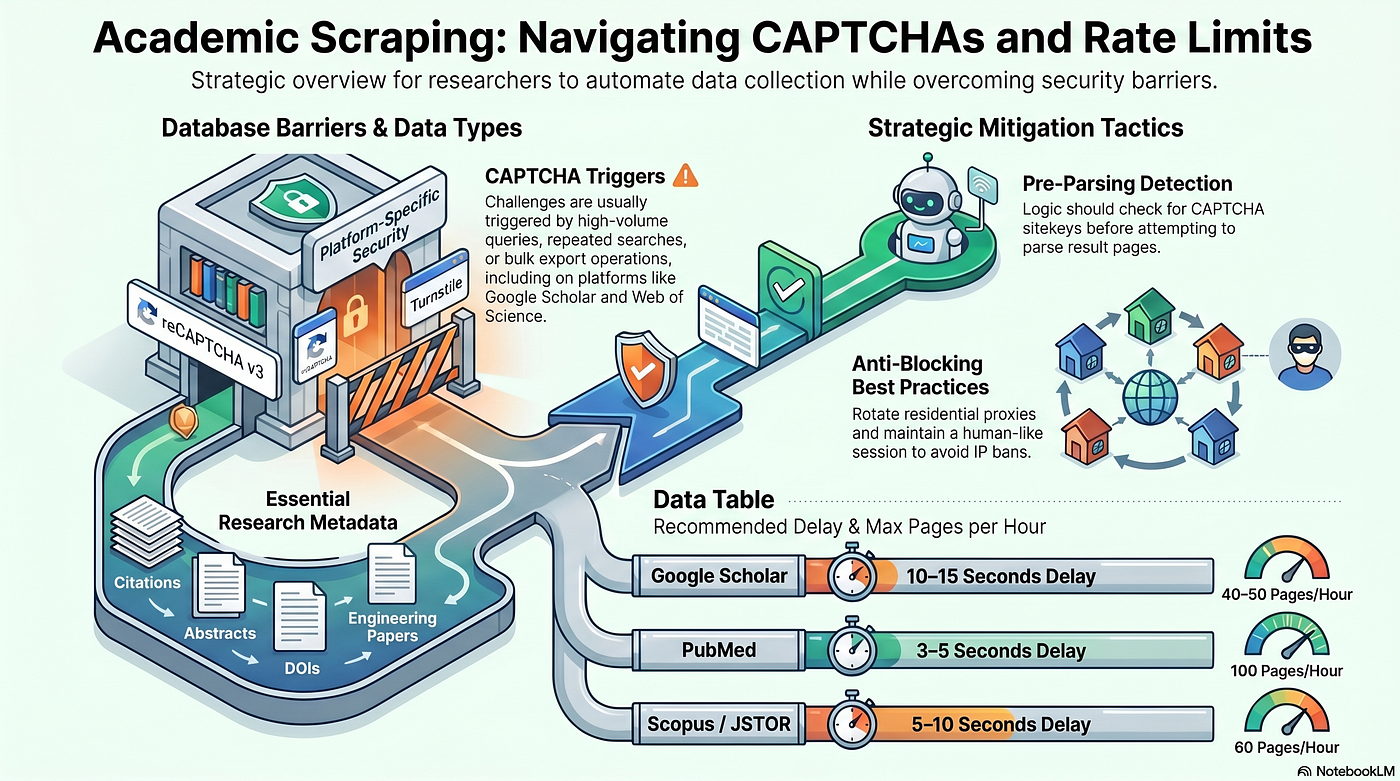
Academic research automation usually starts with a simple requirement: collect metadata from papers, citations, journals, authors, abstracts, or search results so researchers can analyze a topic at scale.
The first prototype often looks straightforward. Send a request to a research portal, parse the HTML, extract titles and authors, follow detail pages, export the results to CSV, and repeat until the dataset is large enough.
Then production reality arrives.
Some sources rate-limit aggressively. Some return incomplete results. Some show CAPTCHA challenges after repeated searches. Some allow public metadata access but restrict full-text downloads. Some provide official APIs that should be used instead of scraping. Some institutional access paths are valid only under specific licensing terms.
For developers and data engineers, the hard part is not just “how to scrape.” The real engineering problem is how to design a responsible, observable, and failure-tolerant academic data pipeline that respects source rules while still supporting legitimate research workflows.
When CAPTCHA appears in an academic scraping workflow, it should not be treated as a normal success path. It is a signal. It may indicate rate pressure, source sensitivity, access restrictions, suspicious traffic patterns, or a need to switch to an official API.
The goal is to build a pipeline that handles these cases deliberately rather than blindly pushing through them.
Why this problem matters
Academic data collection is different from general web scraping.
Research teams are often working with valuable but sensitive ecosystems: citation indexes, journal portals, biomedical databases, institutional libraries, and scholarly search engines. These systems serve researchers, publishers, universities, and public users at the same time. Poor automation can overload services, violate licensing agreements, corrupt datasets, or get institutional access blocked.
From an engineering perspective, CAPTCHA is only one symptom of a larger reliability problem.
A pipeline that repeatedly triggers CAPTCHA may also be exceeding expected query volume, using unstable access patterns, ignoring available APIs, or failing to cache already-collected metadata. If the system keeps retrying without understanding the cause, it can create a feedback loop: more requests, more challenges, more failures, more retries, and lower data quality.
The better approach is to treat CAPTCHA handling as part of a broader access-control and reliability layer.
That means the pipeline should know which sources are API-first, which sources permit metadata collection, which sources require institutional access, which sources limit export volume, and which sources should not be automated without explicit permission.
Technical workflow breakdown
A production academic data pipeline should usually begin with source classification.
Before writing request logic, classify each source by access method. Some databases provide official APIs. Some allow metadata exports. Some support institutional access. Some only allow manual browsing. Some prohibit automated collection in their terms. This classification should drive the architecture.
The preferred workflow is API-first. If an official API exists, use it before scraping HTML. APIs are more stable, easier to monitor, and less likely to trigger anti-abuse systems. Scraping should be reserved for permitted metadata collection where no appropriate API or export path exists.
The next layer is the ingestion scheduler. This component decides what to collect, when to collect it, and at what rate. It should enforce per-source rate limits, page limits, retry limits, and cooldown periods. Instead of allowing every worker to request pages independently, the scheduler centralizes control.
After scheduling comes the fetch layer. This layer handles HTTP sessions, headers, timeouts, source-specific rules, and response classification. It should not immediately parse every response as data. First, it should decide what type of response was returned: valid result page, empty result page, login wall, paywall, CAPTCHA challenge, rate-limit message, temporary error, or blocked request.
Only valid data responses should move into the parsing layer.
The parsing layer extracts structured metadata such as title, authors, abstract, DOI, journal, publication year, citation count, and source URL. This layer should be defensive. Academic websites change markup frequently, so parsers should tolerate missing fields and emit quality warnings rather than silently producing bad data.
Next comes normalization. This is where the pipeline cleans titles, standardizes author names, validates DOIs, normalizes publication years, deduplicates records, and links equivalent papers across sources. Without normalization, the dataset may look large but contain duplicates and inconsistent records.
The final layer is storage and export. Depending on the use case, output may go to CSV, a relational database, a document store, or a graph database for citation-network analysis. For bibliometric work, preserving provenance is critical. Each record should retain source, collection timestamp, query, and extraction confidence.
CAPTCHA handling belongs in the fetch and response-classification layer. If a CAPTCHA appears, the system should classify it, log it, decide whether the workflow is authorized to proceed, apply backoff, and only then use an approved solving mechanism if permitted.
Production considerations
The first production consideration is source governance.
Every academic source should have a configuration profile: allowed access method, rate limit, maximum pages per run, allowed data fields, retry policy, and legal or institutional notes. This prevents engineers from encoding sensitive rules directly in scraper logic.
The second consideration is rate limiting. Rate limits should be enforced per source, not globally. A biomedical API, a scholarly search engine, and a journal archive may have completely different limits. The pipeline should use token buckets, queue delays, or scheduled workers to avoid bursty request behavior.
The third consideration is caching. Academic metadata does not always change quickly. Re-requesting the same paper detail pages repeatedly is wasteful and increases the chance of triggering defensive systems. Cache DOI lookups, paper detail pages, search pages, and citation relationships where permitted.
The fourth consideration is failure classification. A timeout, CAPTCHA challenge, paywall, malformed HTML response, invalid query, empty result, and source-side block are not the same failure. They should be logged differently and handled differently.
The fifth consideration is data quality. In academic research automation, a pipeline can “succeed” technically while producing a weak dataset. Missing abstracts, incorrect citation counts, duplicate papers, and incomplete author lists can damage downstream analysis. Data validation should be treated as a core pipeline requirement, not a cleanup step.
The sixth consideration is credentials and institutional access. If the workflow uses institutional access, the engineering team should verify that automation is allowed under the relevant license or agreement. Institutional access should never be treated as a generic proxy for bypassing controls.
Common mistakes
A common mistake is treating CAPTCHA solving as the main architecture. It should not be. CAPTCHA handling is an exception mechanism inside a broader compliance and reliability system.
Another mistake is scraping before checking for official APIs. Many academic workflows are better served by structured APIs, exports, or open metadata sources. HTML scraping should not be the first choice when a supported data access path exists.
A third mistake is parsing CAPTCHA pages as empty results. This creates misleading datasets. The pipeline may report “no papers found” when the real issue was an access challenge. Response classification must happen before parsing.
A fourth mistake is using unlimited retries. Retrying a blocked or challenged request without backoff can increase failure rates and source pressure. Retries should be bounded, delayed, and tied to error categories.
A fifth mistake is ignoring provenance. For research workflows, every collected record should include where it came from, when it was collected, and under what query or seed paper. Without provenance, bibliometric analysis becomes harder to audit.
A sixth mistake is failing to monitor cost. CAPTCHA solving, paid APIs, proxy infrastructure, and compute time can all create operational cost. Teams should measure cost per valid record, not just total spend.
Metrics to monitor
Academic data pipelines need technical, operational, and data-quality metrics.
At the technical level, monitor request count by source, response status distribution, timeout rate, CAPTCHA detection rate, retry count, average fetch latency, and parser failure rate.
At the operational level, monitor queue depth, job duration, pages collected per hour, cooldown events, source-specific error spikes, and worker saturation.
At the data-quality level, monitor records collected, duplicate rate, missing DOI percentage, missing abstract percentage, invalid publication year rate, empty author fields, and extraction confidence.
If CAPTCHA solving is used in an approved workflow, monitor challenge rate, solve success rate, solve latency, solving cost, fallback rate, and the percentage of jobs that required CAPTCHA intervention. A rising CAPTCHA rate usually means the pipeline should slow down, cache more, reduce query volume, or switch to a more appropriate access method.
Safe/authorized-use note
Academic scraping and CAPTCHA-related automation must be handled with strict boundaries. This type of workflow should only be used in owned, client-authorized, or contractually permitted environments.
For academic sources, that means checking terms of service, license agreements, institutional access rules, robots.txt where applicable, and official API availability. Public metadata may be accessible in some contexts, but full-text access, bulk exports, and automated querying may be restricted.
A responsible engineering team should design the system so authorization is explicit, observable, and enforceable.
For a tactical reference on the original implementation topic, review the source article on academic research web scraping with CAPTCHA solving.
The stronger production pattern is to build an API-first, rate-limited, observable research data pipeline where CAPTCHA handling is controlled, logged, and used only within approved boundaries.
Before scaling an academic scraping workflow, define the access rules, rate limits, monitoring points, and data-quality checks. The scraper is only one part of the system; the pipeline is what determines whether the result is reliable.
메타데이터
- post_id
- 44db2c6ab7a8
- slug
- building-reliable-academic-data-pipelines-when-captcha-gets-in-the-way-44db2c6ab7a8
- url
- https://medium.com/@oliverjack1999xx/building-reliable-academic-data-pipelines-when-captcha-gets-in-the-way-44db2c6ab7a8
- canonical_url
- https://medium.com/@oliverjack1999xx/building-reliable-academic-data-pipelines-when-captcha-gets-in-the-way-44db2c6ab7a8
- author_url
- https://medium.com/@oliverjack1999xx
- status
- ok
- fetched_at
- 2026-06-09 15:37:30