Myanmar’s Rohingya Genocide and the ICJ: Why The Gambia Is Right — and the Junta Is Afraid
In January 2026, at the International Court of Justice (ICJ) in The Hague, lawyers for The Gambia laid out in painstaking detail how…
Myanmar’s Rohingya Genocide and the ICJ: Why The Gambia Is Right — and the Junta Is Afraid
In January 2026, at the International Court of Justice (ICJ) in The Hague, lawyers for The Gambia laid out in painstaking detail how Myanmar’s military — the Tatmadaw — tried to erase the Rohingya as a people. They did not just describe “excesses” in a counter-insurgency campaign. They presented a decade‑long project of exclusion, dehumanization, and annihilation — one backed by law, bullets, fire, and hate sermons.
Myanmar’s junta, fronted at the ICJ by minister Ko Ko Hlaing and Attorney General Thida Oo, answered with a familiar script: deny genocidal intent, blame “terrorists,” claim the Rohingya are not really from Myanmar, and dismiss reams of UN evidence as “emotional language” and “blurry pictures.”
The contrast could not be starker. When you put together the history of state formation and exclusion in Myanmar, the patterns of violence in Rakhine, the machinery of information control and propaganda, the role of Ma Ba Tha and other extremist Buddhist networks, and the testimonies of survivors, the junta’s narrative collapses.
The Gambia is right. The evidence of genocide is overwhelming. And the ICJ case matters not just for the Rohingya, but for whether any state can commit atrocities in real time and then hide behind slogans about “terrorism” and “sovereignty.”
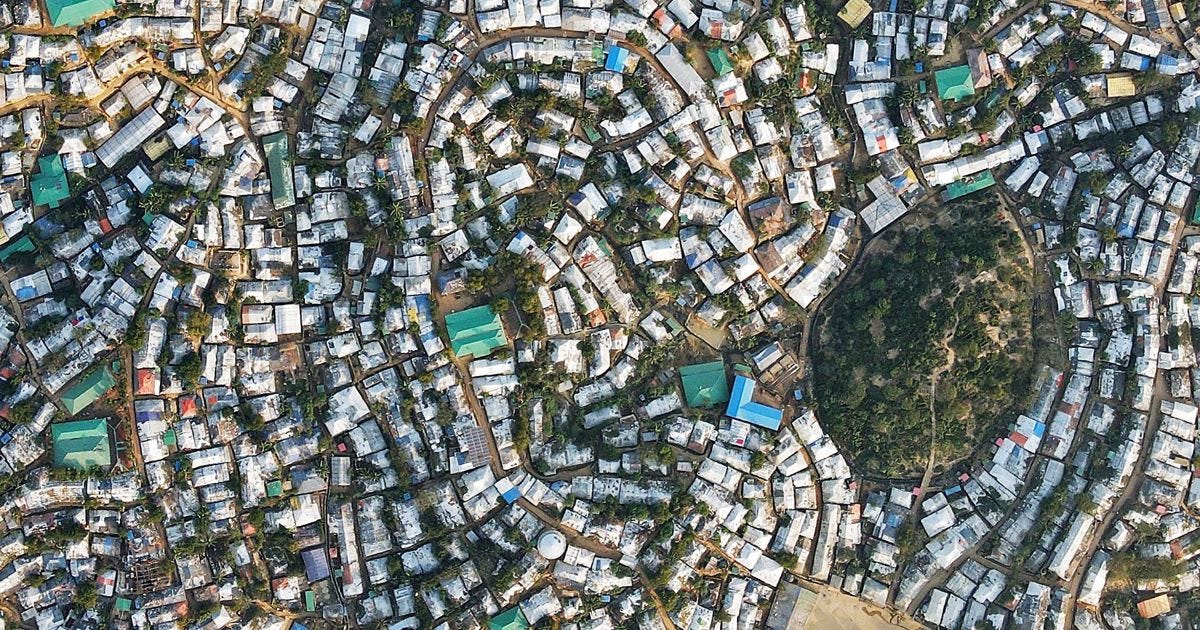
Rohingya refugees living in the vast, overcrowded camps of Cox’s Bazar, Bangladesh — the lasting footprint of Myanmar’s 2017 “clearance operations.” via Help Refugees Now
1. A state built to exclude Rohingya
To understand the genocide, you have to start with how post‑colonial Myanmar defined the nation. From the 1950s onward, military and civilian elites built a state where belonging depended less on civic citizenship and more on being recognized as one of the taingyintha — “national races.”
That move was not neutral. It was a political technology designed to include some and exclude others.
- The 1982 Citizenship Law crystallized this hierarchy by tying full citizenship to belonging to a list of “national races” said to have settled before 1824, the start of British rule. Rohingya were deliberately left off that list.
- The law created a tiered system of full, associate, and naturalized citizenship, but in practice Rohingya were pushed off even the lower rungs: documentation demands (“conclusive evidence” of pre‑1948 residence) were impossible for many rural villagers whose lives had been repeatedly disrupted by earlier campaigns.
- Authorities gradually stripped Rohingya of ID cards, deleted them from voter rolls, and refused to enumerate them as an ethnic category, using administrative omission to make them stateless and invisible on paper even as they remained physically present.
The result was not an accidental glitch in bureaucracy. It was lawfare: the use of citizenship rules and registry practices to create statelessness and normalize Rohingya as foreigners — “Bengalis” — even in the villages where their grandparents had lived.
This is the backdrop for 2016–2017. When the Tatmadaw moved, it was not striking citizens whose rights it recognized. It was moving against a group it had spent decades preparing the public to see as an alien presence. That matters for genocidal intent: the law had already declared that these people did not belong.
2. Patterns of violence: not “excesses,” but a blueprint
The UN Independent International Fact‑Finding Mission (FFM) and other investigations have meticulously documented how the Tatmadaw conducted “clearance operations” in northern Rakhine after small-scale Rohingya militant attacks in October 2016 and August 2017.
Across at least 54 locations, the same methods repeated:
- Mass killings: Soldiers and allied Rakhine militias separated men and boys from women, drove them to fields or riverbanks, and executed them with machine guns, machetes, or bayonets.
- Sexual violence by design: Women and girls, some as young as 10, were gang‑raped, often by groups of five to twenty soldiers, sometimes with knives held to their genitals, and in many cases killed afterwards. The UN and Human Rights Watch described rape as “orchestrated” and a “tactic of war,” not random abuse.
- Arson and destruction: Entire Rohingya villages were systematically burned. Satellite imagery confirmed that hundreds of villages were razed in a short period, often coinciding with survivor testimony about troops and helicopter gunships.
- Forced displacement under fire: As Rohingya fled towards the Naf River, soldiers fired on boats. Bodies washed up on the Bangladesh side. More than 700,000 people crossed the border in a few months.

Satellite imagery of Rohingya villages in northern Rakhine before and after the 2017 operations, showing systematic burning consistent with survivor accounts via BBC
These are not the hallmarks of “clashes” with insurgents. In many of the worst massacres, there is no credible evidence of ARSA presence. The targets were civilians, especially those categories — adult men, community leaders, boys — that make a group sustainable over time.
This is exactly what The Gambia argues under Article II of the Genocide Convention:

The junta’s line at the ICJ — that these were proportionate responses to “terrorist attacks” and that Gambia’s evidence is weak or biased — cannot be squared with this consistency of methods across space and time.
3. Survivor testimonies: names, not numbers
Statistics can numb. Survivor testimonies restore the human scale of what happened.
- A woman eight months pregnant told interviewers that soldiers tied her to a bed, gang‑raped her for hours, and then killed her toddler by smashing the child’s head on the ground. She only survived by feigning death in a burning house.
- Another described how troops separated men and boys, killed her brother in front of her, then held her down while five soldiers raped her one after another, stabbing her side when she struggled. She walked for days to Bangladesh with torn genitalia.
- In village after village, parents saw their babies thrown into rivers or fires, elderly people beaten and left to burn, and entire extended families wiped out.
Doctors Without Borders (MSF) estimated that at least 6,700 Rohingya were killed in the first month of the 2017 crackdown alone. Later analyses suggest over 24,000 dead and tens of thousands raped or severely injured.
The junta tells the ICJ these accounts are exaggerated or fabricated, cobbled together by hostile NGOs. But the convergence of testimonies taken independently by MSF, Human Rights Watch, the US Holocaust Memorial Museum, USC Shoah Foundation and others — all describing the same tactics in different locations — is powerful corroboration.
If this is not “serious bodily and mental harm” and “conditions of life calculated to bring about [a group’s] physical destruction,” it is hard to imagine what would be.
4. Information control and propaganda: manufacturing denial
One of the reasons the Rohingya genocide took so long to be recognized for what it was is that the Tatmadaw built an information black hole around northern Rakhine.

Every tent is a family’s story of flight from massacres and burned homes in Rakhine State via Anadolu Ajansı
- Physical access denial: Independent media, UN agencies, and most aid workers were barred from the worst‑hit areas during and after the operations. Journalists who tried to investigate, like Reuters reporters Wa Lone and Kyaw Soe Oo, were arrested on bogus “state secrets” charges after documenting a massacre at Inn Din.
- State media disinformation: Government outlets mistranslated or edited survivor statements to remove any mention of rape, and ran stories blaming ARSA or even Rohingya themselves for burning villages.journalism.
- Social media incitement: Military-linked pages on Facebook — often disguised as entertainment or celebrity accounts — pumped out thousands of posts calling Rohingya “maggots,” “dogs,” “snakes,” and “Bengali terrorists,” accompanied by explicit calls to “exterminate” them. UN investigators later traced some 10,000 pieces of hate content over six months to these networks.
Facebook’s own commissioned investigation, as well as independent researchers, concluded that the platform’s algorithms amplified this content and that the company ignored clear warnings from civil society and its own staff about looming violence.
This is not peripheral. At the ICJ merits hearings in January 2026, Gambia’s counsel made the hate campaigns a central plank of their argument for genocidal intent, showing how Tatmadaw commanders and extremist monks used both state media and social media to dehumanize Rohingya and portray their elimination as self‑defense.
The junta’s propaganda around the ICJ itself follows the same pattern:
- Domestic Burmese articles and speeches cast Gambia as a tiny African pawn of Western and “Islamic” powers, attacking Myanmar’s dignity rather than seeking justice for Rohingya.
- Junta-aligned commentators insist that if there was any wrongdoing, it should be handled by the ICC against individuals, not by “burning the rice barn” (suing the state) for the sake of the “rat” (the generals) — a false dichotomy that ignores the Genocide Convention’s clear regime of state responsibility.
- Pro‑junta writers warn that if Myanmar loses, ordinary citizens will suffer from sanctions and reparations, blaming activists and “national traitors” for cheering ICJ proceedings — while omitting the simple point that the easiest way to avoid such consequences would have been not to commit mass atrocities in the first place.
Information control is part of the genocide, not a separate issue. It made the violence possible, delayed international response, and now underpins denial.
5. Ma Ba Tha: the “unholy nexus” between monks and military
No discussion of Rohingya genocide is complete without Ma Ba Tha — the Patriotic Association of Myanmar, or Organization for the Protection of Race and Religion.
Ma Ba Tha’s story is the story of how Buddhism was weaponized for ethno‑religious nationalism.

Ma Ba Tha and allied nationalist monks at a rally in Myanmar, presenting their politics as “defense of race and religion” while targeting Muslims and Rohingya via Lowy Institute
- Emerging from the 969 movement in the early 2010s, Ma Ba Tha branded itself as defender of “race and religion,” warning that Muslims were “breeding” to overrun the Buddhist majority.
- Its monks, particularly Wirathu, led rallies, preached boycotts of Muslim businesses, and lobbied for the 2015 “Race and Religion Protection Laws,” which restrict interfaith marriage, conversion, and births — laws clearly targeted at Muslims.
- In Rakhine and elsewhere, Ma Ba Tha monks stood shoulder‑to‑shoulder with military officers, echoing narratives that portrayed Rohingya as jihadi infiltrators and “dogs” who did not deserve to live in Myanmar.
This is not just the judgment of outside observers. At the 2026 ICJ hearings, Gambia’s lawyers explicitly named Ma Ba Tha leaders as inciters:
- USC Shoah Foundation and UN reports document sermons by prominent monk U Thuseitta (Thi Gu) proclaiming that killing non‑Buddhists is not sinful because they are like animals who do not know good and evil. The Tatmadaw shared his sermon 11 times on its own Facebook pages.
- Wirathu’s notorious speeches, calling Rohingya “mad dogs” and urging Buddhist communities to boycott and expel them, are part of the evidentiary record.
Even now, with the junta facing Genocide Convention charges, Ma Ba Tha‑aligned “nationalist” networks organize rallies in Yangon to “support” the ICJ defense team. They do so under junta instructions not to use the word “Rohingya” or overt hate speech — a tactical restraint, not a change of heart.
This “unholy nexus” — as one recent analysis aptly called it — between monks and military created the moral license for genocide. You do not get systematic village burnings and mass rapes without a long prior campaign to persuade ordinary people that their victims are less than human.
6. Regional politics and international complicity
None of this happened in a vacuum.
- Bangladesh now hosts over one million Rohingya in Cox’s Bazar, the world’s largest refugee camp, under severe resource strain and growing insecurity. Its priority is repatriation — but it cannot safely send people back while the same military (and now other armed actors) control Rakhine and continue abuses.
- ASEAN has hidden behind its “non‑interference” norm, issuing statements and a vague Five‑Point Consensus on post‑coup Myanmar that does not seriously address Rohingya rights or accountability.
- China and India, pursuing port projects, pipelines, and influence in Rakhine, have shielded Myanmar from stronger UN measures and prioritized “stability” over justice.
And then there is arms complicity. As one recent op‑ed noted, Israel supplied naval patrol boats, small arms, and training to Tatmadaw units involved in clearance operations — including Special Forces — even as Rohingya fled across rivers and seas. Israeli courts ordered a halt; the government quietly ignored them and continued sales even after the 2021 coup.
This matters at The Hague. When The Gambia argues that genocide occurred, it is also implicitly raising a question about all the states — in the region and beyond — that armed, trained, or diplomatically protected the perpetrators.
7. The ICJ case: what’s really at stake
The case The Gambia filed in 2019 is not a witch‑hunt. It is a textbook invocation of obligations under the 1948 Genocide Convention, to which both Myanmar and Gambia are parties.
Gambia’s core legal arguments
- Jurisdiction and standing: The Convention creates erga omnes partes obligations — owed to all state parties. Any party can bring a case when there is a serious risk of genocide, even if it is not the directly injured state. The ICJ confirmed this in 2022, rejecting Myanmar’s objections.
- Genocidal acts: The Gambia alleges that the Tatmadaw committed killing, serious bodily/mental harm, and life‑destroying conditions against Rohingya as a protected national/ethnic group, in violation of Articles II(a)–(c).
- Genocidal intent: It asks the Court to infer dolus specialis from patterns of violence, the scale and selectivity of attacks, the destruction of villages and mosques, the longstanding persecution framework, and the dehumanizing rhetoric of officials and monks amplified by state and military media.
Myanmar junta’s reply
- No genocide, just counter‑terrorism: The operations were justified responses to ARSA attacks; any abuses were isolated and already “investigated” domestically.
- No protected group: Rohingya are “Bengalis” — foreigners, not a national/ethnic group — and thus not protected under the Convention.
- Weak evidence: UN fact‑finding missions and investigative mechanisms are accused of bias and relying on hearsay. The junta’s lawyers describe Gambia’s case as built on “emotional language” and “blurry pictures.”
Why the junta’s arguments fail
- On protected group status: The idea that the Rohingya are not a “protected group” because the Myanmar state refuses to list them as a “national race” is legally irrelevant. Genocide Convention protection depends on objective criteria — a stable, self‑identifying group victimized as such — not on domestic recognition. The Rohingya plainly qualify as an ethnic/national group targeted because of their identity.
- On intent: Courts rarely have written orders saying “destroy this group.” They infer intent from what perpetrators do and say. Systematic village burnings, selective killing of men and boys, mass rape, attacks on escape routes, and the erasure or expropriation of Rohingya land, combined with years of dehumanizing propaganda, form a strong mosaic of genocidal intent.
- On evidence: The ICJ is not relying on Facebook posts and NGO reports alone. It has UN FFM and IIMM files, satellite imagery, medical surveys, and thousands of consistent testimonies. The junta has offered almost nothing comparable — just its own “whitewash” military reports, which human rights groups have already shown to be factually false.
- On “counter-terrorism”: Even if ARSA committed serious abuses (and there is evidence it did, including against Hindu residents), that does not license collective punishment of an entire population. International law on counter‑insurgency is clear: targeting civilians is prohibited. The patterns in Rakhine go far beyond legitimate military operations.
What an ICJ judgement can do
The ICJ cannot jail Min Aung Hlaing. That is the job of the ICC and national courts. But an ICJ merits judgment finding Myanmar responsible for genocide or for failing to prevent and punish genocide would still be momentous.
It could:
- Declare Myanmar in breach of the Genocide Convention, affirming Rohingya as victims of one of the gravest crimes under international law.
- Order reparations and guarantees of non‑repetition — including rights‑respecting citizenship reforms, restoration of property, safe and dignified return for refugees, and genuine prosecutions of perpetrators.
- Provide powerful legal and evidentiary support for ICC arrest warrants and for sanctions, arms embargoes, and other measures at the UN Security Council and in national courts.
That is why the junta is so eager to discredit the court or predict that “nothing will happen.” They know an adverse judgment will not topple them overnight. But it will put a legal bolt through the story they have told their own public and the world: that there was no genocide, just a necessary war on “terrorists.”
8. Why The Gambia’s case matters — and why it deserves support
The Gambia is a small West African state. It has no direct territorial or economic stake in Rakhine. What it has — like every other party to the Genocide Convention — is a legal and moral stake in whether the promise of “never again” means anything in practice.
By bringing this case, The Gambia has:
- Affirmed that states can and should act as “good Samaritans” when mass atrocities occur, even far from their own borders.
- Given Rohingya survivors a forum where their suffering is not just a matter of politics and charity, but of law.
- Tested and strengthened the idea of erga omnes obligations: that some duties — like preventing genocide — are owed to humanity as a whole.
Myanmar’s junta and its supporters call this “scapegoating” and “humiliation.” They insist that if there were rats in the rice barn, the answer is to set a trap for the rats (the generals) at the ICC, not to burn the barn (sue the state) at the ICJ.
But that metaphor is backwards. The ICJ case is not about burning Myanmar. It is about shining a light on what was already burned — the villages and communities of Rakhine — and about making clear that a state cannot escape responsibility for genocidal acts by hiding behind new uniforms or new constitutions.
9. The real question
At bottom, the ICJ case forces a simple but uncomfortable question on everyone — not just in Myanmar, but in ASEAN, in Beijing and New Delhi, in Tel Aviv and Washington, and in The Hague itself:
When a state builds an exclusionary citizenship regime, floods its airwaves and feeds with hate, deploys its army to kill, rape, and burn on an ethnic basis, and then lies about it, do we treat that as an internal security matter — or as genocide?
Everything we have seen — in the legal architecture of “national races,” in the patterns of violence, in the coordinated propaganda, in the sermons of Ma Ba Tha monks, in the Rohingya voices from Cox’s Bazar, and in the junta’s ICJ defense — points in one direction.
This was not a mistake. It was not mere “ethnic cleansing,” as some diplomats once cautiously said. It was a genocidal project.
The Gambia has had the courage to say so in court. The rest of us — scholars, journalists, activists, and ordinary readers — should have the courage to say so outside it.
Because if the Rohingya genocide, documented in such agonizing detail and carried live on our screens, does not qualify as genocide in law and in public conscience, then the word has little left to offer the next group marked for destruction.
메타데이터
- post_id
- 44dbabc0d762
- slug
- myanmars-rohingya-genocide-and-the-icj-why-the-gambia-is-right-and-the-junta-is-afraid-44dbabc0d762
- url
- https://medium.com/@steinmyint/myanmars-rohingya-genocide-and-the-icj-why-the-gambia-is-right-and-the-junta-is-afraid-44dbabc0d762
- canonical_url
- https://medium.com/@steinmyint/myanmars-rohingya-genocide-and-the-icj-why-the-gambia-is-right-and-the-junta-is-afraid-44dbabc0d762
- author_url
- https://medium.com/@steinmyint
- status
- ok
- fetched_at
- 2026-06-24 11:06:28




