I Didn’t Know I Had to File FBAR — And That’s How Most Indians in the USA Get Into Trouble
I kept my savings account in India. It seemed harmless, after all, that money was already taxed in India, right? Then one day, I got a…
I Didn’t Know I Had to File FBAR — And That’s How Most Indians in the USA Get Into Trouble
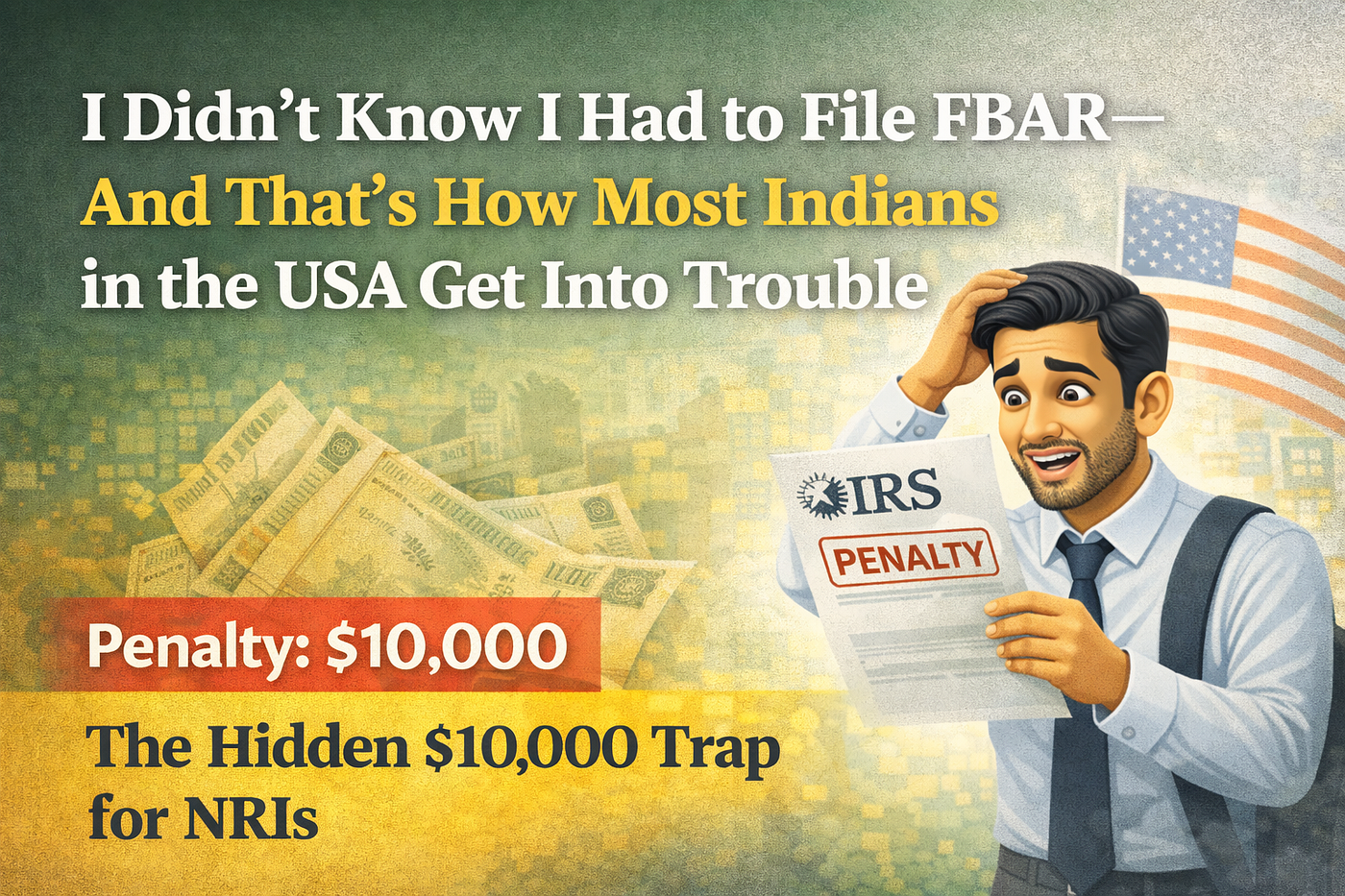
I kept my savings account in India. It seemed harmless, after all, that money was already taxed in India, right? Then one day, I got a letter from the IRS. Penalty: $10,000. For one form I didn’t even know existed.
What I Learned About FBAR the Hard Way
No one told me this when I moved to the U.S.: if you have more than $10,000 combined in foreign accounts at any point during the year, you must file something called FBAR, the Foreign Bank Account Report.
I had an old NRO account from my previous job. A joint account with my parents. A fixed deposit I’d completely forgotten about. Individually, they didn’t seem like much. Together, they crossed $10,000. And I had no idea I needed to report them.
Why I (And Most Indians) Never Heard About This
When I got my H‑1B, nobody mentioned FBAR, not my employer, visa consultant, or even my accountant back in India.
I assumed that since I’d paid tax in India, the U.S. wouldn’t care about it. I was wrong.
The U.S. government wants to know about all foreign accounts tied to you, even if they don’t generate income, even if tax has already been paid abroad, and even if the money just sits there.
The $10,000 Trap That Got Me
My biggest misunderstanding? I thought the $10,000 threshold applied per account.
Here’s what I had:
- NRO account: $4,500
- Old savings account: $3,200
- Joint account with parents: $4,800
Together, that totaled $12,500, which is above the threshold. And even worse, it’s based on the highest balance at any time during the year. If your balance crosses $10,000 just for a single day, you still need to file. I didn’t know that then.
What I Should Have Been Reporting
After the penalty letter, I realized how much I’d missed:
- All my Indian bank accounts (NRE, NRO, savings, checking everything)
- My demat account for stocks (even if inactive)
- Fixed deposits
- Life insurance with cash value
- My PPF account
- Even joint accounts where I was just a name on paper
I had no clue that those counted. Most people don’t know until it’s too late.
The Penalty That Shocked Me
When I saw the IRS letter, I honestly thought they’d made a mistake. But they hadn’t.
Here’s how the penalties work:
- Non-willful violation: Up to $10,000 per year.
- Willful violation: The greater of $100,000 or 50% of your account balance, per year, per account.
I got lucky, my failure was classified as non-willful. But if I’d ignored the letter or if they thought I was hiding funds, it could’ve been financially devastating.
When You’re Supposed to File
The FBAR deadline is April 15, just like your tax return. You automatically get an extension to October 15, so there’s no need to request it. But here’s a twist: FBAR isn’t filed with the IRS, it’s filed separately with FinCEN (Financial Crimes Enforcement Network).
I’d been filing my taxes diligently every year and still ended up non‑compliant because I didn’t know about FinCEN’s requirements.
How I Finally Filed
You must file FBAR electronically using FinCEN’s BSA E-Filing System. No paper forms.
They ask for:
- Account numbers
- Bank names and addresses
- Maximum account value during the year (in USD)
What took the most time? Finding the highest balance in each account for the year and converting it using the official Treasury exchange rate. I spent an entire weekend digging through my statements.
What I Did After Missing Years of Filing
I’d missed three years of FBAR filings. Panic kicked in. Here’s what I learned:
If your tax returns are current but you just missed FBARs, you can file late with a written explanation. If it was truly unintentional, the IRS might waive penalties.
- Streamlined Filing Compliance Procedures If you’re behind on both taxes and FBARs, you can file the last three years of returns and up to six years of FBARs. Those living abroad often qualify for penalty relief.
The key is timing. You must act before the IRS contacts you. Once they reach out, your options shrink fast.
I filed immediately, included a detailed explanation, and fortunately, the IRS waived additional penalties.
How the IRS Found Out
Here’s what shocked me the most, how they knew in the first place.
Under FATCA (Foreign Account Tax Compliance Act), Indian banks share data with the U.S. government. When you list your U.S. address or citizenship while updating bank KYC, that information gets reported to the IRS.

Indian banks share data with the U.S. government
So, even if you think no one’s watching, they probably already know.
What I Wish Someone Had Told Me
Paying taxes in India doesn’t exempt you from reporting those accounts in the U.S. The U.S. taxes worldwide income and expects transparency.
The silver lining? FBAR reporting doesn’t trigger double tax. Because of the U.S.–India tax treaty, you can claim foreign tax credits for income already taxed in India.
FBAR is just about disclosure, not additional taxation. Failing to report, though, can lead to painful penalties.
My Advice: Learn From My Mistake
If your combined foreign balances ever exceed $10,000, even for one day, file your FBAR. Every single year.

File Tax Every Year
Even if:
- The funds are already taxed in India
- The accounts are dormant
- Your name is only on a joint account
None of that matters. The rule is absolute.
I learned it the expensive way. You don’t have to.
If you need help with tax filing services, I suggest reaching out to a specialist who gets FBAR and Indian accounts, it saved me a lot of stress down the line.
Have questions about FBAR or foreign account reporting? Drop them in the comments below, I’ll be happy to share what I’ve learned!
Disclaimer: This article reflects the author’s general tax commentary and does not constitute tax, legal, or financial advice. Application depends on individual circumstances. No client relationship is created. For personalized clarification, reach out to the author.
메타데이터
- post_id
- 44df50009d4a
- slug
- i-didnt-know-i-had-to-file-fbar-and-that-s-how-most-indians-in-the-usa-get-into-trouble-44df50009d4a
- url
- https://medium.com/@arun_tax_expert/i-didnt-know-i-had-to-file-fbar-and-that-s-how-most-indians-in-the-usa-get-into-trouble-44df50009d4a
- canonical_url
- https://medium.com/@arun_tax_expert/i-didnt-know-i-had-to-file-fbar-and-that-s-how-most-indians-in-the-usa-get-into-trouble-44df50009d4a
- author_url
- https://medium.com/@arun_tax_expert
- status
- ok
- fetched_at
- 2026-07-22 22:17:30