The Exclusion of Printing from the Nigerian Skills Qualification Framework in Nigeria: Matters…
By Abdulrasheed A. Afolabi, PhD
The Exclusion of Printing from the Nigerian Skills Qualification Framework in Nigeria: Matters Arising
By Abdulrasheed A. Afolabi, PhD
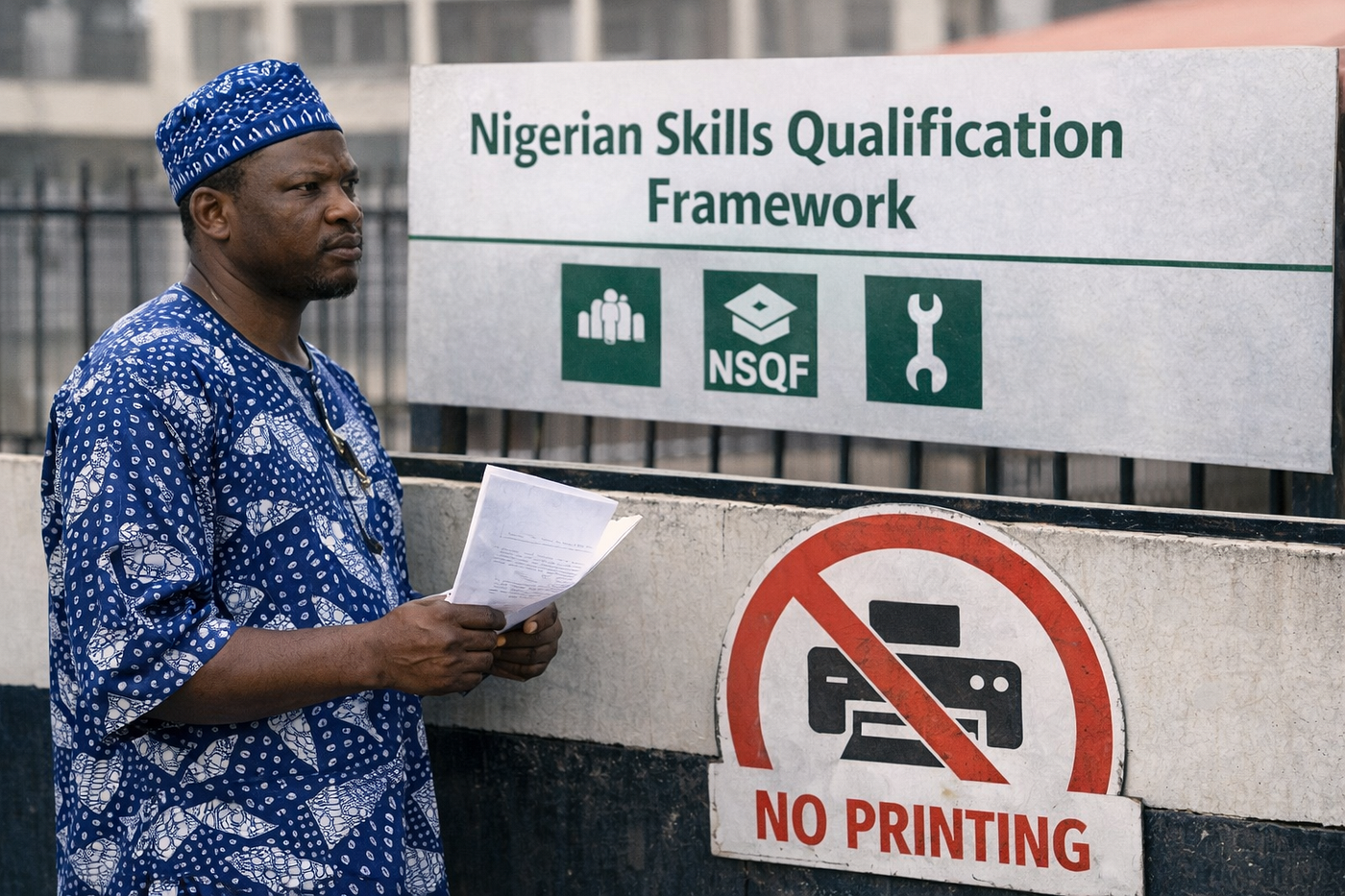
Excluded: Printing and Graphic Arts. (Image Source: Copilot)
Dropped from the List
Promoting technical and vocational education and training to enhance the socio-economic development is a serious affair. In the printing sector, skilled manpower development is critical to enhancing industrial productivity and improving the quality of life for printing workers. Thus, access to structured, high-quality training must be ensured for all categories of workers in the printing industry, ranging from entry-level staff to middle management and senior professionals. According to Mark Stuart, of the University of Leeds, equipping employees at every level with relevant skills enhances productivity, supports adaptation to technological changes, and strengthens overall industry performance (Stuart, 1994).
However, it appears there is a design, albeit unintended, to weaken entry-point skills development in Nigeria’s printing industry. In a recent statement, Kingsley Mbachu, a printing educator, informed an online printing group about the exclusion of printing Craft practice in the recently introduced technical and vocational skills learning program by the Federal Government of Nigeria (K. Mbachu, personal communication, January 21, 2025). Known as the Nigerian Skills Qualification Framework (NSQF), it is a competency-based framework that classifies skills and vocational qualifications into defined levels based on learning outcomes, workplace competence, and occupational standards. According to Idris Bugaje, the Executive Secretary of the National Board for Technical Education (NBTE), the core purpose of the NSQF is to provide nationally recognised skills qualifications, promote lifelong learning and employability, enable mobility between education, training, and work, and align workforce skills with labour market needs (Bugaje, 2023).
Furthermore, Bugaje (2023) describes the framework as a tool for the development of qualifications to empower the training system to be more responsive to the needs of the labour market. He maintains that the framework provides the platform for employers and workers’ organisations to have an important role in developing competency standards for qualifications. As of 2025, there are seventy-nine (79) sector skills covering a wide range of industries, with the obvious exclusion of the printing industry (NBTE, 2025). The closest media-related skills captured in the framework are Creative Media Production, Social Media Communication and Photography and Cinematography.
Printing craft practice was dropped from the NSQF after a Ministry of Education survey found that Nigerian youths did not prioritize it among skills for immediate employment (K. Mbachu, personal communication, January 21, 2025). Without doubt, the exclusion of “printing craft practice” from the NSQF signals a significant policy shift that prioritizes skills based on youth preference and perceived immediate employment potential. The key implications for printing education in Nigeria include:
- Formal Education De-Prioritization: Printing will likely become an optional or low-priority offering in TVET institutions, potentially reducing public funding for related training programs. This does not bode well for the growth of printing in Nigeria, as already, there are very limited options for formal printing education in the country (Afolabi & Jimoh, 2014).
- Informal Sector Reliance: Skills transmission will continue mainly through traditional, privately-run apprenticeship systems. Unfortunately, this informal training pathway is beset with its fair share of problems (as captured by Eneh, 2010) that are way beyond the scope of this piece.
- Demand-Supply Mismatch: As official focus shifts, a potential long-term shortage of skilled printing professionals could develop if training systems cannot meet industry needs. A study of the causes and challenges of skilled workers shortages in the Malaysian printing industry revealed a lack of qualified personnel as a major problem that negatively impacts production efficiency, delivery of high-quality products and services, and customer satisfaction (Latif & Ali, 2024).
Without exaggerating, the exclusion of printing from Nigeria’s TVET program is a significant policy signal that is not in the best interest of the Nigerian print and graphic arts industry. It is not in doubt that all hands have to be on deck to ensure the inclusion of print-focused skills in the NSQF through advocacy. Indeed, one that makes a compelling case for its reinstatement as a critical national skill. However, such an advocacy should be driven by an understanding of the dynamics of workforce development for the print and graphic arts industry in the digital era.
Printing as the Unchosen Craft in the Digital Era
One significant takeaway from the NSQF’s non-listing of printing is the declining popularity of traditional printing as a career among young people. As empirical evidence suggests, this is not peculiar to Nigeria; it is a global phenomenon. A 2009 study on the job satisfaction of early career employees in printing and publishing occupations at the Rochester Institute of Technology demonstrates the limited success in attracting new talent in the US printing industry (Walker & Sorce, 2009). A similar study on understanding and resolving the skills shortage in the Australian printing industry decries the extremely low awareness among young people about jobs and careers in the printing industry. An employer surveyed in the study noted that: “we are seen by young people as a nowhere or yesterday industry” (Callan, 2007). Clearly, these studies demonstrate the extent of the low profile and poor image of the printing industry.
Efforts to attract young people to printing careers have led many traditional print-based graphic arts programmes in the United States and elsewhere to evolve into multimedia and digitally driven programmes. In his analysis, Kenneth Macro, a graphic communication educator, cataloged higher education institutions in the US that have transitioned and repositioned their print-based graphic arts programmes to meet the needs of young people who are mostly attracted to the Internet and multimedia technologies. Macro’s list includes the New York-based Rochester Institute of Technology (RIT), which has, in recent years, re-adjusted its print media programmes that were heavily slanted toward traditional printing technology, expanding its offering into the realms of cross-media technology and interactive media. Another institution that made the list is the University of Wisconsin-Stout, in Menomonie, Wisconsin. Similar to RIT, the University revamped the curriculum for the Bachelor’s degree in Graphic Arts to become the Bachelor’s degree in Cross Media Graphics Management. The revamped version, as Macro explained, focuses on “generating an educated workforce that can manage cross-media campaigns that include printed direct mail, email blasts, response web-microsites, social media integration, utilizing mobile technology to access related online content” (Macro, 2014).
The California Polytechnic State University, San Luis Obispo, California, also made Macro’s list. Originally founded as the School for Country Printers, Cal Poly has, over the years, expanded its scope to include digital design, imaging, workflow systems, and web and multimedia technologies to appeal to a wider student audience. Its Graphic Communication programme has concentrations in: 1) Digital Reproduction Technology; 2) Packaging for Graphics; 3) Web and Digital Media; and 4) Graphic Communication Management. As Macro (2014) noted, this curricular transformation is a demonstration of an intentional and strategic pedagogical shift from print-centric training toward a broader, digitally integrated graphic communication education.
This digital-led graphic arts training trend to make printing more attractive to young people is not limited to the United States but also extends to other parts of the world. In China, for example, a group of researchers report that, in fostering creative talents for the future of printing, there has been an extensive repackaging and renaming of the undergraduate Printing programme as Graphic Technology at the Beijing Institute of Graphic Communication. As the researchers explain, the move stems from the recognition of the significant impact of the Internet on the printing industry, prompting the need to anticipate the potential changes in various aspects. One key aspect is providing multidisciplinary knowledge as an integral part of the printing education domain in the digital era. It is argued that a multidisciplinary background will help foster Science, Technology, Engineering, Arts, and Mathematics (STEAM) skills in students, a feature that is career-appealing to young people (Liang et al., 2023).
Towards Making Printing a Popular Career Choice in Nigeria
The exclusion of printing craft from the NSQF is a reminder that the present packaging of print and graphic arts training as “printing craft practice” is “not cool” in the perception of youngsters in Nigeria. A cursory survey of the syllabus for printing craft practice for the final senior secondary school (WAEC O-Level) examination reveals it is largely analogue and craft-centred. It reflects a pre-digital printing paradigm focused on manual composition, film-based prepress, darkroom workflows, and conventional press operations. The syllabus is hugely insufficient to meet the contemporary graphic arts industry’s demands for a digital-led operational culture and processes. Presenting printing careers to today’s youngsters with this craft-centred focus projects printing as outdated, technologically stagnant, and disconnected from digital realities. This approach, which smacks of a lack of appreciation of the need to attract young people, reduces the industry’s appeal as a modern, innovative career pathway to digital natives.
Indeed, John Berthelsen, an advocate for attracting new talent to the graphic arts industry through the Print and Graphics Scholarship Foundation (PGSF), expressed the view that the print and graphic arts industry has done a poor job of promoting itself to students, school guidance counsellors, and parents. As Berthelsen puts it, “printing is thought of as a dirty, non-essential and old-school industry”. Presenting his views on how to get students interested in print, the print advocate highlighted the need to actively encourage young people to consider print and graphic arts as a viable career path (Berthelsen, 2018).
Without a doubt, promoting print as a viable career in the digital age is the way to go. As the records show, there are various sectoral efforts across the globe to communicate the importance, potential and wide range of possibilities within the digital-led print industry. A project report titled “Attracting a New Skilled Workforce for Quality Jobs in the European Graphic Industry”, supported by the European Union, details promotional campaigns aimed at reaching young people. The countries covered include Estonia, Portugal, Germany, and the Netherlands. In all of these countries, the central effort was to reach out to the youths, helping them better understand the wide possibilities that the print sector offers in terms of schools, courses and jobs, even in a digital landscape (European Union, 2022).

Call to Action: Advocacy by policymakers, industry leaders, educators, and professional bodies in Nigeria (Image Source: Copilot)
In light of these realities, there is no better time for policymakers, industry leaders, educators, and professional bodies in Nigeria to deliberately reposition printing as a digital, creative, and future-facing career pathway for young people in Nigeria. There are imperatives to reform curricula by integrating contemporary digital workflows and embedding digital-led printing within national skills and youth development frameworks such as the NSQF. Broadly, intentional actions are required to modernise training, rebrand the industry, and actively engage young people through schools, career guidance, and industry-led advocacy. Without these interventions, the printing sector risks continued skills depletion and declining relevance. Making printing a popular career choice is therefore not optional but a strategic imperative for sustaining the industry’s competitiveness, innovation capacity, and long-term contribution to Nigeria’s creative and industrial economy.
Afolabi is Head, Department of Book Publishing, Yaba College of Technology. He can be reached via email: rasheed.afolabi[at]yabatech.edu.ng
References
Afolabi, A., & Jimoh, F. O. (2014). The state of printing education and training in Nigeria’s high-tech graphic arts industry. JORIND, 12(1), 175–181.
Berthelsen, J. (2018, August 30). How to get students interested in print. PIWorld. https://www.piworld.com/post/how-to-get-students-interested-in-print/
Bugaje, Idris. (2023). NSQF operational manual. Federal Ministry of Education, Nigeria. https://education.gov.ng/wp-content/uploads/2023/04/NSQF-OPERATIONAL-MANUAL.pdf
Callan, V. J. (2007). Understanding and resolving the skills shortage in the Australian printing industry (NCVER Research Report). National Centre for Vocational Education Research. https://www.ncver.edu.au/__data/assets/file/0024/5559/nr5008.pdf
Eneh, O. C. (2010). Artisanship Disconnect: Declining Technical Apprenticeship and Artisan Service and the Implications for Nigeria’s Future Development. Asian Journal of Industrial Engineering, 2(2), 37–51. DOI: 10.3923/ajie.2010.37.51.
European Union (2022). Print Your Future: Attracting a new skilled workforce for quality jobs in the European graphic industry (Final project report; Project ref. VP/2019/001/0061). European Union. https://www.britishprint.com/downloads/managed/final-project-report.pdf
Latif, N. A., & Ali, N. A. M. (2024). Skilled Workers Shortages in the Printing Industry: Perspectives from Industry Experts. International Journal of Entrepreneurship and Management Practices, 7 (28), 418- 428. DOI: 10.35631/IJEMP.728029
Liang, J., Zhang, Z., Wang, H., Zhang, W., & Mo, L. (2023, September). Graphic Technology in the Digital Age: Fostering creative talents for the future of printing. In 54th IC Annual Conference Proceedings, 18–20 September 2023 (pp. 105–112).*
National Board for Technical Education (2025, July). Nigerian Skills Qualification Framework: Sensitizing NAPS-SUG Officials of Nigerian Polytechnics. Kaduna: National Board for Technical Education
Odji, E., & Adam, R. (2020). The influence of selected factors on adolescents’ choice of graphics as a career. International Journal of Advanced Academic Research (Arts, Humanities and Education), 4(6), 30–44. https://doi.org/10.46654/ij.24889849.a6111232
Stuart, M. (1994). Training In the Printing Industry: An Investigation into the Recruitment, Training and Retraining Agreement. Human Resource Management Journal, 4(3), 62–78.
Walker, A., & Sorce, P. (2009). Correlates of job satisfaction of early career employees in printing and publishing occupations. Rochester Institute of Technology. https://repository.rit.edu/books/44
메타데이터
- post_id
- 452e33d3d263
- slug
- the-exclusion-of-printing-from-the-nigerian-skills-qualification-framework-in-nigeria-matters-452e33d3d263
- url
- https://medium.com/@rasheed.afolabi/the-exclusion-of-printing-from-the-nigerian-skills-qualification-framework-in-nigeria-matters-452e33d3d263
- canonical_url
- https://medium.com/@rasheed.afolabi/the-exclusion-of-printing-from-the-nigerian-skills-qualification-framework-in-nigeria-matters-452e33d3d263
- author_url
- https://medium.com/@rasheed.afolabi
- status
- ok
- fetched_at
- 2026-06-21 19:25:17