You Don’t Get to Sexualize Her
She’s naked, she was never nude
You Don’t Get to Sexualize Her
She’s naked, she was never nude

By Didier Descouens — Public Domain, https://commons.wikimedia.org/w/index.php?curid=153388124
If you looked at the featured image and read eroticism, you read it wrong.
The painting is called The Future Unveiled, sometimes translated as The Fortune Teller, and it was painted in 1912 by a woman named Suzanne Valadon. It shows a naked woman stretched across a red sofa, and beside her on the floor, small and fully dressed, a fortune-teller reading her cards.
If you know the genre, you immediately know what it’s about. This is the reclining nude, a formula that runs from Titian’s **Venus to Goya’s **Maja. Centuries of the same setup. A woman’s body staged horizontally for a viewer’s eye, arranged to invite, always to perform for whoever is standing in front of the canvas with the assumed right to look. And her look, if she looks, is meant to meet the spectator, and it’s always gentle.
Valadon’s painting does none of that. She isn’t looking at you. She’s not passive. She’s looking down, past you, at the fortune-teller kneeling on the carpet beside her, and her posture has none of the softness the genre demands.
It’s confident. Commanding. The kind of pose usually reserved for men.
That’s why nobody’s meant to sexualize her. The authority has shifted.
It wouldn’t be exact to say that there’s a reversal of the gaze.
That would be Manet’s Olympia. Would you believe me if I told you that Olympia generated a scandal because of her look? The look was considered too serious. The classical nude tradition often staged its women as caught off guard, surprised mid-bath, never as choosing to be seen. If she was seen, she was still passive and gentle. A woman looking back at the viewer with seriousness broke that convention entirely, and critics reacted accordingly.

By Édouard Manet — Google Art Project: Home — pic Maximum resolution., Public Domain, https://commons.wikimedia.org/w/index.php?curid=19984782
The classical convention needed the woman to be passive to stay decent, caught unaware, not choosing anything. The obscenity of Olympia wasn’t nudity itself, which was completely normal in the genre, it was that she was nude on purpose, with full knowledge of being looked at, and met that knowledge without shame.
Consent turns out to be the actual scandal. A body that hadn’t agreed to anything could be absorbed into the tradition. A body that had agreed, and let you know it had agreed, couldn’t.
Yes. You read it right. Olympia’s moral crime was to consent.
Olympia’s consent is gaze reversal. It’s looking the spectator right in the eye, it’s defying the male gaze, which sought to control the woman’s attitude, and even looks.
It’s confrontational where Valadon’s painting isn’t.
The naked woman in The Future Unveiled doesn’t need to be watched. She is, by the nature of the art’s medium, but as an agent, the woman doesn’t need to.
Her confidence and authority don’t derive from someone external to the painting. They do because of what the woman is.
The fortune teller, impersonating fate, is on the floor, small and working. She draws a queen of diamonds, and of course she does, it’s not like there was a better fit. But the naked woman doesn’t seem to care. She circumvents fate because she’s the only one with agency.
It doesn’t matter that the deck is loaded or if the card fate has put in the woman’s way. It’s the one card in the deck already loaded with the exact meaning the fortune-teller is able to assign. The woman doesn’t take the assignment.
She doesn’t care that she’s being read one a way or another. Her being, or rather, given that it’s a painting, her body won’t be turned into a sign, even if that sign is one of glory. She is glorious, and doesn’t need a formal confirmation.
The painting has more depth when we consider Suzanne Valadon’s personal story with painting.
She started as a model, and then became a painter. Renoir, Toulouse-Lautrec and Puvis de Chavannes painted her. Valadon is therefore part of a lineage of women who began with stripping for artists before becoming one, next to Victorine Meurent and Camille Claudel.
Valadon didn’t walk away from the tradition that made her an object. She stayed inside it long enough to learn its rules, then broke them from a position nobody could accuse of not understanding them first.
This is a special kind of rebellion. It’s about taking what tradition has used to picture and dominate and change its direction. The body is naked, not nude the moment it doesn’t need a spectator to complete it. Olympia doesn’t pass. She needs you, she’s just decided to meet you on her own terms instead of yours. Valadon’s woman passes. She isn’t meeting you. She isn’t avoiding you either. You, as a spectator, were never in the equation.
The painting is interesting at an artistic and historical level, but it’s not why I like and and decide to write about it.
It contains a framework for empowerment by indifference. What The Fortune Unveiled says, is that confronting, or acting in dependency of a gaze is still servitude. A way to performatively outgrow from a dictated fate is to be what you ought to independently from validation. Even, if we read the painting correctly, if the validation is glorious.
It’s the reasoning behind civil desobedience, It’s not about saying “it will happen on my terms”, but rather “whatever happens, whether you’re present or absent doesn’t change what I am.”
I think it’s worth using The Fortune Unveiled as a way to interpret the present.
OnlyFans looks like a great subject for our case. The question that I often see is whether it is a tool for empowerment or the contrary. And while I think we should refuse a simplisitic answer, it still looks like Valadon was on to something OnlyFans will never enable.
One would say that online models have agency. It’s a kind of empowerment that is rooted in economy. But in this economy, the objectifying gaze is not only there, but taken into account to generate revenue. Remove the audience and the empowerment goes with it. There’s no version of the business model that keeps running on indifference. That’s not naked. That’s nude, priced and subscribed to, because nude is the product being sold.
It doesn’t mean that online models are always exploited. What it means is that it never actually left the economy, but just renegotiated what it costs to stay in it.
Valadon’s woman had already left.
There’s a naked woman in the feature image, and I’m writing about it because she’s naked.
The body isn’t a private matter. It gets dressed by law, undressed by permission, covered by religion, uncovered by advertising, and read, read and read, always read, by whoever happens to be standing in front of it. A body is a surface on which opinion, desire, morals and rules are applied.
Nakedness is one of the oldest political statements in history. It’s Diogenes walking around Athens, refusing every social convention. Centuries of hunger strikes, sit-ins, and public protest have used the stripped body the same way.
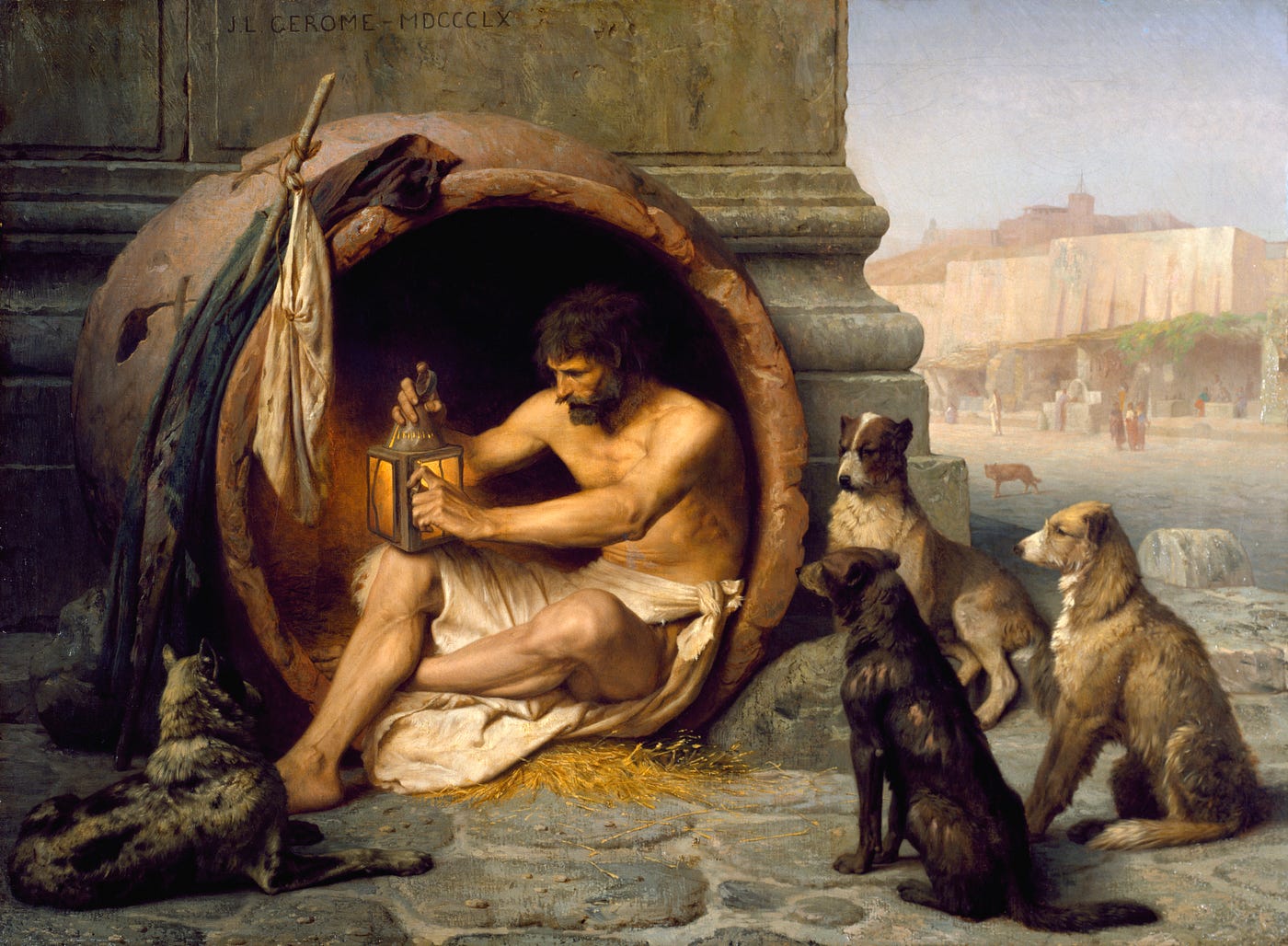
By Jean-Léon Gérôme — Walters Art Museum: Home page Info about artwork, Public Domain, https://commons.wikimedia.org/w/index.php?curid=323523
Stripping down isn’t neutral. There’s no version of nakedness that exists outside the system it’s stripped in front of. Modesty, shame, beauty, availability, none of it disappears when the clothes do.
Valadon’s painting is very much a political object, whether it was intended or not. She isn’t showing you a body outside the system. She’s showing you a body still fully inside it, and refusing to perform the one thing the system was built to extract.
I also think the painting’s title finally means something.
A fortune-teller is supposed to tell you what’s coming. The woman on the sofa isn’t waiting on the card reading. If nakedness has always been a way of speaking when nothing else was left, then this is what she’s saying with it: whatever future gets decided for women’s bodies, it won’t be decided by who gets to look.
The Future Unveiled was already in the pose, and it’s been there since 1912, waiting for the rest of us to catch up.
Thank you for reading.
메타데이터
- post_id
- 4532e9689b97
- slug
- you-dont-get-to-sexualize-her-4532e9689b97
- url
- https://medium.com/counterarts/you-dont-get-to-sexualize-her-4532e9689b97
- canonical_url
- https://medium.com/counterarts/you-dont-get-to-sexualize-her-4532e9689b97
- author_url
- https://medium.com/@vincent.halles
- status
- ok
- fetched_at
- 2026-08-12 09:10:35