I Watched My Liquid Fund During the COVID Crash. Here’s Exactly What Happened Day by Day.
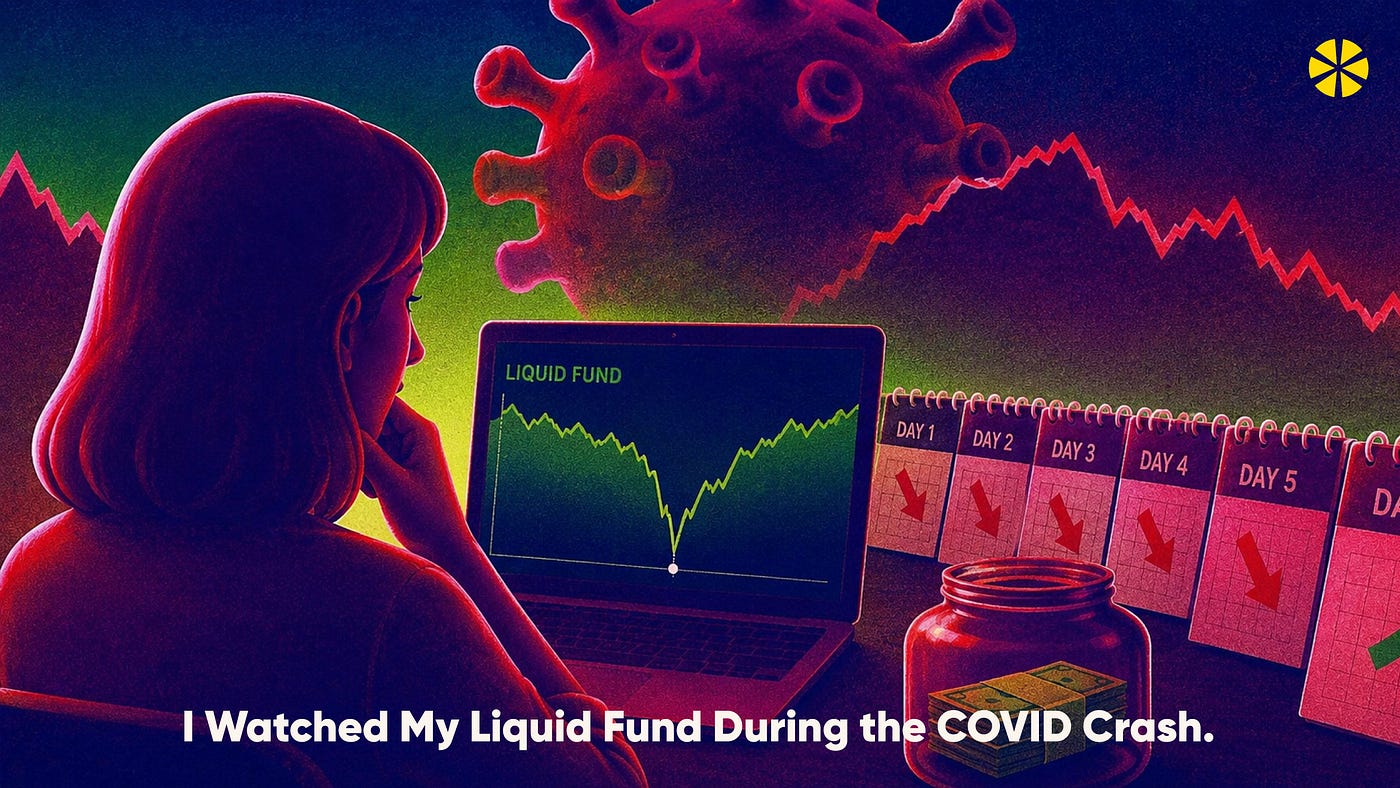
In March 2020, I developed a new morning ritual.
I Watched My Liquid Fund During the COVID Crash. Here’s Exactly What Happened Day by Day.
In March 2020, I developed a new morning ritual.
Wake up. Pick up phone. Check COVID case counts. Check headlines. Check the Sensex. Then check my liquid fund.
At the time, I wasn’t doing this as a finance writer or someone working in fintech. I was doing it as a very normal, slightly anxious Indian saver trying to answer a very basic question:
What actually happens to “safe” money when everything around it feels like it’s breaking?
That month was the first real stress test of how I think about idle cash.
Equity markets were in free fall. The Sensex was collapsing so fast that “another 1,000-point fall” had become routine. WhatsApp groups were full of panic. People who had never cared about market news suddenly had opinions on circuit breakers, redemptions, and global liquidity. And somewhere in the middle of all that, a lot of us had a practical concern no one talks about enough:
If my short-term money is in a liquid fund, should I be worried too?
This is my personal account of holding a liquid fund through the COVID crash in India — and then, almost immediately, through the Franklin Templeton shock that made everyone question whether any debt product was truly boring.
Why I had money in a liquid fund in the first place
Let me start with the unglamorous part.
This wasn’t wealth-building money. It wasn’t retirement money. It wasn’t “let me beat the market” money.
It was idle money.
The kind of money that sits between goals. Salary not yet spent. Emergency buffer not immediately needed. Travel money that wasn’t going to be used soon because, well, the world had shut down. The kind of money many Indians still leave in savings accounts by default, often earning less than inflation and definitely doing very little.
That was exactly the behaviour I had been rethinking. If you’ve ever calculated the opportunity cost of letting cash sit lazily in a savings account, it changes how you look at short-term money. We’ve written about that more directly in this breakdown of what idle money in a savings account actually costs.
So I had moved a portion of my short-term cash into a liquid fund because, on paper, it matched the job:
- relatively low volatility,
- high-quality short-duration debt exposure,
- easier access than locking money into an FD,
- and typically better post-tax utility for some use cases than just letting cash rot in a bank account.
In normal times, that decision felt boring.
In March 2020, boring became very interesting.
The first shock: equity markets crashed, but my liquid fund barely moved
This is the part that genuinely surprised me.
When the equity market was falling every day, I assumed everything with the word “fund” in it would look scary on the app. I expected at least some dramatic visual signal — a sharp dip, jagged chart, something that said: yes, panic is here too.
But when I opened my liquid fund, the NAV didn’t behave like that at all.
It felt almost uneventful.
Day after day, while equities were swinging wildly, my liquid fund looked… mostly stable. Not frozen, not artificially constant, but calm. The NAV movement was small. Incremental. Boring in the way I had originally hoped it would be.
That was my first real education in what a liquid fund is not.
It is not a low-volatility equity proxy. It is not a “slightly safer market fund.” It is not meant to react to the same drivers as stocks.
A liquid fund, in simple terms, is usually holding very short-maturity debt instruments. That matters because when maturity is short and underlying papers are high quality, interest-rate sensitivity and mark-to-market drama are typically much lower than what investors imagine when they hear “market-linked.”
If you want the simple explainer version, this guide on what liquid funds are and how they work covers the basics well.
But theory aside, March 2020 was when I felt the distinction emotionally.
I stopped mentally grouping my liquid fund with “the market.”
That was a useful correction.
My actual day-by-day experience
I didn’t keep a formal diary then, but I remember the pattern clearly because of how repetitive it became.
Week 1: Curiosity
The first few days, I checked because I was curious.
Markets were crashing globally. Every app was red. I wanted to see whether my liquid fund had “caught” the panic yet.
It hadn’t, at least not in any dramatic way.
The NAV was still inching along with the kind of muted movement you’d expect from a short-duration debt product. If you had hidden the equity headlines from me and shown me only that screen, I would not have guessed the world was in extreme financial stress.
That was reassuring, but also confusing. Was I missing something?
Week 2: Suspicion
Then came the second phase: distrust.
I think this is common for first-time liquid fund users during a crisis. When something looks too stable while everything else is melting, you start wondering if stability is real or delayed.
I remember thinking:
- Is the risk just hidden?
- Will there be a sudden drop later?
- Am I looking at an NAV that hasn’t “caught up” yet?
- Is this one of those products that appears safe until the day it isn’t?
What I was really wrestling with was the difference between volatility and credit risk.
A good liquid fund can appear stable through an equity crash because it is exposed to a different asset class. But that does not mean all liquid funds are identical, or that no debt fund can ever face stress. The relevant risks are different: portfolio quality, concentration, liquidity in the underlying market, and fund management discipline matter a lot.
At the time, I didn’t have that framework as clearly as I do now.
Week 3: Relief
As the days passed, my own fund continued to behave largely the way I had hoped. No dramatic drawdown. No scary graph. No feeling that my emergency-ish money had suddenly become speculative capital.
That experience made one thing very concrete for me:
In a pure equity panic, a well-constructed liquid fund can do exactly what you want idle money to do — stay usable, stay relatively steady, and not hijack your emotional bandwidth.
And then Franklin Templeton happened.
Then the Franklin Templeton crisis changed the conversation overnight
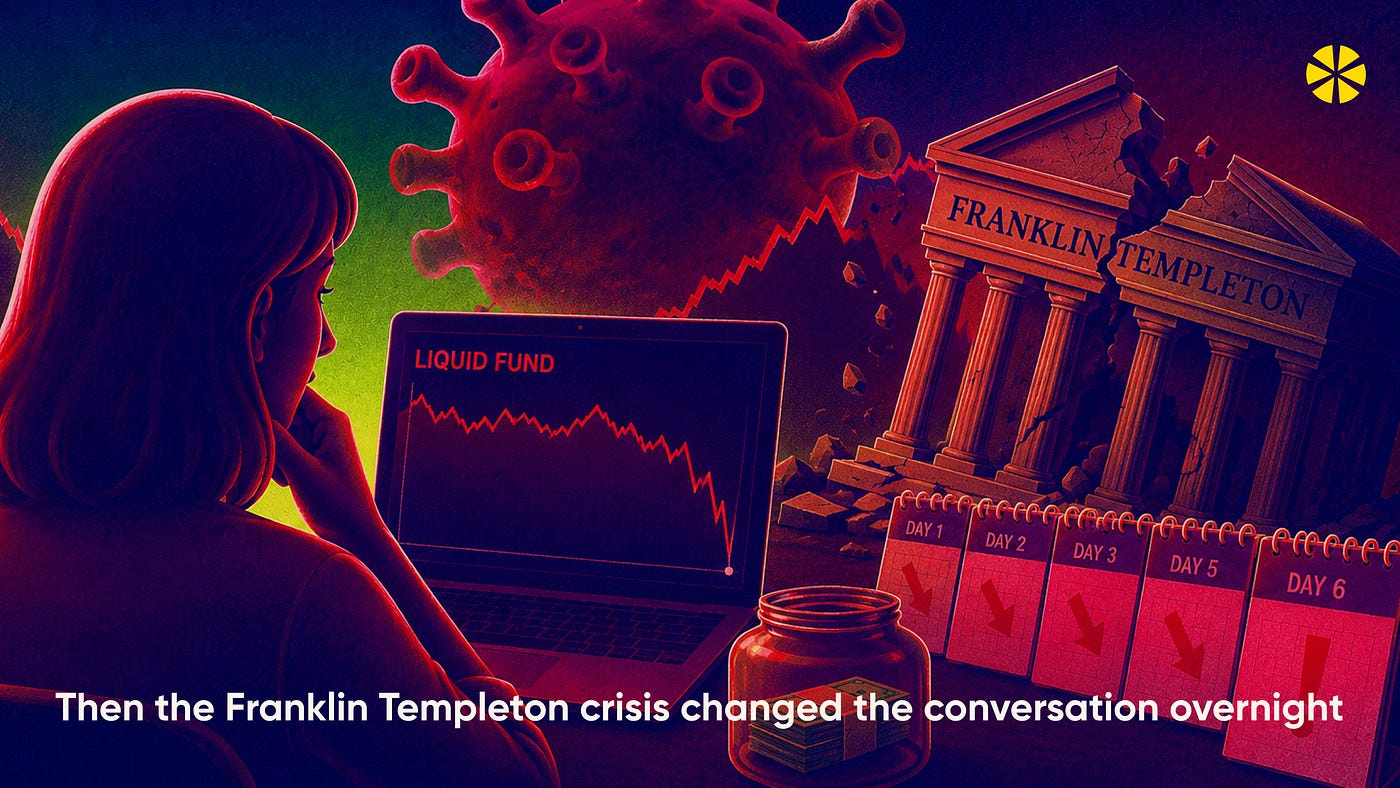
If the COVID market crash taught me that liquid funds are different from equities, the Franklin Templeton episode taught me something more uncomfortable:
Debt funds are not risk-free just because they are debt funds.
This is where many articles become too clean and retrospective. They skip the emotional reality of that week.
The Franklin news did not feel like a technical credit-market event to regular investors. It felt like a trust rupture.
Until then, the mental model many people had was simple:
- equity funds can fall,
- liquid funds are safe parking,
- end of story.
But when the broader debt fund crisis hit public conversation, people stopped asking “What is the return?” and started asking better questions:
- What does the fund actually hold?
- How liquid are those papers if too many investors redeem at once?
- Is there yield coming from quality, or from hidden risk?
- Are all low-volatility debt funds equally safe? Obviously not.
This was the point when I started paying much more attention to portfolio composition than category label.
“Liquid fund” is useful, but not sufficient. The label gives you a starting point, not a complete risk assessment.
What I personally saw in my own fund during that phase
This is important: my own liquid fund did not suddenly implode.
And that distinction mattered a lot for my learning.
Because what happened in my experience was not “all liquid funds collapsed” — they didn’t. What happened was more educational than that:
- my own fund remained broadly stable,
- but my confidence became more selective,
- and I stopped using category-level assumptions as a substitute for understanding the portfolio.
That shift in mindset has stayed with me ever since.
Before 2020, “safe enough” was mostly about product type.
After 2020, “safe enough” became about a few sharper filters: 1. What’s in the portfolio? 2. How high is the credit quality? 3. Is the fund taking hidden risk to show slightly better yield? 4. Would I still be comfortable holding this if headlines got chaotic again?
That is a much better way to think about short-term money.
So, is a liquid fund safe during a crash?
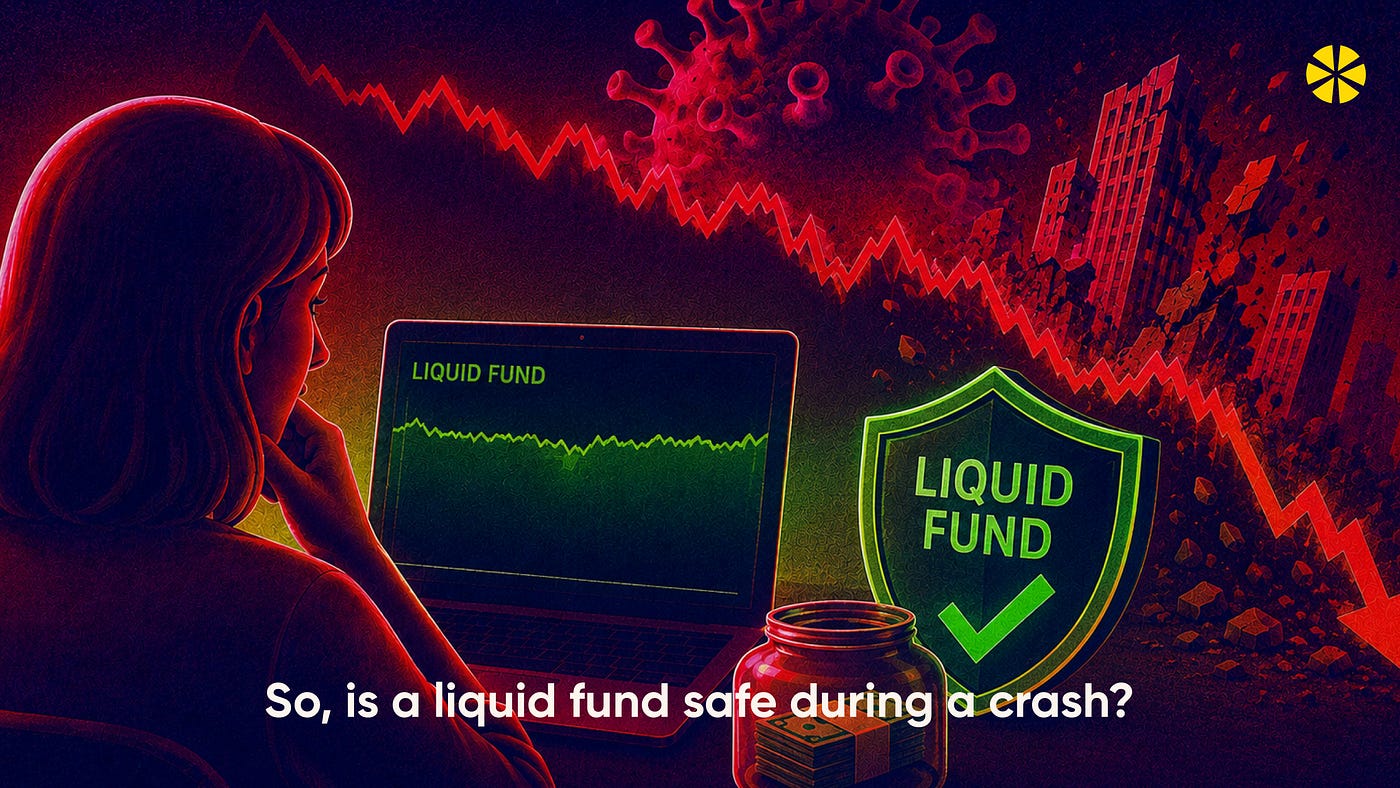
My honest answer is: it depends on what you mean by safe.
If by safe you mean “will it behave like a savings account with government-backed certainty?” then no, that’s the wrong expectation.
If by safe you mean “can a good liquid fund be relatively stable and usable even during a severe equity crash?” then in my personal experience, yes — that was exactly what I saw.
But I would add three caveats that matter a lot.
1. A liquid fund is not a savings account
This sounds obvious, but people forget it when apps make everything look equally simple.
A savings account offers certainty of balance and immediate usability within the banking system. A liquid fund is a market-linked product investing in short-term debt instruments. That usually means low volatility, not zero risk.
If you’re comparing the two, this side-by-side comparison of savings accounts, liquid funds, and higher-yield alternatives is a useful framework.
2. “Low risk” is not the same as “no bad outcomes”
Most of the time, the difference feels academic.
In stress periods, it becomes very real.
You are not just choosing a bucket called “debt.” You are choosing a manager, a portfolio strategy, and a set of trade-offs between yield and quality.
3. Your use case matters more than the category name
I would not use the same parking strategy for:
- next week’s rent,
- an emergency medical buffer,
- money needed in 45 days,
- or vaguely idle money I may not touch for 4–6 months.
Investors often ask broad questions like “Are liquid funds safe?” The better question is: safe for what purpose, over what time frame, with what liquidity need?
That question usually leads to better decisions.
The biggest lesson I took away
The biggest lesson from watching my liquid fund during the COVID crash was not that all fears were overblown.
It was that panic is clarifying.
When markets are calm, every product description sounds reasonable. During a crisis, you quickly learn what job each bucket of money is actually doing.
My liquid fund taught me that short-term money does not need to be lazy just because it needs to be accessible. But it also taught me that “access + low volatility” is not a permission slip to stop asking questions.
That combination of lessons is a big part of how we think at Multipl too. A lot of what we build and write about comes back to one simple idea: money meant for near-term life goals should work harder than a traditional savings account, but it should also stay aligned with how real people actually spend, save, and need access. If that broader framing is useful, our main guide to managing short-term money in India is a good next read.
What I would tell a first-time investor today

If you’re anxious about holding a liquid fund during a crash, here’s my straight answer:
Don’t judge it by equity-market emotions. Do judge it by portfolio quality, liquidity needs, and your time horizon.
And if you’ve never lived through a real market stress event, don’t underestimate how different those two things feel in practice.
In March 2020, I kept opening my app expecting drama.
Most days, I saw steadiness.
Then the Franklin Templeton crisis reminded me that steadiness should never be confused with blind trust.
That combination — calm observation followed by sharper scrutiny — probably made me a better investor than any tidy explainer article could have.
And honestly, that’s why I still think this experience matters.
Not because it proves liquid funds are perfect.
But because it shows what they actually feel like when the world is not.
Multipl is a AMFI registered Mutual Fund Distributor (ARN №319633). Based on historical returns of Liquid Fund category. Disclaimer: Mutual Fund investments are subject to market risks, read all scheme related documents carefully.*
메타데이터
- post_id
- 455dc0370780
- slug
- i-watched-my-liquid-fund-during-the-covid-crash-heres-exactly-what-happened-day-by-day-455dc0370780
- url
- https://medium.com/@bhakti_16339/i-watched-my-liquid-fund-during-the-covid-crash-heres-exactly-what-happened-day-by-day-455dc0370780
- canonical_url
- https://medium.com/@bhakti_16339/i-watched-my-liquid-fund-during-the-covid-crash-heres-exactly-what-happened-day-by-day-455dc0370780
- author_url
- https://medium.com/@bhakti_16339
- status
- ok
- fetched_at
- 2026-07-06 22:15:05



