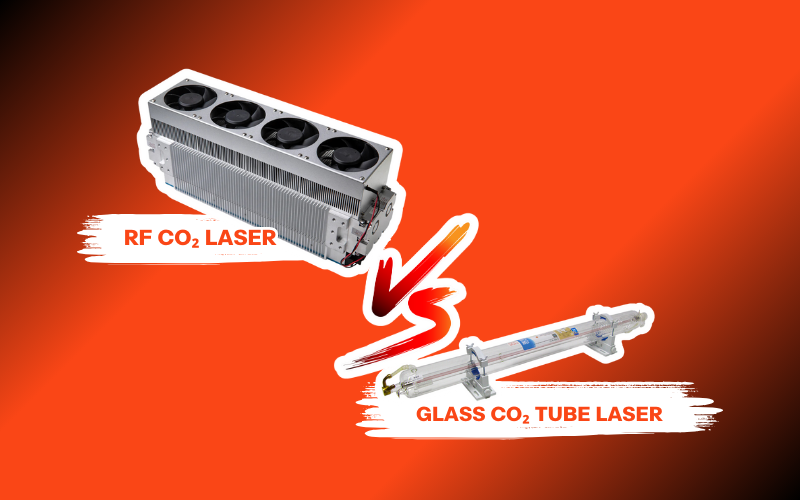
How I Help Customers Choose Between RF and CO₂ Glass Tube Lasers
When someone asks me, “Which laser should I buy?” My answer is almost never based on wattage first.
How I Help Customers Choose Between RF and CO₂ Glass Tube Lasers
When someone asks me, “Which laser should I buy?” My answer is almost never based on wattage first.
Instead, I ask a different question:
“What do you want your business to look like in one year?”
That answer tells me whether a traditional CO₂ glass tube or an RF laser tube is the better investment.
I’ve helped many makers choose their first laser machine. Some wanted to start an Etsy shop from their garage. Others already owned a busy trophy business or sign shop and needed to increase production. Interestingly, they often asked the same question:
“Is an RF laser really worth the extra money?”
The short answer is it depends on what you’re making and how often you’re making it.
Allow me to explain.
First, They Are Both CO₂ Lasers
This is the first misconception I like to clear up.
An **RF laser isn’t a different type of laser.** It’s still a CO₂ laser.
The difference lies in how the laser gas is excited.
- A glass CO₂ tube uses direct current (DC).
- An RF laser tube uses radio frequency (RF) energy to excite the gas.
Both cut and engrave wood, acrylic, leather, rubber, paper, fabric, and many other non-metal materials.
The real differences show up once you start using them every day.
Think of It Like Buying a Car
I often compare it to choosing between two vehicles.
A glass tube laser is like a reliable pickup truck.
It gets the job done.
It costs less.
Maintenance is straightforward.
An RF laser is more like a luxury sports sedan.
It’s smoother.
Faster.
More refined.
And it stays consistent even after years of heavy use.
Neither choice is wrong.
The best choice depends on where you’re going.
1. Lifespan: The Biggest Difference
One of the first questions customers ask is:
“How long will the tube last?”
This is where RF tubes shine.
A typical glass CO₂ tube lasts around 1,500–3,000 hours, while many RF laser tubes operate for 20,000–50,000 hours before replacement becomes necessary.
If you’re engraving only on weekends, a glass tube may last several years.
If you’re running eight hours a day producing wholesale orders, you’ll reach those hours much faster.
For a business, less downtime usually means higher profits.
2. Beam Quality Makes a Bigger Difference Than Most People Expect
Here’s something beginners rarely think about.
Two lasers can both say 40W on the specification sheet.
Yet one produces razor-sharp text.
The other leaves slightly fuzzy edges.
Why?
This is because beam quality matters just as much as power.
RF tubes generate a smaller, more stable laser spot with less beam fluctuation, which makes them great for fine engraving, small fonts, photos, and detailed graphics. The glass tubes tend to give you a bigger, less consistent beam that’s better for general cutting than ultra-fine detail.
If you do personalized gifts, jewelry boxes, leather wallets, or photo engraving, you’ll see the difference immediately.
3. Speed Isn’t Just About Moving Faster
Many advertisements boast engraving speeds of over 1,000 mm/s.
But speed means very little if the laser can’t keep up.
RF tubes respond almost instantly when changing power because they use high-frequency modulation. So cleaner corners, smoother black & white engraving, and reliable quality at high speeds. Glass tubes are slower to react and thus are better for simple engraving and cutting jobs.
And this is the biggest factor when you’re making hundreds of products.
Saving even 20 seconds per product quickly adds up over a full production run.
4. Maintenance: One Requires More Attention
One customer once told me,
“I bought the cheaper machine, but I spend more time maintaining it than using it.”
That stuck with me.
Glass tube lasers require a water chiller, cooling maintenance, and eventually tube replacement.
RF tubes are sealed systems that generally require little maintenance, and many lower-power models are air-cooled, reducing overall system complexity.
For hobby users, maintenance isn’t a major concern.
For a busy business owner, less maintenance means more time making products.
5. Upfront Cost vs Long-Term Value
There’s no avoiding this conversation.
Glass tube lasers are significantly less expensive.
That’s why they’re such a popular choice for first-time buyers.
RF machines cost more upfront.
But here’s what experienced shop owners often tell me after a year or two:
“I wish I had bought the RF machine from the beginning.”
Why?
Because they’re no longer paying for frequent tube replacements, additional downtime, or inconsistent engraving quality.
Over several years of heavy production, the total cost difference often becomes much smaller than expected.
Which One Is Right for You?
Here’s the advice I usually give.
Choose a Glass CO₂ Laser If:
- You’re starting your first laser business.
- Your budget is limited.
- Most of your work involves cutting wood or acrylic.
- You produce products occasionally rather than every day.
It’s an excellent way to enter the laser industry without a giant investment.
Choose an RF laser if:
- You engrave every day.
- Fine detail is critical.
- You create photos, leather goods, awards, or premium gifts.
- Downtime costs your business money.
- You want a machine that can support years of production.
For growing businesses, the higher initial investment often pays for itself through better efficiency and consistency.
What I Usually Recommend
When someone tells me they’re opening an Etsy shop from home, I don’t immediately recommend the most expensive machine.
A glass-tube laser may be exactly what they need.
But when someone says they already have customers waiting, wholesale orders coming in, or plans to run the machine every day, my recommendation usually changes.
That’s where an RF laser becomes less of a luxury and more of a business investment.
At OneLaser, this is precisely why we offer both options. Some makers thrive with a glass tube system like the **OneLaser XT, while others benefit from the long lifespan and precision of an RF-powered machine like the [OneLaser XRF](https://www.1laser.com/products/onelaser-xrf-desktop-laser-machine) or hybrid systems in the [Hydra** series](https://www.1laser.com/collections/hydra-series). Our goal isn’t to sell the most expensive machine — it’s to help you choose the one that fits your work.
At the end of the day, the best laser isn’t the one with the biggest specification sheet.
It’s the one that helps you make better products, keep customers satisfied, and grow your business with confidence.
메타데이터
- post_id
- 455f396c8463
- slug
- how-i-help-customers-choose-between-rf-and-co₂-glass-tube-lasers-455f396c8463
- url
- https://medium.com/@OneLaserOfficial/how-i-help-customers-choose-between-rf-and-co%E2%82%82-glass-tube-lasers-455f396c8463
- canonical_url
- https://medium.com/@OneLaserOfficial/how-i-help-customers-choose-between-rf-and-co%E2%82%82-glass-tube-lasers-455f396c8463
- author_url
- https://medium.com/@OneLaserOfficial
- status
- ok
- fetched_at
- 2026-08-01 04:33:50