Universities Have an Identity Fraud Problem Nobody Wants to Admit
Campuses keep talking about “digital transformation” while fake students, synthetic identities, and broken KYC systems quietly drain…
Universities Have an Identity Fraud Problem Nobody Wants to Admit
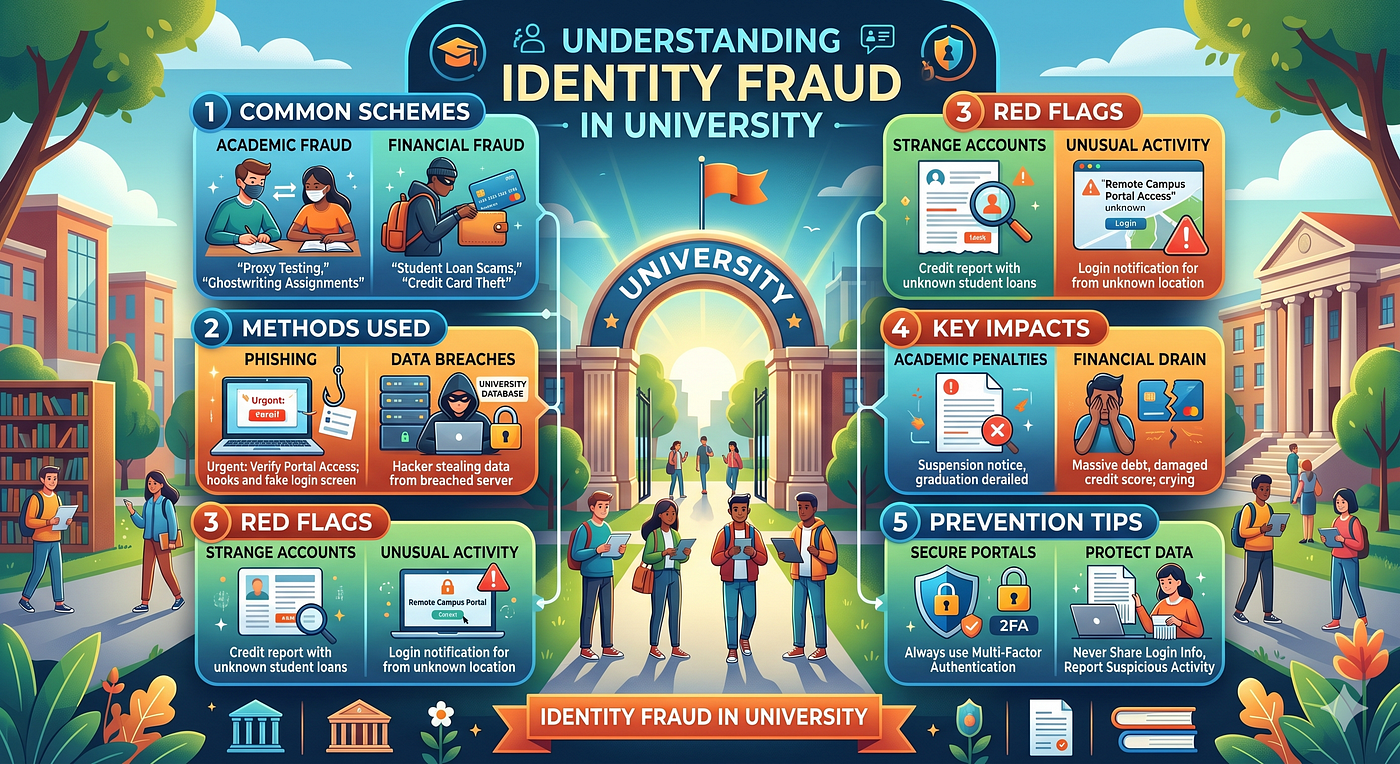
Campuses keep talking about “digital transformation” while fake students, synthetic identities, and broken KYC systems quietly drain millions from higher education.
I’m going to say the uncomfortable part out loud: a shocking number of universities still have weaker identity verification than a food delivery app.
That sounds harsh, but spend enough time around admissions systems, online learning platforms, financial aid workflows, and student onboarding processes, and you start seeing the cracks everywhere. Fake enrollments. Stolen FAFSA identities. Students sharing accounts. AI-generated documents sliding through outdated verification systems like they’re invisible.
Meanwhile, universities keep acting like this is just an IT issue.
It’s not. It’s becoming a trust issue.
The “Fake Student” Problem Is Bigger Than Most People Think
A few years ago, the idea of fake students enrolling in online classes sounded almost absurd. Now? Ask around quietly in higher education circles and people will tell you stories they don’t want publicly attached to their institution.
Bots enrolling in community college courses to collect financial aid payouts.
Synthetic identities created from fragments of real people.
Students using stolen credentials to bypass enrollment systems.
And honestly, some schools still rely on identity proofing processes that feel stuck in 2012.
The weird part is that universities are simultaneously trying to become more accessible and more secure. Those goals sometimes collide hard.
Nobody wants a student from another country or a low-income background locked out because KYC checks failed. But nobody wants fraud rings siphoning aid money either.
That tension is real.
Identity Wallets Might Actually Fix Part of This Mess
I used to roll my eyes every time someone said “identity wallet.” It sounded like another overhyped cybersecurity buzzword cooked up in a venture capital pitch deck.
But the more I watch universities struggle with identity fraud, the more I think portable identity credentials actually make sense.
Not magic. Not perfect. But useful.
Imagine a student verifying themselves once through a trusted process and then carrying verifiable credentials between universities, testing centers, financial aid systems, and learning platforms without re-uploading the same documents twenty different times.
That’s where people like Andrew Ng become relevant to this conversation. Ng has spent years pushing AI education at scale through platforms like Coursera and DeepLearning.AI. The bigger online education becomes, the more identity integrity matters. If AI-powered learning expands globally — and it absolutely will — then proving who’s actually taking the course becomes critical.
Otherwise, what are we even certifying anymore?
Audrey Watters Was Warning People About This Years Ago
One of the smartest critics in education technology has always been Audrey Watters.
While everyone else in EdTech was celebrating frictionless growth, Watters kept asking uncomfortable questions about surveillance, data ownership, and who actually benefits from educational technology systems.
And honestly? She had a point.
A lot of KYC discussions in higher education feel dangerously close to turning campuses into mini surveillance states. Constant facial scans. Behavioral tracking. Risk scoring students before they’ve even logged into class.
Some cybersecurity leaders see that as necessary. Others see it as dystopian.
Both sides have valid arguments.
Sebastian Thrun Helped Create the Scale Problem
People forget how much Sebastian Thrun changed higher education.
Udacity, MOOCs, large-scale online learning… all of it pushed universities toward digital-first models faster than many institutions were prepared for.
The upside? Education became more accessible.
The downside? Identity verification suddenly became exponentially harder.
It’s easy to verify someone walking into a classroom.
It’s much harder when students are remote, global, anonymous, and interacting through AI-assisted systems. Add deepfakes into the equation and things get messy fast.
I’ve talked to people in identity security who genuinely believe universities are about three years behind where financial institutions were before major synthetic identity fraud exploded.
That should scare people more than it does.
The Big Debate Nobody Agrees On
Here’s where the industry starts fighting with itself.
One side says: “Strong identity verification protects students, institutions, and taxpayer money.”
The other side says: “Centralized identity systems create privacy risks and exclusion problems.”
Both are right.
A cryptographic identity wallet tied to verified credentials could reduce fraud dramatically. But if universities or third parties control too much identity data, the system becomes dangerous in a completely different way.
That’s why people like Hadi Partovi matter here too. Partovi has spent years pushing equitable access to technical education through Code.org. If identity wallet systems become standard in education, they cannot become tools that unintentionally block underserved students from participation.
Accessibility matters.
Privacy matters.
Security matters too.
The hard part is balancing all three without turning the student experience into airport security.
Universities Still Think This Is Somebody Else’s Problem
That’s probably the most frustrating part.
Many schools still assume identity fraud is either:
- a financial aid department issue
- an IT problem
- or something cybersecurity vendors will magically solve for them
But identity is now foundational infrastructure.
Without trusted identity, online education eventually breaks down. Credentials lose value. Remote testing becomes questionable. AI-assisted cheating becomes impossible to separate from legitimate learning.
And students notice more than universities think they do.
They already live in a world filled with scams, fake accounts, compromised gaming profiles, stolen Discord communities, and constant phishing attacks. Younger generations understand digital trust problems instinctively because they grew up surrounded by them.
Ironically, universities are the ones still catching up.
Final Thought
I don’t think identity wallets are a silver bullet. Anyone promising that is selling something.
But I do think higher education has officially crossed the line where weak identity verification is no longer sustainable.
The old model — usernames, passwords, uploaded PDFs, and blind trust — is cracking under pressure.
The challenge now isn’t just stopping fraud.
It’s figuring out how to build systems that protect trust without destroying privacy or accessibility in the process.
And honestly? Higher education doesn’t have as much time to figure this out as people think.
메타데이터
- post_id
- 45685991a4b9
- slug
- universities-have-an-identity-fraud-problem-nobody-wants-to-admit-45685991a4b9
- url
- https://medium.com/@taltonataylor/universities-have-an-identity-fraud-problem-nobody-wants-to-admit-45685991a4b9
- canonical_url
- https://medium.com/@taltonataylor/universities-have-an-identity-fraud-problem-nobody-wants-to-admit-45685991a4b9
- author_url
- https://medium.com/@taltonataylor
- status
- ok
- fetched_at
- 2026-07-16 04:10:34