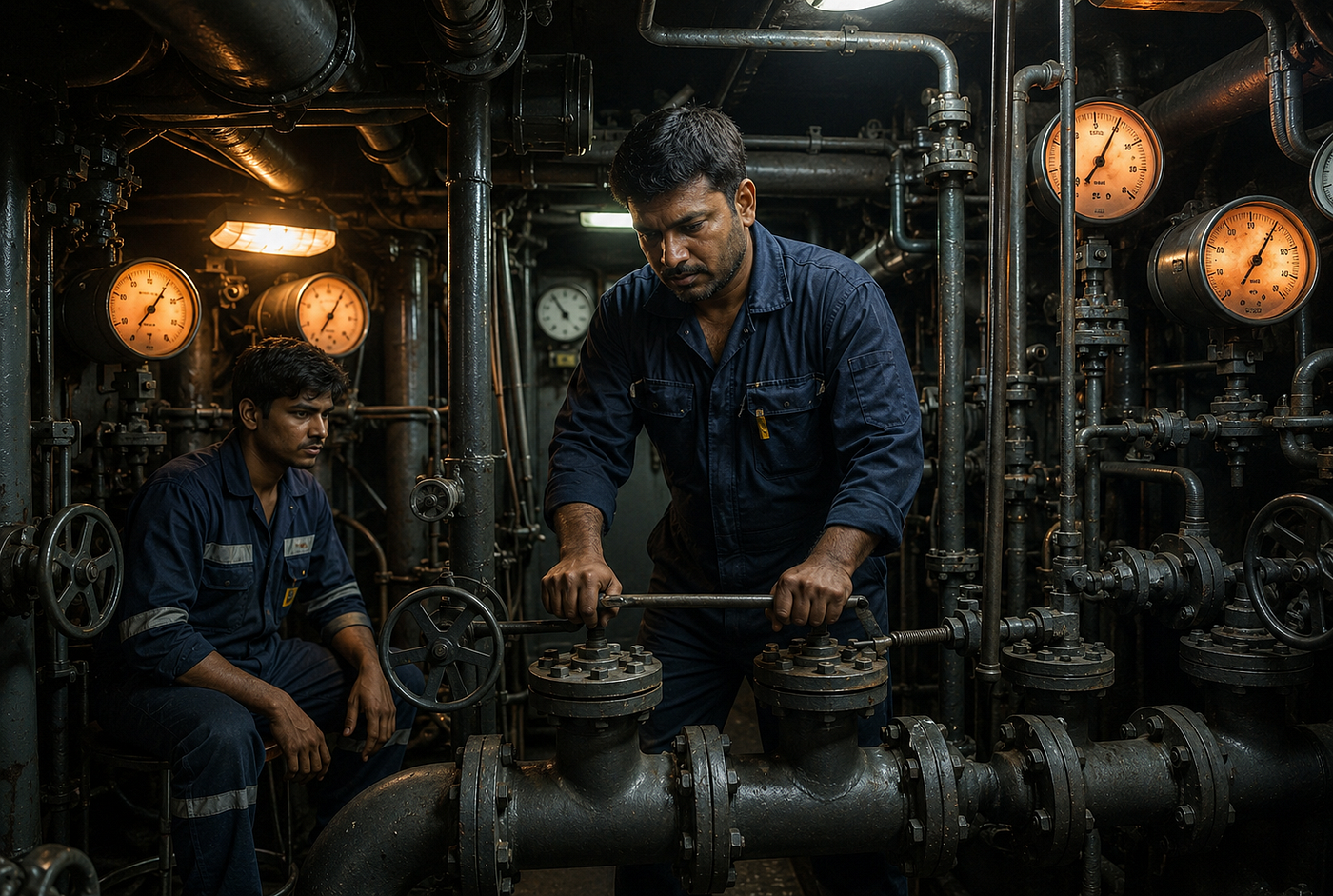
Blow Past Auxiliary Engine Liners
A Lesson in Defying Maritime Convention and Outsmarting “Unsolvable” Machinery
MARITIME LESSONS
Blow Past Auxiliary Engine Liners
A Lesson in Defying Maritime Convention and Outsmarting “Unsolvable” Machinery
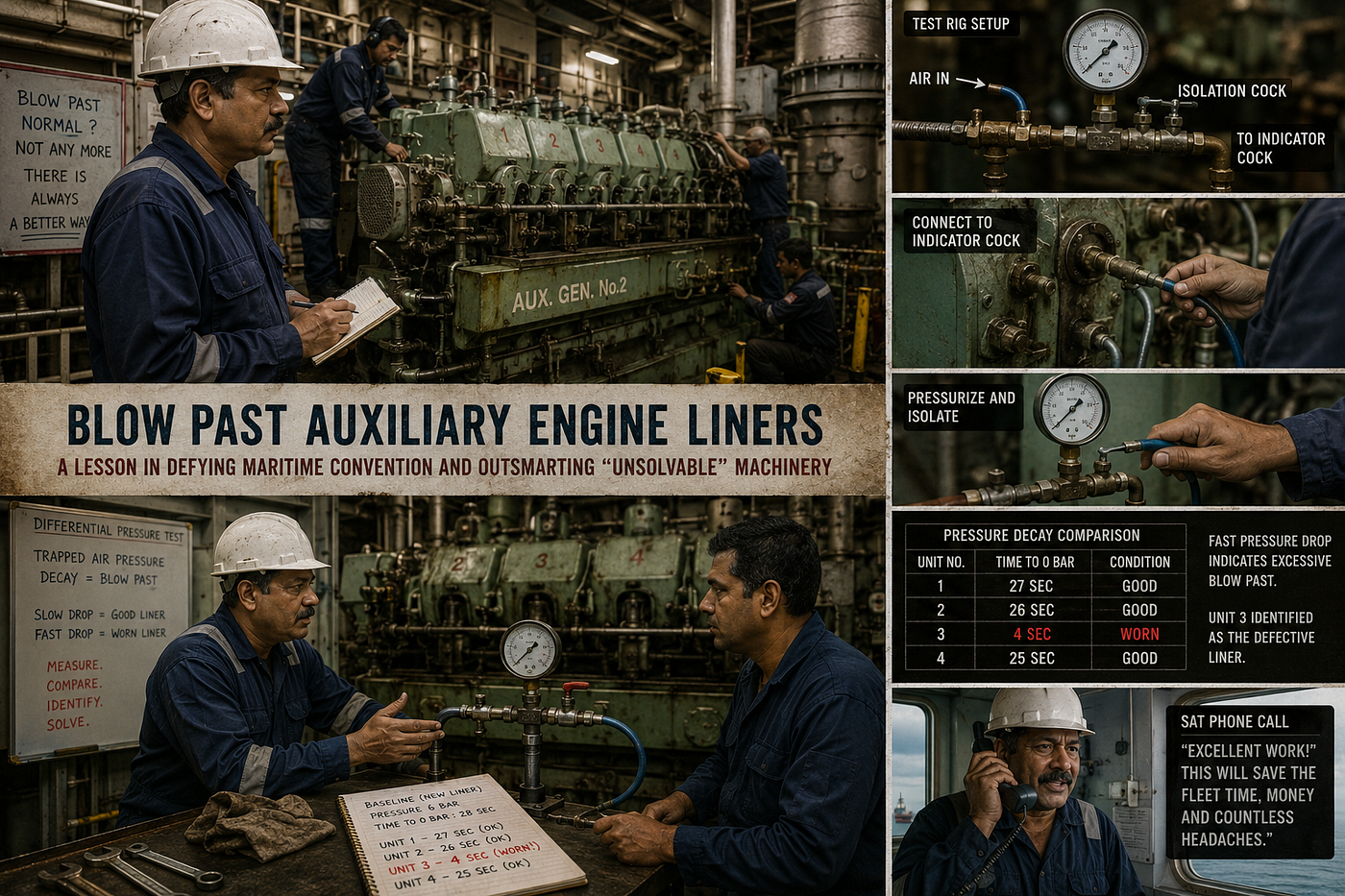
Solving the riddle of the auxiliary engine liners using a custom-built differential pressure test rig to isolate the defective unit.((Illustration generated via ChatGPT AI)
Not a Member? Read free here.
A Resignation on Principle
I decided to quit the company that had originally given me my break as a Chief Engineer, and I did so purely on a matter of principle. When I had initially signed my contract to join their vessel, I informed the office well in advance that I required a relief after exactly four months of service.
Management companies are sweetness personified and will grant your every wish until they successfully get you onboard. The moment your boots hit the deck, a collective amnesia sets in; they suddenly cannot recall a single promise made or verbal assurance given. Though I had sent several follow-up calls regarding my relief date, I had unfortunately neglected to keep a record.
When the time arrived for me to be relieved, Mr. Charles and Captain Paul were no longer working in the office, and the new staff declined any knowledge of my agreement. I signed off the ship in protest, paid for my own return airfare, and told them in no uncertain terms that I would never be joining their fleet again.
Upon returning home, I walked into the office of another highly reputed shipping company. Captain Rana interviewed me, and I was put through a standard computer competency test, though the entire process felt like a mere formality.
As soon as I checked into my hotel afterward, the top brass of my previous company began calling my phone repeatedly, apologizing profusely, and promising to refund my airfare alongside offering substantial salary increments if I returned. I politely but firmly declined their offers.
Later, Captain Rana told me that in all his years of recruiting, it was incredibly rare to receive such excellent, glowing performance reports when contacting a candidate’s previous employers.
The Italian Lottery of Bankruptcy Spares
I officially joined my new vessel in the busy port of Rotterdam. My Second Engineer, Aslam, was Bangladeshi, and the rest of the crew were capable Filipinos. While the ship itself was not exceptionally old and the deck machinery was in good condition, the auxiliary generators were an absolute nightmare.
The original manufacturer of those engines had gone bankrupt, meaning genuine OEM spare parts were no longer available on the market. To keep the fleet running, the company had contracted a third-party firm in Italy that specialized in manufacturing aftermarket liners, pistons, and piston rings, as well as reconditioning old cylinder heads.
Changing cylinder liners had become a grueling, regular feature of life in the engine room. There was a relentless, heavy blow-past of combustion gases past the piston rings and directly into the crankcase.
When we checked the generator’s sump oil level, a continuous, hot flow of exhaust gas would blow out of the dipstick entry — a defect that the company had stubbornly come to accept as “normal.” Eventually, the blow-past would reach a critical stage where the updraft of escaping gas was so violent that it was physically impossible to pour fresh oil into the sump because the force of the gas blew it right back out.
When things got that bad, the engineers would be forced to change the liners one by one. The entire process was treated like a blind lottery. The crew would change a single liner at random, put it back together, and start the generator. If the gas flow visibly reduced, they considered themselves lucky. If it didn’t, they would tear down the next unit, repeating the exhausting cycle until they stumbled upon the culprit. Due to this severe wear, these aftermarket liners never lasted more than 6,000 to 8,000 running hours.
The Cynicism of the Engine Room
I thought this entire trial-and-error approach was absolute madness. I approached Second Engineer Aslam and told him flatly that there had to be a scientific, logical way to identify the defective liner before tearing the machinery apart.
Aslam gave me a defiant, deeply skeptical look. He informed me that there were three identical sister ships in the fleet suffering from this same issue, and not a single Chief Engineer, Superintendent, or shore-side expert had ever been able to suggest a way to isolate the problem unit.
In his mind, there was no option but to follow the established routine blindly. I initially tried to identify the leaking unit by taking peak firing pressures. Still, on medium-speed, four-stroke auxiliary engines, it is practically impossible to pinpoint a single worn liner using this method alone when the engines run at 900 RPM (Revolutions per minute).
Amused by my initial failure, Aslam quietly laughed to himself, smugly convinced that there was no way of singling out a defective liner. Because the ship operated on a standard watch-keeping schedule, I decided to begin conducting my own Sherlock Holmes private engineering experiments during the Third Engineer’s watch, between 12:00 and 16:00 hours.
I deliberately chose this window because I did not want Aslam to have the slightest inkling of what I was scheming down below.
Aslam was undoubtedly a hard-working engineer; he held his chief Engineer’s certificate of competency and was actively in line for his next promotion. However, I had never encountered a more painfully reticent person in my entire career. Extracting a simple, monosyllabic reply from him was as difficult as a dentist extracting a deeply rooted wisdom tooth.
Whenever I assigned him a job, I never knew whether he would actually execute it, or whether he even agreed with my technical suggestions. Eventually, I pulled him aside and told him plainly that once he was promoted to Chief Engineer, he would not have the luxury of keeping quiet when a Superintendent was barking urgent questions over the satellite phone, and that he desperately needed to develop his conversational skills.
Today, ironically enough, he is a Technical Manager in a prominent German shipping company. It is amazing how, once a responsibility is forced upon you, you have no choice but to conform and grow.
The Differential Pressure Breakthrough
Through quiet experimentation, I finally engineered a foolproof way of identifying the worn-out liner using basic physics. I assembled a specialized testing rig: I connected a flexible air hose to a manual isolation cock, and attached the other end of the cock to an indicator valve fitting via a custom pipe arrangement. I then mounted a reliable pressure gauge directly onto the piping. All checks were made with engines in stop condition.
To establish a baseline measurement, I chose an engine unit that had been recently overhauled with a brand-new liner, piston, and piston rings. I manually turned the flywheel of the engine until this specific unit reached Top Dead Center (TDC) on its firing stroke, ensuring that both the inlet and exhaust valves were tightly shut, sealing the combustion chamber.
I connected my testing rig to the indicator cock, opened the air supply for a few seconds to pressurize the cylinder, and then swiftly snapped the isolation cock shut. I precisely noted the time it took for the trapped air pressure to bleed past the rings and drop all the way to zero.
Armed with this baseline, I systematically checked every single unit on the generator, recording the exact breakdown time for each. On the units with heavily worn liners, the trapped pressure dropped almost instantly. My diagnostic tool worked flawlessly.
Silence and Success on the Sat Phone
The next time the generator’s blow-past became unbearable, and it was time to change parts, I walked into the engine room and instructed Aslam to change the liner on one specific cylinder unit. Assuming that I was merely guessing at random as everyone else had done for years, he grudgingly changed the designated liner. When the engine was boxed up and restarted, the blow-past stopped completely. Aslam shrugged it off, chalking it up to pure beginner’s luck.
The following month, on a completely different generator, I ran my pressure test again and correctly identified the failing unit on the very first try. The engine room crew was absolutely thrilled. By isolating the exact point of failure beforehand, their backbreaking workload was drastically reduced, saving them from days of unnecessary overhauls.
Finally, swallowing his immense pride, Aslam approached me and sheepishly asked how I was consistently identifying the failing liners. I looked him in the eye and told him that I would happily explain the methodology to the incoming Chief Engineer and the visiting Superintendent, but I would not share it with him. I wanted him to understand that instead of assisting his Chief in finding a solution to a chronic problem, all he had chosen to do was stand on the sidelines and pass snide remarks.
When the technical Superintendent arrived, he was absolutely thrilled with the breakthrough. Not only had our ship’s spare parts requirement plummeted, but the constant problems of machinery downtime, complex port logistics, and chasing down Italian suppliers had suddenly become completely manageable.
The company’s Managing Director even called me directly on the satellite phone, thanking me profusely and speaking at great length about the achievement. Shortly thereafter, official instructions were sent out to all sister ships in the fleet, mandating that they follow my exact testing procedure in the future.
Thanks for Reading!
⚔️ Love Audio Dramas? Immerse yourself in a gripping world of kings, vows, and empires. Stream my hit fantasy audio series, Hasten-Gard, on Pocket FM! 👉 Listen Here
Explore My Collections:
- 📜 **The Legend of Bhishma:** The full, chronological epic saga.
- 🎭 **Wit & Wisdom:** Satire and humor in the spirit of Mullapudi and Wodehouse.
- ⚓ Crossings: Reflections on sea life, schooling, and life’s journeys.
- 🏺 **Ancient Echoes:** Reimagined tales from Indian Folklore and Epics.
📬 Never Miss a Story: If these reflections on life, sailing adventures, and ancient wisdom resonated with you, click here to visit my profile, follow, and enable email notifications.
📬 Stay Updated: Subscribe to my Substack to get every new story delivered directly to your inbox.
Author’s Note: This story is an excerpt from my book, “Merry Mariner and His Rudderless Boat.” Please find the full collection of maritime memoirs and life lessons from the high seas on Amazon here. Amazon here.
Support the Journey
If these stories resonate with you, consider supporting my work:
- ☕ International: Buy a Coffee on Ko-fi
- 💳 India (UPI):
raoos45-1@okhdfcbank - 🎨 Art: View My Painting Collection
메타데이터
- post_id
- 4571637da84c
- slug
- blow-past-auxiliary-engine-liners-4571637da84c
- url
- https://medium.com/illumination/blow-past-auxiliary-engine-liners-4571637da84c
- canonical_url
- https://medium.com/illumination/blow-past-auxiliary-engine-liners-4571637da84c
- author_url
- https://medium.com/@akgirisam
- status
- ok
- fetched_at
- 2026-07-16 00:09:14