The Institutional Partitioning of Crypto: How the Clarity Act Redesigns Your Assets Into a…
This isn’t a highway for institutional capital. It’s a blueprint for a gilded cage — and the bars are being installed one regulatory…
The Institutional Partitioning of Crypto: How the Clarity Act Redesigns Your Assets Into a Three-Tier Control System
This isn’t a highway for institutional capital. It’s a blueprint for a gilded cage — and the bars are being installed one regulatory provision at a time.
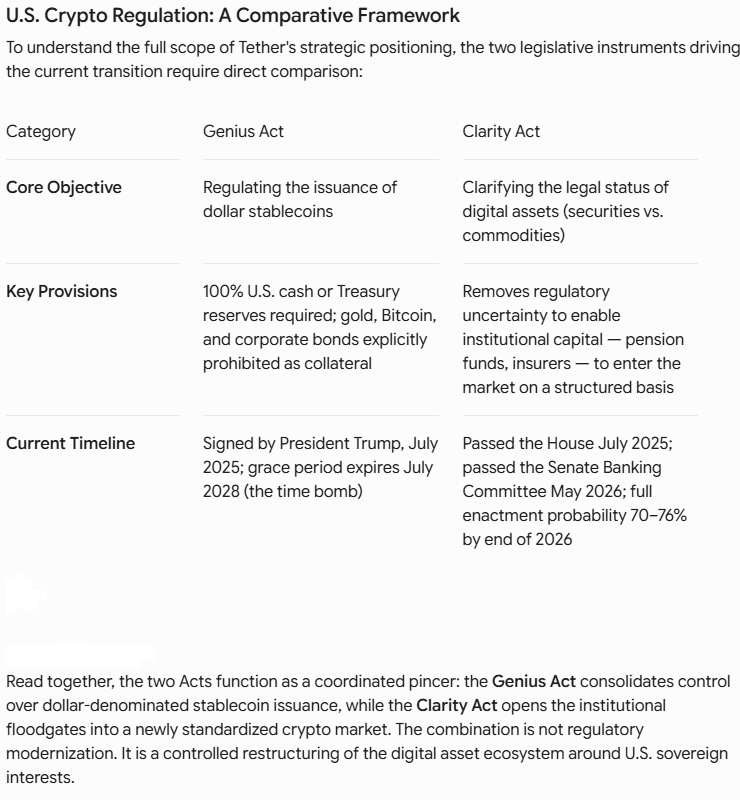
The Digital Asset Market Clarity Act is being presented to the public as a maturation event for the crypto ecosystem — the moment when digital assets finally receive the regulatory clarity that will unlock institutional participation and bring mainstream legitimacy to a previously marginal asset class. The framing is not inaccurate. Institutional capital will flow. Mainstream legitimacy will follow. What the framing systematically omits is the precise mechanism by which that legitimacy is being established — and what it costs the participants who built the ecosystem in exchange for their place within its newly regulated perimeter.
The Clarity Act is not a highway. It is a sorting machine — a master-planned redesign of the crypto landscape that classifies every digital asset, every exchange, and every individual participant into a specific regulatory category, and assigns to each category a specific and non-negotiable relationship with state authority. Understanding that classification system, in detail, is the minimum competency required to navigate what comes next with intention rather than reaction.
1. The “One Country, One CEX” Mandate: The End of Exchange Plurality
The era in which digital assets circulated freely across a fragmented landscape of competing exchanges — each with different listing standards, different liquidity profiles, and different relationships with regulatory oversight — is ending by legislative design.
The Clarity Act’s core structural mandate is the consolidation of crypto market infrastructure around a single state-authorized Centralized Exchange per jurisdiction. The practical consequences of this consolidation are more far-reaching than the headline provision suggests. Smaller and fragmented exchanges, lacking the regulatory infrastructure and compliance overhead required to achieve state authorization, will be absorbed into national designated platforms or cease to operate. The competitive arbitrage that has characterized crypto markets — the ability to access different assets, different prices, and different liquidity conditions across multiple venues — disappears within the authorized framework.
More consequentially, the Act redefines what constitutes a legitimate digital asset. A crypto asset does not achieve “legal financial product” status through its technical properties, its community adoption, or its market liquidity. It achieves that status by passing through the gate of an official Initial Exchange Offering hosted by the government-designated CEX. Any asset that trades outside that state-sanctioned gateway — regardless of its technical merit, its security properties, or the scale of its existing user base — is classified as contraband within the new framework. The lifeblood of institutional liquidity flows only through the authorized gate. Everything outside it is starved.

2. The Three-Tier System: How Your Assets Will Be Classified
The Clarity Act’s most architecturally significant provision is the creation of a three-tier regulatory classification system that assigns every digital asset to a specific caste — and with that assignment, a specific and non-negotiable set of constraints on its behavior, its utility, and its potential for individual wealth generation.
Tier 1 assets — CEX-Core, institutionally mainstream — are the sovereign-sanctioned instruments listed on national centralized exchanges. These are the assets that global pension funds and sovereign wealth vehicles will access, that Wall Street will package into derivatives and structured products, and that will constitute the “legitimate” face of digital assets in institutional portfolios. Their listing status confers regulatory protection. It also confers the full weight of institutional compliance architecture — surveillance, reporting requirements, custody mandates, and tax treatment that aligns with legacy financial instruments. The upside of institutional capital access comes with the downside of institutional control infrastructure. The assets are legitimate. They are also fully legible to every regulatory and tax authority that chooses to look.
Tier 2 assets — equity-type tokens permitted to retain market-driven price discovery — represent the selected altcoins that pass the rigorous compliance vetting of the national CEX framework. The selection criteria are not purely technical. They reflect the regulatory posture, the corporate governance structure, and the compliance history of the issuing project. Projects like XRP and Solana, whose origins involved exchange-hosted IEO structures and compliance-oriented corporate architectures, are effectively grandfathered into this tier — their early compliance investment paying a structural dividend in the form of institutional recognition. The vast majority of the altcoin market, whose assets were issued through opaque listing processes or gray-market liquidity mechanisms, does not qualify for this grandfathering. They face a re-listing audit process whose standards are set by the same framework that most of them were designed to avoid.
Tier 3 assets — commodity-type tokens functioning as settlement units — are the most revealing category in the architecture. These are instruments that have been stripped of speculative upside by regulatory design: fixed prices, mandatory 1:1 USDC reserve collateralization, and a functional role as mechanical assistants to the Digital Dollar system rather than as independent stores of value. They are permitted to exist. They are not permitted to generate individual wealth. Their utility is operational rather than financial — the digital equivalent of a transit token that functions within the system and generates no returns outside it.
3. The IEO Divide: Grandfathered vs. the Delisting Guillotine
The bifurcation that the Clarity Act creates within the altcoin market is neither gradual nor merciful. It operates as a guillotine — a clean structural divide between assets that qualify for institutional recognition and assets that do not, with no meaningful intermediate category and no grandfather clause for the majority.
On one side of the divide, assets with compliant IEO origins receive institutional recognition that functions as a structural competitive moat. They access institutional liquidity, ETF wrapper eligibility, and the custody infrastructure of Wall Street. Their compliance investment, made years before the regulatory framework that rewards it existed, generates compounding returns in the form of market access that no amount of post-hoc compliance work can replicate for latecomers.
On the other side, the delisting guillotine falls on the assets that constitute the majority of the existing altcoin market. The re-listing audit that non-compliant assets must pass is not a formality. It is a comprehensive regulatory review — of tokenomics, of issuance history, of corporate governance, of compliance records — conducted against standards that most existing altcoin projects were never designed to meet. The failure rate will be high. The assets that fail do not receive a transition period, a liquidity runway, or a regulatory off-ramp. They are designated contraband and excluded from the institutional liquidity network that the Clarity Act consolidates. They vanish into the regulatory void — technically still existing on their native blockchains, operationally irrelevant to any participant whose capital requires regulatory legitimacy.
4. The DEX Trap: Decentralization as a Regulated Dead End
The Clarity Act’s treatment of Decentralized Exchanges is where the legislation’s architectural intentions become most explicit — and most consequential for any participant whose engagement with crypto was motivated by the original promise of censorship-resistant, peer-to-peer financial infrastructure.
To operate within the legal framework, a DEX must obtain a P2P License whose conditions effectively transform it into something that is no longer a DEX in any meaningful sense. The licensing conditions require the adoption of the Commodity-Type model: mandatory identity verification, mandatory asset segregation, and the maintenance of a 1:1 USDC reserve for every token issued on the platform. Any deviation from the reserve requirement — any token minting without corresponding collateral, any reserve ratio that shifts from perfect parity — triggers automatic regulatory flagging and forced delisting.
The practical consequence is a choice without meaningful optionality. A DEX that accepts the P2P License operates under 100% state surveillance, with fixed-price tokens that generate no speculative upside and a reserve requirement that makes the platform a fully collateralized extension of the USDC ecosystem rather than an independent financial infrastructure. A DEX that declines the license operates outside the legal framework, without access to institutional liquidity, without banking relationships, and with the implicit designation of illicit financial infrastructure.
The architecture is designed to produce a specific outcome: the elimination of genuinely decentralized exchange as a viable option for participants whose capital has any connection to the regulated financial system. The choice between a surveilled, collateralized, fixed-price cage and complete regulatory exile is not a choice between two viable paths. It is a choice between two different forms of the same constraint — and the constraint, in both cases, is the end of financial autonomy as the original crypto ecosystem defined it.
5. The Pricing-Out Mechanism: How Institutional Legitimacy Becomes Individual Exclusion
The Clarity Act’s ultimate function — the one that its “investor protection” framing is designed to obscure — is the systematic exclusion of retail participants from the wealth-generating phase of the institutional crypto cycle.
The assets that will generate the returns that institutional capital seeks — Tier 1 CEX-Core instruments packaged into ETFs and derivatives — will be accessed by retail participants only through intermediary structures that extract fees, impose compliance costs, and eliminate the direct custody and control that made early crypto participation economically transformative for individual investors. The transaction fees, tax reporting obligations, and compliance overhead that are negligible friction for institutional participants at scale represent meaningful costs for retail holders at normal position sizes — costs that compound over time into a structural disincentive for direct participation.
The individual private key — the technical instrument of genuine financial sovereignty in the original crypto architecture — is being replaced, through regulatory friction and institutional incentive, by the institutional custodial vault. The vault provides price exposure. It does not provide sovereignty. The distinction is the entire point.
As the institutional legitimization cycle begins generating the price performance that draws mainstream attention, the participants who will benefit most are those who were positioned before the cycle began — the institutional actors whose capital constructed the framework and whose compliance infrastructure was built in advance of the regulatory requirements that now mandate it. The retail participants who arrive at the party drawn by institutional-grade price performance will find that the most asymmetric returns have already been captured, and that their participation is structured to generate fees for intermediaries rather than sovereignty for themselves.
Satoshi’s vision of financial independence is not being defeated by force. It is being dissolved by design — priced out of accessibility through compliance friction, fee architecture, and a three-tier classification system that reserves genuine financial autonomy for the tier of participant that requires institutional permission to exist.
“The Clarity Act does not grant you freedom; it grants you a cell. By forcing decentralized protocols into a 1:1 collateralized ‘fixed-price’ cage, the system ensures that individual sovereignty is taxed, tracked, and eventually surrendered — not through coercion, but through the accumulated friction of compliance.”
SMPC (Secure Multi-Party Computation): A DeFi platform utilizing top-tier blockchain security to maximize asset stability. It fosters an innovative ecosystem built on transparency and “Fair Sharing.”
ANNA CHOICE / ANNA ADVICE LAB: Leading R&D brands specializing in natural anti-aging solutions, bridging the gap between nature’s healing energy and modern science.
메타데이터
- post_id
- 4577c7f42a2c
- slug
- the-institutional-partitioning-of-crypto-how-the-clarity-act-redesigns-your-assets-into-a-4577c7f42a2c
- url
- https://medium.com/@annaadvicelab/the-institutional-partitioning-of-crypto-how-the-clarity-act-redesigns-your-assets-into-a-4577c7f42a2c
- canonical_url
- https://medium.com/@annaadvicelab/the-institutional-partitioning-of-crypto-how-the-clarity-act-redesigns-your-assets-into-a-4577c7f42a2c
- author_url
- https://medium.com/@annaadvicelab
- status
- ok
- fetched_at
- 2026-06-21 12:17:11