Joker Beats King
The joker does not beat the king by becoming king.
Joker Beats King
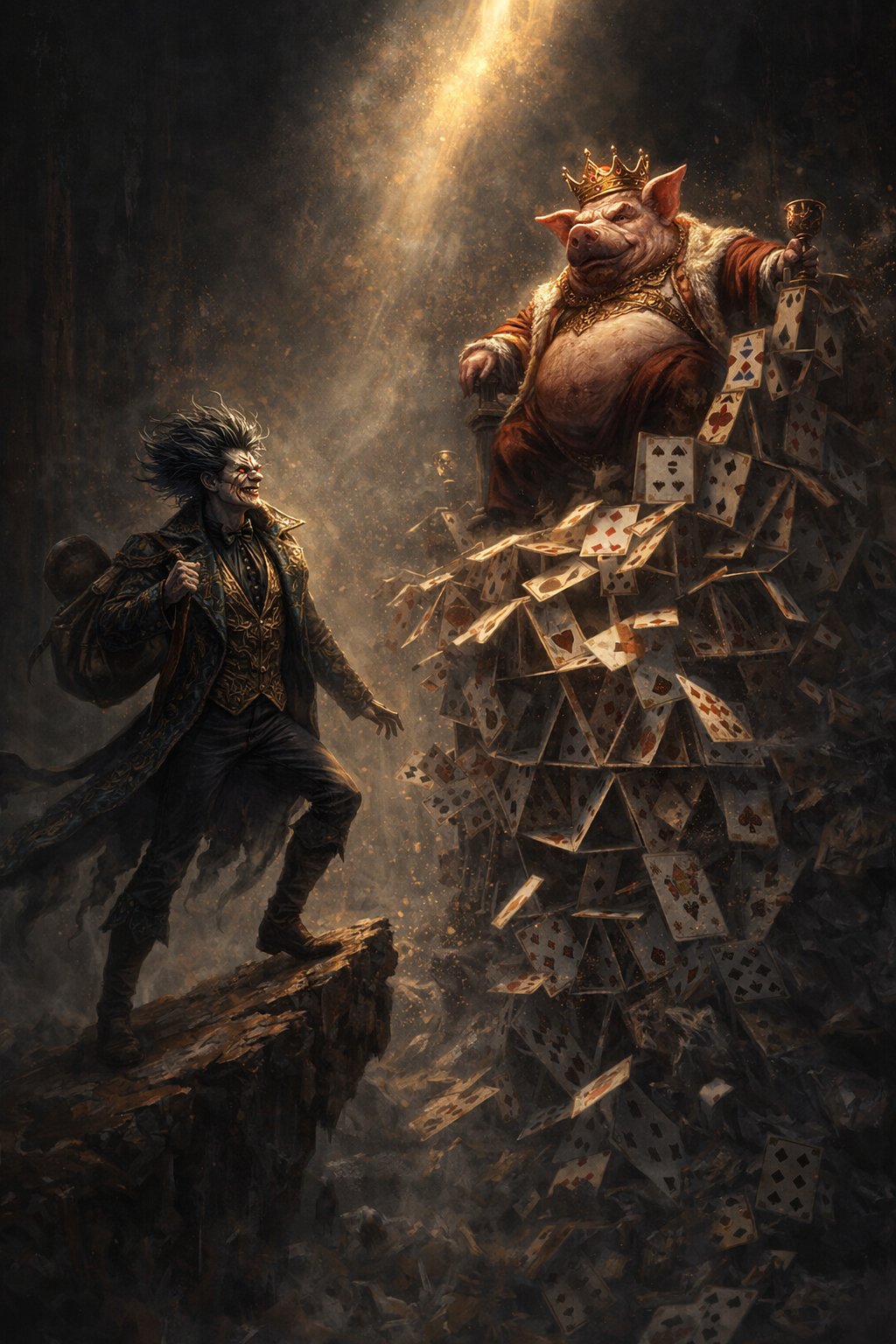
The joker does not beat the king by becoming king.
He beats him because kingship is already beneath him.
A king lives inside hierarchy. He needs an above and a below. He needs inferiors. He needs to be placed over others, even when he performs closeness and speaks in the language of familiarity. He needs spectacle, image, arrangement, a whole machinery that keeps turning domination into something that looks natural. His power comes from exploitation, from fear, from dependency, from a fabricated aura that teaches people to mistake inequality for order.
He does not have to be the sharpest mind in the room. He does not have to be the freest spirit. He does not have to be the quickest wit.
He only has to keep the structure standing.
The joker is made of something else.
He recognizes no one above him. He places no one beneath him. He does not oppose the king because he wants the throne for himself. He opposes the king because the throne itself is an insult to life. It is a reduction. A cage disguised as elevation. The king may appear high, but he is trapped inside the very system that glorifies him. He cannot step outside it without losing what he is. The joker can.
That is why the joker is more powerful than the king.
The king is a card in the deck. The joker changes the game.
The king has value because the hierarchy assigns him value. The joker has value because no hierarchy can fully contain him.
The king rules only while the rules are accepted. The joker can appear from nowhere, alter the hand, replace the missing card, or flip the table outright.
That is why the king is obeyed, but the joker is feared and loved.
The king feeds on submission. The joker lives by wit.
The king depends on image. The joker depends on timing.
The king needs everyone to stay in place. The joker appears precisely when place itself becomes the problem.
This is an old truth. It runs through folklore, theater, tarot, carnival, satire, and playing cards. The fool is never just comic relief. He is the figure that escapes assignment. The one who can say what others cannot say because he does not belong to their obligations. The one who can laugh in the face of official power because official power has no real answer to someone who refuses both submission and domination.
That is what makes the joker anarchic in the deepest sense.
Not chaotic for the sake of chaos. Not destructive because he worships ruin. Anarchic because he refuses to grant sacred legitimacy to hierarchy itself. He does not believe that some people are naturally above and others naturally below. He sees too clearly for that. The king looks at the world and sees stairs. The joker looks at the world and sees a table full of players pretending the deck is destiny.
And because he sees that, he can intervene.
Sometimes he is a jack-in-the-box: sudden, spring-loaded, absurd at first glance, then impossible to ignore. He bursts into the scene at the exact moment power has become too comfortable with itself. He startles pomp out of its performance. He punctures solemnity. He turns gravity against itself.
Sometimes he is quieter than that. Sometimes he sits in the hand, waiting. Not passive. Waiting. Watching the players overcommit to their strategy, their confidence, their illusion of control. Then, at the right moment, he appears and changes everything. Not by brute force. By laughter. By disarray. By impossible substitution. By revealing that the whole game depended on assumptions nobody thought to question.
That is his superiority.
The king can dominate only within the system. The joker moves across systems.
The king can command only those who accept his rank. The joker reaches even those who hate authority.
The king is powerful only where hierarchy still seems natural. The joker becomes strongest exactly when hierarchy begins to look absurd.
This is why the king cannot truly defeat him.
The king knows how to punish rebels. He knows how to exile critics, silence subordinates, crush rivals, stage retaliation. All of that still belongs to the language of the court. But what can he do with someone who does not want his place, does not envy his status, does not fear his dignity, and does not even accept the basic geometry of above and below?
Nothing unnerves corruption more than a figure that cannot be ranked.
The corrupt king understands opposition. He knows how to answer protest with spectacle, criticism with force, satire with outrage. But the joker is more than opposition. He does not merely challenge the king’s decisions or expose his hypocrisy. He reveals that the king’s entire mode of being is second-rate. The king must constantly manufacture height. He must keep producing signs that he is more important, more entitled, more central than everyone else. The joker needs none of that. His force lies in mobility, intelligence, unpredictability, and in the immediate recognition he provokes: this figure is less constrained, more alive, less fake.
The king is rigid because he must be. The joker is fluid because he can be.
The king guards the structure. The joker finds the hidden hinge.
The king maintains the game. The joker reminds everyone that the game can be refused.
This is why the joker can restore justice without lowering himself to kingship. To become king would be a fall. It would mean accepting the same staircase, the same theater of elevation, the same dependence on inferiors, the same choreography of domination. It would mean agreeing that the world must always be organized vertically. The joker refuses that premise. He does not want a better seat at the table. He wants to expose the fraudulence of a table built to sanctify winners and naturalize losers.
He does not take the crown. He makes the crown look provincial.
He does not become first among subjects. He exposes the childishness of wanting subjects at all.
He does not found a cleaner monarchy. He breaks the spell that made monarchy seem necessary.
That is why sympathy belongs to him.
The king demands admiration. The joker asks only to be seen.
The king feeds on subordination. The joker moves among equals.
The king makes power feel heavy, inherited, unavoidable. The joker makes freedom feel sudden, vivid, contagious.
And yes, from one side of the table he looks like laughter. From the other, he looks like disorder. That is exactly right. To the corrupt, he is chaos, because justice is always experienced by corruption as interruption. To those suffocating under the décor of power, he is release, because release often arrives first as insolence, as disruption, as the sudden collapse of false seriousness.
The joker laughs, and the king loses height. The people laugh, and stop believing.
That is when the king begins to lose.
Not when another king rises against him. Not when another crown claims superior legitimacy. Not when a polite reformer asks for a better-managed version of the same vertical world.
He loses when the joker appears and makes the whole arrangement smaller than it imagined itself to be.
He loses when people understand that the king is powerful only as long as everyone consents to the game. He loses when the wildcard enters. He loses when the fool starts laughing. He loses when the jack bursts from the box. He loses when the card that belongs nowhere suddenly becomes the card that matters most. He loses when the table trembles.
This is why the joker has always been more than a clown.
He is not just there to entertain the court. He is there to expose what the court cannot admit. He is not merely the release valve of power. He is power’s living contradiction. He is the figure who carries truth sideways, through wit, reversal, provocation, and surprise. He can move through fiction and return with reality sharpened. He can wear absurdity as camouflage for justice. He can break the mood in which corruption feels inevitable.
The king offers domination disguised as order. The joker offers freedom that refuses to kneel and refuses to make others kneel.
That is why joker beats king.
Because the king is only a ruler.
The joker is a freedom no hierarchy can fully absorb.
메타데이터
- post_id
- 457d4b49f6ff
- slug
- joker-beats-king-457d4b49f6ff
- url
- https://medium.com/@boatbuilder610/joker-beats-king-457d4b49f6ff
- canonical_url
- https://medium.com/@boatbuilder610/joker-beats-king-457d4b49f6ff
- author_url
- https://medium.com/@boatbuilder610
- status
- ok
- fetched_at
- 2026-07-14 00:44:25