We Ain’t Comin’ Out
I went looking for an adventure and more than 30 years later, I see Waco very differently
We Ain’t Comin’ Out
I went looking for an adventure and more than 30 years later, I see Waco very differently
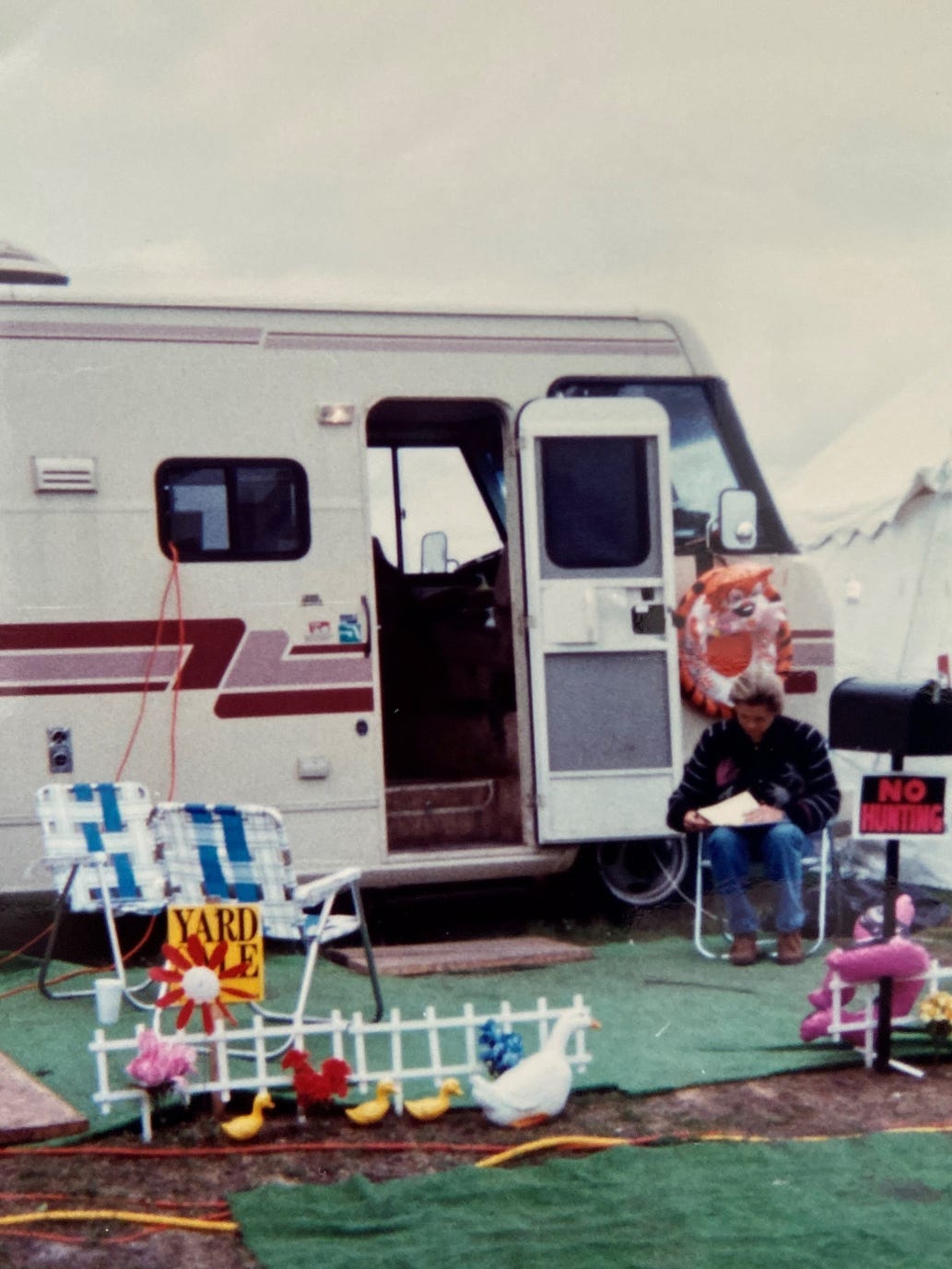
Settling in: some reporters made themselves at home in the media village near Waco. Picture by author
I like an adventure. So, when the siege at Waco, Texas, was unfolding in 1993, it seemed like a good idea to fly from Auckland to cover it as a freelance reporter.
I’d been interested in cults for a while, and the Branch Davidian compound at Mount Carmel, outside Waco, housed a particularly interesting one.
The siege had begun on February 28, when agents from the Bureau of Alcohol, Tobacco and Firearms (ATF) attempted to execute search and arrest warrants at the compound of the religious sect led by David Koresh, born Vernon Wayne Howell. A gun battle broke out, leaving four ATF agents and six Branch Davidians dead. What followed was a 51-day siege that would end on April 19 when the compound was consumed by fire, killing Koresh and most of the people still inside.
At the time, I thought Koresh was simply a fascinating, dangerous religious eccentric with a penchant for guns, prophecy and multiple women. From what I now know about compulsive sexual behavior, abuse and the way power operates in closed systems, I look at him somewhat differently.
Koresh claimed exclusive sexual access to women and girls within his community and fathered children with a number of his followers. Allegations of abuse were contested and remain part of the complicated history of Waco, but even the US Justice Department’s subsequent review said there was historical evidence of physical and sexual abuse of children before the siege.
Today, after years of working as an addictions therapist and watching events unfold at New Zealand’s own closed religious community of Gloriavale, I am less interested in putting a retrospective clinical label on Koresh than I am in the conditions surrounding him: absolute authority, religious entitlement, secrecy, female subservience, a closed community and a leader who could redefine sexual access as something ordained by God.
I didn’t understand all that in 1993 — I just wanted to get inside the story.
Not long before the siege began, I had become friends with Christopher Harder, an eccentric, chain-smoking Canadian barrister practicing law in Auckland. He had earned a reputation for taking on colorful, high-profile cases and had written a book about one involving a dominatrix and a murder.
Harder decided he wanted to go to Waco and negotiate an end to the siege.
I wanted to go along.
It would be an adventure. It might even be a good story.
The stand-off had already been going for several days when we made the lightning decision to fly. I rushed home to pack. My daughter Lili, then 13, was intrigued. I couldn’t get hold of her father, my husband Peter, who was holed up in a film studio.
When he eventually came home and asked where Mum was, Lili told him:
‘She’s gone to Texas.’
Before we left I asked Harder what his first words would be if he managed to get inside the compound and talk to Koresh.
‘You’re fucked,’ he said.
I suggested he might need to do a little research into conflict resolution.
Harder said he’d buy a book about it at the airport.
Our third travelling companion was Albert, a young Polynesian man from South Auckland who had once been part of the Davidian sect and had stayed at Mount Carmel several years earlier. His brother and sister-in-law were still inside the compound.
Harder thought Albert might be our ‘in’.
Albert, understandably, was happy to come along, all expenses paid.
Before we left Auckland, I tried to interest a couple of Texan radio stations in the story of a New Zealand lawyer and his ‘client’ flying halfway around the world to help end the siege. The plan was to have the stations broadcast our arrival, in the hope that Koresh might hear that Harder was in town and prepared to negotiate.
Waco 100, the local country-and-western station, liked the story but the news editor told me Koresh didn’t listen to country music — he was more of a rock man.
‘Try KLRD in Dallas,’ she suggested.
The news guy at the Dallas talk station had far more important things on his mind, including the rigors of the overnight shift ahead of him and the fact that anything could happen in Waco.
Some tinpot little lawyer from Downunder wasn’t going to make the earth move for him.
No siree.
A car phone!
After the long flight from Auckland to Dallas–Fort Worth, we collected a rental car that, to my amazement, had a telephone in it.
This was 1993. A phone in a car was unheard of back home.
I called my sister Annie in Seattle.
‘So you got a gig in Waco!’ she shrieked. ‘How did you get that?’
‘A crazy lawyer,’ I replied.
We checked into the Waco Holiday Inn and I immediately went out to buy newspapers and magazines. There was no Google, no Wikipedia and no convenient device in my pocket containing most of the accumulated knowledge of civilization.
I bought the Waco Tribune-Herald, the New York Times, the Los Angeles Times, USA Today, Time and Newsweek. We read everything about Koresh and the Branch Davidians that we could get our hands on.
Meanwhile, I eavesdropped.
I’ve always liked eavesdropping. It’s useful for a journalist.
Everyone in the restaurants was talking about the siege and what W-A-C-O apparently stood for: We Ain’t Comin’ Out.
I ate delicious blackened catfish and listened.
We also watched hours of siege coverage on television. Koresh had been injured during the initial ATF raid, but FBI spokesman Bob Ricks told CNN that his condition appeared to be improving.
It was Koresh’s guns that had brought the authorities to Mount Carmel in the first place. Local people told me that everyone knew Koresh had been stockpiling weapons, preparing for the Armageddon he believed was coming.
We called Sergeant Margo Sims at the Waco Police Department. She agreed to meet Harder straight away.
‘If you’ve got credentials, you’ve got to show them,’ she told him.
Harder did indeed have credentials and played what he later called ‘a heavy hand of good credentials’. He and Sims established a good rapport.
She didn’t even object when he stole her pen.
It was St Patrick’s Day. A sign in the police station said: ‘Kiss me quick, I’m Irish.’
On our second day at the Holiday Inn I found myself in the lift with a shifty-eyed ATF man I had recognized from a press conference the day before when I had caught his eye and asked him a question.
He had looked nervous, shook his head and stayed shtum.
So in the lift I simply nodded.
He still looked nervous.
The ATF had cocked up the original raid badly, and I would have loved to be a fly on the wall during some of the discussions between the ATF and the FBI.
I bet there were plenty of dogfights.
I was picking up the Texas lingo pretty damn quick.
Or PDQ, as my father used to say.
Koresh, meanwhile, appeared to be relishing the situation. The FBI was recording conversations over the telephone line into the compound, and the people inside knew they were being listened to.
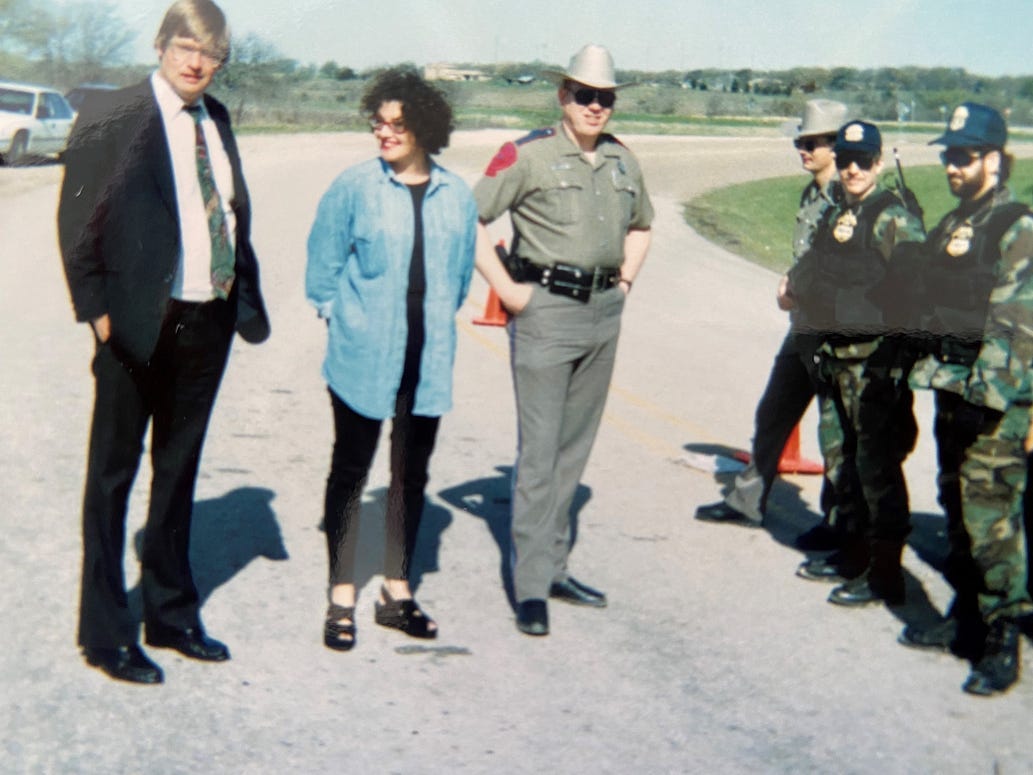
Somewhere in Waco: Harder, me, and a group of assorted law-enforcement officials. Picture author’s own
The authorities were applying pressure.
At one point a tank crushed a vehicle belonging to one of the people inside because it was blocking the road.
I wrote in my notebook: ‘The press conferences are fucking amazing. All the camera operators are the same the world over — hardened, blasé, just want to go home.’
Every morning, about a hundred reporters, photographers and television crews gathered for a briefing from Bob Ricks.
I never managed to get a question in, but I revelled in the cut and thrust between Ricks and the reporters who had flown in from all over the world. Among the few I talked to, it was generally accepted that I’d come the furthest.
Everyone was extraordinarily helpful.
Southern hospitality, said Sergeant Sims.
‘Damn rart,’ I thought.
Gard, I was even thinking in a Texan accent.
Granny appears
One day Koresh’s grandmother arrived at the convention center where the daily press briefings were held.
The media gave the poor woman a terrible time. She thought she might be able to persuade her grandson to surrender, but she seemed utterly bewildered by the furious scrum of reporters, photographers and camera crews.
Somehow, during the chaos, I found myself standing beside her right shoulder.
The photograph made the front page of a local newspaper the next morning.
I had never made the front page before.
Page three naked, yes, but that’s another story.
I wrote in my journal: ‘It’s these sort of times when I quite miss the cut and thrust of daily news. At least I don’t have to rush off and file like the bloke sitting near me here out the back of the convention centre.’
No plan
There was a slight flaw in my own operation.
I still hadn’t worked out who might actually buy my stories, nor exactly how I was going to get them back to Auckland.
Eventually, I faxed two stories from the Holiday Inn office, where the staff also kindly allowed me to use their electric typewriter.
The authoritarian
Bob Ricks was brilliant at controlling the press conferences. When he didn’t want to answer a question, he simply said:
‘Next!’ with absolute authority.
As he left one briefing, a journalist boomed: ‘Elvis has just left the building!’
There were plenty of people besides journalists trying to find their way into the drama.
I met three middle-aged couples from the Cult Awareness Network of North Texas. They took me to their van and told me stories about children who had disappeared into cults and the families who tried to get them out.
All had sons or daughters involved in closed groups.
They kept mentioning Montana. Montana, apparently, had cults. And guns. Lots of ’em.
Most of my time in Waco, though, involved waiting.
Waiting for somebody to come out of the compound. Waiting for the FBI to make a statement. Waiting to see whether Koresh would surrender. Waiting for something — anything — to happen.
‘The boredom stops you sleeping,’ said Jim, a British journalist who thought there was a book in it.
‘It’s an option,’ I replied, borrowing one of Bob Ricks’s favorite phrases.
Except in his Texan accent it came out more like: ‘It’s nart an arp-shun at this stage.’
Harder eventually got a meeting with an FBI agent, arranged through Sergeant Sims.
I wasn’t invited.
Afterwards he muttered darkly, which led me to suspect it had not been a triumph of international conflict resolution.
Albert spent much of the waiting time clipping stories out of each day’s newspapers for me with my nail scissors.
He was bored, too.
I vetoed Harder’s plan to crawl across a neighboring farmer’s land on his hands and knees to reach the compound.
By then Mount Carmel was surrounded by tanks, armed federal agents and some extremely large guns.
I told him the idea was madness and his wife back in New Zealand would be worried if she knew what he was contemplating.
So we went with Plan B and drove towards the compound.
On the way, Harder stopped to ask a local man for directions to the media village, a few kilometers away.
‘You mean the zoo?’ the man said.
We eventually reached the FBI roadblock. Only I could pass through it because I had a press card.
A police officer asked to see my credentials. As I reached into my pocket, he reached for his gun.
Everyone was nervous.
Near the roadblock, however, capitalism was flourishing. People had erected roadside stalls selling custom-made T-shirts and commemorative baseball caps.
Some shirts said ‘Kill Koresh’.
Another sign said: ‘Honk your horn if you hate the ATF’.
Albert started crying. He was deeply upset that people were making money out of what, for him, was a family tragedy. His brother and sister-in-law were still inside.
I comforted him.
Then I bought three T-shirts and two baseball caps.
One said: ‘WACO — We Ain’t Comin’ Out’.
At the makeshift media village I met a reporter whose byline I had been reading in Time magazine for years.
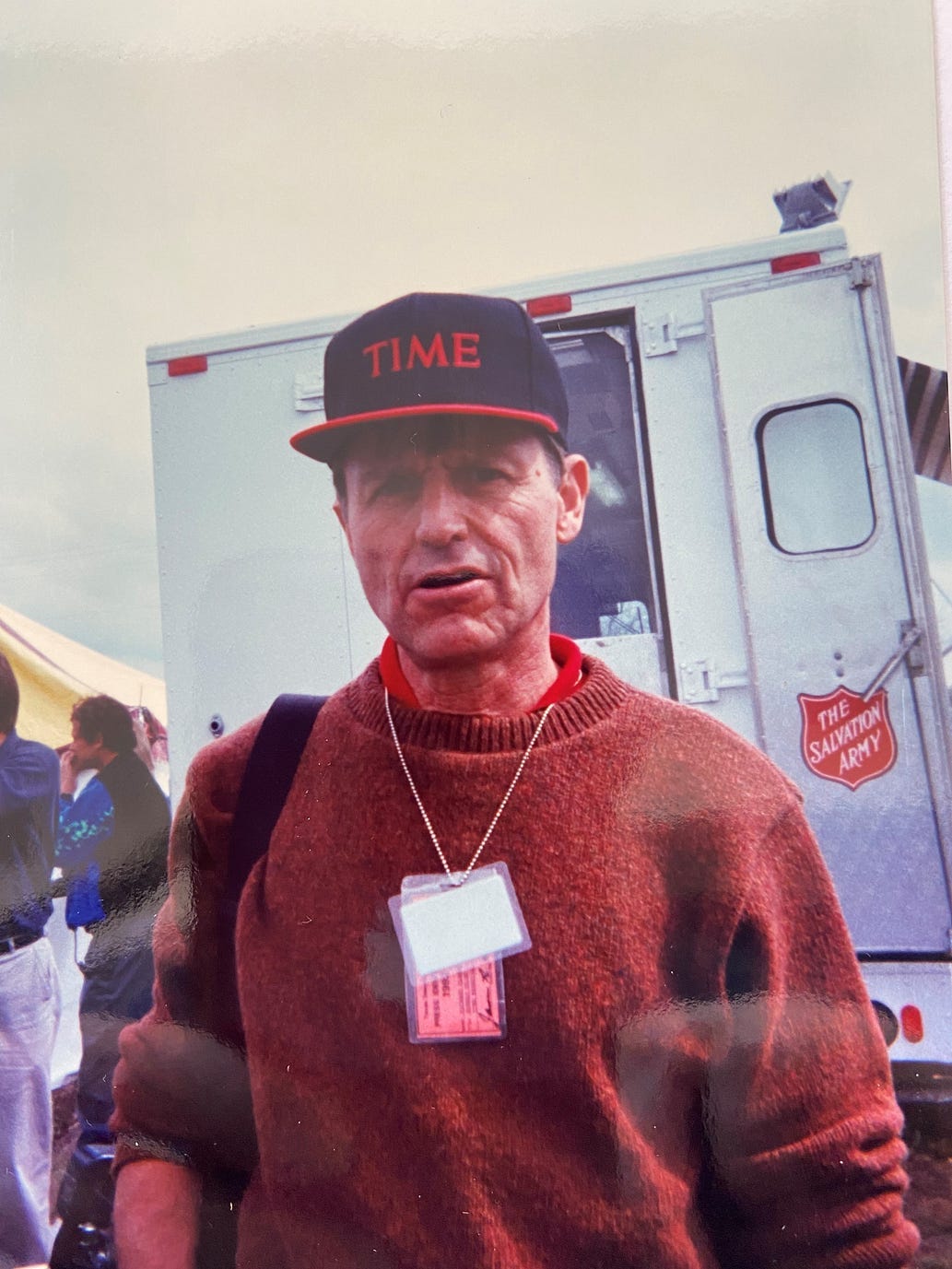
The ‘Time’ reporter whose cap I coveted and whose name I’ve lost to time. Pic by author
He was a gentle sort of man, not at all the hard-bitten international correspondent I had imagined.
We hung out together while waiting for something to happen, and I tried to persuade him to give me his Time baseball cap with the famous magazine logo on it.
He refused. Apparently, I wasn’t the first journalist to covet it.
The media village was an extraordinary place. Reporters, photographers and technicians were camped out in tents and motorhomes. One campervan even had its own tiny white picket fence.
Glamorous female television reporters did their makeup while they waited; they slept in tents and trailers so they could stay close to the action.
The camera operators and photographers were the most fun. My husband Peter was a cameraman and over the years I had learned to speak their language.
Some of the stills photographers had enormous telephoto lenses. One let me look through his, and for the first time I could clearly see the compound, shimmering beyond the heat rising from the paddocks.
It looked dismal — a bit like a fort.
From time to time a helicopter flew overhead.
Some of the photographers waved the peace sign at it.
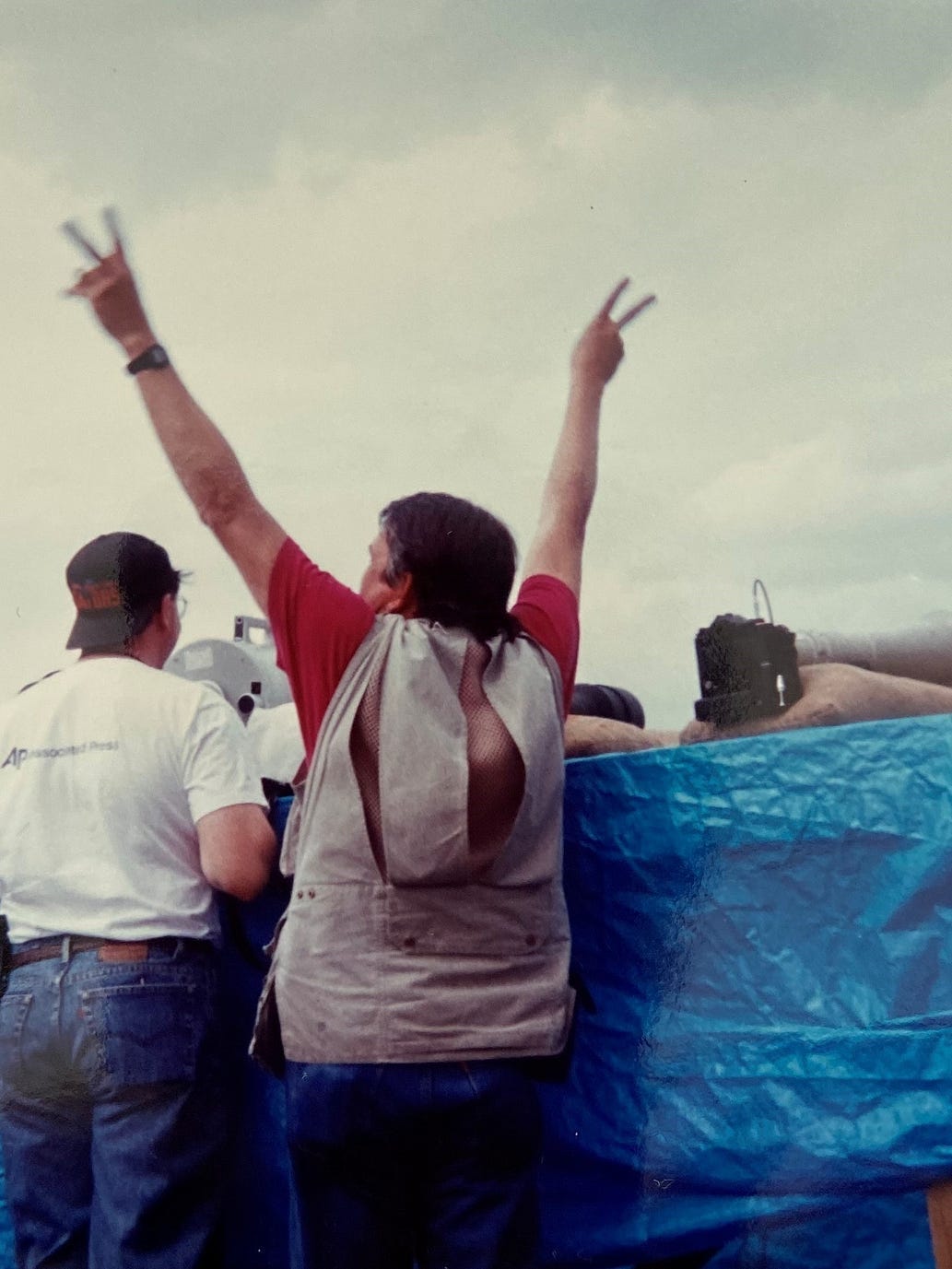
All in vain: a photographer’s plea to a hovering helicopter. Picture by author
I continued collecting Texan expressions in my notebook.
Like a duck on a June bug.
Although in Texas it sounded more like dooon burg.
A blind hog finding an acorn.
I’ll be on it like stink on shit.
Knock a buzzard off a shit wagon.
And, for scenes such as the media frenzy around Koresh’s grandmother:
Massive clusterfuck.
Or simply:
Goat fuck.
I was learning so much.
We had been in Waco for about a week and were getting nowhere.
The FBI wasn’t returning calls. Harder had a murder trial to get back to in Auckland. Eventually we decided to leave Waco and drive back to Dallas for the long flight home.
Then, naturally, something happened.
I wrote in my journal: ‘Events have overtaken us. I knew this would happen.’
Albert had been given permission to visit Oliver Gyarfus, one of the Davidians who had left the compound and was now in custody.
Suddenly we were in an NBC suite at the Hilton. Gyarfus was on the phone to NBC journalist James Blue while Albert sat beside him and Blue typed into his laptop.
Albert was rattled. The media had gathered outside the jail — not en masse, but enough to put the frighteners on him.
Several serious newspaper photographers took pictures of me with my little disposable cameras, which had cost about $US12 each.
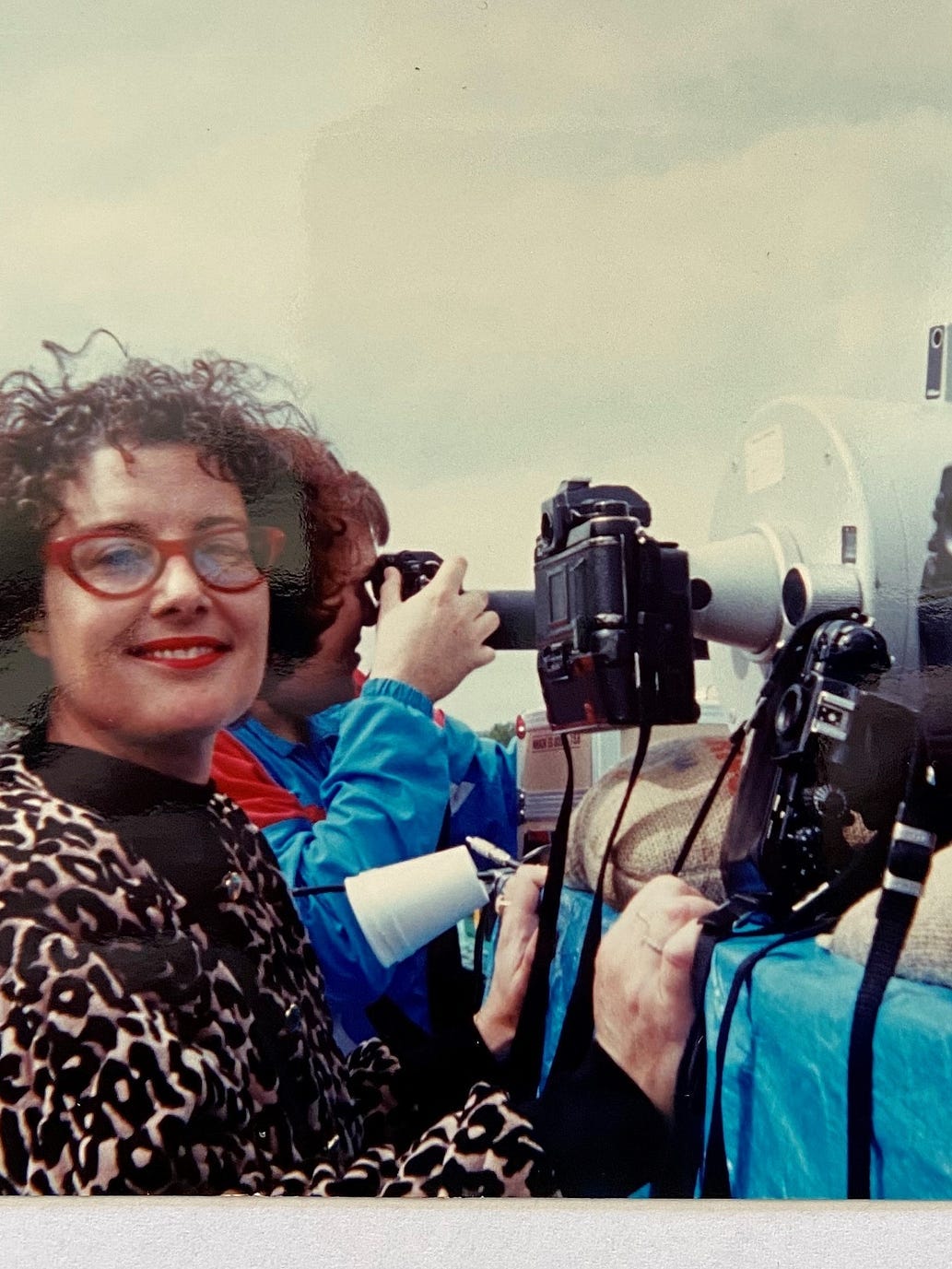
I was lucky to look through the powerful lenses of the news guys’ cameras at the media village.
One of them assured me they would produce photographs good enough for publication.
Gyarfus and another man who had left the compound, Brad Branch, told NBC they had been ‘rough-housed’ by the ATF on the way to jail.
The journalist asked Gyarfus: ‘Do you understand why people are afraid of your group and your church?’
It was a good question.
On my last day in Texas, I went shopping.
I bought three pairs of Levi’s because the American ones seemed much better than the ones available in New Zealand. I bought Peter a pair of cowboy boots (which he never wore), along with T-shirts, a baseball cap and a Western shirt.
About $US300 altogether.
I had become friendly with Robert, the kindly African-American shoeshine man at the Holiday Inn. On my final day he drove me around in his own car from shop to shop.
I was rushing, but I needed mementos.
The fire
A few days after we returned to Auckland, I heard that the compound was on fire.
I raced to a friend’s house to watch CNN.
There it was: the ugly collection of buildings I had looked at through the photographer’s telephoto lens, now engulfed in flames.
Koresh had finally got his Armageddon.
I remember watching with a strange mixture of horror and distance. I had been there only days earlier, waiting in the heat with the other journalists, laughing at Texan expressions, eating catfish and trying to persuade an American reporter to give me his hat.
Albert’s family members had been inside.
There were children inside.
The adventure had become something else entirely.
More than three decades later, Waco still interests me, but not for quite the same reasons.
My work as an addictions therapist has made me wary of simple explanations for complex behavior, and I would no longer casually decide that David Koresh ‘was probably a sex addict’. Addiction is a clinical matter; power is another.
What interests me now is what happens when those two things might intersect, particularly when one person acquires almost unlimited authority over a closed community.
In 1993, I went to Waco looking for an adventure and a story. I found both. But I was looking at the surface: the guns, the FBI, the tanks, the crazy lawyer, the journalists sleeping in campervans, the T-shirts, the accents and the spectacle of it all.
Today I would be looking much harder at the people inside.
Especially the women and children.
My two stories for the Sunday Star-Times back home earned enough money to pay for about six of the meals I’d eaten in Waco.
Financially, the expedition was a complete disaster.
As an adventure, however, it was hard to beat.
And I’ve still got the T-shirt.
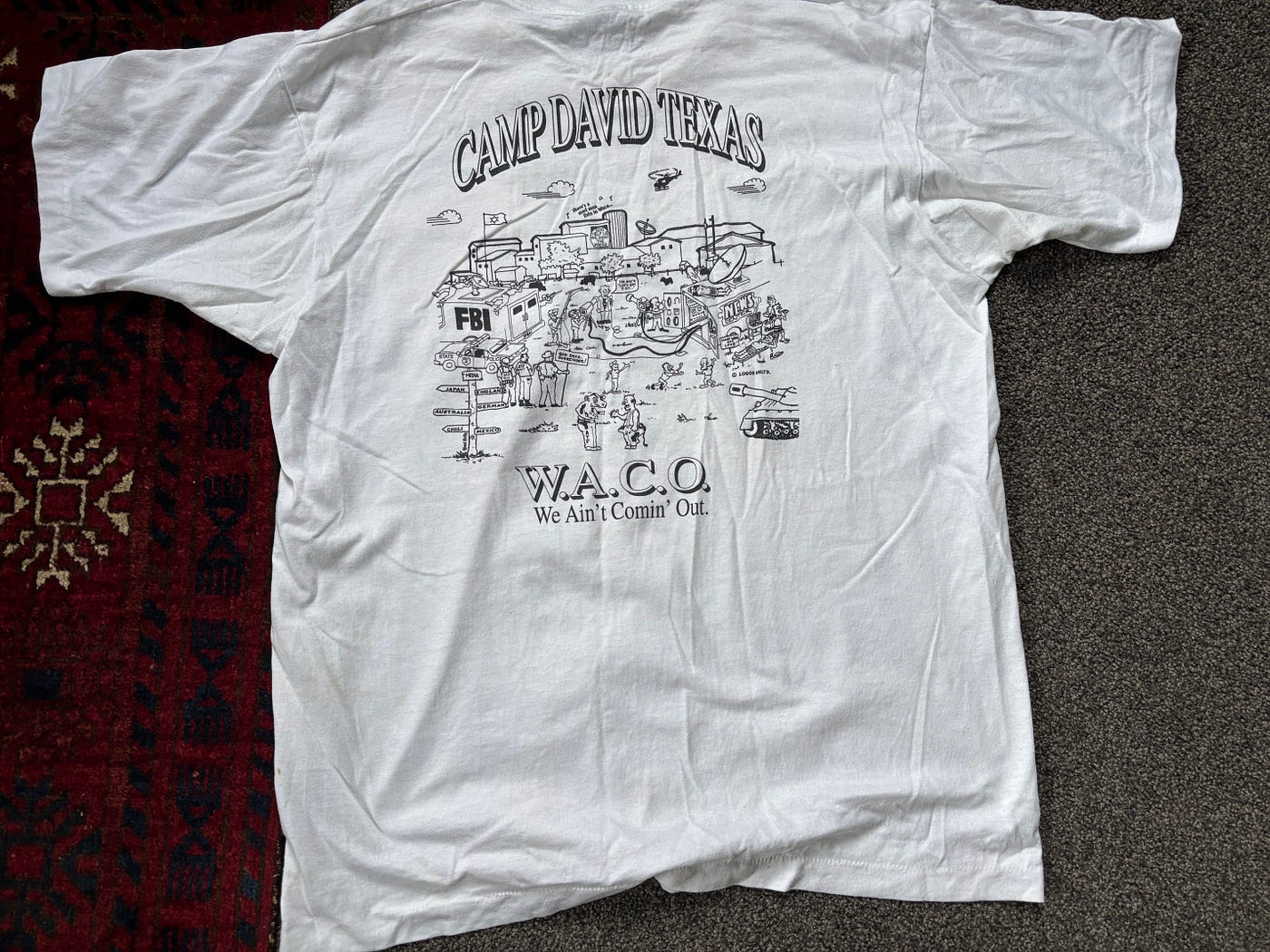
The T-shirt that I keep in a drawer. Picture by author
Thanks for reading.
메타데이터
- post_id
- 4595d02cb7cd
- slug
- we-aint-comin-out-4595d02cb7cd
- url
- https://medium.com/@bridgetstellaruxtonwilson/we-aint-comin-out-4595d02cb7cd
- canonical_url
- https://medium.com/@bridgetstellaruxtonwilson/we-aint-comin-out-4595d02cb7cd
- author_url
- https://medium.com/@bridgetstellaruxtonwilson
- status
- ok
- fetched_at
- 2026-07-26 23:08:37