The Ghost in the Legal Tower: Why Europe’s “Tech Sovereignty Package” is the Ultimate Test for the…
Beyond Data Residency: The Forgotten Materiality of Law
The Ghost in the Legal Tower: Why Europe’s “Tech Sovereignty Package” is the Ultimate Test for the Rule of Law in the AI Age
Beyond Data Residency: The Forgotten Materiality of Law
For nearly two decades, the European Union has operated as the world’s undisputed regulatory superpower. Brussels wrote the GDPR, and the world’s engineering teams scrambled to comply. Brussels enacted the EU AI Act, and Silicon Valley re-aligned its product roadmaps. In the theater of global tech governance, Europe played the role of the grand architect, drafting elegant normative tapestries while outsourcing the physical weaving to third-country technology conglomerates.
This model was built on a comfortable, low-level assumption: that law is a disembodied force. We believed that as long as a legal framework possesses democratic legitimacy and punitive teeth, it can dictate the terms of reality from a position of pure text.
On May 27, 2026, the European Commission formally shattered that illusion with the release of the Tech Sovereignty Package, anchored by the Cloud and AI Development Act (CADA).
CADA does not merely introduce a new compliance checklist; it represents a profound philosophical pivot. It is an admission of a structural vulnerability that Europe has spent a generation trying to ignore: The legal efficacy of a norm presupposes sovereign control over the technical infrastructure upon which it operates.
When European rules run on non-European tech stacks, the “Rule of Law” becomes a fragile hostage to foreign jurisdiction. This is the story of how Europe is attempting to hard-code its legal code into its computer code, and why this experiment will either save or marginalize the continent in the century of artificial intelligence.
1. The Day the Pyramid Cracked: From Kelsen to the International Criminal Court
To understand why Europe is suddenly obsessed with building its own cloud tiers and supercomputing factories, we must look at an event from May 2025 that sent shockwaves through the Berlaymont.
The International Criminal Court (ICC) in The Hague found its digital communications abruptly compromised. Microsoft, acting under what was widely understood to be a non-public administrative directive linked to US extraterritorial intelligence laws, temporarily suspended email services for the office of the Chief Prosecutor.
The policy implications were immediate and chilling. European policymakers looked at each other and asked: If a foreign corporation, bound by a foreign capital’s secretive judicial orders, can cut off the communications of a top-tier international war crimes prosecutor with the stroke of a pen, what happens when they decide to turn off the operational infrastructure of a member state’s healthcare system? Or its judicial database?
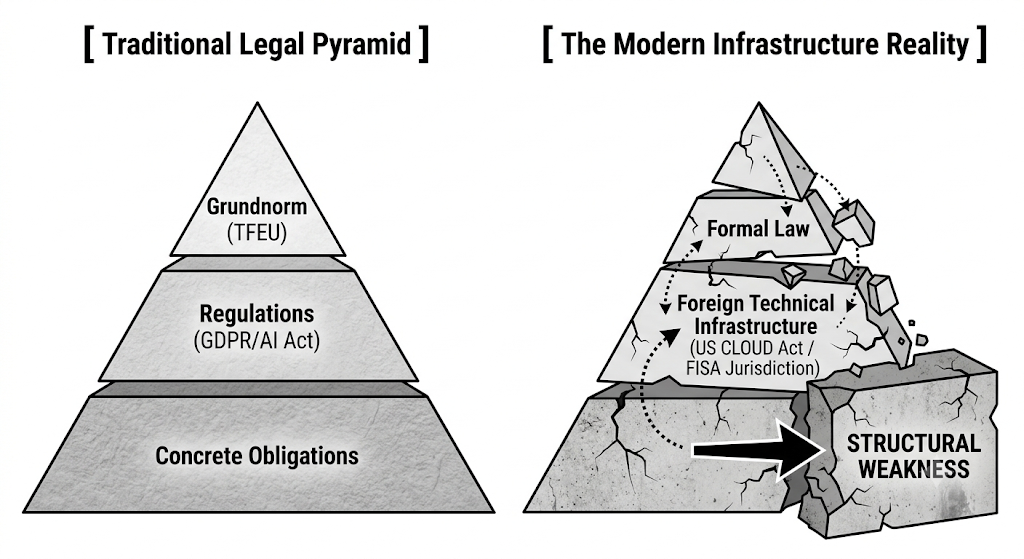
Ideal vs Reality
This structural crisis can be perfectly framed through the lens of Hans Kelsen’s Pure Theory of Law.
In Kelsen’s philosophy, a legal system is a hierarchy of norms, a pyramid where every regulation derives its validity from a higher authority, climbing all the way up to the fundamental Grundnorm. In Europe, this chain is textually flawless: the Treaty on the Functioning of the European Union (TFEU) empowers the Regulation, which empowers the national supervisory body, which imposes the concrete obligation on the user.
But Kelsen’s pure theory was designed for a world of physical borders, sovereign ink, and geographic enforcement. It never anticipated an era where the validity of a norm remains intact, but its substantive efficacy is quietly hollowed out from below.
If an EU regulation commands that data must be kept private and uncompromised, but that data lives on a server subject to the US CLOUD Act or FISA section 702, the US executive branch can demand access to that data regardless of where it is physically stored. “Data residency” — the practice of hosting data within European geographic borders — is a legal cosmetic. It does not alter the corporate ownership of the technology stack, which is the true conduit for extraterritorial law enforcement.
From a Kelsenian perspective, Europe’s tech sovereignty movement is a desperate, structural attempt to restore the integrity of its legal pyramid. It recognizes that if you do not own the cables, the silicon, and the hypervisors, your laws are ultimately advisory notes written on rented paper.
2. Hard-Coding the Admission Criteria: CADA as Hart’s Secondary Rules
If Kelsen diagnoses the disease, H.L.A. Hart explains the remedy Europe is attempting to construct.
In his classic The Concept of Law, Hart argued that a mature legal system cannot exist on “primary rules” alone (the rules telling citizens what they can and cannot do). It requires “secondary rules” — rules about rules — which dictate how primary rules are recognized, changed, and adjudicated.
The newly unveiled Cloud and AI Development Act (CADA) is essentially the infrastructuralization of Hart’s Rules of Recognition.
CADA establishes a strict, mandatory Four-Tier Sovereignty Framework for cloud workloads. Public institutions dealing with highly sensitive data — specifically explicitly naming the medical, financial, and judicial systems — can no longer simply pick the cheapest or most efficient cloud provider. They must map their data workloads into specific tiers based on four technical dimensions: service control, AI inference data processing location, infrastructure residency, and cybersecurity.
Under this framework, the secondary rules shift from abstract legal tests to technical architecture blueprints:
- The Rule of Recognition: What constitutes a “sovereignty-compliant infrastructure”? It is no longer evaluated by a lawyer reading a contract; it is determined by CADA’s explicit technical metrics, operationalized through the European Cloud Services (EUCS) certification scheme.
- The Rule of Change: Which foreign or domestic cloud providers are permitted to upgrade or alter their access to public sector workloads? This is now governed by the shifting technical matrices enforced by ENISA (European Union Agency for Cybersecurity).
However, Hart’s framework also reveals CADA’s deepest institutional vulnerability: The Rule of Adjudication.
Currently, when an American tech giant constructs a customized “sovereign cloud” solution for a European government, who decides if it genuinely eliminates foreign legal risk? CADA relies on a patchwork of cross-border enforcement and national competent authorities utilizing pathways under the NIS2 Directive and the Data Act. Because the EUCS framework remains technically voluntary for private industries, the mechanism to judge and penalize cross-border infrastructural non-compliance is still a work in progress.
Yet, the message from Brussels is unmistakable. To reach the highest tier of compliance, a provider must prove it is owned and controlled exclusively by EU entities, employs EU personnel within the territory, and is structurally immune to third-country laws.
Europe is drawing a digital line in the sand. It is turning infrastructure into a gatekeeper.
3. The Justification of Inefficiency: Raz, Posner, and the “Compliance Premium”
This brings us to the ultimate pragmatic argument leveled against European tech sovereignty: Is it worth the economic cost?
To require European public institutions to abandon or restrict their use of hyper-optimized American public clouds (AWS, Microsoft Azure, Google Cloud) in favor of emerging, less mature domestic alternatives seems, on its face, like economic self-sabotage.
According to Gartner projections for 2026, global spending on sovereign clouds is skyrocketing to $80 billion, with Europe experiencing an explosive 83% year-over-year increase. A massive portion of this capital is not going toward buying more compute power or better AI models; it is going toward paying a “compliance premium” — the cost of rewriting architectures to satisfy sovereign boundaries.
To decode this economic-legal tension, we must stage a debate between the moral philosopher Joseph Raz and the father of law-and-economics, Richard Posner.
The Posnerian Critique: Deadweight Loss
From a static, wealth-maximization perspective, Posner would look at CADA and diagnose a classic regulatory drag. By restricting the market and forcing public entities to buy from less efficient, lower-capacity European providers, the state is creating a massive deadweight loss. Money that could be spent curing diseases via advanced AI models or streamlining public transport is instead spent on building duplicate servers and localizing data centers. It is an artificial market distortion that reduces aggregate societal utility.
The Razian Defense: The Asymmetry of Reasons
But Joseph Raz’s Normal Justification Thesis (NJT) offers a profound counter-argument. Raz argues that an authority is justified if it helps its subjects better conform to the reasons that already apply to them.
If we look at Europe’s newly deployed EuroHPC AI Factories — the network of 19 sovereign supercomputing hubs and antennas spanning 17 member states — they undeniably suffer from an immediate “NJT deficit” in raw commercial performance when compared to Silicon Valley.

Two Versions
However, Raz’s thesis contains a vital asymmetry when legal risk is factored in. The question for a European hospital system training an oncology AI model is not simply: “Which supercomputer has the fastest throughput?” The true question is: “Which infrastructure allows me to fulfill my absolute structural duties of patient data privacy, GDPR compliance, and research ethics without the structural risk of foreign state subpoena?”
The US CLOUD Act creates what economists call a non-internalizable external risk. It is a risk that an American provider cannot contractually waive or eliminate, because their corporate parent remains under the jurisdiction of the United States.
Therefore, Europe’s insistence on its own technical stack — even if less efficient in the short term — is a rational mechanism to internalize and correct a geopolitical market failure. The compliance premium is not wasted money; it is an insurance premium paid to eliminate an unquantifiable sovereign risk.
4. The Architecture of Trust: How the EHDS Redefined Data Spaces
Nowhere is this transition from text to architecture clearer than in the evolution of European data spaces.
For years, Europe pinned its hopes on GAIA-X, an ambitious project intended to create a unified, federated data architecture for Europe. But GAIA-X committed a fatal Hartian error: it attempted to build a regime based entirely on voluntary cooperation and soft standards without a mandatory rule of recognition.
Because it allowed foreign tech giants to sit at the governance table, those hyperscalers simply adapted their marketing language, claimed “GAIA-X compliance,” and continued to swallow the market. GAIA-X became a hollow normative shell — a Trojan Horse for the status quo.
Learning from this failure, Europe pivoted from voluntary federations to hard institutional mandates. The vanguard of this new approach is the European Health Data Space (EHDS), which went into effect in March 2025.
The EHDS splits data governance into two elegant, Dworkinian categories:
- Primary Use: Empowering individual patients to access and transfer their health data across European borders. This functions as a Dworkinian individual trump — a fundamental right that overrides the bureaucratic or commercial resistance of local hospital monopolies.
- Secondary Use: Opening up massive, anonymized health datasets for scientific research, policy creation, and AI training.
But the real stroke of institutional genius in the EHDS lies in its enforcement mechanism: Trusted Research Environments (TREs).
Under the EHDS, secondary health data cannot be downloaded, exported, or processed on just any commercial cloud. It must remain within a TRE — a legally mandated, highly secure, closed computational environment. If an international pharmaceutical company or a tech giant wants to train an AI model on European health data, they cannot pull that data into their proprietary cloud architectures. They must bring their algorithms into the European TRE.
This completely flips the power dynamic. By embedding the law directly into the hosting environment, the EHDS ensures that “EU Rules” are finally backed by an “EU Tech Stack.” It renders projects like Microsoft’s Azure Health Data Services structurally obsolete within the European public sphere unless they completely surrender their infrastructural control to local sovereign entities.
5. The Tri-Polar AI Horizon: A Map of the New Digital World
As we look toward the horizon of the late 2020s, the global geopolitical map of artificial intelligence has resolved into a stark, tri-polar jurisprudential struggle. Each pole represents a fundamentally different philosophy of power, technology, and human rights.
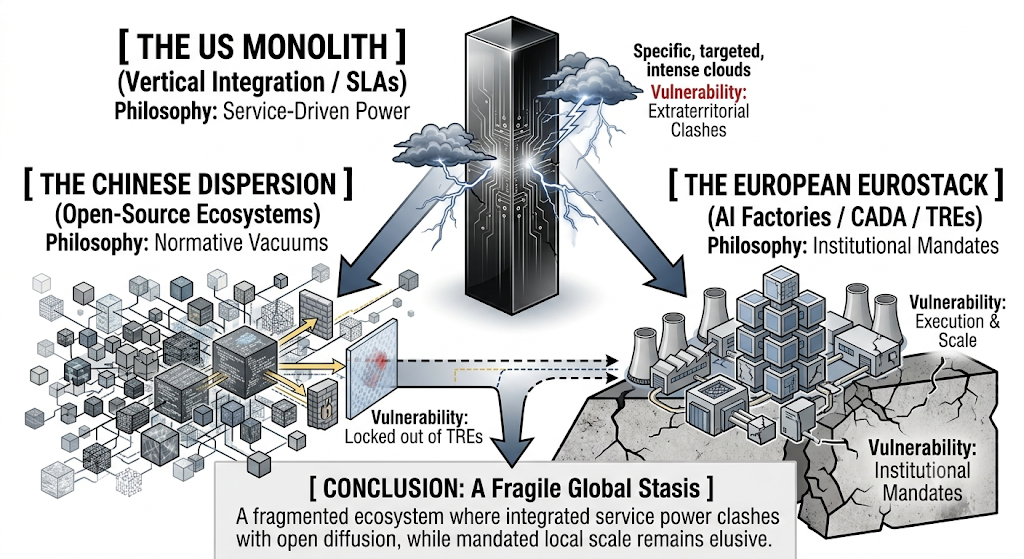
Tri-Polar
1. The United States: Service-Driven Empowerment
This pole relies on massive, vertically integrated, private technology platforms. Its philosophy is rooted in raw market efficiency, unmatched computing scales, and contract-based assurances (SLAs). However, its fundamental vulnerability is its legal landscape: the structural overreach of laws like the CLOUD Act makes it impossible for these entities to ever provide a genuine, absolute sovereign guarantee to a foreign state.
2. China: Distributed Open-Source Ecosystems
This pole increasingly leverages open-source AI models and decentralized developer communities to export its technological influence. By fostering a normative vacuum, it invites global talent and capital to build on its foundations without immediate regulatory friction. Yet, its structural vulnerability is institutional exclusion: because European frameworks like CADA and the EHDS explicitly mandate secure, closed, sovereign environments, these open-source models are locked out of Europe’s most lucrative and high-value institutional data sectors.
3. Europe: The EuroStack
Europe’s strategy is an aggressive attempt to fuse public infrastructure investment with sovereign law. It is deploying EuroHPC AI Factories to build raw compute power, CADA to enforce structural cloud tiers, and EHDS TREs to lock sensitive data inside sovereign borders. Its philosophy is that true freedom in the digital age requires public ownership of the underlying technical foundations.
The Ultimate Lesson: The Materiality of Freedom
The next few years will reveal whether Europe’s grand synthesis can succeed. The vulnerability of the EuroStack is not its logical coherence; it is its execution speed. While Brussels builds its AI factories, the pace of technological innovation in Silicon Valley and Shenzhen continues at an exponential clip. Regulators are still running a race against an industry that moves faster than the legislative process can turn.
But the ultimate takeaway of Europe’s Tech Sovereignty Package is a profound lesson for every nation, corporation, and legal scholar navigating the AI era:
Normative power without infrastructural independence is a luxury we can no longer afford.
If you rely entirely on an external tech stack, your regulatory system is an illusion. True sovereignty in the digital age cannot be won with a beautifully drafted piece of paper or a multi-million euro regulatory fine. It must be built out of silicon, routed through sovereign data spaces, and hosted on infrastructure that no foreign power holds the switch to turn off.
Europe has finally realized that the ghost in the legal tower needs its own physical body. The only question left is whether it can finish building that body before the world moves on.
메타데이터
- post_id
- 45991dff588b
- slug
- the-ghost-in-the-legal-tower-why-europes-tech-sovereignty-package-is-the-ultimate-test-for-the-45991dff588b
- url
- https://medium.com/@vrk.kao/the-ghost-in-the-legal-tower-why-europes-tech-sovereignty-package-is-the-ultimate-test-for-the-45991dff588b
- canonical_url
- https://medium.com/@vrk.kao/the-ghost-in-the-legal-tower-why-europes-tech-sovereignty-package-is-the-ultimate-test-for-the-45991dff588b
- author_url
- https://medium.com/@vrk.kao
- status
- ok
- fetched_at
- 2026-08-05 19:51:00






