Measuring End-to-End Latency in Automated Trading Systems: A Deep Dive with Polymarket
Introduction
Measuring End-to-End Latency in Automated Trading Systems: A Deep Dive with Polymarket
Introduction
In modern electronic trading systems, latency is often the difference between profit and loss. Whether you’re building a market-making engine, arbitrage bot, statistical trading strategy, or prediction market execution system, understanding and measuring end-to-end latency is critical.
Many developers focus solely on execution speed while overlooking the complete lifecycle of a trading event. The reality is that trading latency consists of multiple independent components, each contributing to the final delay between market information arrival and order execution.
This article provides a practical framework for measuring end-to-end latency in automated trading systems, with specific examples using Polymarket’s APIs and WebSocket infrastructure.
Polymarket trading bot
What Is End-to-End Latency?
End-to-end latency is the total time required for a trading signal to travel through an entire trading pipeline.
A simplified definition:
End-to-End Latency = Market Data Latency + Strategy Processing Time + Order Submission Latency + Exchange Processing Latency + Confirmation Latency
In production trading systems, measuring only one component provides an incomplete picture.
For example:
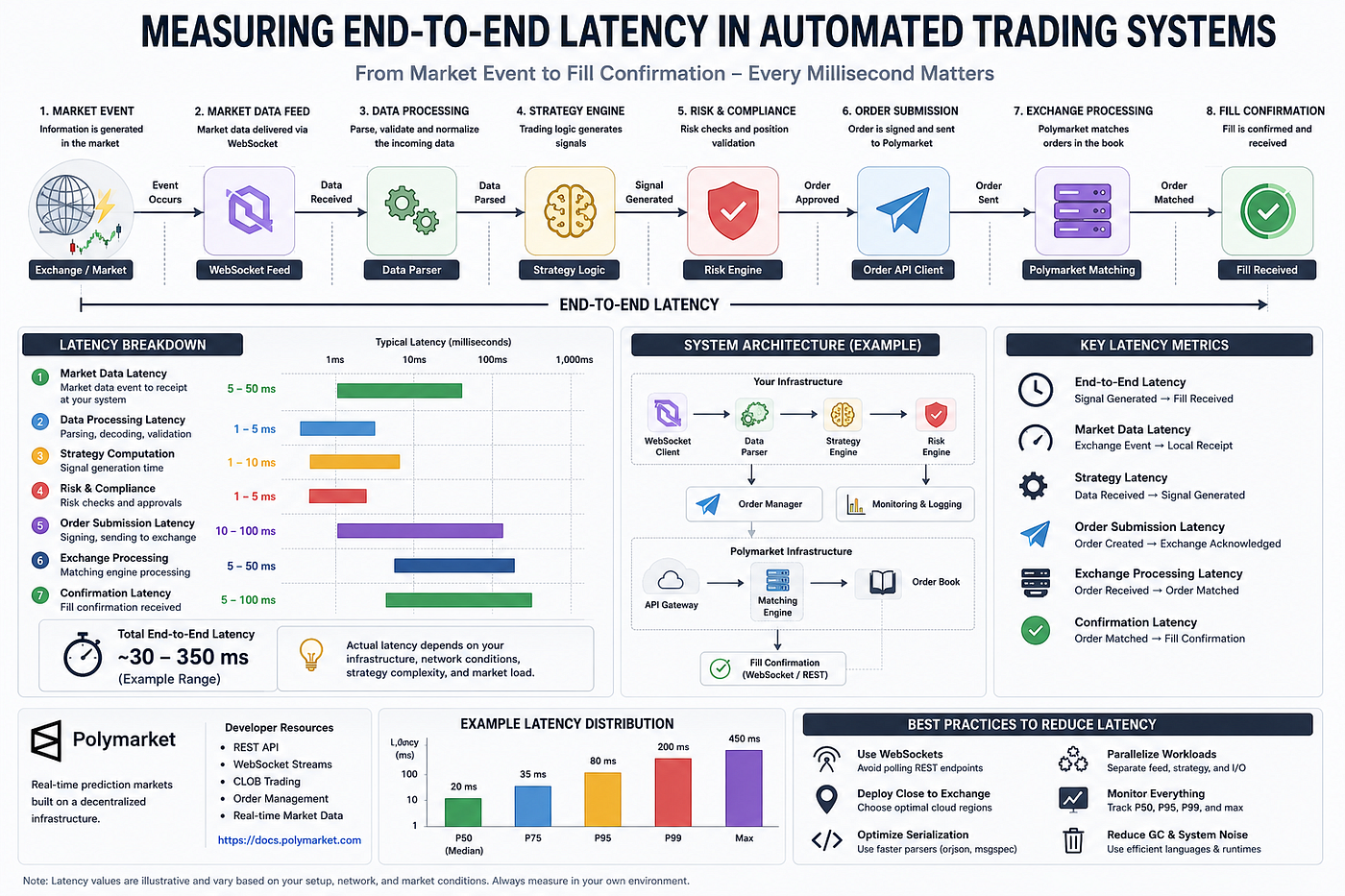
StageTypical LatencyMarket Data Feed5–50 msStrategy Logic1–10 msRisk Checks1–5 msOrder Transmission10–100 msExchange Matching5–50 msTrade Confirmation5–100 ms
Even a seemingly fast strategy can become unprofitable if cumulative latency exceeds the market opportunity window.
Why Latency Matters in Prediction Markets
Prediction markets such as Polymarket present unique latency challenges.
Unlike traditional equity exchanges, prediction markets often involve:
- Rapid information incorporation
- Event-driven volatility
- Market inefficiencies lasting only seconds
- API and WebSocket communication layers
- On-chain settlement infrastructure
Polymarket provides REST APIs, CLOB APIs, and WebSocket streams for real-time market interaction. The platform offers market data feeds, orderbook updates, trade streams, and order management functionality through its developer APIs.
Developers building automated trading systems on Polymarket frequently encounter latency bottlenecks in:
- WebSocket market data ingestion
- Order signing
- Network transmission
- Exchange-side processing
- Confirmation handling
Trading System Latency Architecture
┌─────────────────┐
│ Market Event    │
└────────┬────────┘
         │
         ▼
┌─────────────────┐
│ WebSocket Feed  │
└────────┬────────┘
         │
         ▼
┌─────────────────┐
│ Data Parser     │
└────────┬────────┘
         │
         ▼
┌─────────────────┐
│ Trading Logic   │
└────────┬────────┘
         │
         ▼
┌─────────────────┐
│ Risk Engine     │
└────────┬────────┘
         │
         ▼
┌─────────────────┐
│ Order Generator │
└────────┬────────┘
         │
         ▼
┌─────────────────┐
│ Exchange API    │
└────────┬────────┘
         │
         ▼
┌─────────────────┐
│ Order Fill      │
└─────────────────┘
Each stage should be independently measured.
Without granular measurement, identifying performance bottlenecks becomes nearly impossible.
The Five Critical Latency Metrics
1. Market Data Latency
Measures how long it takes market information to reach your trading system.
Formula:
Market Data Latency =
Receive Timestamp - Exchange Event Timestamp
Example:
market_data_latency = (
    local_receive_time -
    exchange_event_timestamp
)
print(f"{market_data_latency:.2f} ms")This metric determines how stale your data is when your strategy makes decisions.
2. Strategy Computation Latency
Measures internal processing time.
Example:
import timestart = time.perf_counter()signal = trading_strategy(orderbook)end = time.perf_counter()strategy_latency = (
end - start
) * 1000print(
f"Strategy: {strategy_latency:.3f} ms"
)For HFT systems, strategy latency should ideally remain under 1 ms.
3. Order Submission Latency
Measures the time required to transmit an order to the exchange.
start = time.perf_counter()response = submit_order(order)end = time.perf_counter()submit_latency = (
end - start
) * 1000This is often one of the largest latency contributors.
4. Exchange Processing Latency
Represents the delay inside the exchange infrastructure.
Exchange Processing =
Exchange ACK Timestamp -
Exchange Receive Timestamp
This metric is difficult to observe directly unless the exchange provides timestamps.
5. Round-Trip Latency
Measures the full execution loop.
Round Trip =
Fill Confirmation Time -
Signal Generation Time
This is the most important KPI for live trading.
Measuring Latency in Polymarket
Polymarket provides several WebSocket channels for near real-time market updates, including orderbook snapshots, price changes, trade updates, and user activity streams. Developers can subscribe to market and user channels to receive live trading data.
Useful resources:
Polymarket Developer Documentation
Polymarket Docs : [https://docs.polymarket.com/]
WebSocket Latency Measurement Example
import json
import time
import websocket
def on_message(ws, message):
receive_time = time.time() data = json.loads(message) if "timestamp" in data:
event_time = (
data["timestamp"] / 1000
) latency_ms = (
receive_time - event_time
) * 1000 print(
f"Latency: {latency_ms:.2f} ms"
)ws = websocket.WebSocketApp(
"wss://ws-subscriptions-clob.polymarket.com/ws/market",
on_message=on_message
)ws.run_forever()This simple implementation allows traders to continuously monitor feed quality.
Latency Instrumentation Framework
A production-grade trading system should log timestamps at every stage.
Example:
from dataclasses import dataclass@dataclass
class LatencyTrace:
market_received: float
signal_generated: float
order_sent: float
exchange_ack: float
fill_received: floatLatency calculations:
feed_latency = (
    trace.signal_generated -
    trace.market_received
)
submit_latency = (
trace.exchange_ack -
trace.order_sent
)execution_latency = (
trace.fill_received -
trace.signal_generated
)Store these metrics in:
- Prometheus
- InfluxDB
- TimescaleDB
- ClickHouse
for long-term analysis.
Visualizing Trading Latency
Understanding latency distribution is often more important than average latency.
Many systems achieve:
- Average latency: 20 ms
- P95 latency: 80 ms
- P99 latency: 400 ms
The tail latency frequently causes the largest losses.
Monitor latency percentiles continuously.
Common Sources of Latency
Network Distance
Physical distance matters.
A server located:
- New York → Exchange: 5–20 ms
- London → Exchange: 60–100 ms
- Asia → Exchange: 150–300 ms
can significantly impact execution quality.
WebSocket Processing
Poor message handling can introduce unnecessary delays.
Avoid:
json.loads(message)inside expensive processing loops.
Instead:
- Use faster JSON libraries
- Process asynchronously
- Separate feed handlers from trading logic
Database Writes
Many systems accidentally block execution by performing synchronous writes.
Bad:
save_to_database()
submit_order()
Better:
submit_order()
async_save()
Garbage Collection
Python GC pauses can occasionally introduce latency spikes.
Monitor:
import gcgc.get_stats()High-frequency systems often move critical paths to:
- Rust
- C++
- Go
- Python
for deterministic performance.
Advanced Latency Analysis
Professional firms analyze:
Mean Latency
Average DelayP95 Latency
95% of events are fasterP99 Latency
Worst-case performanceJitter
Latency VarianceThroughput
Messages per SecondThese metrics reveal hidden performance problems that average latency cannot.
Real-World Polymarket Considerations
Polymarket’s architecture combines APIs, WebSocket feeds, and a central limit order book (CLOB). Market data is available through streaming channels, while trading operations are performed through authenticated endpoints.
Community reports indicate that latency can vary depending on:
- Geographic location
- Infrastructure region
- Network routing
- Market activity levels
- WebSocket congestion
Some developers report sub-50 ms feed ingestion under favorable conditions, while others observe higher latency during peak activity. These observations highlight the importance of measuring your own environment rather than relying on theoretical benchmarks.
Best Practices for Reducing Latency
1. Use Persistent WebSocket Connections
Avoid polling REST endpoints.
WebSockets provide continuous updates with lower overhead. Polymarket offers dedicated WebSocket channels for market and user data streams.
2. Deploy Near Exchange Infrastructure
Choose cloud regions geographically close to exchange infrastructure.
3. Minimize Serialization
Use:
- orjson
- msgspec
- protobuf
when possible.
4. Parallelize Workloads
Separate:
- Feed handling
- Strategy computation
- Order management
- Logging
into independent services.
5. Monitor Everything
You cannot optimize what you do not measure.
Track:
- Feed latency
- Order latency
- Fill latency
- Queue delays
- CPU utilization
- Memory usage
Frequently Asked Questions (FAQ)
What is considered low latency for automated trading?
Generally:
- Under 10 ms: Excellent
- 10–50 ms: Very Good
- 50–200 ms: Acceptable
- Above 200 ms: Potentially problematic
The acceptable threshold depends on strategy type.
Is average latency enough?
No.
Always monitor:
- P95
- P99
- Maximum latency
Tail latency often impacts profitability more than average latency.
How do I measure WebSocket latency?
Compare:
Local Receive Timestamp
-
Exchange Event Timestamp
and synchronize clocks using NTP.
Why is my strategy profitable in backtesting but not live?
Most backtests assume:
- Zero latency
- Perfect fills
- No slippage
Real-world latency can invalidate these assumptions.
Does cloud location matter?
Absolutely.
Network distance is one of the largest contributors to total latency.
Can latency arbitrage work on prediction markets?
Latency-based strategies may exist when market prices react more slowly than external information sources. However, profitability depends on execution quality, transaction costs, competition, and market structure.
Conclusion
End-to-end latency measurement is one of the most overlooked aspects of algorithmic trading. Successful trading systems are not merely fast — they are measurable, observable, and continuously optimized.
For Polymarket traders, understanding latency across WebSocket feeds, strategy execution, order submission, and confirmation flows is essential for maintaining an edge in rapidly changing prediction markets.
The key takeaway is simple:
Measure every stage, monitor every percentile, and optimize the bottleneck — not the symptom.
If you can accurately quantify latency, you can systematically reduce it. And in automated trading, every millisecond matters.
Further Reading:
- Polymarket Developer Documentation: https://docs.polymarket.com
- WebSocket Market Data Documentation
- CLOB API Reference
- Order Management API
- Real Time Data Socket Documentation
Open Source Trading Bot
https://github.com/Benjam1nCup/Polymarket-trading-bot-python-V2
If you’re building Polymarket trading infrastructure, I’d love to hear about your approach, optimizations, and trading strategies. Feel free to connect, contribute, or share your ideas.
[embed]@maksim42 on Polymarket Check out this profile on Polymarket.polymarket.com
[embed]@dava1414 on Polymarket Check out this profile on Polymarket.polymarket.com
Contact Info
Telegram
Tags: #polymarket #polymarket-trading-bot #trading #bot #Crypto #TradingBots #AlgorithmicTrading #PredictionMarkets #Web3 #DeFi #Blockchain #QuantitativeTrading #Fintech #python #OpenSource #CryptoTrading
메타데이터
- post_id
- 459cf1f00f07
- slug
- measuring-end-to-end-latency-in-automated-trading-systems-a-deep-dive-with-polymarket-459cf1f00f07
- url
- https://javascript.plainenglish.io/measuring-end-to-end-latency-in-automated-trading-systems-a-deep-dive-with-polymarket-459cf1f00f07
- canonical_url
- https://javascript.plainenglish.io/measuring-end-to-end-latency-in-automated-trading-systems-a-deep-dive-with-polymarket-459cf1f00f07
- author_url
- https://medium.com/@benjamin.bigdev
- status
- ok
- fetched_at
- 2026-06-15 20:49:13