You, Too, Can See Little Folks on Your Next Mushroom Trip
I think my Lanmaoa asiatica spores got mixed in with my psilocybin spores and produced Lilliputan hallucinations
Pitfall hallucinations
You, Too, Can See Little Folks on Your Next Mushroom Trip
I think my Lanmaoa asiatica spores got mixed in with my psilocybin spores and produced Lilliputan hallucinations

A screen capture from an animated movie of Gulliver’s Travels by Max Fleischer. Public domain. See notes.
. . . the shrooms were saying, “Welcome to our world, Baby Psychonaut.”**
In recent years, I took a series of doses of psilocybin. A minimum of five grams of dried mushrooms, possibly seven at times. I did that eight times in four months.
On my first experience, fifteen minutes after chewing them up, we went for a walk outside. We wanted to see what the world looked like.
It was twilight. We walked two blocks. The streetlights blinked on, and, almost simultaneously, shot up into giant, skinny mushrooms with lights shining out of their mushroom caps, illuminating the sidewalk as the sunlight faded. As if the shrooms were saying, “Welcome to our world, Baby Psychonaut.”
The trees waved in the wind. Branches clattered against each other, intertwining, forming patterns against the sky — patterns that were beginning to undulate and flow down the trunks, through exposed roots, spreading out into the surrounding grass, which was also beginning to swirl.
I seemed to be visualizing the idea that everything is connected.
We sat on a park bench, staring slackjawed at the grass, like perfectly normal folks. We got up and turned around to walk back.
Then I saw them: Little green men.
Do Playschool toys still come with little wooden workers to put in the cement trucks or in the factories? They reminded me of them. They were rather blocky little fellows, many with hammers in their hands, maybe four inches tall, with no features, just round, green heads, like 3-D stick figures.
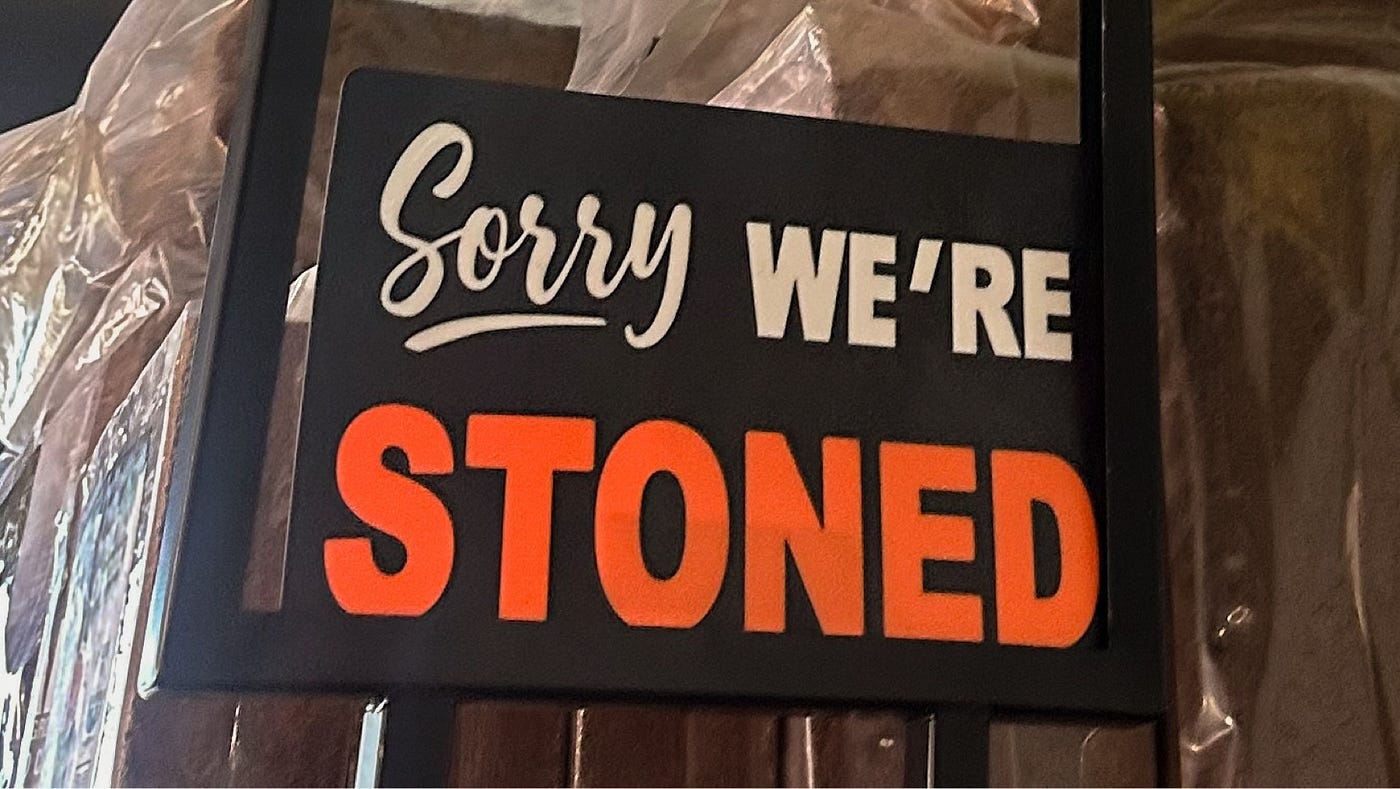
Author photo.
They seemed busy and happy.
As we walked back, they were swinging their little hammers, fixing things in the cracks in the sidewalk, in the gravel. They climbed up tree trunks, looking determined.
We both saw them — or, at least, we both saw tiny people. When we got home and looked out the window, they were down there. Dozens of them, working away in the street.
None of my subsequent experiences during those months featured the little green guys. I was somewhat disappointed and curious about what had happened.
All the doses were the same, five to seven grams of psilocybin mushrooms.
Or so I assumed.
Lilliput is one of two islands, that, along with Blefuscu, Jonathan Swift created in his classic novel, Gulliver’s Travels, written in 1726. Swift was satirizing not only human nature, but the very unreliable travel literature of his day and the previous century, written by people who didn’t quite know where they were and may have been given to making things up.
His imagined island was somewhere near Tasmania.

An illustration of Gulliver’s Travels by Richard Redgrave, 1804–1888. Public domain. See notes.
Interest in Lanmaoa asiatica has hit the mainstream.
The category we refer to with the phrase, psilocybin mushrooms, is a large group of fungi united by their ability to produce psilocybin. But the most potent are of the genus, psilocybe.
In the Yunnan province of China, another type of mushroom altogether, Lanmaoa asiatica, grows in forests, where it exists symbiotically with pine trees. It’s also a really damn weird mushroom, and consuming it without proper preparation can also make you see things.
What you’ll see is very different from a psilocybin trip: “Lilliputan hallucinations” as the medical people call them. These types of hallucinations are not frequent, and don’t just arise from the Yunnan species.
Researchers in India noted in a 2007 report in the German Journal of Psychiatry in “Understanding a Strange Phenomenon: Lilliputian Hallucinations” that they are “reported in a variety of states ranging from toxic metabolic states, medical, neurological and psychiatric conditions.”
Interest in Lanmaoa asiatica has hit the mainstream.
Colin Domnauer, biologist and researcher from the U.S., told the BBC in a January, 2026 article by Rachel Nuwer, “At a mushroom hot pot restaurant there, the server set a timer for 15 minutes and warned us, ‘Don’t eat it until the timer goes off or you might see little people,”
Domnauer started researching the mushrooms when he found many reports of their effects, over thousands of years and across many cultures.
I have chowed down excellent Chinese food in Chicago, New York and San Francisco, as well as Hong Kong. Trust me: the Chinese know their food.
And one thing they know in Yunnan is that Lanmaoa asiatica are great if they’re cooked thoroughly.
Giuliana Furci, the founder and executive director of the Fungi Foundation, a non-profit group dedicated to discovering, documenting and conserving fungi, told Newur, “There were many accounts about the existence of this psychedelic, and many people who looked for it, but they never found the species.”
. . . if this sounds surreal, there may be a reason.
In 2024, in an article, “Neuropsychiatric symptoms following the consumption of Lanmaoa asiatica, a poisonous mushroom native to Yunnan” the Hong Kong Journal of Emergency Medicine reported on a cluster of emergency room cases.
Among the clinical manifestations, the main neuropsychiatric symptoms were visual hallucinations (69.1%) (seeing little people), fatigue (49.4%), and dizziness (35.80%) and the rest were auditory hallucinations (3.7%), sensory abnormalities (2.5%), ataxia (3.7%), and headache (2.5%).
Researchers point out that Yunnan has many mushrooms, but the ER mushroom-poisoning cases seem to have been caused by Lanmaoa asiatica.
In 2021, Jan Dirk Blom of Leiden University, the Netherlands, published a paper in Neuroscience and Biobehavioral Reviews noting:
All hallucinations described were of the projective kind, in that the hallucinated beings appeared to the observer as residing or moving about in the outside world. They involved tiny men, women, children, gnomes, imps, or dwarfs, often strikingly dressed as harlequins, clowns, dancers, soldiers, peasants, ‘mandarins’, ‘caftan wearers’, and so on.
In other words, I imagine them looking like children’s-book illustrations come to life.
A recurring comment was that the figures were ‘rendered in exquisite detail’. In 83 % of the cases large groups were reported (running into the thousands, and in two cases even into the millions); the remaining 17 % of the patients reported <10 hallucinated beings, including 12 % who reported only one or two of them.
These hallucinations were extensively studied in 1909 by a French psychiatrist, Raul Leroy, who bestowed the name, “Lilliputan hallucinations” upon them.
He found frequent reports of “minute size, colorfulness, mobility, and affability.” Often there are very large numbers of them, and they do climb around — “marching under real doors, and climbing on real chairs and tables, while generally respecting the laws of gravity and three-dimensional space.”
They are, he concluded, “reality-grounded projective hallucinations.”
Leroy, by the way, spent five months at the Neuropsychiatric Center of the French Second Army of Saint-Dizier, working with André Breton, who spent those months at the center as a medical intern during World War I.
Leroy had many conversations with Breton, who later led the Surrealist movement in France, after a battle for supremacy among Surrealism’s many adherents, in 1924.
So, if this sounds surreal, there may be a reason.

André Breton (1869–1966), by an unknown photographer, 1924. Public domain. See notes.
People are alive today who have taken a quarter pound of psilocybin mushrooms. They didn’t die, but they say they saw God.
That first experience, I suspect, likely included mushrooms that were not psilocybin. I do remember my fellow psychonaut remarking about the presence of red mushrooms among his whiter ones.

Bags of dried Psilocybe semilanceata. Photo by Scienceman71. Public domain. See notes.
The photo above is one type of psilocybin-producing mushroom. There are many. But they are white, grey or whitish when dried. Lanmaoa asiatica is red or reddish, even when dried. (I am unable to find a public domain photo if the latter. There are many pictures of it you can look up on Google Images.)
Psilocybin is inactive. It becomes active in the human body when physical processes convert psilocybin to psilocin, which activates the 5-HT2A receptor, which causes the hallucinogenic effects not only of psilocin but of other psychedelics.
Exactly how this activation produces hallucinations is still unknown. Despite the fact that people use the mushrooms for recreation and spiritual exploration, it remains illegal in the U.S.A. The research is thinner than it perhaps should be because of legal constraints, but we do know that it does not harm the human body and it is not addictive.
People are alive today who have taken a quarter pound of psilocybin mushrooms. They didn’t die, but they say they saw God.
We slept late the next day and ate well. The world still seemed brighter and more colorful than it had before.
As I mentioned, I took eight doses of what I believed were psilocybin mushrooms over a four-month period. I think that only the first dose contained Lanmaoa asiatica.
My hypothesis, at this point, is that spores of that species were shipped from a spore supplier to a grower who produced the shrooms I took on that first experience. I am not sure where they sprouted up, but it could have been China or the Philippines.
During all my trips, I was elated and happy. At no time during any of my experiences did I feel sick or frightened, though I had one episode of dizziness. I remained conscious that what I was experiencing was the result of a substance I’d willingly downed. In other words, I knew all along that I wasn’t losing my mind.
The first trip, as is common, started about 20 minutes after dosing, peaked in an hour or two, and subsided in four hours, when the effects gradually disappeared.
My subsequent experiences, all fine mushroom trips, seemed a bit flatter in contrast to the first.

Jean de Bosschère illustration of Gulliver’s Travels. Public domain. See notes.
But all of them, including the first, involved another type of hallucination, which is common on psilocybin. I can only describe them this way: objects seemed outlined with brilliant, pulsating color, taking geometric forms, which drew everything together and seemed to illustrate the idea that all things are connected and pulsating with energy.
On the way back, we walked past an apartment building that had looked, to my non-stoned mind, to be a place where many people have long been sad. It was dark and foreboding. Other places, places where children are cared for, were cheerfully lit, bright and happy.
I tend to feel that I was actually seeing energy because when I tried to use my laptop to play music, it gave off a weird light that broke into what looked like sparks — in other words, the Magical Mystery Machine was the most energy-producing object in my environment, once we returned to our quarters.
We slept late the next day and ate well. The world still seemed more colorful than it had before.
On subsequent psilocybin trips, I missed the little green guys.
Years and years ago, I experimented several times with LSD — or what was being sold as LSD when I was a kid. I took five trips, starting at age 15 and continuing until I was in my early 20s.
The effects were quite different from psylocibin. Maybe it was the particular substance I took, or the dose, but I found LSD was much more about mental processes, about altered thought processes. On LSD, I can specifically remember staring into hallucinated patterns and feeling “at one” with them.
But this was not a pleasant or uplifting experience for me. I felt my ego dissolving at a time when I barely had an ego, and it was scary.
But as teenagers like to think, everybody else was doing it. And I had read in an encyclopedia that it was safe and non-addictive. However, that didn’t mean it was good for me, as it turned out. I was way too young and I quit when I realized that — an insight that came to me while tripping.
Those more recent, repeated doses of psilocybin had long-term effects, none negative. I had creative breakthroughs. I noticed my priorities shifting: from worrying about my to-do lists and fearing the imagined outcome of every single action I took — the result of years of living on almost no money — I began to take small risks and welcome whatever life throws at me.
On subsequent psilocybin trips, I missed the little green guys. But I am glad that I may have solved their mystery, at least for myself, for now.
It’s amazing to live in a world where I can learn in seconds what people eat in a far-flung region of China.
If only Jonathan Swift were alive today.
Notes:
My sources are included in the text, which gives dates of publication, name of publication, and name of study.
Photo Notes:
Photo 1:
URL:https://commons.wikimedia.org/wiki/File:GulliversTravelsFleisherStudios003.jpg
Attribution: Max Fleischer, Public domain, via Wikimedia Commons
Photo 2: Taken by the author.
Photo 3:
URL:https://commons.wikimedia.org/wiki/File:Szene_aus_Gulliver%27sReisen-_Gulliver_in_Brobdingnag.jpg
Attribution: Richard Redgrave, Public domain, via Wikimedia Commons
Photo 4:
URL:https://commons.wikimedia.org/wiki/File:Andr%C3%A9_Breton_1924.jpg
Attribution: André Breton (1869–1966), Public domain, via Wikimedia Commons
Photo 5:
URL:https://commons.wikimedia.org/wiki/File:Psilocybe_semilanceata_1.jpg
Attribution: Scienceman71, CC BY-SA 4.0 <https://creativecommons.org/licenses/by-sa/4.0>, via Wikimedia Commons
Photo 6:
URL:https://commons.wikimedia.org/wiki/File:Gulliver%27s_Travels_into_Lilliput_and_Brobdingnag_07.jpg
Attribution: Jean de Bosschère, Illustrator.Jonathan Swift, author., Public domain, via Wikimedia Commons
메타데이터
- post_id
- 45aec50f48ab
- slug
- you-too-can-see-little-folks-on-your-next-mushroom-trip-45aec50f48ab
- url
- https://medium.com/pitfall/you-too-can-see-little-folks-on-your-next-mushroom-trip-45aec50f48ab
- canonical_url
- https://medium.com/pitfall/you-too-can-see-little-folks-on-your-next-mushroom-trip-45aec50f48ab
- author_url
- https://medium.com/@lauramarland
- status
- ok
- fetched_at
- 2026-06-09 14:34:10