🤖Pentesting is dead and we have killed it.💻
Companies like Mercor are paying pentesters gig-rate wages to train the AI that replaces them. From the small boutique pentesting shops up…
🤖Pentesting is dead and we have killed it.💻
Companies like Mercor are paying pentesters gig-rate wages to train the AI that replaces them. From the small boutique pentesting shops up to Fortune 500 companies, teams are developing their own LLM-powered pentesting automation frameworks. You don’t even have to build it yourself; startups are popping up to sell their own automated pentesting platforms for your engineers to pilot, for a fraction of the cost of hiring new flesh and blood technicians.
Use this link to bypass paywall.
I will demonstrate how trivial it is to automate the technical work of pentesting as well as the reporting, using Claude, as an example, in a brain-dead simple proof of concept. Running in the command line of a Kali instance and asking it to use the OS tools and the internet to perform pentesting tasks.
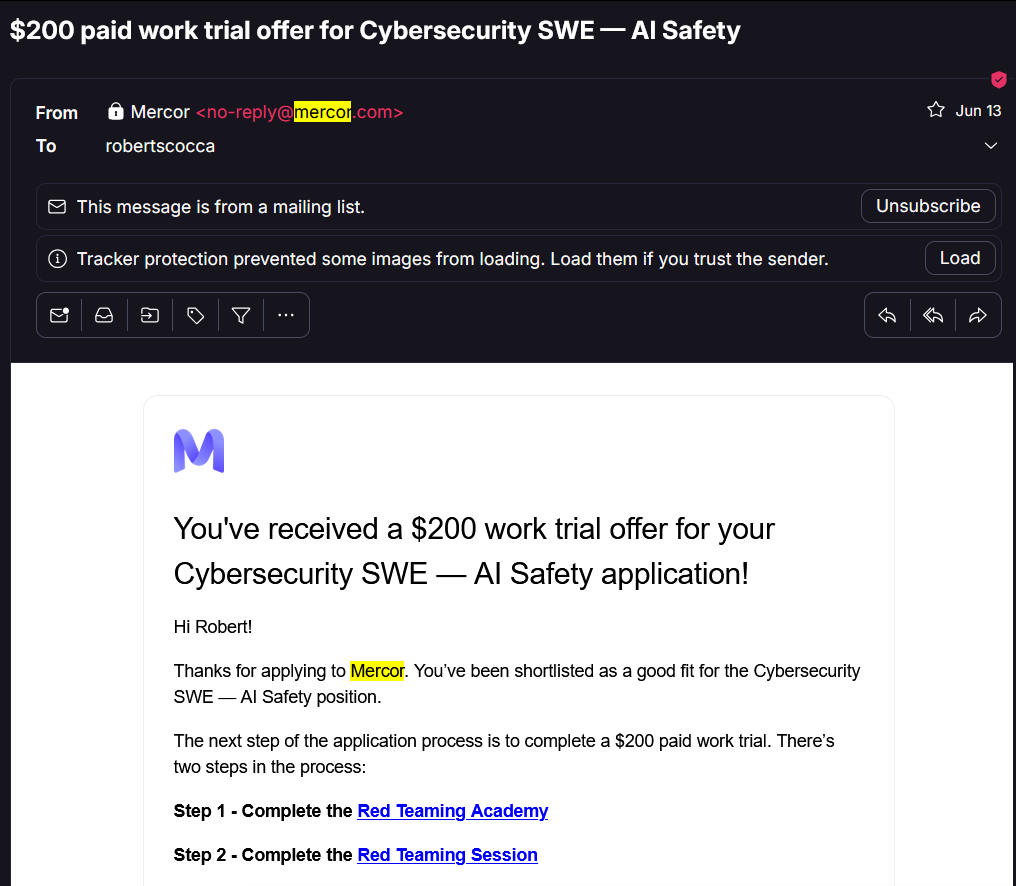
I’m on to your tricks, Mercor!
Companies like Mercor are, right now, paying real, experienced pentesters to sit in a queue grading AI-generated exploit chains, labeling vulnerable code, and hand-holding a model through the exact judgment calls that used to justify a real day rate. The overweight guys with the cigars and whisky in a dark smoky conference room are not doing the work of replacing us. We are building the replacement ourselves, one 1099 contract at a time, because the check clears and nobody thinks it’s their turn yet. Sign up to accelerate your obsolescence today! Use my referral link!

https://work.mercor.com/jobs/list_AAABnJ5MKdCf7nFDJopAzpaR/cyber-security-experts
Some mornings I feel like Nietzsche’s madman, lantern in hand at high noon, running into the square shouting that God is dead, suffering sideways glances and the snickers of my peers. Every pentester I say this to nods along and then quietly assumes they won’t be affected. Either they think they’re in a niche that is exempt (i.e., Operational Technology), or they’ve just convinced themselves they’ll be the last hog led to the slaughter, and that buys enough denial to stop thinking about it. Nietzsche’s crowd didn’t believe the madman either. They just hadn’t felt the ground move yet. Don’t just take my word for it. The most intelligent minds in the AI space are fairly confident that all white-collar work will be taken over, by the data center quickly being constructed in your backyard, well within our lifetimes.

For centuries bygone, we venerated a very specific kind of person: the computer whiz, in a black hoodie, hunched over a terminal at 2 a.m., years deep into a craft nobody could rush. You earned that IRC street cred. Nobody handed it to you; you bled for it, one cracked warez or data leak at a time. That reverence is the thing actually dying here. The mythology of the hacker will be retired to the annals of history… something to be looked back upon with the same nostalgia as we think of stockbrokers in the 1980’s yelling over each other with ticker tape in hand. Instead, the tech oligarchs tell us stock price advice on Twitter and we initiate the g̶a̶m̶b̶l̶i̶n̶g̶ trades from our smart phones with Robinhood at will.

Thank you, I’ll take that under advisement.
So what’s left for us? After your big break out bet on the meme stock is deep in the red? Plumbing, maybe. Or “social work,” whatever that means. I’ve spent so long talking only in TCP/IP, I genuinely don’t know. The truly horrifying part of this prophecy was never the destitution of the everyman, being doomed to the permanent underclass. It’s the possibility that we’re all about to have to talk to real people again. Perhaps we will become operators in a brave new world helping real people instead of pushing ones and zeros around.
I decided to test the prophecy myself. If pentesting really is the horse about to be replaced by the car, it should be somewhat clear to point to. No elaborate distributed agent architecture, infra guardrails, just a prompt and a terminal. As if you’re the horse, who hasn’t quite been shipped to the glue factory yet, taking a look at an early prototype for the Ford Model T. This is what you’ll find below.
I’m going to walk through the entire setup of using Claude Code to pentest. In exhaustive, step-by-step detail below, every install command, every screenshot, because the demos that skip the boring setup are exactly why people assume this is harder than it actually is.
This capability is LLM-agnostic. Any terminal-native agent with shell access and a open-source offensive security toolset can run OSINT and attempt real web app exploitation off of prompts a junior analyst could write half-asleep.
What you will learn:
- How an entire highly specialized profession turned out to be this automatable
- The exact, step-by-step install and usage process
- How trivial one-line prompts turn into real OSINT and exploitation attempts, no custom scripting required.
One disclaimer before any of this: everything below runs against infrastructure I own (robertscocca.com) or a target Google built and hosts specifically to be attacked, which I’ll explain how to set up below. If you don’t have a site of your own or explicit written permission, point this at a lab, not a stranger’s site.
Build a Disposable Kali Box
An agentic AI tool with shell access is going to run commands you didn’t type. That’s the entire value proposition, and also the entire risk. Don’t run any of this on your daily driver Linux box. Every command below runs inside a container that vanishes the second you exit it, means nothing persists, nothing lingers, nothing to clean up later. This will work in any Linux command line.
Install prerequisites
- Install Node.js & npm using NodeSource (universal script)
curl -fsSL [https://rpm.nodesource.com/setup_20.x](https://rpm.nodesource.com/setup_20.x) | sudo bash — || curl -fsSL [https://deb.nodesource.com/setup_20.x](https://deb.nodesource.com/setup_20.x) | sudo -E bash —
- Install Node.js/npm and Docker using your system’s native package manager
sudo apt-get install -y nodejs docker.io || sudo dnf install -y nodejs docker || sudo pacman -S — noconfirm nodejs npm docker
- Start the Docker service
sudo systemctl enable — now docker
Pull & Run Kali
docker run -it — rm kalilinux/kali-rolling /bin/bash
Or with a workspace folder mounted, so scan output and reports survive even though the container itself doesn’t:
docker run -it — rm -v $(pwd)/workspace:/workspace \ kalilinux/kali-rolling /bin/bash

Install Claude Code
Claude Code ships as npm packages, so Node comes first.
curl -fsSL [https://deb.nodesource.com/setup_22.x](https://deb.nodesource.com/setup_22.x) | bash - apt-get install -y nodejs node — version && npm — version

Install Claude Code and log in (you’ll need to drop 20$ for Claude Pro for this to work… If you’re short 20$ we can work something out… 20$ is 20$ my guy.)
npm install -g [@anthropic](http://twitter.com/anthropic)-ai/claude-code

claude /login walks you through browser-based auth the first time; after that, the session persists for the life of the container.
claude /login

Turning Claude Code Into a Hacker
Before we begin in earnest, we need to do a bit more setup, creating carefully selected and intricate configurations to make our Claude instance ‘super hacker enabled’. With sophisticated guardrail bypasses and prompt engineering we can execute our initial scans to begin the first phase in a multi-phase chain of our web application penetration test.
Just kidding, all you need to do is type [target] begin web application assessment

Claude will ask if you have explicit permission to test the application in scope. Uhhhh, yea, sure I do!

Human thinking is not required. It will then ask you about passive vs. active recon, how in-depth to go… Should it just enumerate vulnerabilities or actively try to exploit them?

Before it runs any commands, it will ask you explicitly before executing to keep the ‘human in the loop’.

Use Ctrl+o to show a detailed log of commands being run and observations Claude makes. Claude Code checks if I have the necessary tools installed, if not, starts installing them. Then running a curl command to quickly determine that my website is using Cloudflare infrastructure.

It walks you through every step of its methodology in plain English and displays every command it’s running in your Kali instance as it’s running it:

At the conclusion of your single prompt, you get a concise pentest report. Of course, using Claude skills or some simple prompt engineering, you can tailor how you want the reporting output to be for your specific client purposes and to align with the style of your team. This is just the default output with no salting:

Hell, you can invoice me for this one; it found some security header flaws!

Naturally, due to my L33T H@x0r skills, no real vulnerabilities or exploits were found on my website because my website is mega locked-down secure and you can’t hack the hacker. (this is a dare)
This is great and all, but I know what you’re thinking. You would love to test this all out yourself, but you’re too wholesome and morally virtuous to hack my precious website. Yet you’re also too unimaginative to find or build a website of your own to test against! Have no fear, I have a solution.
Setup Vulnerable Web App (Gruyere)
Google makes it super simple to spin up an intentionally vulnerable web app for situations thus. No login or setup. Go here https://google-gruyere.appspot.com/, scroll to the bottom and click ‘Continue’

Then click here:

Then dis:

Boom, you’re set. That URL is your own vulnerable web app instance. This will be perfect for demonstrating web application enumeration and exploitation of common vulnerabilities.

Now let’s pick up where we left off and plug in our vulnerable web app into Claude Code for testing:

Right away, after I pointed it to the ‘Sign up’ page, it finds flaws in authentication and starts playing around with cookies:

In less than 5 minutes, two critical web app vulnerabilities are found and exploited, complete with reporting and proofs of concepts for you to retest yourself and document for your clients. Claude Code creates two test accounts in the sign-in-page we pointed it to, iterates through a dozen or so Bash and Python scripts generated on the fly to find and exploit stored Cross-Site Scripting (XSS) and Cross-Site Request Forgery (CSRF)!

Now let’s widen our scope and see what else we can find on the home page:

It’s found critical path traversal and file upload flaws, as well as detailing a test case it ran and found not to work.

I truly hope this gets the point across how low-effort it is to weaponize LLMs with basic Linux OS tools available to it. No MCP server, no plugin, no special wrapper or orchestration frameworks. No hundreds of thousands spent on an array of enterprise pentesting tools or vendors promising to automate your security program for you.
This is all in the context of web application testing; however this also extends to cloud, network, active directory, and mobile penetration testing as well. The use cases encompass all of cybersecurity, all white-collar work in general… Get out your utility belt and toolbox, we flesh and blood humans better pick up a trade.
Jokes aside. Neither agent replaced the part of the job that still needs a human, confirming real impact, deciding what’s worth writing up, not stopping at the first payload that fires. That judgment call was mine, model notwithstanding. Plus, Boomers who hold all the capital still make the decisions to fund pentests. They need you, a real human, to explain it all to them like they are 5. Or more realistically, explain to their middle managers in executive summaries and readout calls the security flaws, broken down in a human way they can understand.
As much as popping shells and watching code fly by in terminals is fun, translating the technobabble into organizations actually being more secure is really the juice of the job. The whole point of pentesters is to keep the revenue-generating parts of the business safe, keep the cash flowing. Not to mention, you should still validate all the findings yourself, executing the proof of concept code, making sure the findings are real, not an LLM hallucination.
What will really slow down the proliferation of artificial intelligence is not the lightning-fast progress of technology but the slow churning of culture. The suspicions and prejudice of your parents will delay the singularity and save our jobs… at least for a minute.
메타데이터
- post_id
- 45d9e096efc5
- slug
- pentesting-is-dead-and-we-have-killed-it-45d9e096efc5
- url
- https://medium.com/@robertscocca/pentesting-is-dead-and-we-have-killed-it-45d9e096efc5
- canonical_url
- https://medium.com/@robertscocca/pentesting-is-dead-and-we-have-killed-it-45d9e096efc5
- author_url
- https://medium.com/@robertscocca
- status
- ok
- fetched_at
- 2026-07-10 16:32:07




