GE Profile Ovens Explained: A Practical Buyer’s Guide for 2026
Shopping for a new oven can turn into a rabbit hole fast, especially once “GE Profile” shows up in your search results. Is it just a…
GE Profile Ovens Explained: A Practical Buyer’s Guide for 2026
Shopping for a new oven can turn into a rabbit hole fast, especially once “GE Profile” shows up in your search results. Is it just a fancier badge on the same appliance, or does it actually cook better? This guide breaks down what the GE Profile lineup really offers, which models are worth shortlisting, and what to check before you buy.
What Is the GE Profile Line, Exactly?
GE Appliances sells several tiers of ovens. At the entry level sits the standard GE range — dependable, no-frills, and budget-friendly. At the top sit GE Cafe and GE Monogram, aimed at buyers who want premium finishes and full customization. GE Profile sits in the middle: it brings genuine convection performance and smart features to the table without the luxury price tag.
You’ll find the Profile badge across several formats — built-in wall ovens, freestanding and slide-in ranges, and even microwave-oven combo units. Because the lineup spans so many configurations, most shoppers spend more time comparing formats within GE Profile than comparing GE against other brands.
Is the Price Jump From Standard GE Worth It?
The extra cost isn’t just branding. Three upgrades typically justify it:
True European Convection — An additional heating element paired with a fan spreads heat more evenly across multiple oven racks than a basic bake element can manage alone.
No-Preheat Air Fry — A built-in air-fry function inside the oven cavity itself, skipping the wait time you’d normally spend preheating a separate appliance.
Smart Connectivity — Wi-Fi through the SmartHQ app, voice assistant support, and on newer models, an internal camera that identifies food and suggests a cooking setting.
If you rarely bake more than one tray at a time and don’t care about app control, a standard GE oven might serve you just fine. But if you cook for a family regularly, host often, or frequently juggle multiple racks, the difference becomes noticeable quickly.
Choosing a Format First
Format Ideal For
Compact Wall Oven Small kitchens or as a second oven
Double Wall Oven Households cooking several dishes simultaneously
Single Oven, Double-Oven Function Double-oven flexibility inside a single-oven cutout
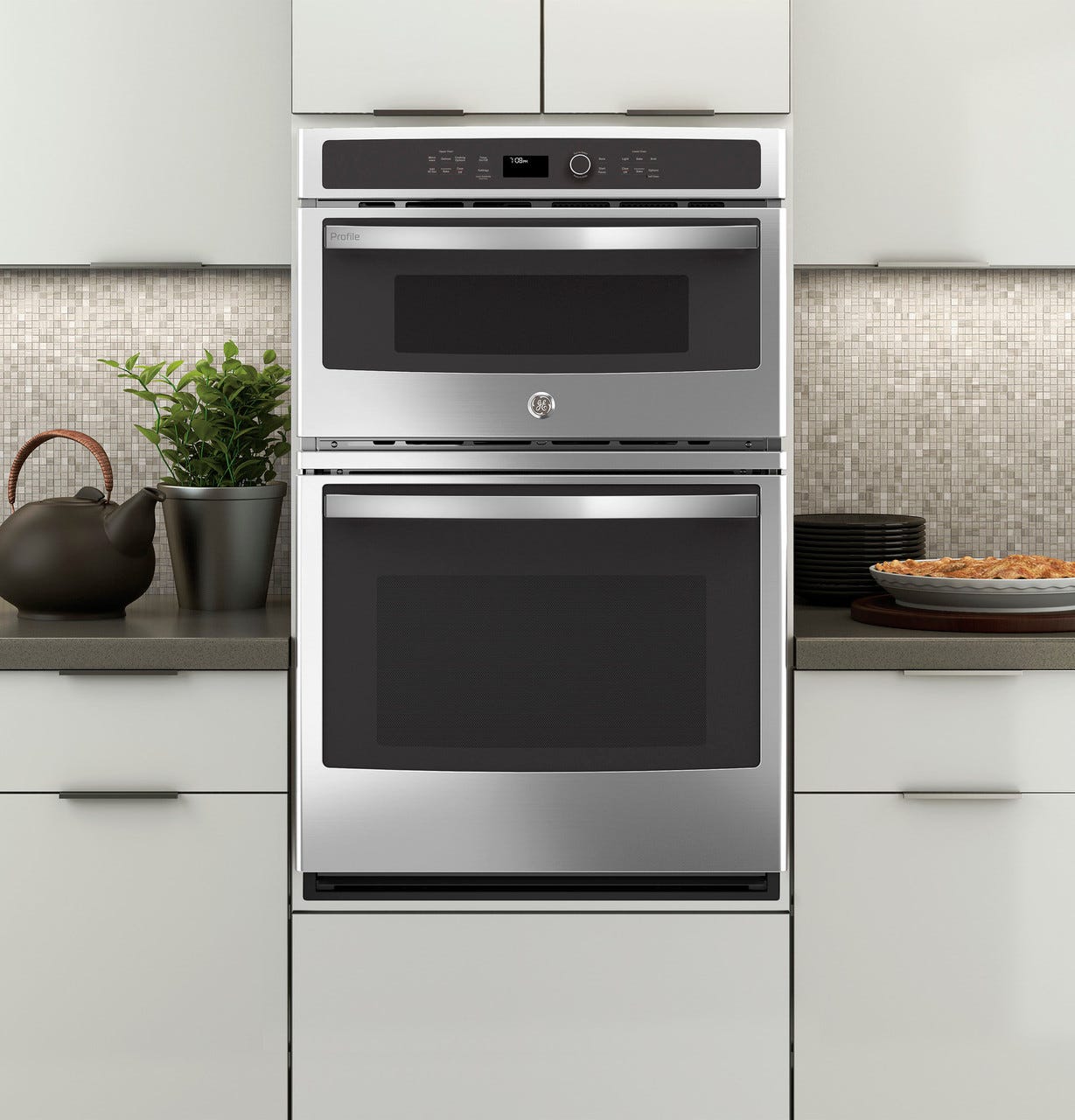
Wall Oven + Microwave Combo Space-limited kitchens needing two appliances in one footprint
Slide-In / Freestanding Range A full cooktop-and-oven replacement without a wall cutout
Pick the format that matches your kitchen layout before you start comparing individual models — it narrows the field considerably.
Features That Actually Matter
True European Convection with Direct Air circulates heat from a rear element and fan, which is the main reason Profile ovens bake more evenly across multiple racks than entry-level models.
Precision Cooking modes can automatically adjust time and temperature for specific dishes, which helps when you’re cooking something unfamiliar.
No-Preheat Air Fry skips the warm-up stage entirely, often getting food from raw to crisp faster than a countertop air fryer.
Remote Temperature Probe support (available on select models) lets you track internal meat temperature from your phone via SmartHQ, cutting down on how often you open the oven door.
Steam-assisted self-clean handles everyday spills with a shorter, lighter cycle, saving the full self-clean mode for heavier buildup.
Camera-guided cooking, found on the newest Smart Convection models, can recognize certain foods on the baking sheet and suggest a cooking mode. It’s a newer feature that not many buyers have tested yet.
Five GE Profile Models Worth Considering
GE Profile PTS7000SNSS (30" Single Wall Oven) — A 5.0 cu. ft. single oven with a 7-inch touchscreen, True European Convection, No-Preheat Air Fry, Scan-to-Cook, and steam-assisted self-clean. Solid pick if you only need one oven done right.
GE Profile PTD7000SNSS (30" Double Wall Oven) — Two full-size convection cavities in one unit, built for households cooking multiple dishes at different temperatures — think meal-prep days or holiday cooking.
GE Profile PK7800SKSS (27" Wall Oven + Microwave Combo) — Pairs a True European Convection wall oven with a convection microwave above it. A strong option for smaller kitchens that still need two appliances.
GE Profile PB965YPFS (30" Freestanding Double Oven Range) — A complete range with two ovens, five cooktop elements, Wi-Fi, and No-Preheat Air Fry. Good for anyone replacing an entire range rather than a built-in wall oven.
GE Profile PSS93YPFS (30" Slide-In Range) — A 5.3 cu. ft. True Convection slide-in range with a storage drawer, SmartHQ connectivity, and Chef Connect compatibility with an over-the-range microwave. A clean, modern option that skips wall-oven installation altogether.
What GE Profile Ovens Typically Cost
Single wall ovens: roughly $2,000–$3,000
Double wall ovens: roughly $3,000–$4,500
Microwave combo units: roughly $3,000–$5,000
Freestanding and slide-in ranges: roughly $1,700–$3,500
These are general ranges — actual pricing shifts with finish, promotions, and retailer.
Before You Order: Installation Checklist
Confirm exact cutout dimensions (width, height, depth) against the specific model’s install guide
Verify 240V electrical supply for wall ovens
Check clearance and gas line requirements for gas ranges
Make sure door swing works with your kitchen layout
Match finish with your existing appliances
Most wall ovens are built to fit standard existing cutouts, but if you’re replacing an older unit, it’s worth confirming with the manufacturer whether any modification costs apply.
Troubleshooting Common Error Codes
Code Likely Cause
F0 / F1 Touchpad or control board fault
F2 Oven exceeded safe temperature limit
F3 Temperature sensor or cooling fan issue
F9 Door lock fault, often after a power surge
A power cycle — turning the unit off, letting it cool, and cutting power briefly — resolves many one-off faults. If a code keeps returning, it’s a sign of an actual component issue worth calling a technician for.
Maintenance Habits Worth Keeping
Wipe up spills before they bake on — carbonized residue is what drives longer self-clean cycles. Use the steam-clean option for light messes and save full self-clean for heavier buildup. Keep firmware updated on connected models, since GE periodically rolls out new Air Fry modes and features over Wi-Fi.
Frequently Asked Questions
Is GE Profile a good brand to buy from?
For most households, yes. It combines genuine convection performance with useful smart features at a price below Cafe and Monogram, making it a strong mid-tier pick.
What separates GE Profile from standard GE?
Standard GE covers the basics without smart features. GE Profile adds True European Convection, no-preheat air fry, Wi-Fi/app control, and — on newer models — camera-guided cooking.
Is GE Profile the same as GE Cafe?
Not quite. Cooking performance is comparable, but Cafe focuses more on finish options and premium styling, usually at a higher price than Profile.
Do GE Profile ovens need Wi-Fi to work?
No. Core functions like bake, broil, and convection work fine offline. Wi-Fi only unlocks app features — remote monitoring, alerts, and voice control.
Can I install a GE Profile wall oven myself?
A direct swap into an existing matching cutout may be manageable, but any job involving new 240V wiring should go to a licensed electrician.
Why does my GE Profile oven show an F-code?
F-codes flag a detected fault — an over-temperature event, sensor issue, or control board problem. A power cycle clears many of these; a recurring code usually means a part needs replacing.
How long do GE Profile ovens typically last?
With normal use and upkeep, most units in this range are built to last 10+ years, though electronic components like control boards are usually the first to need repair.
Final Thoughts
GE Profile earns its higher price mainly through real cooking improvements — not just app gimmicks — while still staying well below Cafe and Monogram pricing. The smartest approach is to decide on the format that fits how you actually cook, confirm your cutout and electrical setup, and then compare specific models rather than shopping on brand name alone.
For more oven buying guides and reviews, visit *Top Oven Deals*.
메타데이터
- post_id
- 45e64a20168c
- slug
- ge-profile-ovens-explained-a-practical-buyers-guide-for-2026-45e64a20168c
- url
- https://medium.com/@harnoorputta/ge-profile-ovens-explained-a-practical-buyers-guide-for-2026-45e64a20168c
- canonical_url
- https://medium.com/@harnoorputta/ge-profile-ovens-explained-a-practical-buyers-guide-for-2026-45e64a20168c
- author_url
- https://medium.com/@harnoorputta
- status
- ok
- fetched_at
- 2026-08-22 06:41:47