Are Polish and Ukrainian Really as Similar as Everyone Says? A Linguist-Approved Reality Check
Debunking the myths from Reddit, Quora — for anyone who’s ever Googled “Slavic languages” and walked away more confused
Are Polish and Ukrainian Really as Similar as Everyone Says? A Linguist-Approved Reality Check
Debunking the myths from Reddit, Quora — for anyone who’s ever Googled “Slavic languages” and walked away more confused
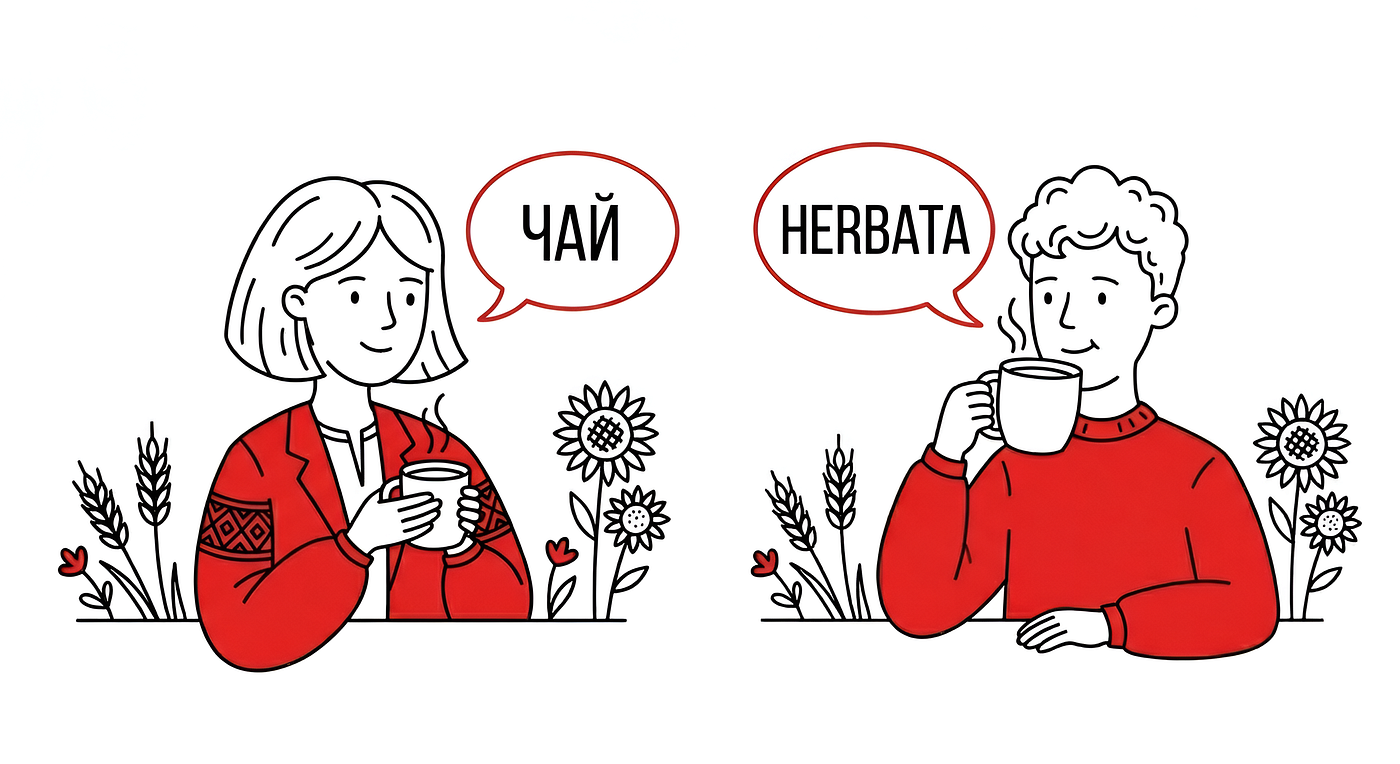
Image generated by the author with Gemini
There’s a particular type of comment that appears under almost every YouTube video, Reddit thread, or Quora question about Slavic languages. You’ve almost certainly seen it:
“Polish and Ukrainian are basically the same thing. If you know one, you pretty much know the other. Slavic languages are just one big family.”
Upvoted. Agreed upon.
The problem is it’s only partially true — and the parts that are wrong matter quite a lot if you’re actually trying to learn one of these languages, travel somewhere, or just understand what’s going on in Eastern Europe.
So let’s go through it properly.
No gatekeeping.
Just the actual story.
Shocking Fact #1: They Don’t Even Use the Same Alphabet
Here’s the detail that somehow disappears in every viral thread about Slavic languages.
Polish uses Latin letters.
Ukrainian uses Cyrillic.
Two entirely different writing systems — the same difference as between English and Greek.
Polish: Gdzie jest kawiarnia?
Ukrainian: Де є кав’ярня?
Both mean: Where is the cafe?
Here’s something interesting: spoken out loud, a Ukrainian and a Pole would actually understand each other fairly well on this one. The words are close enough in sound that both sides would get the meaning.
But put it in writing — suddenly it’s two completely foreign scripts staring back at them.
This cafe example is almost the best-case scenario, by the way.
Later in this article, we’ll get to the phrases where even the sounds don’t help at all.
A person who studied Polish for a year cannot read a Ukrainian street sign.
Not slowly, not with effort — simply cannot.
Because they never learned that alphabet.
It’s 1,000 years of different history compressed into two writing systems:
Poland was shaped by Western Catholic Europe, where the Latin alphabet came with Christianity, scholarship, and looking westward toward Rome. Ukraine was shaped by Byzantine Christianity, which arrived with Cyrillic, created by Saints Cyril and Methodius in the 9th century, specifically to write Slavic languages for newly converted peoples.
Different church. Different letters.
For a thousand years.
So How Similar Are They, Really?
Polish and Ukrainian share a significant chunk of vocabulary — they come from the same Proto-Slavic ancestor, after all.
Polish and Ukrainian are more like ambitious cousins than twin sisters.
They can recognize each other at a family reunion. Finishing each other’s sentences is a different story entirely.
Here’s what that actually looks like. The same question in both languages:
“What time does this place close?”
Polish: O której godzinie to miejsce jest zamknięte?
Ukrainian: О котрій годині це місце зачинено?
A Ukrainian speaker might recognize godzinie / годині (hour — same root). But O której / О котрій, zamknięte / зачинено — same ideas, wildly different in sound.
Shocking Fact #2: Ukrainian Has a Letter That Was Banned
This is the one people screenshot and send to friends.
In 1933, Soviet authorities imposed a new orthographic reform on the Ukrainian language. One of its most victims was the letter Ґ.
Here’s the thing about Ґ: it represents a hard “g” sound — the kind in “go” or “game.”
But in Ukrainian, this sound was declared ideologically suspect.
So Ґ was removed from the official Ukrainian alphabet. It was restored after Ukrainian independence in 1991.
Today you’ll find it in words like ґанок (porch) and ґрунт (soil) — ordinary, humble words that spent decades being officially erased.
And here’s where it gets delightfully complicated. Because modern Ukrainian actually has two different “g-adjacent” letters:
Ґ — the hard “g” as in “go.”
Г — something closer to the English “h,” but not quite. Softer than the Polish “h,” different from the Ukrainian Х. So Ukrainian has three sounds — Г, Ґ, and Х — that English collapses into roughly two.
Confused? Good. That means you’re paying attention.
No one said this was going to be easy.
Shocking Fact #3: Polish Preserved a Sound That Most of Europe Forgot
Old Slavic — the ancestor of all modern Slavic languages — had nasal vowels. Sounds are made partly through the nose, giving the language a particular resonance.
Over the centuries, almost every Slavic language quietly dropped them.
Ukrainian dropped them. Russian dropped them. Czech dropped them. Bulgarian dropped them.
Polish kept them.
The letters ą and ę are alive and well in everyday Polish.
*Szczęście* means happiness.
*Kąt* means corner.
For a Ukrainian speaker hearing Polish for the first time, these nasal vowels are genuinely disorienting. It’s like meeting a distant relative who still has a family trait you lost generations back.
After all that — different alphabets, different sounds — you’d expect Polish and Ukrainian to keep drifting further apart.
In fact, in one quiet but powerful way, they’re moving in the same direction.
Now let’s move on to something a bit less dramatic — but just as important.
English Is Quietly Winning in Both Languages
“At least Slavic languages haven’t been flooded with English loanwords.”
Here’s a reality check: English is currently the closest thing the world has to a global lingua franca. It’s the language of international business, aviation, science, tech, pop culture, and — crucially — the internet.
Every living language is absorbing English right now. Simultaneously.
Polish and Ukrainian are no exception.
Polish tends to adapt English words into its own spelling rules and keep them looking somewhat Latin.
Ukrainian takes the same word and renders it phonetically in Cyrillic. Same borrowed concept — completely unrecognizable on the page.
Selfie
Polish: selfie — copied directly from English
Ukrainian: селфі — same word, different alphabet, identical meaning
Manager
Polish: menedżer — Polish spelling wrestling with an English word
Ukrainian: менеджер — Cyrillic rendering of the same borrowed concept
Both languages borrow more English words every year anyway.
The younger generation in both Poland and Ukraine today uses words like cringe, trash, vibe, hype — casually, naturally, the same way a teenager in California would. They arrive as-is and immediately feel at home.
Globalization of language is no joke.
The language lives on.
This Is Where English Speakers Walk Into a Wall
If you’ve ever struggled with English verb tenses (had been going, would have done, might have been thinking), you know the feeling of a grammar system that seems designed to humble you.
Polish and Ukrainian have a different trap waiting.
CASES.
Both languages have 7 grammatical cases.
In English, word order tells you who’s doing what: “The dog bit the man” means something very different from “The man bit the dog.”
In Polish and Ukrainian, the endings of words carry that information instead.
The word for “city” in Polish is miasto — but depending on how it’s used in a sentence, it becomes miasta, miastu, miastem, mieście… and there are seven possible transformations, each with different rules, each depending on context.
- Every noun.
- Every pronoun.
- Every adjective.
All of them changing endings, all the time.
The good news: it’s not impossible. It just requires accepting, for a while, that you will confidently say something grammatically wrong and smile through it.
So What Do You Actually Take Away From All This?
Polish and Ukrainian are two distinct, historically extraordinary languages.
- They share roots, some vocabulary, and centuries of complicated neighborly history.
- They do not share an alphabet, a sound system, or a grammar that makes one basically the other.
- They’ve both survived things most languages don’t survive: empires, occupation, deliberate suppression.
- They’re both absorbing English right now, like everyone else.
- They’re both worth understanding on their own terms — not flattened into a Quora comment that 2,000 people upvoted without questioning.
The confident answer in that thread was wrong. But now you have a better one.
Disagree with something here? Great — tell me exactly what in the comments. I read all of them and will respond.
If you found this useful and want more on Slavic languages and the kind of facts that don’t make it into Wikipedia summaries, follow me here on Medium.
메타데이터
- post_id
- 45eb4e585639
- slug
- are-polish-and-ukrainian-really-as-similar-as-everyone-says-a-linguist-approved-reality-check-45eb4e585639
- url
- https://medium.com/language-mind/are-polish-and-ukrainian-really-as-similar-as-everyone-says-a-linguist-approved-reality-check-45eb4e585639
- canonical_url
- https://medium.com/language-mind/are-polish-and-ukrainian-really-as-similar-as-everyone-says-a-linguist-approved-reality-check-45eb4e585639
- author_url
- https://medium.com/@polskizleo
- status
- ok
- fetched_at
- 2026-06-23 06:34:20