Reading Freud’s “Libidinal Types” (1931)
Freud proposes that the libido plays an essential part in the general psychical economy of not just patients but indeed everyone. The…
Reading Freud’s “Libidinal Types” (1931)
Freud proposes that the libido plays an essential part in the general psychical economy of not just patients but indeed everyone. The libidinal arrangement is more primordial than that of desire, and so remains independent from diagnostic structure. Hence, Freud wrote that “it must be required of all such types that they shall not coincide with clinical pictures.” He does this for another reason too: so as not to presume in advance that any particular libidinal economic arrangement is tied directly or leads naturally toward particular neuroses. Libidinal types are independent of any complaint, independent of any symptomatology, and indeed of any admission into the clinic.
He proposes three main libidinal types: (1) erotic, (2) obsessional, and (3) narcissistic.
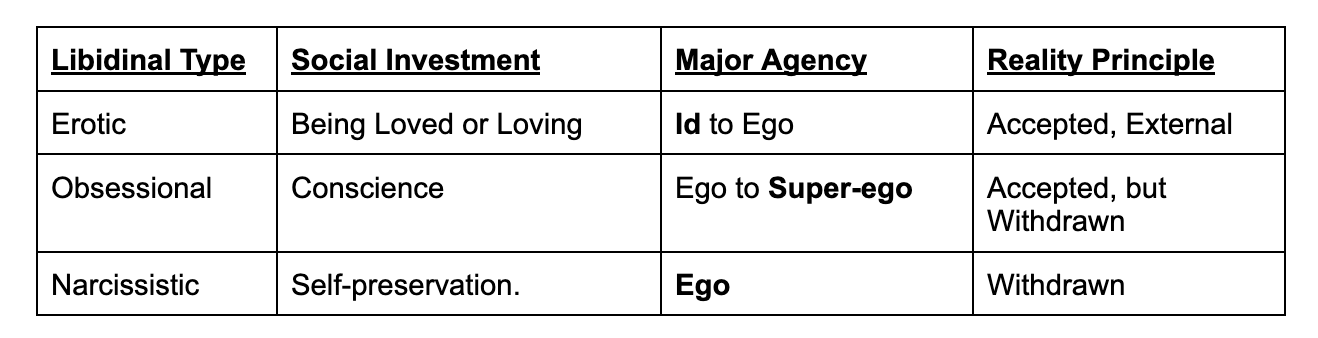
The “erotic” type: the main libidinal investment is toward being loved and loving another. This makes the erotic libidinal type essentially a social investment: being the object of another’s love, or else reducing another to the object of one’s own love. The prevalent feature in this type is a fear of loss of love which makes them “dependent on others who may withhold their love from them.” The major psychical agency, the dominant one, is the “id,” which rules the other agencies of “ego” and “super-ego”: the investment seems to be external.
The “obsessional” type: for this type it is not the “id” which takes centre stage but the “super-ego.” The super-ego segregates from the ego to take centre stage promoting a distinctive preoccupation with “conscience,” that is, normative questions. The social investment is replaced is not as clearly present as in the erotic type. Rather, there is an “internal” investment. The “obsessional” type is largely self-reliant, and, Freud claims: “from the social standpoint, these are the true, pre-eminently conservative vehicles of civilization.”
The “narcissistic” type: it would seem in this case that the “ego” takes centre stage, prepared for aggressiveness . The tensions between the super-ego and ego are not apparent, nor is the id attempting to exert external investment. Rather, there is a quest for independent self-preservation: “he is not open to intimidation.” The narcissistic type does not prefer to be loved, as an object; rather, loving another is preferred. The “narcissistic” type presents him or herself as a “personality,” and can “lead” others or even “support” them. However, they can also be particularly damaging to others, or to civilization.
I would summarize this in the following table:
Freud then proposes a manner of producing more nuance from these types by offering further combinations of terms:
- Erotic-Obsessional: in this case there is a “preponderance of instinctual life” that is “restricted by the influence of the super-ego.” As such, there is often an increased dependence on parents, educators, and exemplars.
- Erotic-Narcissist: the most common “mixed” libidinal type. It is the unification of opposites. Aggressiveness and activity come along with a predominance of narcissism.
- Narcissist-Obsessional: this variation is “most valuable from a cultural standpoint.” It adds a degree of the demands of conscience and “vigorous action” to the external world, and “strengthens the ego against the super-ego.”
Freud then asks: do any of these have a “special disposition to pass over into neurosis”? He claims that there is no evidence to suggest that any one has such a special disposition. Moreover, he claims that these libidinal types do not give us any new information about neurosis. Moreover, his claim is that these types can exist independent of any neurosis.
However, perhaps the “mixed” types provide “more favorable soil for conditions leading to a neurosis.” Yet, theoretically, it would seem possible to hypothesize that erotic types, when neurosis sets in, will likely develop into hysteria, and obsessional types into obsessional neurosis. He then adds: “people of the narcissistic type who are exposed to a frustration from the external world […] are peculiarly disposed to psychosis […] and criminality.” Yet, Freud says that we cannot say this for certain, and that we also cannot say for certain what brings any type into illness.
In this piece, Freud seems to be interested in two things: first, starting from the basis of the libido rather than desire or symptomology, and; second, building upon his categories, almost as if by “axial coding,” in order to arrive at higher order categories (e.g., the movement from the id, ego, and super-ego, to libidinal types, and then to the categories of neurosis).
메타데이터
- post_id
- 45eef4bbcc50
- slug
- reading-freuds-libidinal-types-1931-45eef4bbcc50
- url
- https://medium.com/@duanerousselle/reading-freuds-libidinal-types-1931-45eef4bbcc50
- canonical_url
- https://medium.com/@duanerousselle/reading-freuds-libidinal-types-1931-45eef4bbcc50
- author_url
- https://medium.com/@duanerousselle
- status
- ok
- fetched_at
- 2026-06-09 15:37:30