How might other countries react if the U.S. acquired Greenland?
If the U.S. were to acquire Greenland, reactions from other nations would likely vary depending on their geopolitical, economic, and…
How might other countries react if the U.S. acquired Greenland?
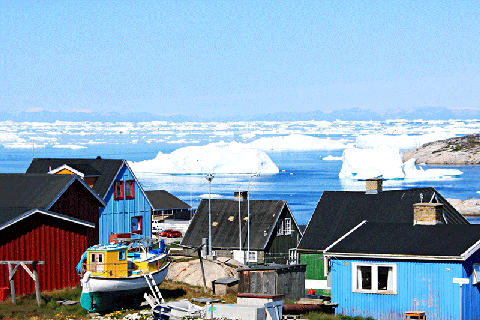
If the U.S. were to acquire Greenland, reactions from other nations would likely vary depending on their geopolitical, economic, and strategic interests:
Denmark
- Firm Resistance: Denmark, which currently governs Greenland, would likely strongly oppose the move, seeing it as a violation of its territorial integrity and historical connection to Greenland.
- Damaged Relations: Danish leaders might view this as a betrayal of their partnership with the U.S., potentially harming cooperation within NATO and the Arctic Council.
European Allies
- Criticism of Colonialism: Many European countries could condemn the acquisition as echoing outdated colonial practices, undermining Greenland’s right to self-determination.
- NATO Tensions: Allies might worry about the impact on NATO unity, particularly if tensions flare between Denmark and the U.S.[3].
Russia and China
- Heightened Rivalry: Both nations would likely see the acquisition as a U.S. power grab in the Arctic, escalating competition in the region.
- Strategic Moves: Russia might bolster its military presence in the Arctic, while China could seek stronger ties with Greenland or other Arctic states to counter U.S. influence.

- Local Pushback: Many Greenlanders prefer independence or maintaining ties with Denmark over U.S. control. The move could spark protests and political unrest on the island.
- Negotiation Power: Greenland might use the situation to demand greater autonomy or financial support from Denmark or the U.S..
Global Community
- Ethical and Legal Concerns: The international community might criticize the acquisition as a violation of sovereignty and self-determination principles.
- Arctic Governance Issues: Other Arctic nations could fear that U.S. control over Greenland would disrupt collaborative governance in the region.
In short, acquiring Greenland would likely trigger widespread opposition, heighten geopolitical tensions, and complicate international relations in the Arctic.
How would Greenland’s residents feel about the U.S. taking over their territory?
Most of Greenland’s residents are strongly against the idea of the U.S. acquiring their territory. A recent poll showed that 85% of Greenlanders reject becoming part of the United States, with only 6% in favor and 9% undecided. Many see such proposals as a threat to their autonomy and identity, with 45% viewing U.S. interest as a “threat” and only 43% seeing it as an “opportunity”.
While some Greenlanders recognize potential economic benefits from closer ties with the U.S., the majority prefer maintaining their current relationship with Denmark or pursuing greater independence. Residents value the free healthcare, education, and subsidies provided by Denmark, which they fear could be at risk under U.S. control. Overall, Greenlanders emphasize their right to self-determination and reject being treated as a bargaining chip in geopolitical negotiations.
How could U.S. interest in Greenland affect its independence movement?
U.S. interest in Greenland could have a significant impact on the island’s independence movement in several ways:
Boosting Independence Aspirations
- Negotiation Leverage: U.S. interest gives Greenland more bargaining power in discussions with Denmark, highlighting its strategic and economic value. This could push Denmark to offer greater autonomy or financial support to keep Greenland within its kingdom.
- New Partnerships: Some Greenlandic politicians see U.S. attention as a chance to explore direct partnerships with the U.S., potentially bypassing Denmark, especially for military and financial backing.
- Strengthened National Identity: U.S. interest has reignited discussions about Greenlandic sovereignty, with many residents emphasizing their unique identity and desire for self-determination.
- Policy Changes: Danish leaders have started treating Greenland differently, recognizing its growing role in foreign and security policy due to U.S. attention.
Economic Factors
- Less Reliance on Denmark: The possibility of U.S. financial support might encourage Greenland to reduce its dependence on Danish subsidies, a key step toward independence.
- Resource Development: U.S. interest in Greenland’s natural resources could create economic opportunities, though it also raises concerns about exploitation and environmental harm.
- Internal Divisions: While some Greenlanders see U.S. attention as an opportunity, others worry it could lead to dependency on another foreign power, complicating the independence movement.
- Geopolitical Risks: Increased U.S. involvement might provoke tensions with Denmark and other global powers like Russia and China, affecting Greenland’s path to independence.
In summary, U.S. interest has given Greenland’s independence movement a boost by offering new opportunities for leverage and partnerships, but it also introduces challenges related to internal unity and geopolitical dynamics.
메타데이터
- post_id
- 45f809084237
- slug
- how-might-other-countries-react-if-the-u-s-acquired-greenland-45f809084237
- url
- https://medium.com/@afuturebusiness87/how-might-other-countries-react-if-the-u-s-acquired-greenland-45f809084237
- canonical_url
- https://medium.com/@afuturebusiness87/how-might-other-countries-react-if-the-u-s-acquired-greenland-45f809084237
- author_url
- https://medium.com/@afuturebusiness87
- status
- ok
- fetched_at
- 2026-06-20 20:29:01




