The Workers’ Party’s Bold Stand: Rejecting the LO Role and What It Really Costs
In a move that was as predictable as it was principled, the Workers’ Party (WP) yesterday firmly declined Prime Minister Lawrence Wong’s…
The Workers’ Party’s Bold Stand: Rejecting the LO Role and What It Really Costs
In a move that was as predictable as it was principled, the Workers’ Party (WP) yesterday firmly declined Prime Minister Lawrence Wong’s invitation to nominate one of its MPs as the new Leader of the Opposition (LO).
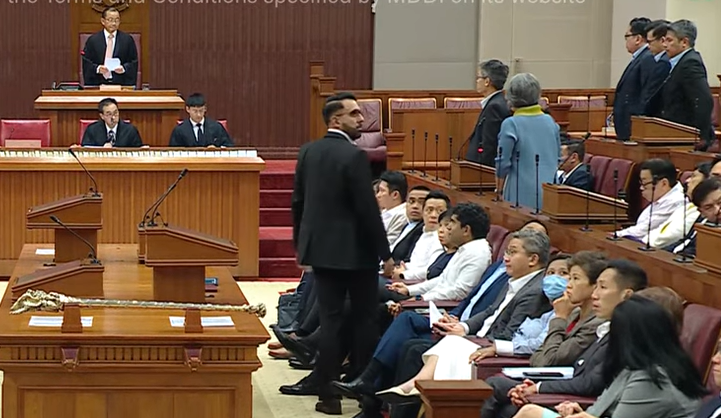
Following Pritam Singh’s removal from the post on 15 January — after his conviction for lying to a parliamentary committee and the subsequent House motion deeming him unsuitable — the WP doubled down: the leader of the largest opposition party is the opposition leader, full stop. No nomination, no compromise, no playing along with what they see as a government-granted privilege rather than a democratic right.
It’s a classic WP play: stand on high principle, rally the base around Pritam Singh’s leadership, and frame the decision as defending the sanctity of the people’s vote against PAP overreach. But as with most high-stakes political gambits in Singapore, the optics are one thing; the repercussions are quite another. Let’s dissect the potential fallout, with no sugar-coating.
First, the most obvious hit — and yes, you’ve probably already heard the talking heads tut-tutting about this, but let’s say it plainly: by walking away from the formal LO title, WP is voluntarily surrendering a suite of tangible parliamentary advantages.
Dedicated staff support, enhanced research funding, priority speaking slots in debates, structured procedural leverage — these aren’t symbolic perks; they’re tools that amplify an opposition’s voice in a legislature where the ruling party commands an overwhelming majority. Snubbing them might feel righteous in the moment, but it risks turning WP’s parliamentary presence from a sharp scalpel into a blunt instrument. The party can still ask questions and file motions, sure — but without the institutional megaphone, their critiques may land with less force and reach fewer ears.
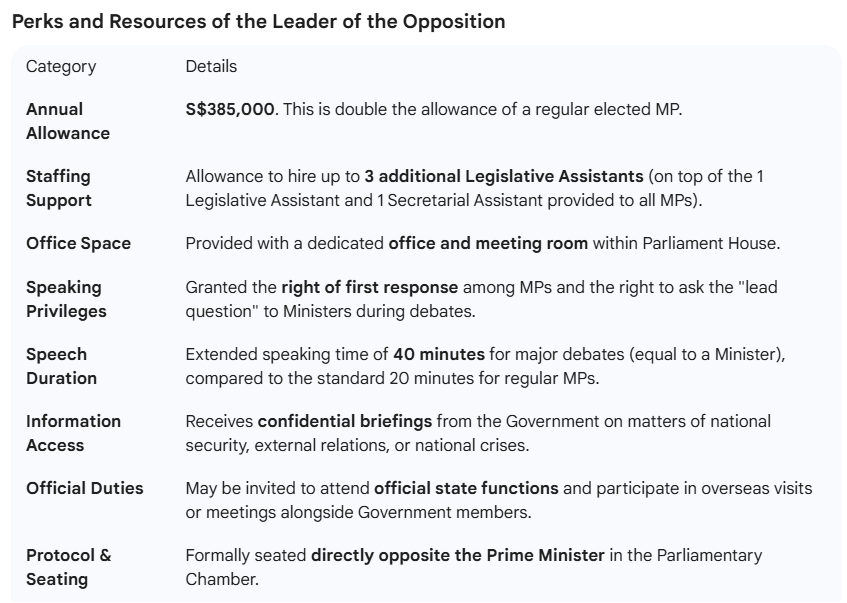
Perks and Resources of the Leader of the Opposition in Singapore
Beyond the resources, though, the decision carries subtler but no less damaging risks.
Public perception could shift in ways that hurt more than help. Singaporeans, by and large, prize pragmatism and results over ideological purity. To many moderate or swing voters — who helped WP secure its 10 seats in 2025 — the boycott might come across not as principled defiance but as petulant sulking or ego-driven drama. “Why turn down a platform to hold the government accountable just because it’s not your guy in the chair?” The narrative is ripe for PAP-friendly commentators to exploit: WP prioritizing party loyalty (and Pritam Singh’s status) over constructive national service.
Workers’ Party chief Pritam Singh speaks with SM Lee Hsien Loong at the Istana on July 27, 2020, after he was offered the LO role by the former Prime Minister.
Internally, the move locks WP tighter around Singh at a potentially vulnerable moment.
The swift, unified rejection signals impressive party discipline — no leaks, no public wavering — but it also ties the party’s parliamentary strategy to one leader whose recent legal troubles have already dented his (and by extension the party’s) standing with some voters. If grassroots enthusiasm for Singh remains rock-solid, this could strengthen cohesion. If not — if fatigue or doubts creep in among MPs or supporters — resentment could build: why forfeit visibility and influence for the sake of a point?
All Workers Party MPs voted against the motion to remove Pritam Singh as LO
The PAP, meanwhile, emerges with a propaganda gift on a silver platter.
PM Wong’s office has already responded with measured magnanimity: accepting the decision, leaving the LO post vacant “until such time that the WP is ready,” and subtly reminding everyone that this is an “exceptional situation” due to Singh’s conviction. The subtext is clear — the government offered inclusivity, the opposition refused. In future elections, expect this episode replayed as Exhibit A in arguments that a stronger opposition would be chaotic or irresponsible.

Longer term, WP’s stand could inadvertently weaken the very institution it claims to champion. By refusing to engage, they help hollow out the LO role’s precedent. What was introduced in 2020 as a milestone in Singapore’s political maturation now risks becoming optional or irrelevant. Future governments might find it easier to sideline or quietly retire the position if opposition cooperation isn’t forthcoming — ironic, given WP’s stated goal of advancing accountability.
Electorally, the gamble is steep.
WP has built its brand on being “rational, responsible, and respectable” — qualities that resonate in a society wary of confrontation. If this principled refusal translates into quieter, less impactful parliamentary performances, voters might question whether WP is delivering value. In a system where bread-and-butter issues often trump procedural drama, being seen as more focused on symbolism than substance could cost seats next time around.
In the end, the WP’s rejection is coherent with its long-standing ethos of independence and fidelity to democratic legitimacy. It rallies the faithful and sends a clear message: we won’t be co-opted. But politics isn’t played in a vacuum of principle alone. The costs — in visibility, leverage, public goodwill, and institutional legacy — are real and accumulating. Whether this proves a masterstroke of defiance or a self-inflicted wound will depend on how effectively WP turns its de facto leadership into tangible gains for Singaporeans — and whether voters reward the stand or quietly penalize the lost opportunities.
For now, the LO chair sits empty. The question is whether the political space it once occupied will feel the absence — or whether Singaporeans will simply move on.
메타데이터
- post_id
- 45f915c612c8
- slug
- the-workers-party-s-bold-stand-rejecting-the-lo-role-and-what-it-really-costs-45f915c612c8
- url
- https://medium.com/@phoebeloh/the-workers-party-s-bold-stand-rejecting-the-lo-role-and-what-it-really-costs-45f915c612c8
- canonical_url
- https://medium.com/@phoebeloh/the-workers-party-s-bold-stand-rejecting-the-lo-role-and-what-it-really-costs-45f915c612c8
- author_url
- https://medium.com/@phoebeloh
- status
- ok
- fetched_at
- 2026-07-13 06:23:13