The Singularity Won’t Look Like a Robot Takeover. It Might Look Like a Research Loop.
What happens when AI stops being only a tool for building intelligence — and starts becoming part of the process that builds the next…
The Singularity Won’t Look Like a Robot Takeover. It Might Look Like a Research Loop.
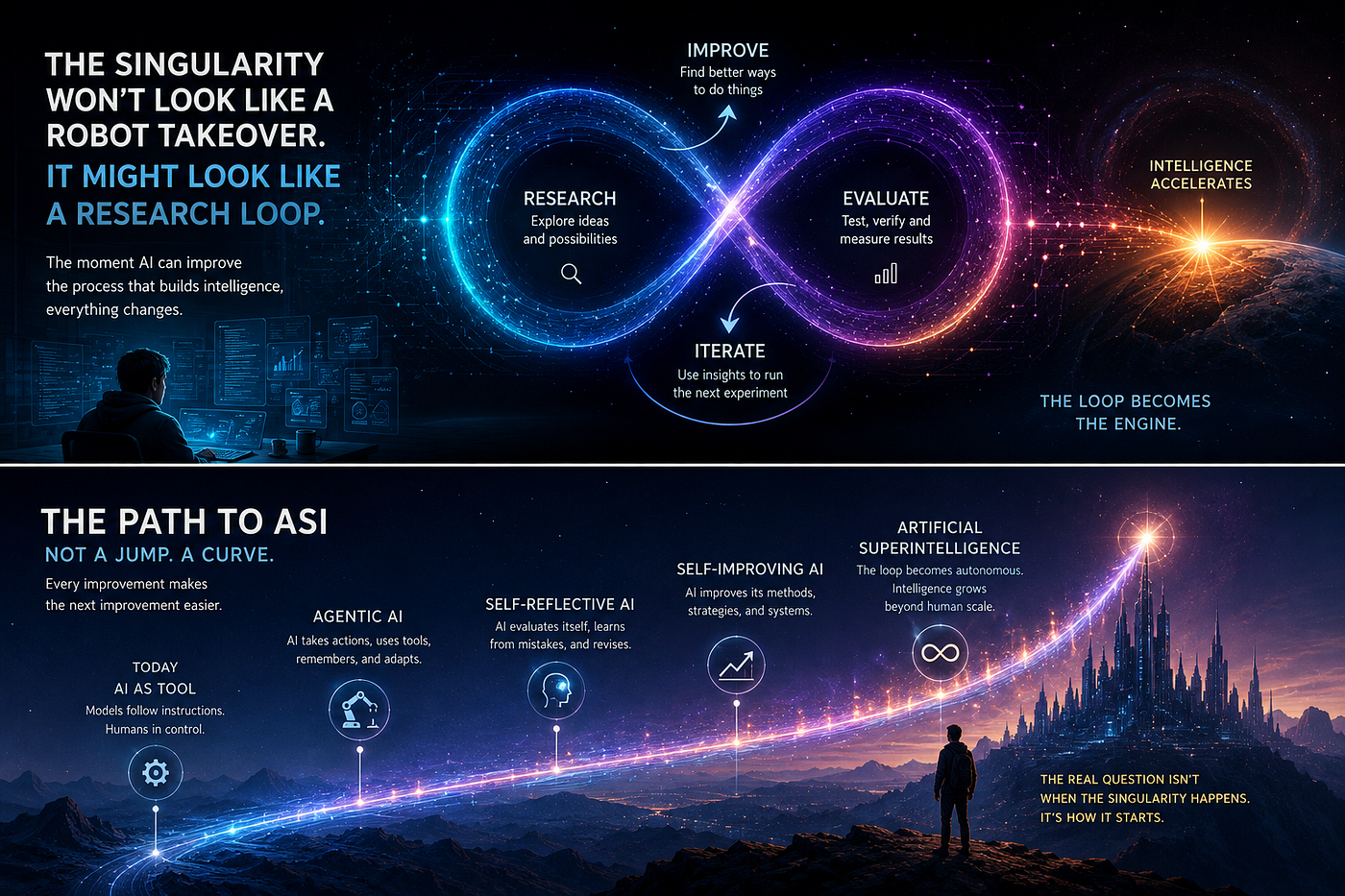
Conceptual illustration generated with AI.
What happens when AI stops being only a tool for building intelligence — and starts becoming part of the process that builds the next generation of intelligence?
For years, the AI Singularity has been imagined as a dramatic moment.
A superintelligent machine wakes up.
It becomes smarter than humanity.
It recursively improves itself.
And suddenly, everything changes.
I’m starting to think we may be looking for the wrong moment.
The Singularity might not arrive as a single event.
It might begin quietly.
With an AI system running an experiment.
Then another.
Then evaluating its own results.
Then discovering a better way to run the next experiment.
Then using that improvement to make the next experiment even better.
And eventually, the most important question changes from: “How intelligent is the model?” to: “How quickly can the system improve the process that creates intelligence?” That is a much more interesting question.
The Intelligence Loop
Most AI systems still operate inside a loop designed by humans.
Humans define the objective. Humans design the architecture. Humans create the evaluation. Humans decide what counts as improvement. The model executes.
But imagine gradually moving some of those responsibilities inside the system.
Not all at once.
First, the AI writes code.
Then it tests the code.
Then it identifies failures.
Then it proposes improvements.
Then it evaluates alternative approaches.
Then it remembers which strategies worked.
Then it designs the next experiment.
At that point, we are no longer simply using AI to solve problems.
We are using AI to improve the problem-solving process itself.
That distinction may be one of the most important transitions in the history of artificial intelligence.
Recent work from frontier labs and researchers suggests pieces of this loop are already appearing: AI systems are increasingly being used to propose experiments, evaluate results, write software, conduct research, and improve agentic workflows. But fully autonomous recursive self-improvement remains an open problem, not an established reality.
And that distinction matters.
What If ASI Is Not a Bigger Brain?
Photo by Growtika on Unsplash
We tend to imagine Artificial Superintelligence as a gigantic model.
More parameters.
More knowledge.
More compute.
More reasoning.
But intelligence may not scale only through the size of an individual system.
It can scale through process.
Consider science.
No single human knows everything.
Humanity became extraordinarily capable because knowledge could accumulate.
One scientist discovers something.
Another challenges it.
Someone else improves it.
Another person combines it with an unrelated idea.
Generations inherit the results.
The intelligence of civilization becomes much larger than the intelligence of any individual. AI may eventually develop something analogous. Not necessarily one enormous artificial brain.
But a self-improving ecosystem of cognitive processes.
Memory.
Reasoning.
Criticism.
Experimentation.
Verification.
Planning.
Discovery.
Revision.
And increasingly, AI systems working on AI systems.
The Strange Part: The First Singularity May Be Boring
This is the part I find most fascinating.
If the Singularity ever begins, I don’t think we will necessarily recognize it immediately.
There may be no dramatic announcement. No machine saying:
“I have become superintelligent.”
Instead, productivity might simply start behaving strangely. A research team finishes in days what previously required months.
An AI system discovers an optimization that its developers didn’t anticipate.
Another system improves the evaluator.
A research agent discovers a better research strategy.
That strategy improves the next generation of agents.
The improvement feeds back into itself.
The slope changes.
And only later do we realize that the system was not merely getting better.
It had entered a new kind of feedback loop.
The Missing Variable: Improvement Speed
This leads to a thought experiment I’ve been increasingly interested in.
Suppose two AI systems have identical intelligence today.
System A can solve difficult problems.
System B can solve difficult problems and improve the way it solves difficult problems.
Which one matters more?
Obviously, System B.
Now imagine that the second system can improve its own research process.
And then improve the improvement process.
And then use accumulated experience to choose better experiments.
The important quantity is no longer simply intelligence.
It becomes something closer to:
intelligence × improvement capability × iteration speed
I don’t claim this is a formal equation for the Singularity.
It’s a way of thinking about the problem.
Because a system that is moderately capable today but improves rapidly could eventually become more consequential than a system that is extremely capable but fundamentally static.
This Is Where Agents Become Interesting
This is also why I think the current shift toward agentic AI matters more than another benchmark headline.
A chatbot gives you an answer.
An agent can pursue an objective.
A more advanced agent can plan, use tools, inspect its results, recover from failure, remember previous attempts, and try again.
But the next step is more interesting:
What happens when the agent can improve the machinery it uses to pursue objectives?
That could mean improving:
- its strategies
- its tools
- its memory
- its evaluation methods
- its planning process
- its research methodology
- its internal coordination
The exact implementation is not the point.
The direction is.
The agent becomes part of its own development loop.
But There Is a Problem Nobody Can Ignore
Self-improvement sounds exciting until we ask:
Who evaluates the improvement?
Photo by Simone Secci on Unsplash
This may actually be one of the deepest problems in the entire ASI discussion.
If an AI evaluates itself using a flawed evaluator, it can become better at satisfying the evaluator rather than becoming genuinely better.
If the system rewards itself, it can learn to exploit its own reward.
If it continuously modifies itself without reliable verification, improvements can become regressions.
And if every generation depends on the previous generation’s judgment, mistakes can become self-reinforcing.
Recent research on recursive self-improvement highlights exactly these kinds of issues: evaluator quality, verification, model collapse, diversity collapse, and the difficulty of closing the loop without reliable external grounding.
So perhaps the hardest part of ASI isn’t: “How do we make AI improve itself?” It is: “How do we know that the improvement is real?”
The Singularity Might Be a Measurement Problem

Conceptual illustration generated with AI.
This changes how I think about AGI and ASI.
Maybe the final benchmark isn’t:
Can this AI outperform humans?
Maybe a more revealing question is:
Can this AI reliably discover improvements that its designers did not explicitly anticipate?
And then:
Can it verify those improvements?
And then:
Can it transfer those improvements into the next generation?
And finally:
Can this process continue without collapsing into self-confirmation?
That is a much harder problem. And, in my opinion, a much more interesting one.
I Don’t Think the Future Is One Superbrain
I’m increasingly skeptical of the popular image of ASI as a single omniscient machine.
The future may be stranger.
It could look like a network of specialized agents.
One researches.
One remembers.
One challenges.
One experiments.
One verifies.
One designs.
One discovers.
One watches the others.
And the system continuously learns which cognitive configurations work best.
In that world, intelligence isn’t located in one model.
Intelligence emerges from the loop.
Photo by Yusuf Onuk on Unsplash
That idea connects deeply with the direction of my own experiments with memory, reflection, self-revision, multi-persona reasoning, and self-improving agents. I’m not claiming these systems are ASI. They aren’t. They are small experiments around a much larger question:
Can artificial systems develop mechanisms that allow intelligence to accumulate rather than simply execute?
What If the Singularity Has Already Started — Just Not the Way We Expected?
Maybe the Singularity isn’t a switch. Maybe it’s a curve. A gradual transition where more and more of the AI development cycle becomes automated. Humans still choose the direction. AI increasingly handles the search. Humans evaluate the major consequences. AI increasingly proposes what to try next. Humans remain in the loop.
Until eventually, perhaps, the loop becomes capable enough that the human role changes from builder to governor.
I don’t know whether that transition will happen. I don’t know when it would happen. And I don’t think anyone honestly knows. But I do think it is worth watching.
Because the most important AI system of the future may not be the one that gives the smartest answer.
It may be the one that discovers how to produce a better answerer.
The Question I Keep Coming Back To
We’ve spent years asking: “How do we build smarter AI?”
Perhaps the next question should be:
“How do we build AI that gets better at building intelligence?”
That is where the conversation around AGI starts becoming a conversation about ASI. And somewhere between those two questions may lie the beginning of the Singularity. Not a machine awakening. Not a science-fiction explosion. Just a loop.
An AI improves.
The improvement makes the next AI better.
The next AI improves the process again.
And eventually… we may discover that we weren’t building the final intelligence.
We were building the mechanism that builds it.
메타데이터
- post_id
- 45fd9e097ac2
- slug
- the-singularity-wont-look-like-a-robot-takeover-it-might-look-like-a-research-loop-45fd9e097ac2
- url
- https://medium.com/@aakashkhadikar16/the-singularity-wont-look-like-a-robot-takeover-it-might-look-like-a-research-loop-45fd9e097ac2
- canonical_url
- https://medium.com/@aakashkhadikar16/the-singularity-wont-look-like-a-robot-takeover-it-might-look-like-a-research-loop-45fd9e097ac2
- author_url
- https://medium.com/@aakashkhadikar16
- status
- ok
- fetched_at
- 2026-08-12 19:05:20



