Logistics Robots Market Growth Fueled by AI Robotics
1. Logistics Robots Market Overview
Logistics Robots Market Growth Fueled by AI Robotics
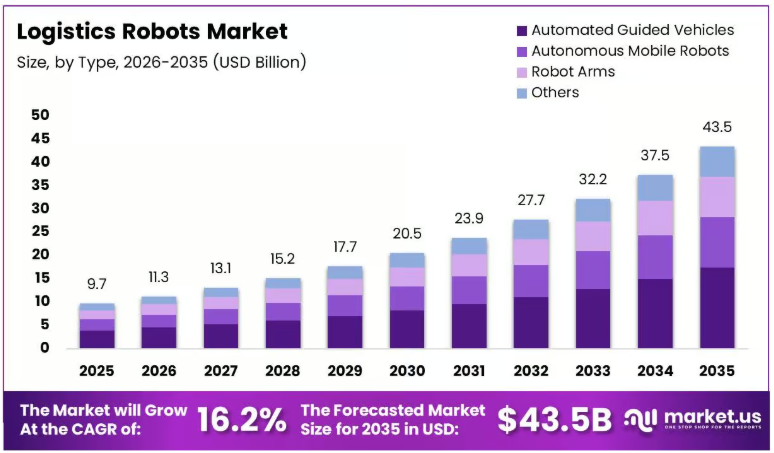
1. Logistics Robots Market Overview
Evolution of Robotics in Logistics
The Logistics Robots Market has transformed dramatically over the last decade as organizations seek greater operational efficiency and supply chain resilience. Warehouses that once relied primarily on manual labor are increasingly integrating robotic systems capable of handling repetitive, labor-intensive, and precision-driven tasks. This transition has been fueled by the rapid expansion of global trade, e-commerce, and digital supply chain ecosystems.
Get the Sample Report link :https://market.us/report/global-logistics-robots-market/request-sample/
Modern logistics robots are equipped with sophisticated navigation systems, real-time sensors, and intelligent software that allow them to operate with remarkable precision. From autonomous transportation of goods to automated inventory management, these solutions have become indispensable assets for organizations striving to remain competitive in a rapidly evolving marketplace.
Key Market Drivers and Business Impact
Several macroeconomic and technological factors continue to accelerate market growth. Rising labor shortages, increasing warehouse complexity, and growing customer expectations for faster deliveries are compelling businesses to invest in robotic automation.
Companies implementing logistics robots benefit from enhanced productivity, minimized operational errors, lower long-term costs, and improved workplace safety. These advantages collectively strengthen supply chain efficiency while enabling organizations to scale operations with greater flexibility.
2. Technological Innovations Reshaping the Industry
Artificial Intelligence and Machine Learning Integration
Artificial intelligence has become the cognitive foundation of modern logistics robotics. Advanced algorithms enable robots to optimize routes, recognize objects, analyze warehouse traffic, and make autonomous operational decisions.
Machine learning further enhances these capabilities by allowing robotic systems to continuously improve through experience. Instead of relying solely on predefined programming, intelligent robots adapt to changing warehouse environments, creating more efficient workflows over time.
Autonomous Mobile Robots and Warehouse Automation
Autonomous Mobile Robots (AMRs) represent one of the fastest-growing segments within the Logistics Robots Market. Unlike traditional automated systems that require fixed infrastructure, AMRs navigate dynamically using cameras, LiDAR, and advanced mapping technologies.
These robots streamline order fulfillment, inventory transportation, and material handling while significantly reducing idle time. Their scalability makes them suitable for both small distribution centers and massive fulfillment facilities, supporting operational expansion without extensive infrastructure modifications.
3. Industry Applications and Market Opportunities
E-commerce, Manufacturing, and Retail Adoption
The explosive growth of e-commerce has significantly increased demand for warehouse automation. Logistics robots enable rapid picking, sorting, packaging, and shipment processing, helping retailers meet increasingly stringent delivery expectations.
Manufacturing facilities also leverage robotic systems for internal logistics, component transportation, and inventory optimization. Retail supply chains similarly benefit through enhanced stock replenishment, improved distribution accuracy, and better inventory visibility across multiple locations.
Challenges and Emerging Investment Opportunities
Despite substantial growth potential, market participants face challenges including high implementation costs, cybersecurity concerns, integration complexity, and workforce training requirements.
However, these obstacles are creating opportunities for software developers, robotics manufacturers, cloud service providers, and system integrators. As robotic technologies become more affordable and modular, adoption is expected to expand across organizations of every size.
4. Future Outlook of the Logistics Robots Market
Trends Influencing Market Expansion
Future market development will be shaped by AI-driven automation, collaborative robotics, predictive maintenance, cloud connectivity, digital twins, and advanced warehouse analytics. Sustainability initiatives are also encouraging the deployment of energy-efficient robotic platforms that reduce operational waste.
The continued evolution of intelligent sensors and edge computing will further improve robotic autonomy, enabling faster decision-making and enhanced operational performance.
Strategic Outlook for Stakeholders
Organizations that prioritize robotic innovation today will be better positioned to address future supply chain challenges. Strategic investments in scalable automation technologies can strengthen operational resilience while improving customer satisfaction and profitability.
As technological sophistication continues to increase, the Logistics Robots Market will remain a cornerstone of next-generation supply chain transformation, delivering long-term value across manufacturing, retail, healthcare, transportation, and e-commerce industries.
메타데이터
- post_id
- 4613d7aa2cc2
- slug
- logistics-robots-market-growth-fueled-by-ai-robotics-4613d7aa2cc2
- url
- https://medium.com/@tommurray6044/logistics-robots-market-growth-fueled-by-ai-robotics-4613d7aa2cc2
- canonical_url
- https://medium.com/@tommurray6044/logistics-robots-market-growth-fueled-by-ai-robotics-4613d7aa2cc2
- author_url
- https://medium.com/@tommurray6044
- status
- ok
- fetched_at
- 2026-07-31 14:10:08