America’s National Game: 1920
Second in a season-long series
America’s National Game: 1920
Second in a season-long series: Ruth, Foster, Jackson

Happy Birthday, US (or us!)
This week, let’s review 1920, a momentous year for baseball and America. I will focus not on a single moment, as with FDR’s greenlight letter, but instead on three individuals: Babe Ruth, Rube Foster, and Joe Jackson. For each of them, it may be said that they changed the game and the nation, up to the present day. When baseball people argue over whether the game’s “modern era” began in 1900, 1901, or 1903 … the only defensible answer is 1920.
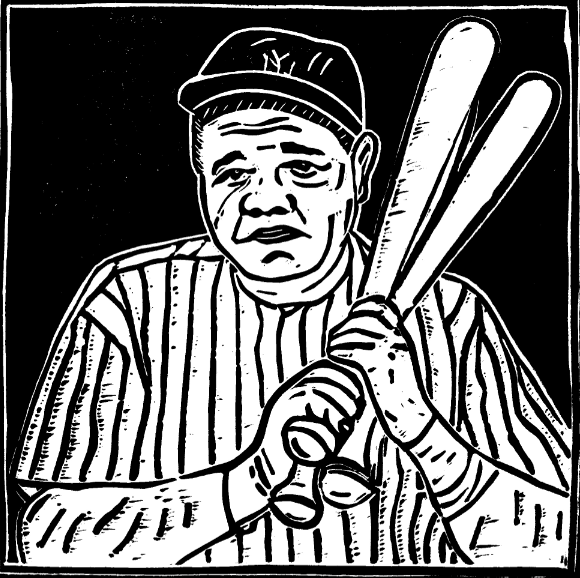
So much has been written about The Babe that I can offer, within these confines, only a slice view of his enduring impact. Like Shohei Ohtani, his modern counterpart, he was a pitcher and a slugger. In 1918 as a part-time outfielder, he hit 11 homers, none of them in his home park — Fenway then had distant fences for a lefty batter (right of dead center, 510 feet). This figure led the league.

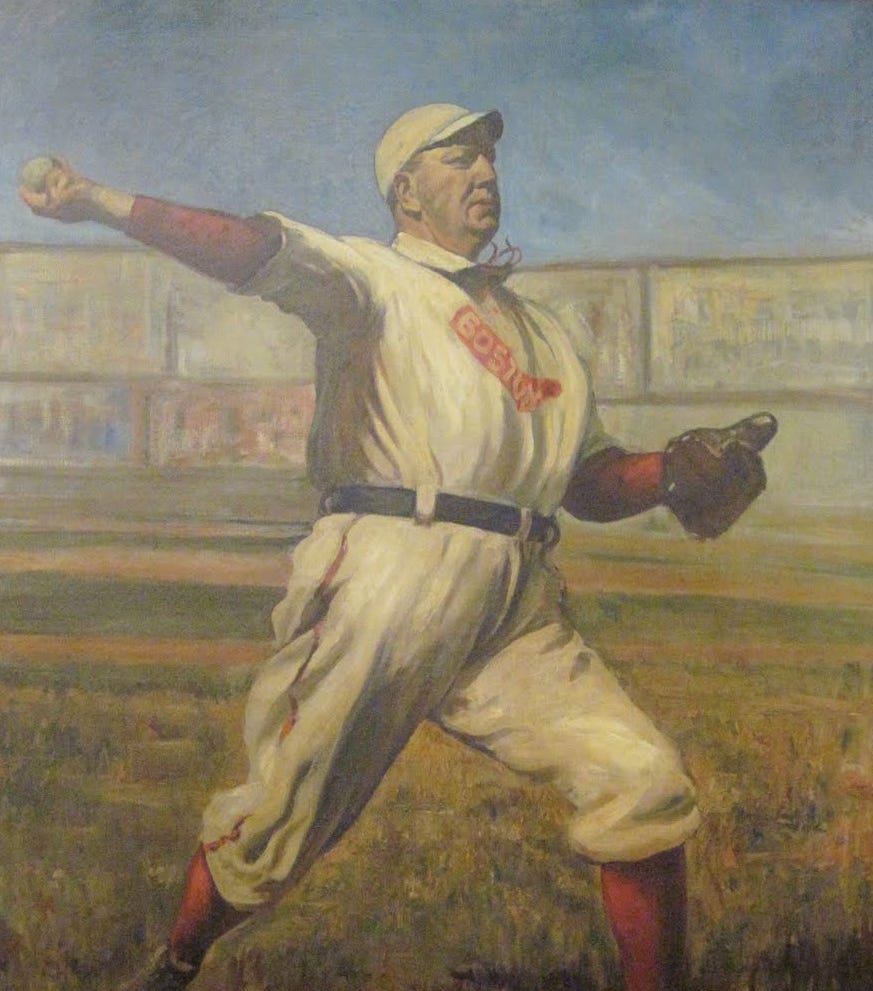
Babe Ruth, 1919
Then in 1919, as more nearly an everyday player — in the outfield for 111 games against only 17 pitching appearances — he exploded for 29 home runs, all but nine on the road. He broke the major league record of 27, set in 1884 by Ned Williamson, a right-handed batter who benefited from a short left-field fence in Chicago. Ruth’s record-breaking 28th home run sailed over the right-field grandstand at the Polo Grounds, home at that time to both the landlord Giants and the tenant Yankees. It was reported as the longest drive anyone had ever seen, including any by Joe Jackson, whose all-out swing Ruth had copied.
So, when Ruth declared his intention not to play with the Red Sox in 1920 unless they doubled his $10,000 salary, New York must have quivered with a sense of opportunity. On his way from Boston to Hollywood, where he was set to star in a feature film, Ruth declared, “I feel that I made a bad move last year when I signed a three years’ contract to play for $30,000.” Two months later, still out west, he added that he could easily make $10,000 a year in the boxing ring as well as the movies (he had made $25,000 for a few weeks’ effort in Headin’ Home).

Babe Ruth, Headin’ Home, 1920
But the Red Sox finished sixth, and owner Harry Frazee, needing money to invest in a Broadway show, sold Ruth to the Yankees for $100,000 (via four annually dated promissory notes, at 6 percent interest) and a $300,000 loan, collateralized by Fenway Park. The deal was done on December 26, 1919 but awaited Ruth’s acquiescence to an increased salary; he was still in California.
The transaction became known, by way of Dan Shaughnessy, as the “Curse of the Bambino.” Boston, which had won the World Series five times, the latest with Ruth pitching, would not claim another title for the rest of the century; the Yankees, who had never captured a pennant prior to Ruth’s arrival, would become a dynasty, winning the championship year after year.

First of four promissory notes from Jacob Ruppert to Harry Frazee, December 26, 1919
On January 5, 1920 it was announced to the press that Ruth was now a Yankee. By hitting 54 circuit clouts in his first year with his new club and 59 in his second, he became The Big Bam, the home-run hero and, with the advent of radio and newsreel footage, a culture hero. Fans across the nation, even if they had never seen him play, knew him.
In mid-1921 Ruth took the lead in career homers, a record he would hold until 1974. Beyond his death in 1948 at 53 (the same age as Jackie Robinson, the hero to be featured next week), he enlivened the game, even pointing the way to sabermetrics. When the New York Times announced Ruth’s sale on January 6, the unknown writer commented, “The short right field wall at the Polo Grounds should prove an easy target for Ruth next season and, playing seventy-seven games at home, it would not be surprising if Ruth surpassed his home-run record of twenty-nine circuit clouts next Summer.”

Andrew “Rube” Foster
Six weeks later, on February 13, 1920, Andrew “Rube” Foster, formerly a star pitcher with several Black clubs and now the co-owner of the Chicago American Giants, founded the first successful Negro League. (There had been short-lived attempts as early as 1887, with the League of Colored Base Ball Clubs.) In a meeting at the Paseo YMCA in Kansas City, Missouri, Foster brought together eight independent baseball team owners to create the Negro National League, which he served as president and treasurer.
In 1903 Andrew Foster had won four games in the best-of-seven championship series against Sol White’s Philadelphia Giants. Describing his style in later years he said, “I have often smiled with the bases full and two strikes and three balls on the hitter. This seems to unnerve them.” When he bested Rube Waddell of the Philadelphia Athletics in an exhibition game that year, fans called him “the Black Rube,” and the nickname stuck.

Pitcher Rube Foster, with Chicago’s Leland Giants in 1909
Before the 1911 season started, Foster formed a partnership with Chicago tavern-owner (and son-in-law of Charles Comiskey) John C. Schorling and created the Chicago American Giants, who played their home games in old South Side Park — where the White Sox had played before 1910.
In 1920, for the new Negro National League, Foster took total control of the fragile circuit. He handled all bookings, was responsible for settling all disputes, and hired the umpires, while continuing as manager of the Giants. As the league grew stronger by the mid-1920s, it spawned imitators. A Southern Negro League soon formed, as did the Eastern Colored League. But the herculean effort of building Black baseball took its toll on Foster. Committed to the Kankakee State Hospital following a nervous breakdown in 1926, he died there in 1930.

Schorling Park in 1925
Eight years later, in the May issue of The Crisis, founded by W.E.B. Du Bois as the monthly of the NAACP, H.B. Webber and Oliver Brown wrote:
Negro baseball is not a new development. It has a long and fascinating history. To the immortal Rube Foster goes the credit for being the person to pioneer in giving our race organized baseball. Previous to this, Negro baseball was of an independent, gaudy type, resembling and retaining most of the objectionable features of the traveling carnival. Owners reaped a rich harvest in playing independent white ball clubs. For this Negro baseball suffered. White fans, who attended and supported the major leagues, looked upon these contests as mere novelty and usually judged the caliber of Negro players by their success against third-rate independent white clubs.
Foster was the first to recognize the absence of the sincere competitive element in these exhibition games. If Negro baseball was to survive and gain the recognition it deserved it had to outgrow the independent, mercenary stage. To achieve this goal, Rube Foster organized the first Negro baseball league in 1920.

The Crisis, May 1938, featuring Josh Gibson
In 2020, the centennial season of Foster’s brainstorm, Commissioner Rob Manfred confirmed his legacy by recognizing the Negro National League, and six other circuits that followed, as major leagues. They now have statistical entries in the official records alongside those of other leagues, teams, and players since 1876.

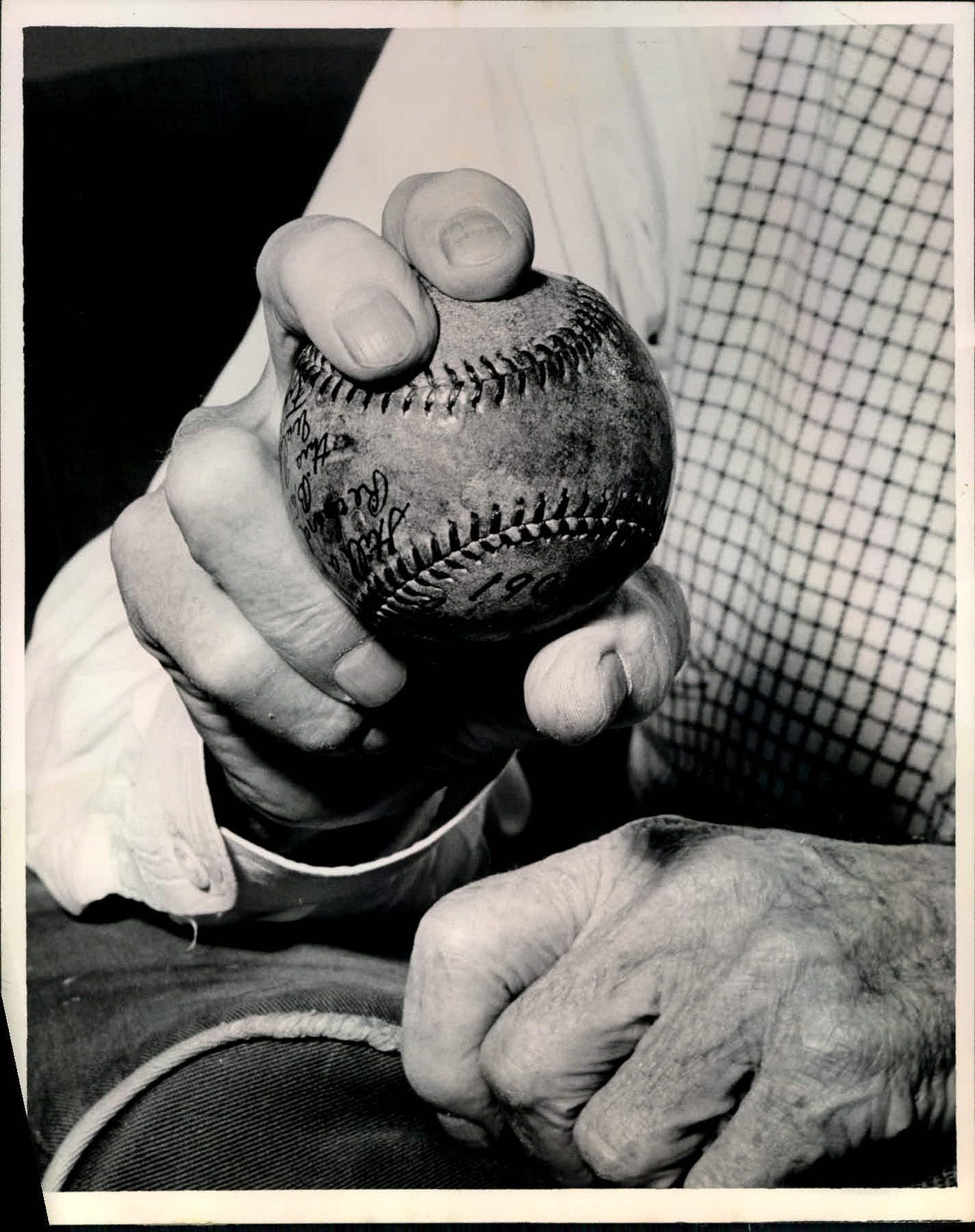
Joe Jackson batting grip, 1918
Last, I highlight Joe Jackson and his Black Sox: the eight men who conspired to throw the World Series of 1919. Jackson not only influenced the slugging style of Babe Ruth but also, like Rube Foster, paved the way for MLB to alter past understandings.

Joe Jackson in the courtroom
Rumors of The Fix had been rampant all season long among players and scribes; suspicion attached to several White Sox games in 1920. But on September 27, all hell broke loose as Jimmy Isaminger of the Philadelphia North American revealed the story. Jackson and Eddie Cicotte had spoken in court about their roles in The Fix; both had accepted gamblers’ cash. Although the Yankees had fallen out of the pennant race, despite Ruth’s exploits, the Chisox were only half a game back on that date, but they lost two of their last three games, handing the flag to Cleveland.

In the wake of Isaminger’s story, newspapers across the nation piled on
Despite their eventual acquittal in court, the eight Black Sox, including Jackson, were banned for life by Commissioner Landis, newly installed by the club owners to restore integrity to the game. Some, including Jackson, appealed their bans repeatedly, but MLB stood firm even after Landis died in 1944; the bans were not lifted even as each of the Black Sox died.
Jackson, whose .356 lifetime batting average was behind only those of Ty Cobb and Rogers Hornsby (and, after MLB’s inclusion of Negro League stats, Oscar Charleston), was blocked from further consideration for the Hall of Fame because of his “permanent ineligibility.” He had previously appeared on the ballot, in both 1936 and 1946, without being voted in. In 2025 Commissioner Manfred clarified that MLB had no interest in extending its ban to the deceased, and a result is that Jackson would now once again become eligible for consideration for the pantheon in Cooperstown.
메타데이터
- post_id
- 46182dd7bbf3
- slug
- americas-national-game-1920-46182dd7bbf3
- url
- https://ourgame.mlblogs.com/americas-national-game-1920-46182dd7bbf3
- canonical_url
- https://ourgame.mlblogs.com/americas-national-game-1920-46182dd7bbf3
- author_url
- https://medium.com/@thorn_john_87223
- status
- ok
- fetched_at
- 2026-08-05 02:45:33