Limitations of Modern Portfolio Theory in Real Markets: What Investors Should Know
Modern Portfolio Theory changed the way investors think about diversification, portfolio risk, and asset allocation. Instead of evaluating…
Limitations of Modern Portfolio Theory in Real Markets: What Investors Should Know
Modern Portfolio Theory changed the way investors think about diversification, portfolio risk, and asset allocation. Instead of evaluating every investment separately, it encourages investors to study how different assets work together within a portfolio.
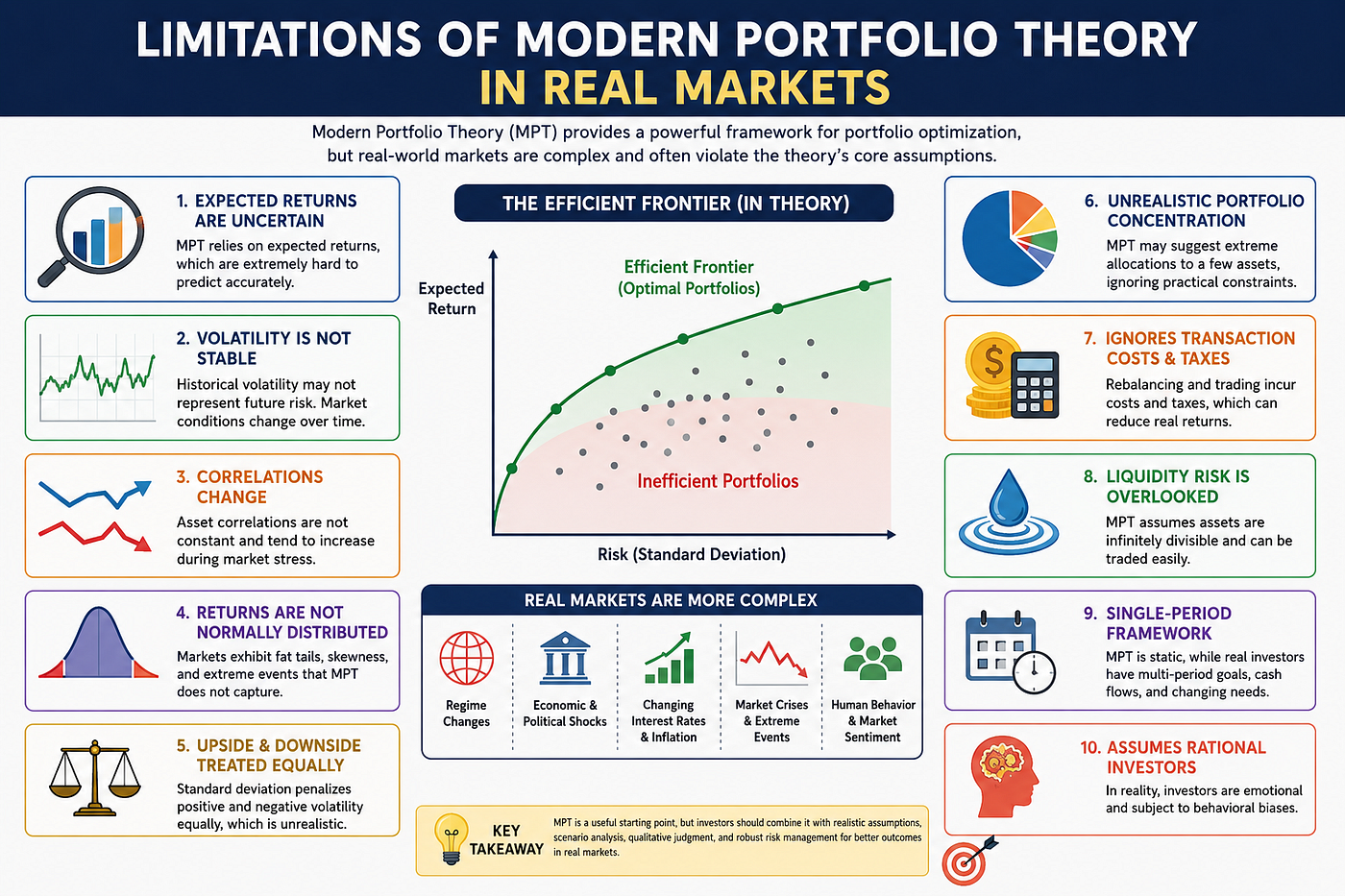
Limitations of Modern Portfolio Theory
The theory provides a mathematical framework for identifying combinations of assets that may offer the highest expected return for a chosen level of risk. It also helps investors understand why a diversified portfolio may carry less risk than a collection of highly correlated investments.
However, the limitations of Modern Portfolio Theory become clearer when its assumptions are applied to real financial markets. Expected returns are uncertain, correlations change, market declines are rarely symmetrical, and investors do not always behave rationally.
Investors can use the Efficient Frontier Calculator to explore how expected returns, volatility, correlations, and portfolio weights influence an efficient portfolio. However, the calculator’s output should support investment analysis rather than replace market research, technical confirmation, or risk management.
What Is Modern Portfolio Theory?
Modern Portfolio Theory, often called MPT, is a portfolio-construction framework associated with economist Harry Markowitz. It evaluates investments by considering two main variables:
- Expected return
- Risk, usually represented by variance or standard deviation
The basic idea is that investors should not select assets only because of their individual return potential. They should also consider how the returns of those assets move in relation to one another.
For example, two stocks may both be volatile. However, if they do not usually rise and fall at the same time, combining them may reduce the volatility of the overall portfolio.
MPT uses expected returns, standard deviations, asset weights, and correlations to calculate possible portfolio combinations. These combinations can then be displayed on an efficient frontier.
A portfolio located on the efficient frontier offers the highest expected return for a specified level of modeled risk, or the lowest modeled risk for a specified expected return.
This framework remains useful. Yet the quality of its output depends heavily on the quality of its assumptions and inputs.
Why Modern Portfolio Theory Still Matters
Before discussing the limitations of Modern Portfolio Theory, it is important to understand why the framework remains influential.
MPT introduced a disciplined method for comparing risk and return. It demonstrated that diversification should not simply mean owning many investments. Effective diversification depends on how those investments interact.
The theory also helped formalize several important investment principles:
- Portfolio risk depends on covariance and correlation.
- Asset allocation can influence long-term results.
- Higher expected returns usually require accepting greater uncertainty.
- An asset should be evaluated within the portfolio rather than in isolation.
- Diversification may reduce asset-specific risk.
These concepts remain relevant for individual investors, portfolio managers, financial advisers, pension funds, and institutional investors.
The problem does not lie in using Modern Portfolio Theory. The problem arises when an investor treats its calculated portfolio as a precise prediction of future market behavior.
1. Expected Returns Are Difficult to Forecast
One of the biggest limitations of Modern Portfolio Theory is its dependence on expected returns.
An optimization model needs an expected return for every asset. Investors commonly estimate this number using historical average returns, analyst forecasts, valuation models, or economic assumptions.
None of these methods can reliably predict the future.
A stock that produced strong returns over the previous ten years may underperform during the next decade. A bond market that benefited from falling interest rates may behave differently when rates rise. A high-growth sector may lose momentum when valuations become excessive.
Even small changes in expected-return estimates can produce major changes in the recommended portfolio.
Suppose an optimization model expects Asset A to return 9% and Asset B to return 7%. The model may allocate a large weight to Asset A. If the forecast for Asset A falls to 7.5%, the recommended allocation could change significantly.
This sensitivity can create what appears to be mathematical precision without dependable forecasting accuracy.
Investors should therefore test several expected-return scenarios instead of relying on one estimate. Conservative, base-case, and optimistic assumptions can reveal whether the portfolio remains reasonable under different conditions.
2. Historical Volatility May Not Represent Future Risk
Modern Portfolio Theory typically uses standard deviation as a measure of risk. Standard deviation estimates how widely an asset’s returns fluctuate around its average return.
Historical volatility is easy to calculate, but it is backward-looking.
A low-volatility asset can suddenly become highly volatile after an earnings shock, regulatory change, geopolitical event, liquidity crisis, or shift in monetary policy. Similarly, an asset that was volatile during a previous period may become more stable under different conditions.
The measurement period also affects the result.
A one-year estimate may reflect current market conditions but include too little data. A ten-year estimate may provide a larger sample but mix several different economic environments.
Portfolio risk is not fixed. It evolves as market conditions change.
Investors should combine historical volatility with forward-looking judgment, stress testing, drawdown analysis, liquidity assessment, and position limits. Standard deviation may help describe normal fluctuations, but it cannot capture every form of investment risk.
3. Correlations Are Not Stable
Diversification in Modern Portfolio Theory depends heavily on correlations between assets.
Correlation measures how closely two investments move together. A correlation near positive one indicates that the assets tend to move in the same direction. A correlation near negative one suggests that they often move in opposite directions.
Low or negative correlations can improve diversification. However, historical correlations frequently change.
Stocks and bonds may display low correlation during one economic period and higher correlation during another. International equity markets may appear diversified during normal conditions but fall together during a global crisis. Different technology stocks may behave independently until a sector-wide sell-off begins.
This creates a serious real-market limitation: the diversification benefit investors expect may weaken when it is needed most.
A portfolio optimized with calm-period correlations can underestimate risk during a market shock.
Investors should review correlations across multiple periods and market environments. They should examine how assets behaved during inflation shocks, recessions, rate increases, credit stress, and sharp equity declines.
Diversification should be evaluated under difficult conditions, not only under average conditions.
4. Standard Deviation Treats Upside and Downside Volatility Equally
Modern Portfolio Theory generally treats all variation around the average return as risk.
However, investors do not usually view upside and downside movements in the same way.
A sudden 10% gain increases standard deviation, but most investors do not consider that gain harmful. A sudden 10% loss may create financial stress, force liquidation, or disrupt a long-term plan.
Standard deviation is therefore an incomplete measure of practical investment risk.
Many investors are more concerned about:
- Maximum drawdown
- Permanent loss of capital
- Downside deviation
- Probability of failing to meet a financial goal
- Sequence-of-returns risk
- Liquidity during a crisis
- Time required to recover from a loss
A portfolio may appear efficient based on variance while remaining exposed to severe downside events.
This is why investors may also use the Sortino ratio, value at risk, expected shortfall, drawdown analysis, scenario testing, and stress testing. No single risk measure captures every danger.
5. Investment Returns Are Not Always Normally Distributed
Many simplified applications of Modern Portfolio Theory assume that investment returns behave in a relatively normal or symmetrical pattern.
Real-market returns often show skewness, fat tails, sudden gaps, volatility clustering, and extreme events.
Large market movements may happen more frequently than a normal-distribution model suggests. Financial crises, unexpected policy decisions, corporate failures, wars, pandemics, and liquidity shocks can produce outcomes far outside ordinary expectations.
These events matter because rare losses can have a major effect on compounded wealth.
A portfolio that loses 50% must subsequently gain 100% to return to its original value. Therefore, extreme downside events deserve greater attention than their apparent probability might suggest.
Investors should avoid interpreting efficient-frontier results as guarantees. Stress tests should include scenarios that are more severe than recent historical experience.
6. The Model Can Produce Concentrated Portfolios
Although Modern Portfolio Theory is closely associated with diversification, an unconstrained optimization can produce surprisingly concentrated allocations.
If one asset has a slightly higher expected return, lower volatility, or more favorable correlation estimate, the model may allocate an excessive portion of the portfolio to it.
The result may be mathematically efficient but practically unsuitable.
A portfolio could become heavily dependent on one sector, country, currency, factor, commodity, or investment style. Small forecasting errors would then have a large impact.
Professional portfolio construction usually includes practical constraints, such as:
- Maximum weight per asset
- Maximum sector exposure
- Regional limits
- Minimum diversification requirements
- Liquidity thresholds
- Leverage limits
- Currency exposure limits
These restrictions may move the portfolio away from the mathematically ideal frontier. However, they can make it more robust and realistic.
7. Transaction Costs Are Often Ignored
A basic Modern Portfolio Theory model may assume that investors can buy, sell, and rebalance assets without cost.
Real investing involves friction.
These costs may include brokerage charges, taxes, bid-ask spreads, fund expenses, market impact, currency-conversion costs, and early-redemption penalties.
A portfolio optimizer may recommend frequent changes because expected returns or correlations have shifted slightly. However, repeatedly trading to maintain an exact target allocation can reduce returns.
A theoretically superior allocation may become inferior after costs.
Investors should rebalance only when the expected benefit justifies the expense. A tolerance-band approach can help. Under this method, the investor trades only when an asset’s weight moves beyond an acceptable range.
For example, an investor targeting a 20% allocation may rebalance only when the weight falls below 17% or rises above 23%.
8. Liquidity Risk Is Not Fully Captured
Two assets can show similar historical volatility while having very different liquidity characteristics.
A large-cap stock or government bond may be traded quickly with limited price impact. A small-cap stock, private investment, thinly traded bond, or specialized fund may be difficult to sell during market stress.
Standard deviation alone may not capture this difference.
Liquidity can disappear when many investors try to sell at the same time. Bid-ask spreads may widen, transaction costs may increase, and market prices may fall below reasonable estimates of value.
An efficient portfolio must therefore consider more than return, volatility, and correlation.
Investors should examine trading volume, market depth, redemption terms, settlement periods, ownership concentration, and the ability to raise cash under pressure.
9. Modern Portfolio Theory Uses a Single-Period Framework
Traditional mean-variance analysis often treats portfolio selection as a single-period decision.
Real investors operate across multiple periods. They receive income, make withdrawals, pay taxes, rebalance holdings, change goals, and respond to new market information.
A retirement investor may need regular cash flow. A young investor may make monthly contributions. A business owner may require liquidity on a specific future date.
These differences can materially affect the appropriate portfolio.
A portfolio that looks efficient over one year may not be suitable for a 25-year retirement plan. Similarly, a high-return portfolio may be inappropriate for an investor who needs cash within six months.
Portfolio optimization should be connected to time horizon, liabilities, cash-flow requirements, tax position, and financial objectives.
10. Investors Do Not Always Behave Rationally
Modern Portfolio Theory assumes that investors make rational choices based on expected return and risk.
Behavioral finance shows that real investors are influenced by fear, greed, overconfidence, loss aversion, recency bias, confirmation bias, and herd behavior.
An investor may select an optimized portfolio during a calm period but abandon it during a market decline. Another investor may increase risk after strong returns or sell after prices have already fallen sharply.
The mathematically optimal portfolio is useless if the investor cannot remain committed to it.
Practical portfolio construction must account for emotional tolerance, not only statistical risk tolerance.
An investor who panics during a 20% decline should not hold a portfolio that regularly experiences losses of that size, even when the long-term expected return appears attractive.
11. Personal Goals Are More Complex Than Risk and Return
Investors do not invest simply to maximize expected return or minimize volatility. They invest to achieve goals.
These goals may include retirement, education, homeownership, financial independence, wealth preservation, charitable giving, or leaving an inheritance.
Two investors with identical wealth and age may require different portfolios because their goals, income stability, family responsibilities, liabilities, and emotional preferences differ.
Modern Portfolio Theory can help with asset allocation, but it cannot determine what matters most to a particular investor.
A goal-based approach asks a different question. Instead of asking which portfolio is statistically efficient, it asks which portfolio provides a reasonable probability of achieving a defined objective.
12. Taxes Can Change the Efficient Allocation
Taxes can significantly affect investment returns.
Interest income, dividends, short-term gains, long-term gains, and tax-advantaged accounts may receive different treatment. The same investment can therefore produce different after-tax returns for different investors.
A basic efficient-frontier calculation may use pretax returns. Yet investors ultimately keep after-tax returns.
Asset location also matters. An investor might hold tax-inefficient assets in a retirement account and tax-efficient assets in a taxable account.
A portfolio that appears optimal before taxes may not remain optimal after taxes. Investors should therefore evaluate after-tax expected returns where relevant.
13. Market Regimes Change
Financial markets move through changing regimes.
Growth, inflation, interest rates, liquidity, credit conditions, and investor sentiment can shift over time. An asset allocation that performs well during falling inflation may struggle during rising inflation. A strategy that benefits from low interest rates may weaken when borrowing costs increase.
Modern Portfolio Theory often assumes that estimated relationships remain sufficiently stable. In practice, structural changes can make historical data less relevant.
Investors should monitor market context and avoid treating portfolio optimization as a one-time exercise.
The portfolio should be reviewed periodically, although frequent changes based on short-term noise should also be avoided.
14. The Efficient Frontier Is an Estimate, Not a Permanent Boundary
An efficient frontier is calculated from selected inputs. Change those inputs, and the frontier changes.
It is not a fixed law of the market. It is a model-based estimate based on assumptions about future returns, volatility, and correlation.
Several investors can use the same assets and produce different efficient frontiers because they use different time periods, return forecasts, data frequencies, constraints, or risk-free rates.
The output should therefore be interpreted as a decision-support tool.
The chart helps investors visualize trade-offs. It does not identify a portfolio that is guaranteed to outperform.
How Investors Can Use Modern Portfolio Theory More Effectively
Despite its limitations, Modern Portfolio Theory remains useful when investors apply it carefully.
First, use realistic and conservative assumptions. Avoid assigning high expected returns simply because an asset performed well recently.
Second, test multiple scenarios. Change returns, volatility, and correlations to determine whether the proposed portfolio remains stable.
Third, add practical constraints. Limit excessive exposure to individual assets, sectors, regions, and currencies.
Fourth, consider additional risk measures. Review maximum drawdown, downside deviation, liquidity, concentration, and potential losses during market shocks.
Fifth, include transaction costs and taxes when they are material.
Sixth, match the portfolio to the investor’s goals, time horizon, cash-flow needs, and ability to tolerate losses.
Finally, monitor the portfolio and rebalance with discipline rather than emotion.
Combining Portfolio Theory With Market Analysis
Modern Portfolio Theory is primarily an asset-allocation framework. It does not replace fundamental analysis, technical analysis, or risk controls.
Fundamental analysis can help investors evaluate valuations, earnings, balance sheets, economic conditions, and long-term business quality.
Technical analysis can help identify trends, support and resistance levels, momentum, volatility changes, and potential entry or exit zones. Volume can indicate whether market participation supports a price movement.
Financial astrology may also be studied as an additional timing layer by investors who follow planetary cycles. However, it should never be treated as a guaranteed forecasting method or a substitute for market evidence.
The Financial Astrology Terminal brings together market data, charts, watchlists, global stocks, indices, commodities, and financial astrology timing insights. Investors can use these resources to study market context while keeping technical confirmation and risk management at the center of every decision.
The practical principle remains clear: Financial astrology prepares, technical analysis confirms, volume validates, and risk management protects.
Risk Management Still Comes First
No optimization model eliminates investment risk.
Every portfolio needs a risk-management framework. This may include position sizing, diversification limits, liquidity reserves, periodic rebalancing, and predefined rules for reducing exposure.
Traders should also consider stop-loss levels, risk-reward ratios, support and resistance, trend direction, and volume confirmation.
Long-term investors may not use tight stop-loss orders, but they still need a plan for controlling concentration, managing drawdowns, and responding to changes in the original investment thesis.
An efficient portfolio on paper can still suffer losses. Risk management determines whether those losses remain manageable.
Conclusion
Modern Portfolio Theory remains one of the most important frameworks in portfolio management. It teaches investors to examine the relationship between assets, consider risk alongside return, and build portfolios through thoughtful diversification.
However, the limitations of Modern Portfolio Theory cannot be ignored.
Expected returns are uncertain. Historical volatility may not represent future risk. Correlations can rise during crises. Standard deviation treats positive and negative volatility equally. Transaction costs, taxes, liquidity, market regimes, investor behavior, and personal financial goals add further complexity.
The efficient frontier should therefore be used as a flexible analytical guide rather than an exact prediction.
Explore different allocations with the Efficient Frontier Calculator. Adjust expected returns, volatility, and correlations to understand how changing assumptions can affect portfolio risk and return.
Use the result alongside fundamental research, technical confirmation, market context, diversification controls, and disciplined risk management. A strong portfolio is not simply the one with the best mathematical output. It is the one that remains practical, resilient, and aligned with the investor’s real financial objectives.
메타데이터
- post_id
- 461d2e5a9450
- slug
- limitations-of-modern-portfolio-theory-in-real-markets-what-investors-should-know-461d2e5a9450
- url
- https://medium.com/@techiteindia/limitations-of-modern-portfolio-theory-in-real-markets-what-investors-should-know-461d2e5a9450
- canonical_url
- https://medium.com/@techiteindia/limitations-of-modern-portfolio-theory-in-real-markets-what-investors-should-know-461d2e5a9450
- author_url
- https://medium.com/@techiteindia
- status
- ok
- fetched_at
- 2026-06-15 20:49:13




