When Did Outcomes Become the Measure of Our Happiness?
You get something done — and you feel happy. You don’t — and suddenly you’re sad, anxious, restless.
When Did Outcomes Become the Measure of Our Happiness?
You get something done — and you feel happy. You don’t — and suddenly you’re sad, anxious, restless.
Then something interesting happens.
Thirty minutes later, the issue resolves. The tension fades. You breathe again. You’re happy.
So what changed?
The outcome — or the meaning we attached to it?
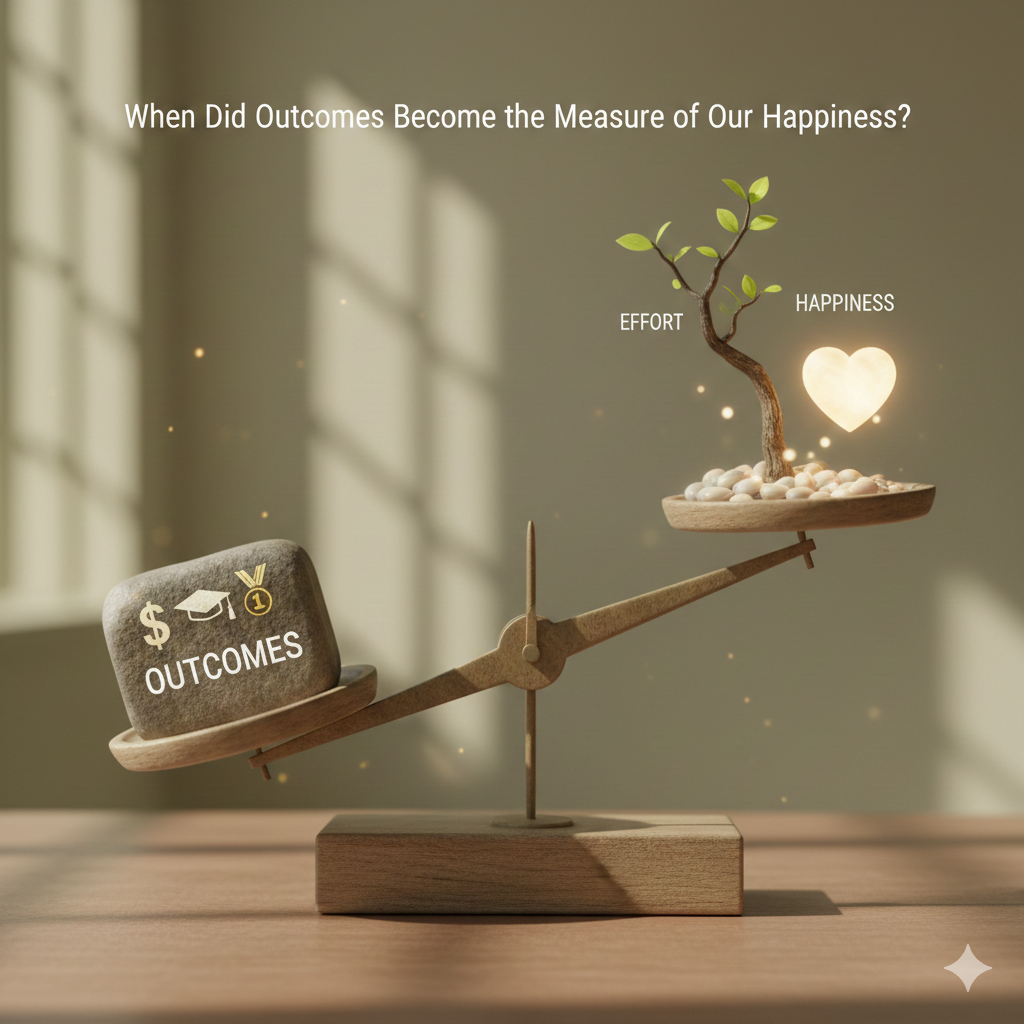
The measure of Happiness!
The Illusion of the Outcome
We treat outcomes like final destinations, when in reality they are temporary events. They arrive, stay briefly, and move on — just like our emotions.
Yet we give them enormous power.
A single result can decide our mood for hours. Sometimes for days. Sometimes we let it decide our self-worth.
But if happiness disappears and reappears so quickly, was it ever truly tied to the outcome? Or were we just reacting to a moment?
Why Do We Link Happiness to Results?
Because outcomes are visible.
They are easy to measure, easy to compare, and easy for the world to reward. Marks, jobs, promotions, money, approval — society constantly reinforces the idea that success equals happiness.
Slowly, almost unknowingly, we internalize a belief:
If I achieve this, I’ll be happy.
And when we don’t?
We feel like we’ve failed — not just at a task, but at life.
Do We Always Need Something to Be Happy?
We don’t need things to be happy.
What we actually need is meaning.
Effort gives meaning. Growth gives meaning. Showing up honestly gives meaning.
Outcomes don’t create meaning — they only highlight it.
That’s why success without fulfillment feels empty, and failure after sincere effort still carries peace.
Is the Stress Even Worth It?
Think about how much stress we carry for outcomes that eventually resolve on their own.
We worry. We overthink. We lose sleep.
And then, one day, the problem solves itself — or becomes irrelevant.
Life moves on.
So was the stress necessary? Or did it only exhaust us without changing the result?
A Healthier Way to Look at Life
This doesn’t mean we shouldn’t care.
It doesn’t mean we shouldn’t feel happy when things go right or sad when they don’t.
Those reactions are human.
What it means is this:
Don’t attach your happiness to outcomes.
Let outcomes be feedback — not identity.
Let effort be your responsibility. Let sincerity be your anchor. Let happiness come from knowing you tried honestly.
The Quiet Strength of Detachment
When you stop obsessing over results, something powerful happens.
You work with more clarity. You feel less anxious. You become more resilient.
And ironically, outcomes often improve — not because you controlled them, but because you weren’t consumed by fear.
Final Thought
Happiness is not a reward you receive after success.
It’s a state that allows you to try, fail, learn, and try again — without losing yourself in the process.
Celebrate success. Accept failure. But don’t give outcomes the authority to decide your peace.
Because life isn’t lived in results — it’s lived in effort.
메타데이터
- post_id
- 4635d5fe615b
- slug
- when-did-outcomes-become-the-measure-of-our-happiness-4635d5fe615b
- url
- https://medium.com/@ADITI23/when-did-outcomes-become-the-measure-of-our-happiness-4635d5fe615b
- canonical_url
- https://medium.com/@ADITI23/when-did-outcomes-become-the-measure-of-our-happiness-4635d5fe615b
- author_url
- https://medium.com/@ADITI23
- status
- ok
- fetched_at
- 2026-07-13 10:16:43