I Stopped Nesting if let in Rust. Here Is What I Use Instead.
guard clauses, binding scope, and why if let is the wrong tool for early returns
I Stopped Nesting if let in Rust. Here Is What I Use Instead

After the match article went out, Jan Magnusson left a comment saying he uses let else more than any of the three constructs I covered. He is not wrong. I left it out deliberately because it solves a different problem.
if let is for handling a successful case. let else is for handling failure before the happy path begins. That distinction sounds small. It changes how you structure entire functions.
The nesting trap
if let is excellent when you care about one variant and want to do something with the value inside it. The issue appears when you are not doing something with the value. You are guarding against its absence.
fn process_user(input: &str) -> Result<(), String> {
    if let Some(user_id) = parse_user_id(input) {
        if let Some(user) = fetch_user(user_id) {
            if user.is_active() {
                send_welcome_email(&user);
                Ok(())
            } else {
                Err(String::from("user is inactive"))
            }
        } else {
            Err(String::from("user not found"))
        }
    } else {
        Err(String::from("invalid input"))
    }
}
Every if let adds a level of indentation. The actual work, send_welcome_email, is buried three levels deep. The error cases are scattered across three different closing braces. Reading this requires tracking the nesting in your head the entire time.
You might ask why not use ?. In real code these checks are often not Results yet. They are Options, custom validations, or pattern matches where you need to convert failure into a domain-specific error before propagating it. You could convert every Option into a Result and use ?, but when the operation is local validation, let else often communicates the intent more directly than a chain of .ok_or() calls.
What let else does
let else flips the control flow. Instead of "if the pattern matches, do this inside a block," it says "the pattern must match, or run this else block." The else block must never continue normally. It must return, break, continue, call panic!, or invoke another diverging function.
fn process_user(input: &str) -> Result<(), String> {
    let Some(user_id) = parse_user_id(input) else {
        return Err(String::from("invalid input"));
    };

    let Some(user) = fetch_user(user_id) else {
        return Err(String::from("user not found"));
    };
    if !user.is_active() {
        return Err(String::from("user is inactive"));
    }
    send_welcome_email(&user);
    Ok(())
}
The happy path now reads top to bottom with no nesting. Each guard clause is self-contained. user_id and user are bound in the outer scope, available for everything that follows, rather than trapped inside an if let block. The error handling sits at the same indentation level as the validation, which is where it belongs conceptually.
The binding scope difference
This is the technical reason let else exists and if let cannot replace it in this position.
With if let, the bound variable lives inside the if block:
if let Some(name) = get_name() {
    println!("{}", name); // name is only alive here
}
// name does not exist here
With let else, the bound variable lives in the surrounding scope:
let Some(name) = get_name() else {
    return;
};
println!("{}", name); // name is alive here, and everywhere after
When you have three or four things to validate before doing real work, if let forces you to either nest everything inside successively deeper blocks or restructure your code around the limitation. let else matches the mental model: validate early, bind the result, continue.
A real scenario: parsing a request
struct Request {
    user_id: Option<u64>,
    body: Option<String>,
    auth_token: Option<String>,
}

fn handle_request(req: Request) -> Result<String, String> {
    let Some(user_id) = req.user_id else {
        return Err(String::from("missing user_id"));
    };
    let Some(body) = req.body else {
        return Err(String::from("missing body"));
    };
    let Some(token) = req.auth_token else {
        return Err(String::from("missing auth token"));
    };
    if !validate_token(&token, user_id) {
        return Err(String::from("invalid token"));
    }
    Ok(format!("processed: {}", body))
}
The let else version reads like a list of preconditions, each one checked and disposed of before the function proceeds. Compare this to the equivalent with if let and you are either nesting three levels deep or scattering early returns through a tangle of closing braces.
When to use each construct
if let when you care about the value inside one variant and want to do something with it, and the else case is either absent or simple.
let else when the pattern must match for the function to continue, you need the bound variable in the outer scope, and failure means returning or breaking early.
The signal that tells you to reach for let else: you find yourself writing if let Some(x) = thing { ...entire function body... } else { return Err(...); }. Any time the else branch of an if let is a single early return and the if body is everything else in the function, let else is the right tool.
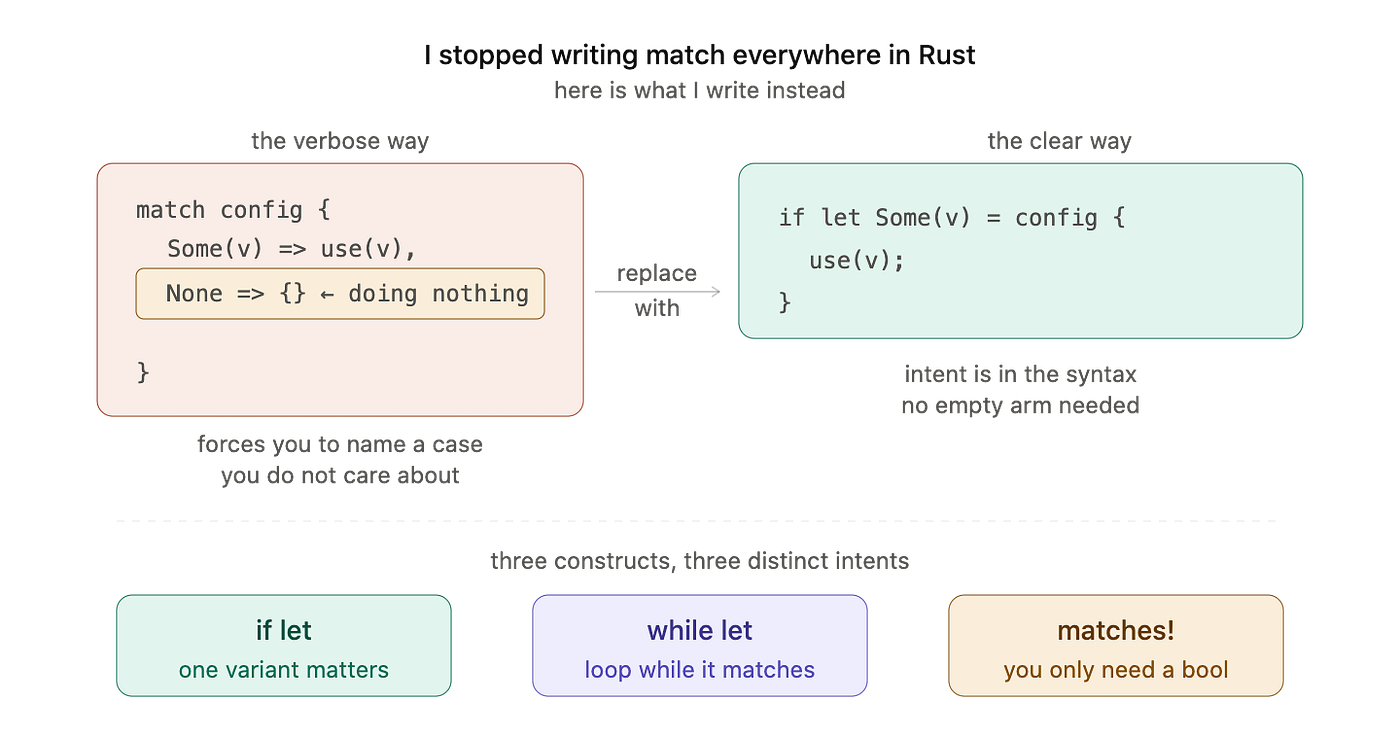
The previous article in this series covers if let, while let, and matches! — the full picture of when each construct is the right choice.
All code in this series is compiled and tested in the companion repository: github.com/shan305/data-structures-rust-java
If you want the full implementation with explanations, five problems per chapter, and every structure built in both Rust and Java side by side: Ownership vs. Reference: Data Structures and Algorithms in Rust and Java
For the Rust foundations this series builds on: Zero to Rust: A Systems Programmer’s Field Guide — $7 · Free 20-page sample
메타데이터
- post_id
- 467c7f22cfe5
- slug
- i-stopped-nesting-if-let-in-rust-here-is-what-i-use-instead-467c7f22cfe5
- url
- https://levelup.gitconnected.com/i-stopped-nesting-if-let-in-rust-here-is-what-i-use-instead-467c7f22cfe5
- canonical_url
- https://levelup.gitconnected.com/i-stopped-nesting-if-let-in-rust-here-is-what-i-use-instead-467c7f22cfe5
- author_url
- https://medium.com/@zeeshankhan0094
- status
- ok
- fetched_at
- 2026-07-21 04:28:33