How CBAM Is Transforming Sustainability From a Cost Center Into a Profit Center
For years, sustainability departments often faced the same challenge.
How CBAM Is Transforming Sustainability From a Cost Center Into a Profit Center
For years, sustainability departments often faced the same challenge.
They struggled to demonstrate direct business value.
Environmental initiatives were frequently viewed as necessary expenses rather than strategic investments. Executives supported sustainability goals because of regulatory requirements, stakeholder expectations, or corporate responsibility commitments, but many organizations continued to see sustainability as a cost center.
That perception is beginning to change.
The European Union’s Carbon Border Adjustment Mechanism, known as CBAM, may accelerate one of the most important shifts in modern business thinking.
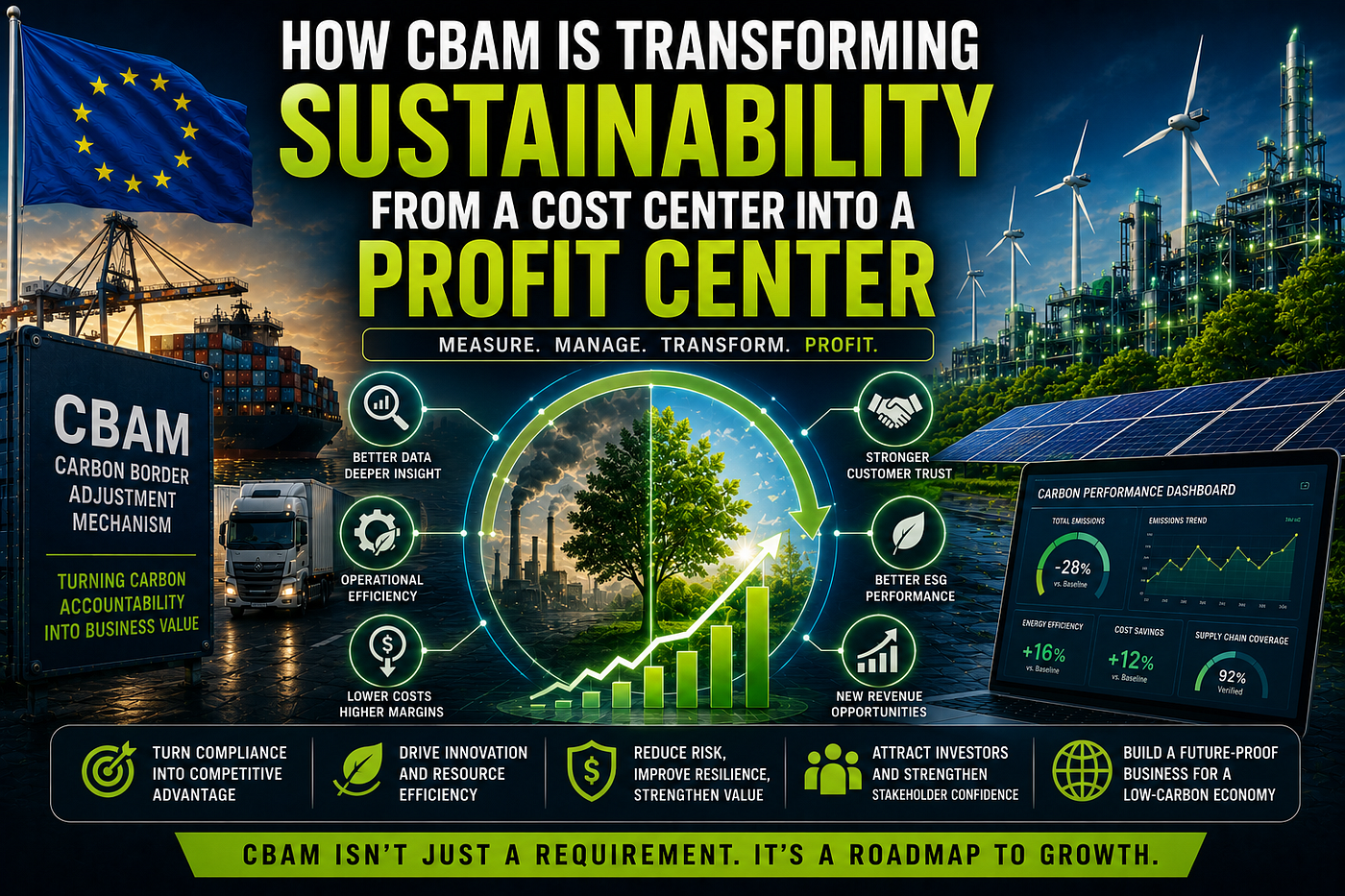
It is helping transform sustainability from a compliance function into a competitive business function.
This distinction matters.
When organizations view sustainability as a cost center, the goal is usually to minimize expenses while meeting obligations.
When organizations view sustainability as a profit center, the goal becomes creating value through innovation, efficiency, transparency, and market differentiation.
The difference between those two approaches can be enormous.
CBAM is pushing companies toward the second mindset.
At its core, CBAM introduces greater accountability for the carbon emissions embedded within certain imported products. Businesses selling into European markets increasingly need detailed information about emissions generated throughout production processes.
For some companies, this appears to be simply another reporting requirement.
For others, it is becoming a catalyst for transformation.
The reason is that measuring emissions often reveals opportunities that businesses were not actively searching for.
Energy inefficiencies become visible.
Resource waste becomes measurable.
Supply-chain gaps become easier to identify.
Operational improvements become easier to prioritize.
What begins as carbon reporting frequently evolves into business optimization.
This pattern is not unique to sustainability.
Throughout history, better measurement has often led to better performance.
Financial reporting improved capital allocation.
Digital analytics improved marketing effectiveness.
Operational dashboards improved manufacturing efficiency.
Carbon measurement may now be delivering similar benefits across industrial operations.
The organizations embracing this shift are discovering that sustainability data can generate economic value.
Consider energy consumption.
Many manufacturing facilities have historically focused on production output, labor costs, and equipment utilization. Energy usage was monitored, but not always analyzed with the same level of strategic attention.
When companies begin collecting detailed emissions information, they often uncover significant opportunities to reduce energy waste.
Lower energy consumption reduces costs.
Lower costs improve margins.
Improved margins strengthen competitiveness.
The sustainability initiative suddenly produces financial returns.
This is where perceptions begin changing.
The conversation moves away from compliance and toward performance.
Another opportunity emerges through procurement.
As carbon transparency becomes increasingly important, businesses gain deeper visibility into supplier operations.
This information helps organizations identify suppliers that are more efficient, more resilient, and more aligned with long-term business objectives.
Better supplier decisions often produce measurable financial benefits.
Supply disruptions become less likely.
Operational risks become easier to manage.
Long-term planning improves.
The value created extends beyond sustainability reporting itself.
Customer relationships also benefit.
Many buyers increasingly prefer suppliers capable of providing reliable environmental data. Transparency builds confidence. Confidence strengthens partnerships.
In competitive markets, trust often becomes a deciding factor.
Companies that can demonstrate strong carbon governance may gain advantages during procurement evaluations, contract negotiations, and supplier-selection processes.
These advantages can translate directly into revenue opportunities.
What makes CBAM particularly significant is that it creates a business case for transparency.
Historically, some organizations viewed environmental reporting as primarily a regulatory exercise.
Now transparency is becoming commercially relevant.
The more valuable transparency becomes, the more businesses invest in systems capable of delivering it.
This investment cycle is creating new opportunities across multiple industries.
Software providers are developing carbon-management platforms.
Artificial intelligence companies are creating emissions-analytics tools.
Consulting firms are expanding sustainability services.
Verification specialists are building assurance capabilities.
Technology providers are developing monitoring systems for industrial operations.
An entire economic ecosystem is emerging around carbon intelligence.
The organizations adopting these tools often gain benefits extending well beyond compliance.
Artificial intelligence provides a useful example.
Many businesses initially implement AI-driven emissions monitoring to simplify reporting requirements.
Once the technology is deployed, companies discover additional applications.
Predictive maintenance.
Energy optimization.
Supply-chain analysis.
Operational forecasting.
Resource planning.
The same platform supporting sustainability objectives can improve overall business performance.
This is how cost centers evolve into profit centers.
Capabilities developed for one purpose begin generating value across multiple areas of the organization.
Investors are increasingly recognizing this dynamic.
Financial markets continue rewarding companies that demonstrate operational resilience, transparency, and long-term adaptability.
Organizations capable of managing carbon-related risks effectively often appear better prepared for future market conditions.
That perception can influence valuations, financing opportunities, and investor confidence.
The strategic implications are substantial.
Companies that treat CBAM as a short-term compliance exercise may meet regulatory requirements but capture limited value.
Companies that use CBAM as an opportunity to modernize operations may achieve something much more significant.
They may improve efficiency.
They may strengthen customer relationships.
They may reduce costs.
They may enhance resilience.
They may unlock entirely new business opportunities.
Over time, these advantages can compound.
A company that saves energy reduces costs year after year.
A company that strengthens supplier visibility improves decision-making year after year.
A company that builds customer trust creates opportunities year after year.
The cumulative effect can be powerful.
This is why some business leaders increasingly view sustainability through a strategic lens rather than a regulatory one.
The objective is no longer simply reducing environmental impact.
The objective is creating business value while reducing environmental impact.
That distinction is reshaping corporate strategy.
CBAM may ultimately accelerate this transformation because it connects sustainability performance more directly to economic outcomes.
When markets reward transparency, organizations invest in transparency.
When markets reward efficiency, organizations invest in efficiency.
When markets reward innovation, organizations invest in innovation.
CBAM is helping align all three.
The result is a business environment where sustainability and profitability become increasingly interconnected rather than competing priorities.
That may be one of the most important shifts taking place in global commerce today.
For decades, sustainability was often viewed as a responsibility.
In the coming decade, it may increasingly be viewed as an opportunity.
And the companies that understand that shift first may be the ones that benefit most from the future economy.
메타데이터
- post_id
- 468697f6d09c
- slug
- how-cbam-is-transforming-sustainability-from-a-cost-center-into-a-profit-center-468697f6d09c
- url
- https://medium.com/@anandv_62921/how-cbam-is-transforming-sustainability-from-a-cost-center-into-a-profit-center-468697f6d09c
- canonical_url
- https://medium.com/@anandv_62921/how-cbam-is-transforming-sustainability-from-a-cost-center-into-a-profit-center-468697f6d09c
- author_url
- https://medium.com/@anandv_62921
- status
- ok
- fetched_at
- 2026-06-15 20:49:13