How Different Diesel Injector Nozzles Behave Under Load: 20 Common Models Explained
Most diesel injector nozzle discussions focus only on compatibility charts, OEM references, or physical dimensions. But in real diesel…
How Different Diesel Injector Nozzles Behave Under Load: 20 Common Models Explained
Most diesel injector nozzle discussions focus only on compatibility charts, OEM references, or physical dimensions. But in real diesel engine operation, those details explain only a small part of actual performance.
What truly matters is how injector nozzles behave under different load conditions.
Two nozzles may appear nearly identical, yet produce completely different combustion characteristics once the engine moves from idle to acceleration or heavy-duty operation. This is why experienced diesel technicians often evaluate injector behavior based on operating pressure, atomization stability, and fuel response — not simply by part number similarity.
In this article, we examine the load behavior of 20 widely used diesel injector nozzle models and explain how different nozzle designs respond during light-load, medium-load, and heavy-load engine operation.
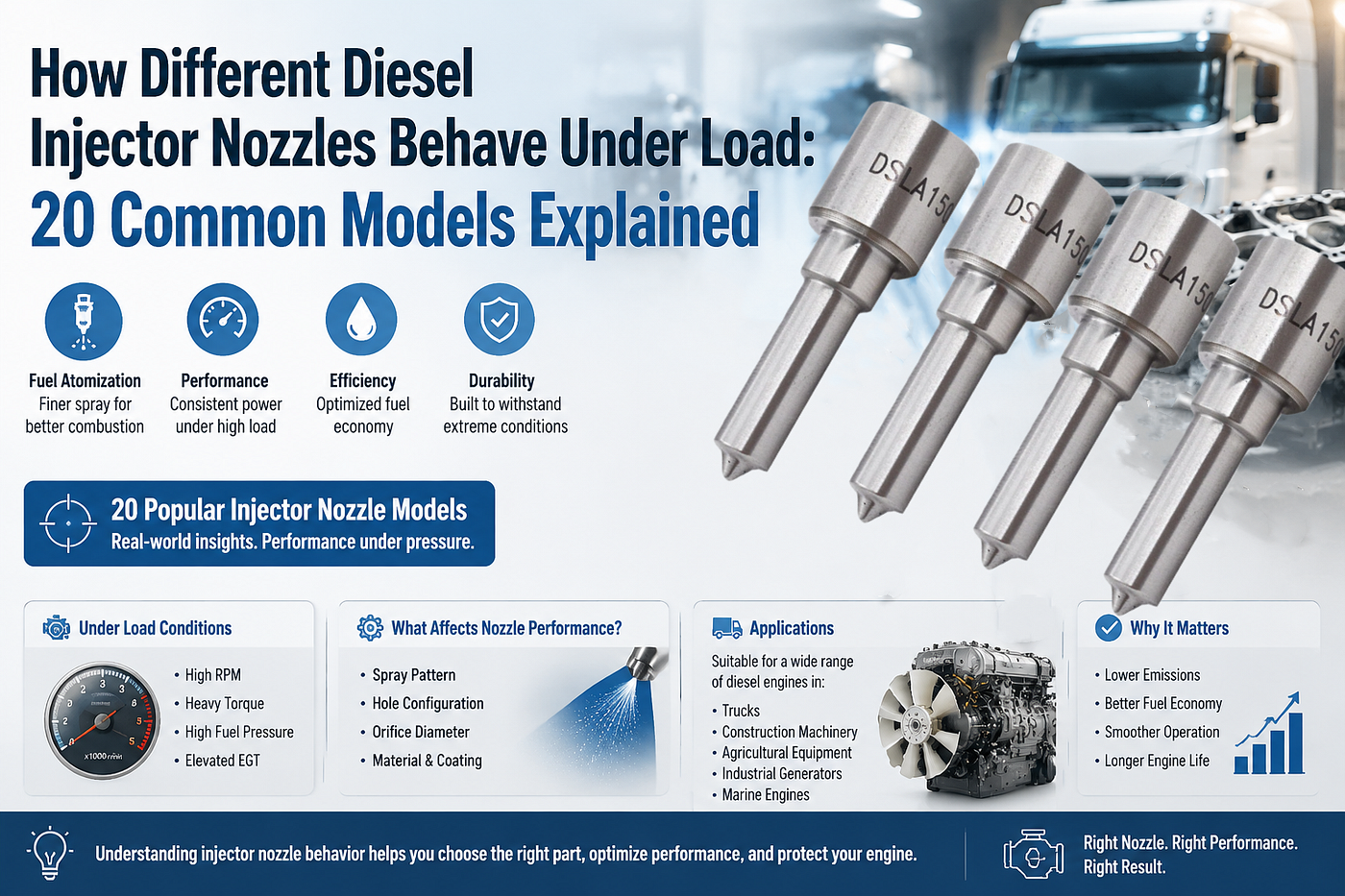
Why Load Behavior Matters More Than Appearance
Modern diesel engines operate under constantly changing fuel pressure conditions.
During idle, injection quantity is extremely small. During acceleration, fuel pressure rises rapidly. Under heavy load, injectors must maintain stable atomization while operating continuously under thermal stress.
Because of this, injector nozzle performance cannot be judged only by:
- external appearance
- OEM similarity
- installation compatibility
- nozzle size alone
Internal flow characteristics and pressure response behavior determine how the engine actually performs.
This is why two visually similar nozzles may produce:
- different idle smoothness
- different smoke levels
- different fuel consumption
- different acceleration behavior
- different exhaust temperatures
The differences become especially obvious under changing load conditions.
Light-Load Behavior: Idle Stability and Low-Pressure Atomization
Light-load operation includes:
- engine idle
- cold start
- low-speed city driving
- low RPM cruising
- stop-and-go traffic conditions
At this stage, injection pressure is relatively low, meaning atomization quality becomes extremely important.
A nozzle with unstable low-pressure behavior often causes:
- rough idle
- unstable RPM
- incomplete combustion
- white smoke
- delayed throttle response
Several common nozzle models are known for relatively stable light-load behavior.
DLLA150P1076 Diesel Injector Nozzle
The DLLA150P1076 nozzle is widely used in light commercial diesel applications because of its stable low-pressure spray characteristics.
Under idle conditions, it tends to maintain relatively fine atomization consistency, helping engines achieve smoother combustion during cold starts and low-speed operation.
This model is often selected when stable idle quality is prioritized over aggressive fuel delivery.
DLLA158P854 Diesel Injector Nozzle
The DLLA158P854 nozzle generally provides slightly stronger low-speed fuel response compared with softer atomization-focused designs.
In properly calibrated systems, this can improve throttle sensitivity during light acceleration. However, in older injection systems with unstable pressure, the nozzle may reveal combustion irregularities more quickly.
This makes calibration quality especially important.
DSLA143P970 Diesel Injector Nozzle
The DSLA143P970 is known for balanced fuel distribution during low-load operation.
Instead of aggressive delivery, it focuses more on combustion smoothness and predictable fuel response, making it common in agricultural and medium-duty diesel applications where steady operation matters more than rapid acceleration.
DLLA145P864 Diesel Injector Nozzle
The DLLA145P864 nozzle performs relatively well in engines that spend long periods at idle or low RPM.
Its fuel delivery pattern often helps reduce startup instability and improves combustion uniformity during extended light-load operation.
This behavior makes it useful in utility vehicles and generators.
DSLA150P764 Diesel Injector Nozzle
The DSLA150P764 nozzle is commonly appreciated for controlled low-pressure spray behavior.
When injection pressure fluctuates slightly, this model still tends to maintain acceptable combustion consistency, helping reduce intermittent idle vibration in aging diesel systems.
DLLA148P915 Diesel Injector Nozzle
The DLLA148P915 is frequently used where stable low-load fuel economy is important.
Its atomization behavior under low pressure often supports cleaner combustion and reduced unnecessary fuel consumption during urban driving conditions.
Medium-Load Behavior: Transition Response and Combustion Smoothness
Medium-load operation is where injector differences become far more noticeable to drivers and operators.
This includes:
- moderate acceleration
- uphill driving
- partial towing load
- highway merging
- commercial transport operation
At this stage, nozzles must balance rapid fuel response with combustion stability.
Poorly matched injectors may cause:
- hesitation
- uneven torque delivery
- increased vibration
- transient smoke
- rough acceleration
DLLA146P1339 Diesel Injector Nozzle
The DLLA146P1339 nozzle is known for relatively fast transition response during acceleration.
As fuel demand increases, it reacts quickly to pressure changes, helping engines build torque more smoothly during medium-load operation.
This makes it popular in commercial transport applications.
DLLA152P1768 Diesel Injector Nozzle
The DLLA152P1768 focuses more on combustion smoothness than aggressive response.
Instead of sharp fuel delivery spikes, it provides more balanced transitional injection behavior, reducing harsh combustion noise and vibration during sustained driving.
DSLA145P300 Diesel Injector Nozzle
The DSLA145P300 nozzle performs well during fluctuating throttle conditions.
Its fuel delivery pattern helps maintain stable combustion when engine load changes rapidly, reducing hesitation and improving driving smoothness.
DLLA153P884 Diesel Injector Nozzle
The DLLA153P884 nozzle is commonly used in engines requiring balanced mid-range torque behavior.
It typically provides relatively stable acceleration characteristics without excessive fuel aggression, helping improve long-distance drivability.
DSLA146P1409 Diesel Injector Nozzle
The DSLA146P1409 maintains controlled combustion during repeated medium-load transitions.
This often helps reduce sudden combustion spikes and improves torque consistency under mixed driving conditions.
DLLA149P786 Diesel Injector Nozzle
The DLLA149P786 nozzle demonstrates good pressure adaptation during moderate acceleration.
Its balanced injection behavior can help reduce transient exhaust smoke while maintaining acceptable throttle responsiveness.
DSLA128P1510 Diesel Injector Nozzle
The DSLA128P1510 is frequently selected for diesel systems requiring smoother partial-load combustion.
Rather than prioritizing aggressive fuel flow, it aims for combustion stability and reduced mechanical harshness.
High-Load Behavior: Pressure Stability and Fuel Delivery Consistency
Heavy-load conditions place maximum stress on injector nozzles.
This includes:
- towing
- construction equipment operation
- heavy cargo transport
- long uphill driving
- continuous high RPM operation
At this stage, internal flow stability becomes critical.
Weak or poorly manufactured nozzles often reveal problems such as:
- power loss
- unstable fuel delivery
- excessive exhaust temperature
- injector overheating
- uneven cylinder combustion
DLLA160P50 Diesel Injector Nozzle
The DLLA160P50 nozzle is highly regarded for stable high-load fuel delivery.
Its internal flow characteristics help maintain injection consistency during sustained heavy-duty operation, making it common in industrial diesel applications.
DSLA156P1114 Diesel Injector Nozzle
The DSLA156P1114 performs particularly well in high-pressure operating environments.
It maintains relatively stable fuel delivery across repeated heavy-load cycles, reducing combustion inconsistency during prolonged operation.
DSLA154P1320 Diesel Injector Nozzle
The DSLA154P1320 focuses on maintaining balanced combustion efficiency during high-load operation.
Instead of maximizing aggressive fuel delivery, it emphasizes pressure stability and controlled thermal behavior.
DLLA155P842 Diesel Injector Nozzle
The DLLA155P842 nozzle is commonly associated with stable high-temperature performance.
In continuous heavy-duty operation, it often demonstrates reliable injection consistency while helping reduce pressure fluctuation under stress.
DSLA153P977 Diesel Injector Nozzle
The DSLA153P977 is frequently selected for applications requiring dependable high-load combustion stability.
Its controlled injection pattern can help maintain smoother cylinder balance during prolonged heavy operation.
DLLA158P1092 Diesel Injector Nozzle
The DLLA158P1092 nozzle performs effectively in engines operating under repeated heavy acceleration cycles.
Its internal flow response helps sustain fuel delivery consistency even when fuel demand changes rapidly under load.
Why Similar Nozzles Can Produce Completely Different Engine Behavior
Many aftermarket buyers assume nozzle compatibility guarantees identical performance.
In reality, very small differences in internal design can significantly change combustion behavior, including:
- spray angle
- hole geometry
- needle response timing
- fuel release characteristics
- pressure recovery speed
These differences directly affect:
- engine smoothness
- fuel efficiency
- combustion temperature
- injector lifespan
- overall reliability
This is why experienced diesel technicians rarely judge nozzles only by appearance.
Final Thoughts
Correct diesel injector nozzle selection depends on behavior under real operating conditions — not appearance, popularity, or simple cross-reference compatibility.
Some nozzles excel during idle stability. Others perform better under transitional acceleration or sustained heavy load. Understanding these differences helps avoid mismatched replacements and improves long-term engine efficiency.
For diesel injector nozzles, plungers, delivery valves, and fuel injection system components, visit:
👉 Related technical reading: **Diesel Injector Nozzle Mismatch: Root Causes, System Impact, and How to Avoid Performance Loss**
메타데이터
- post_id
- 46bf4d38543b
- slug
- how-different-diesel-injector-nozzles-behave-under-load-20-common-models-explained-46bf4d38543b
- url
- https://medium.com/@pioneerdieselparts/how-different-diesel-injector-nozzles-behave-under-load-20-common-models-explained-46bf4d38543b
- canonical_url
- https://medium.com/@pioneerdieselparts/how-different-diesel-injector-nozzles-behave-under-load-20-common-models-explained-46bf4d38543b
- author_url
- https://medium.com/@pioneerdieselparts
- status
- ok
- fetched_at
- 2026-06-09 14:34:10