Digestive Enzyme Supplements: Who Really Needs Them and How to Take Them
Digestive enzyme supplements are effective for those with pancreatic insufficiency and lactose intolerance. This guide covers…
Digestive Enzyme Supplements: Who Really Needs Them and How to Take Them
Digestive enzyme supplements are effective for those with pancreatic insufficiency and lactose intolerance. This guide covers self-assessment checklists, proper dosage timing, and the difference between enzyme supplements and antacids.
Key Summary
“Do you feel bloated after every meal, or get diarrhea whenever you eat fatty foods?”
Digestive enzyme supplements help people with insufficient enzyme production break down food and improve nutrient absorption. However, for healthy individuals with simple indigestion, the scientific evidence is limited, and improving eating habits should come first.
⚠️ Medical Disclaimer This information is for general health education purposes and does not replace medical diagnosis or treatment. If you experience persistent fatty stools, unexplained weight loss, or severe abdominal pain, seek immediate medical attention from a gastroenterologist.
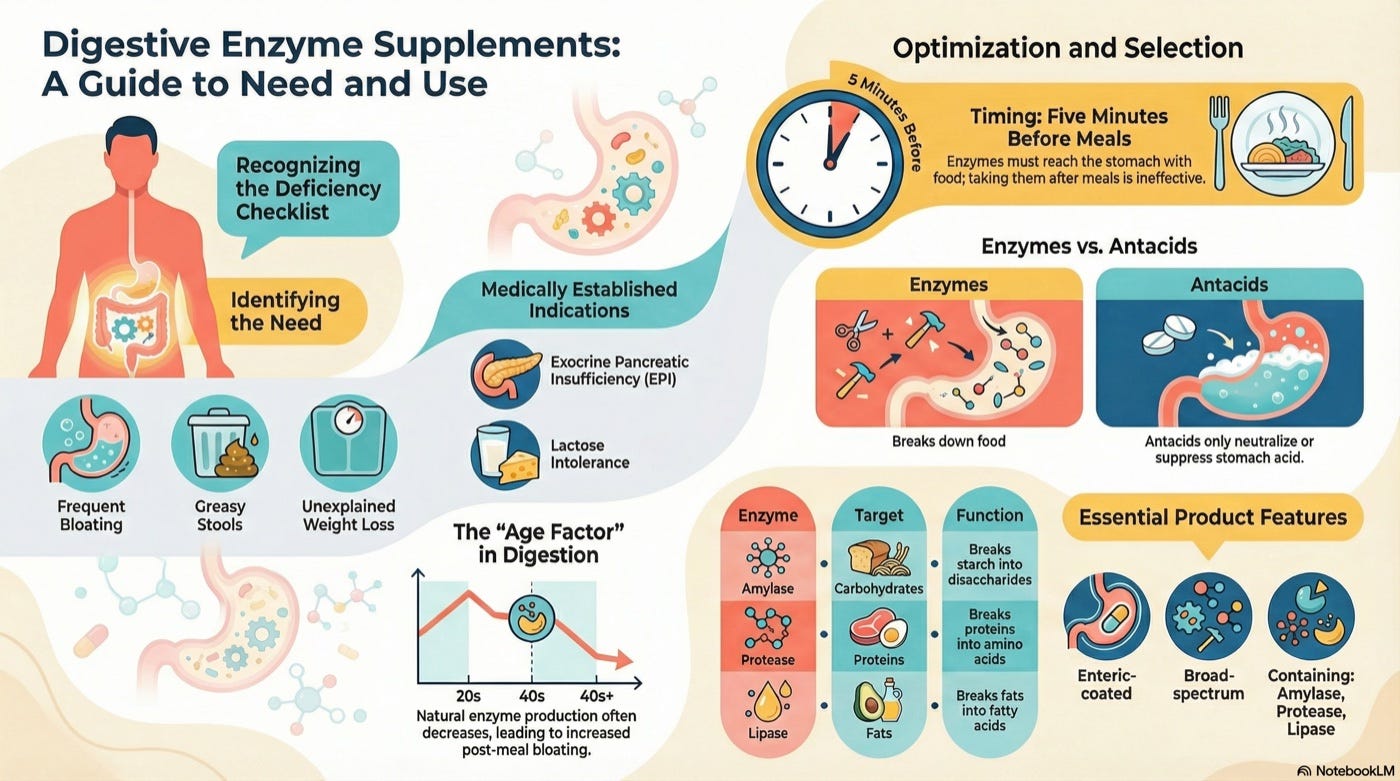
Self-Assessment Checklist: Signs of Digestive Enzyme Deficiency
If 3 or more of the following apply to you, consider digestive enzyme insufficiency and consult a healthcare professional.
- Bloating within 30 minutes to 2 hours after nearly every meal
- Greasy, floating stools that are hard to flush (steatorrhea)
- Unexplained weight loss despite no change in diet
- Severe diarrhea after eating fatty or oily foods
- Abdominal pain, diarrhea, and gas after consuming dairy products
- History of chronic pancreatitis or pancreatic surgery
- No improvement even after taking regular antacids
- Diagnosed with vitamin A, D, E, or K deficiency (blood test results)
- Brittle nails or night blindness (signs of vitamin A deficiency)
- Chronic diarrhea combined with hair loss, dry skin, or muscle wasting
If 5 or more apply, get a Fecal Elastase Test to check your pancreatic function.
🚨 Warning Signs (Seek Immediate Medical Attention)
- ❌ Blood in stool or black tarry stools (possible GI bleeding)
- ❌ Severe abdominal pain with fever and vomiting
- ❌ Jaundice (yellowing of skin or eyes)
- ❌ Sudden weight loss (more than 5kg/11lbs in one month)
- ❌ Persistent fatty stools lasting more than one week
🚑 If you experience these symptoms, do not self-treat with enzyme supplements — visit a gastroenterologist or emergency room immediately.
What Are Digestive Enzymes?
Digestive enzymes are proteins that break down food into absorbable nutrients. They are naturally secreted by the salivary glands, stomach, pancreas, and small intestine.
Types of Digestive Enzymes
Amylase — Carbohydrates (starch) Source: Salivary glands, pancreas Function: Breaks starch into disaccharides
Protease — Proteins Source: Stomach (pepsin), pancreas (trypsin) Function: Breaks proteins into amino acids
Lipase — Fats Source: Pancreas, small intestine Function: Breaks fats into fatty acids and glycerol
Lactase — Lactose (milk sugar) Source: Small intestine Function: Breaks lactose into glucose and galactose
Bromelain — Proteins Source: Pineapple extract Function: Protein digestion + anti-inflammatory
Papain — Proteins Source: Papaya extract Function: Protein digestion
💡 NutriKo Tip: Digestive enzyme production naturally decreases with age. If you notice increased bloating after meals in your 40s and beyond, enzyme insufficiency could be a factor.
Who Actually Needs Digestive Enzyme Supplements?
1. Medically Established Indications
Exocrine Pancreatic Insufficiency (EPI)
A condition where the pancreas cannot produce enough digestive enzymes. Prescription Pancreatic Enzyme Replacement Therapy (PERT) is essential.
Main causes: Chronic pancreatitis, pancreatic cancer, cystic fibrosis, post-pancreatic surgery
Key symptoms:
- Greasy, foul-smelling stools (steatorrhea)
- Unexplained weight loss
- Fat-soluble vitamin (A, D, E, K) deficiency
Prescription medications: Creon, Nutrizym, and others
📚 Reference: Mayo Clinic — Pancrelipase
Lactose Intolerance
A condition where the small intestine lacks sufficient lactase enzyme to digest dairy products.
Symptoms: Bloating, diarrhea, and gas within 30 minutes to 2 hours after consuming dairy
Solution: Take lactase supplements immediately before consuming dairy products
📚 Reference: Cleveland Clinic — Lactase
2. Limited Evidence Cases
General Indigestion
The effectiveness of digestive enzyme supplements for simple indigestion in healthy individuals has limited scientific support.
According to Johns Hopkins Medicine: “Talk to your healthcare provider before taking digestive enzyme supplements.”
According to Cleveland Clinic: “People without chronic health conditions can usually get the enzymes they need from a healthy diet.”
💡 NutriKo Tip: For simple indigestion, prioritize eating slowly, avoiding overeating, and managing stress before reaching for supplements. If symptoms persist beyond 2 weeks, consult a doctor.
Related articles: Bloating Causes and Remedies Guide | IBS Complete Guide
How to Take Digestive Enzyme Supplements Properly
Timing: Before Meals Is Key
5 minutes before or at the start of a meal — Enzymes reach the stomach with food → maximum effect Recommended?: ✅ Yes
30 minutes before a meal — Early enzyme activation → reduced effectiveness Recommended?: ❌ No
After a meal — Food already in transit → minimal effect Recommended?: ❌ No
Important Guidelines
- Do not chew or crush capsules — enteric coating protects enzymes from stomach acid
- Take with every meal — EPI patients must also take with snacks
- Space 2 hours from calcium/iron supplements — these may interfere with enzyme absorption
💡 NutriKo Tip: Take lactase supplements 5 minutes before consuming dairy. The effect lasts only about 30–45 minutes, so timing is crucial.
Related articles: Complete Supplement Timing Guide | Supplement Combinations Guide
How to Choose Digestive Enzyme Supplements
What to Look For
Enteric coating — Protects enzymes from stomach acid; activates in the small intestine
Broad-spectrum formula — Combination of amylase + protease + lipase
GMP certification — Quality assurance from MFDS or FDA
Source verification — Pork-derived vs. plant-based enzymes (important for vegetarians)
Reference Dosage Ranges
Amylase — 3,000–10,000 DU
Protease — 10,000–50,000 HUT
Lipase — 150–1,500 FIP
Lactase — 3,000–9,000 FCC
Digestive Enzymes vs. Antacids: What Is the Difference?
Action — Breaks down food Antacids: Neutralizes/suppresses stomach acid Prokinetics: Promotes gut motility
Key ingredients — Amylase, lipase Antacids: Aluminum hydroxide, PPIs Prokinetics: Mosapride
Best for — Poor digestion, bloating Antacids: Heartburn, excess acid Prokinetics: Slow gastric emptying
When to take — Before meals Antacids: After meals or as needed Prokinetics: Before meals
Side Effects and Precautions
Common Side Effects (Mild)
- Bloating and gas
- Diarrhea or constipation
- Nausea, abdominal discomfort
Serious Side Effects (Rare but Notable)
- Allergic reactions (especially to pork-derived enzymes)
- Fibrosing colonopathy with very high-dose long-term use (extremely rare)
- Hyperuricemia (increased gout risk)
Drug Interactions
Acarbose (diabetes medication) — May counteract enzyme effects
Calcium/iron supplements — May interfere with absorption — space by 2 hours
PPIs (proton pump inhibitors) — Can help protect prescription PERT enzyme activity
Related articles: Supplement Overdose Warning Signs | Iron Supplement Timing Guide
Frequently Asked Questions (FAQ)
Q1. Who really needs digestive enzyme supplements?
Those diagnosed with Exocrine Pancreatic Insufficiency (EPI), lactose intolerance, or cystic fibrosis have the strongest evidence for benefit. For simple indigestion, improving eating habits should come first, and persistent symptoms warrant a doctor’s visit.
Q2. Do I need to take digestive enzymes for life?
EPI patients must take them for life. For lactose intolerance, take lactase only when consuming dairy. For temporary indigestion, you can stop once symptoms improve.
Q3. Should I take them before or after meals?
Immediately before meals (within 5 minutes) or with the first bite is most effective. The enzymes need to reach your stomach together with the food.
Q4. Will digestive enzymes help me lose weight?
No. Digestive enzymes actually promote nutrient absorption, so EPI patients often gain weight after starting enzyme therapy. Do not use them for weight loss.
Q5. Can I take probiotics and digestive enzymes together?
Yes, they are complementary. Digestive enzymes break down food, while probiotics support beneficial gut bacteria. Their mechanisms are different and they work well together.
Q6. Will long-term use make my body stop producing its own enzymes?
Based on current medical evidence, there is no proof that prescribed PERT reduces your body’s natural enzyme production. However, unnecessary long-term use of OTC supplements is not recommended. If symptoms don’t improve after 2 weeks, consult a doctor.
Q7. How do I choose the right digestive enzyme supplement?
Look for enteric-coated products, broad-spectrum formulas (amylase + protease + lipase), and GMP-certified products. Vegetarians should verify whether the enzymes are plant-based or pork-derived.
Conclusion: 3 Principles for Digestive Enzyme Supplements
- 🩺 Identify the cause first: For chronic digestive issues, get a gastroenterology exam before self-supplementing
- ⏰ Timing is everything: Take supplements 5 minutes before meals or with your first bite for maximum effectiveness
- 🔬 Medical indication matters: Supplements are most effective for diagnosed conditions like EPI and lactose intolerance
References
- Johns Hopkins Medicine — Digestive Enzymes and Supplements
- Cleveland Clinic — Digestive Enzymes 101
- Mayo Clinic — Pancrelipase (Oral Route)
- PMC — Digestive Enzyme Supplementation in Gastrointestinal Diseases
Disclaimer: This information is for general health education purposes and does not replace medical diagnosis or treatment. Always consult with a qualified healthcare professional before making health-related decisions.
If you found this helpful, please like and share.
NutriKo | Science-Based Health Information
About NutriKo
NutriKo is a bilingual (Korean/English) health platform providing 400+ evidence-based guides on supplements, nutrition, and wellness.
Website: nutriko.lambpod.kr Blog: nutriko.lambpod.kr/blog Medium: medium.com/nutriko
Originally published at NutriKo
메타데이터
- post_id
- 46df54ef57fe
- slug
- digestive-enzyme-supplements-who-really-needs-them-and-how-to-take-them-46df54ef57fe
- url
- https://medium.com/nutriko/digestive-enzyme-supplements-who-really-needs-them-and-how-to-take-them-46df54ef57fe
- canonical_url
- https://medium.com/nutriko/digestive-enzyme-supplements-who-really-needs-them-and-how-to-take-them-46df54ef57fe
- author_url
- https://medium.com/@jylamb
- status
- ok
- fetched_at
- 2026-06-10 08:17:25