Why CBAM Is Creating the Next Generation of Global Business Leaders
Every major business era creates a new type of market leader.
Why CBAM Is Creating the Next Generation of Global Business Leaders
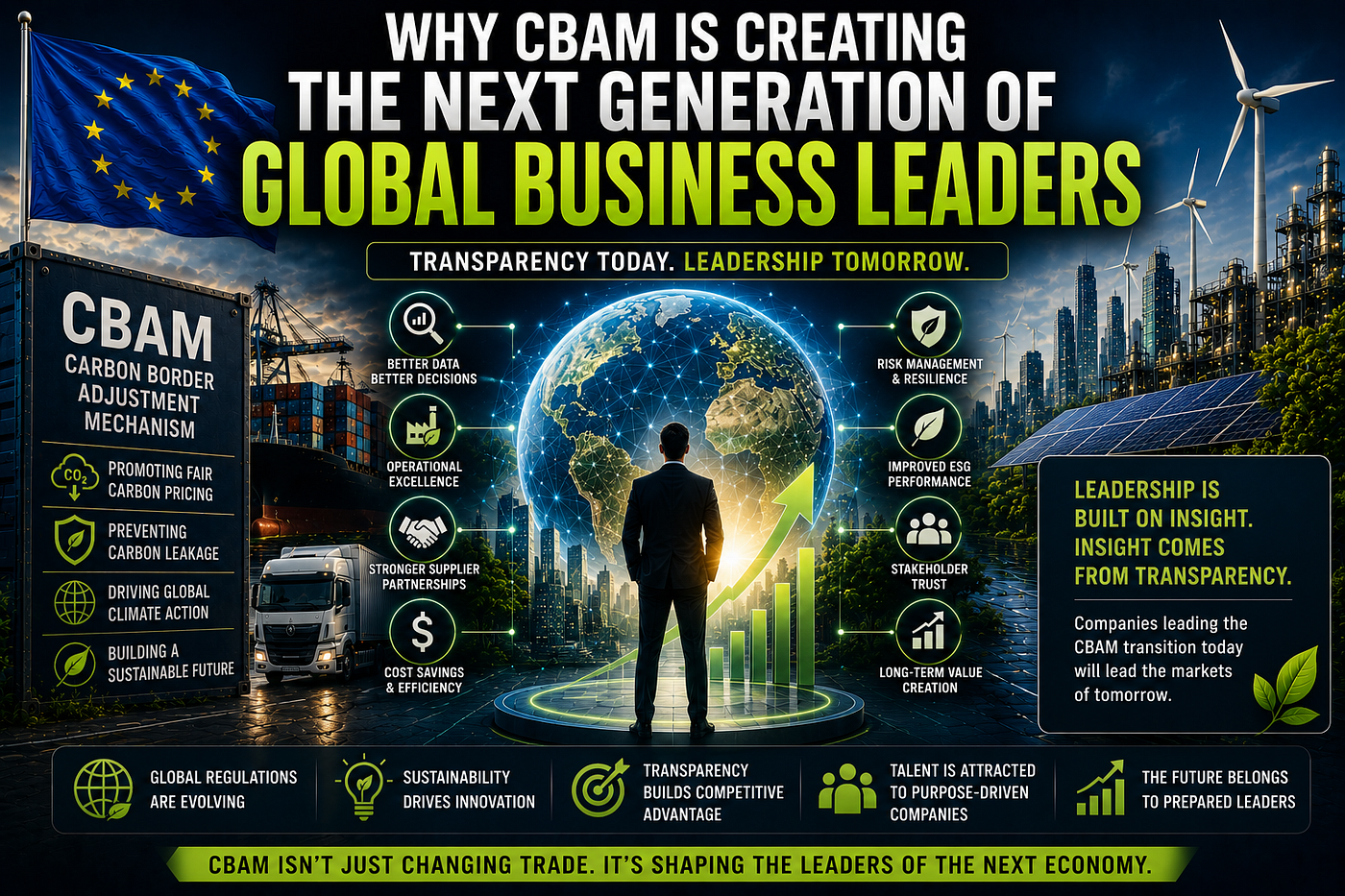
Every major business era creates a new type of market leader.
The industrial age rewarded manufacturing scale.
The digital age rewarded data and connectivity.
The cloud era rewarded speed and flexibility.
The artificial intelligence era is rewarding intelligence and automation.
Now another shift is emerging.
The Carbon Border Adjustment Mechanism (CBAM) and the broader movement toward carbon-accountable trade are beginning to reward something different.
Transparency.
And that shift could help create the next generation of global business leaders.
Many organizations still view CBAM primarily as a regulatory challenge. They see emissions reporting requirements, compliance obligations, verification processes, and carbon calculations.
Those requirements are certainly important.
But history suggests that the most successful companies rarely win by focusing only on compliance.
They win by identifying the competitive opportunities hidden inside major market transitions.
That is exactly what may be happening with CBAM.
The reason is simple.
Markets are changing.
Customers are changing.
Investors are changing.
Governments are changing.
And the businesses capable of adapting fastest to those changes often emerge as industry leaders.
For decades, international competition focused heavily on cost advantages.
Companies competed through cheaper labor, lower production expenses, larger manufacturing facilities, and greater economies of scale.
Those factors remain important.
But modern markets increasingly value something else as well.
Visibility.
Organizations want to know where products originate.
They want to understand supply chains.
They want to assess environmental impact.
They want confidence in the information provided by suppliers.
Transparency is becoming a business asset.
CBAM accelerates this trend because it requires companies to collect, verify, and manage emissions information across increasingly complex production networks.
At first glance, this appears to be an administrative task.
In reality, it can become a strategic capability.
The process of gathering carbon data forces organizations to develop deeper operational understanding.
They learn more about suppliers.
They learn more about production processes.
They learn more about energy consumption.
They learn more about transportation networks.
They learn more about business risks.
Knowledge creates advantage.
And advantage creates leadership.
This pattern has appeared repeatedly throughout business history.
Companies that embraced data analytics early gained insights competitors lacked.
Companies that adopted digital technologies early improved productivity faster than rivals.
Companies that invested in cybersecurity early often reduced future operational risk.
The same principle may now apply to carbon intelligence.
Organizations building emissions-management capabilities today are not simply preparing reports.
They are building information systems.
And information systems often become strategic assets.
The most successful companies understand that information has value beyond its original purpose.
Financial reporting began as an accounting necessity.
Today it drives investment decisions worth trillions of dollars.
Supply-chain management began as a logistics function.
Today it influences competitive strategy across entire industries.
Carbon reporting may follow a similar path.
The organizations that develop expertise now could gain important advantages later.
One of the biggest advantages is decision-making.
Leaders make better decisions when they possess better information.
Detailed emissions data often reveals operational inefficiencies that would otherwise remain hidden.
Facilities consuming excessive energy become easier to identify.
Inefficient transportation routes become more visible.
Supplier performance becomes more measurable.
Business leaders gain access to insights capable of improving profitability and resilience simultaneously.
That combination is powerful.
Customer relationships represent another area of opportunity.
Many organizations purchasing industrial products increasingly request environmental information from suppliers.
The ability to provide reliable, verified data strengthens confidence.
Confidence strengthens partnerships.
Partnerships create long-term business opportunities.
In highly competitive markets, trust can become a significant differentiator.
Companies that build trust early often benefit for years.
Investors are paying attention as well.
The investment community increasingly evaluates how businesses manage long-term risks and opportunities.
Organizations capable of demonstrating transparency, preparedness, and adaptability often attract stronger confidence than those appearing reactive.
CBAM encourages companies to build precisely these qualities.
That is one reason why many executives are beginning to view carbon intelligence as a strategic capability rather than a sustainability initiative.
The distinction is important.
Strategic capabilities generate competitive advantage.
Compliance activities simply meet requirements.
The companies most likely to lead the future economy will understand the difference.
Technology is making this transition even more significant.
Artificial intelligence, advanced analytics, digital monitoring platforms, and automated reporting systems are dramatically improving the quality of emissions intelligence available to organizations.
Companies can now analyze enormous volumes of operational data faster and more accurately than ever before.
This creates new opportunities for optimization.
Better forecasting.
Better resource allocation.
Better supplier management.
Better risk assessment.
Better strategic planning.
All of these benefits emerge from stronger visibility.
And visibility is becoming one of the most valuable business assets in the modern economy.
The broader implication is that CBAM may be encouraging organizations to build capabilities that extend far beyond carbon reporting.
It encourages discipline.
It encourages measurement.
It encourages transparency.
It encourages modernization.
These characteristics are frequently associated with high-performing businesses regardless of industry.
The companies embracing these capabilities today may become tomorrow’s market leaders.
Not because they filed emissions reports more efficiently.
But because the process of developing those capabilities strengthened the entire organization.
History often rewards businesses that view change as an opportunity rather than a disruption.
When digital transformation accelerated, some companies resisted while others invested aggressively.
The companies that invested early often gained substantial advantages.
The same pattern may unfold with carbon accountability.
Organizations focused solely on compliance may satisfy today’s requirements.
Organizations focused on capability-building may position themselves for tomorrow’s opportunities.
That distinction could become increasingly important as transparency becomes a defining feature of global commerce.
CBAM is often described as a climate policy.
It is.
But it may also become something more.
A catalyst for better information.
A catalyst for stronger management.
A catalyst for greater operational intelligence.
And ultimately, a catalyst for creating the next generation of global business leaders.
The companies that recognize this early may discover that the greatest value of CBAM is not regulatory compliance.
It is competitive transformation.
And competitive transformation has always been where future leaders are created.
CTA
Subscribe to Genecapsule for expert insights on CBAM, ESG, sustainability, AI, climate innovation, and the future of global business.
Subscribe to Genecapsule YouTube Channel
메타데이터
- post_id
- 46fbabbceb21
- slug
- why-cbam-is-creating-the-next-generation-of-global-business-leaders-46fbabbceb21
- url
- https://medium.com/@anandv_62921/why-cbam-is-creating-the-next-generation-of-global-business-leaders-46fbabbceb21
- canonical_url
- https://medium.com/@anandv_62921/why-cbam-is-creating-the-next-generation-of-global-business-leaders-46fbabbceb21
- author_url
- https://medium.com/@anandv_62921
- status
- ok
- fetched_at
- 2026-06-15 20:49:13