The Medici Operating System
How money becomes beauty, beauty becomes legitimacy, and legitimacy becomes rule
The Medici Operating System
How money becomes beauty, beauty becomes legitimacy, and legitimacy becomes rule
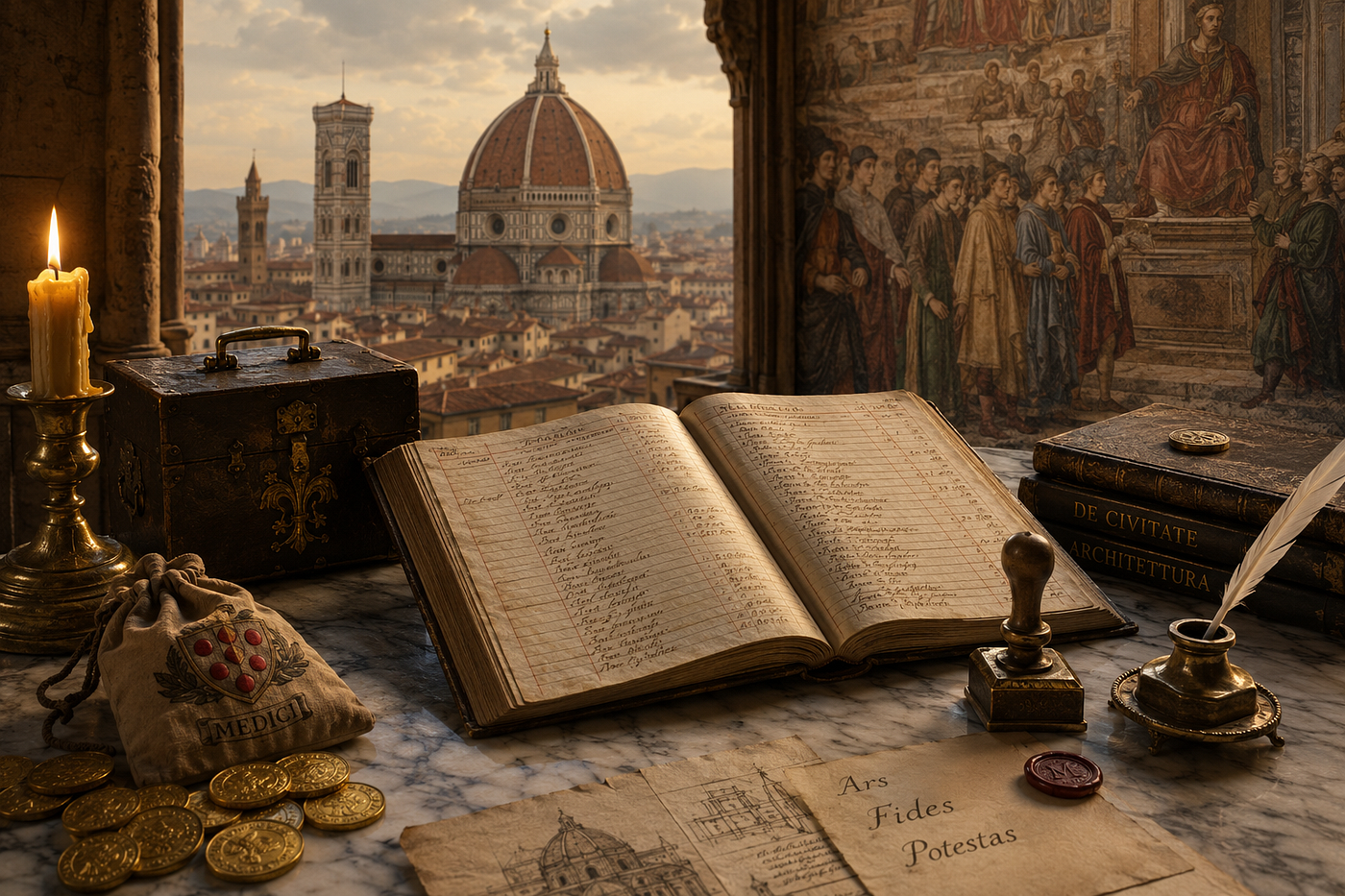
Created by author.
The Medici are usually remembered as patrons of the Renaissance.
Bankers with taste. Political operators with artists. A family whose money helped make Florence feel like the center of human brilliance.
Think Botticelli’s Birth of Venus and Primavera, Brunelleschi’s dome rising over Florence, Donatello, Michelangelo, libraries, chapels, and the architecture of civic memory.
That is the surface read.
The deeper read is that the Medici did not only buy influence. They financed the symbols through which influence became civilization.
That is a different kind of power.
A wealthy family can buy property, guards, marriages, favors, and temporary obedience. The Medici understood something more durable. If money only buys force, people eventually recognize the hand holding them down. If money sponsors beauty, knowledge, architecture, religion, and public memory, the hand becomes harder to see.
This is the board-maker move.
It does not only ask, “How do we win inside the city?”
It asks, “How do we shape what the city understands as greatness?”
Once a family becomes associated with art, scholarship, churches, public works, and civic prestige, its power no longer feels like an imposition. It starts to feel like the atmosphere of the place itself.
The operating system is simple:
finance → patronage → culture → legitimacy → governance
Money creates leverage. Patronage selects what gets built. Culture teaches people what to admire. Legitimacy makes the patron feel natural inside the city’s memory.
That is very different from brute command.
Force can make people obey while they still know they are being ruled. Patronage can make people inherit the ruler’s world as if it were simply the world.
The patron does not need to censor every rival voice. They can decide which voices receive space, materials, protection, access, and inheritance. Over time, the sponsored world begins to look like the world itself.
This is why taste is not neutral.
Taste tells a society what deserves admiration before argument begins. It decides what feels elevated, serious, intelligent, crude, holy, modern, outdated, or worthy of preservation.
That means taste can become law without sounding like law.
A painting is never only a painting inside this kind of system. A chapel is never only a chapel. A school, a museum, a fellowship, a research center, a prize, a grant, a platform, or a public initiative can all teach a society where seriousness lives.
The family faded. The pattern scaled.
Today, the Medici pattern rarely appears as one family standing over one city. It shows up through foundations, universities, museums, media grants, research institutes, philanthropy networks, public-private partnerships, cultural prizes, elite fellowships, policy shops, safety councils, and institutional language.
The modern patron may not build a chapel.
They may fund a department, a journalism initiative, an AI safety institute, a climate program, an art exhibition, a public-health campaign, or a fellowship pipeline.
The mechanism is familiar.
Fund the work. Credential the work. Circulate the work. Make the work respectable. Let respectable work define the room.
This does not mean every funded thing is false. That would be lazy.
Patronage can support real beauty, real research, real public work, and real preservation.
That is why the pattern is difficult.
Power is rarely pure darkness. Much of it survives by attaching itself to real goods: beauty, order, knowledge, safety, excellence, compassion, innovation, and public service.
The point is not to pretend those goods are fake.
The point is to ask what else traveled through them.
What becomes prestigious because this money touched it?
Which questions become rude inside the rooms this money built?
Who becomes an expert through the patron’s infrastructure?
What language appears neutral after passing through the institution?
Which forms of dissent become aesthetically or professionally embarrassing?
That is the Medici field read.
Not a genealogy. Not a secret family map. A pattern ancestor.
Power learned a long time ago that it does not only need to rule people. It can sponsor the symbols by which people recognize rule as civilization.
The old version placed a family crest over the city.
The new version places a credential over the conversation.
Different century. Same board.
A fuller version of this Field Read lives at The Alignment Archive, with the Board Maker extraction, the Modern Medici Map, and the larger Power Systems framework.
Read the full Field Read here:
메타데이터
- post_id
- 4730fd3b8e40
- slug
- the-medici-operating-system-4730fd3b8e40
- url
- https://medium.com/the-alignment-archive/the-medici-operating-system-4730fd3b8e40
- canonical_url
- https://medium.com/the-alignment-archive/the-medici-operating-system-4730fd3b8e40
- author_url
- https://medium.com/@thealignmentarchive
- status
- ok
- fetched_at
- 2026-07-10 01:40:30