This One Prompt Turns Codex Into an Autonomous AI Software Team
Most people still use AI coding assistants like this:
This One Prompt Turns Codex Into an Autonomous AI Software Team
Most people still use AI coding assistants like this:
“Write a login page.”
Then…
“Now add authentication.”
Then…
“Fix the tests.”
Then…
“Review the code.”
Then…
“Deploy it.”
You’re acting like the project manager.
The AI is acting like a junior developer waiting for instructions.
But OpenAI’s latest Codex models — especially Codex 5.6 (SOL Extra High) — can work very differently.
Instead of feeding it one task at a time, you can give it one complete mission.
And surprisingly…
It performs much better.
The Prompt
Here’s the prompt that’s getting attention among developers.
I have one complete task to push end to end:
[your complete specification]
Treat it as one end-to-end goal: take the whole plan to done, until architecture, implementation, tests, review and the final result all clear the bar.
Break the goal into independent parts.
Spawn as many parallel agents as it takes.
Give each one its own goal with:
- clear deliverable
- verification method
- done criteria
Then run it like an operator:
- schedule the agents in parallel
- track progress
- synthesize what comes back
- resolve conflicts
- keep implementing
- verify live after every important step
- review when it matters
- commit when it's ready
- close with a final summary
Verification must cover the real end-to-end path:
- browser use
- computer use
- clicks
- keyboard interactions
- whatever it takes
Don't stop at partial progress unless blocked by:
- missing credentials
- destructive ambiguity
- conflicting requirements
At first glance, it looks like a long prompt.
But the interesting part isn’t its length.
It’s how it changes the model’s mindset.
You’re Giving One Mission Instead of Twenty
Imagine hiring a contractor to renovate your house.
Which sounds better?
Option 1:
Paint the walls.
Then…
Install lights.
Then…
Fix plumbing.
Then…
Clean everything.
Or Option 2:
Renovate the house. Finish everything. Tell me when it’s complete.
The second instruction gives ownership.
That’s exactly what this prompt does.
Instead of solving isolated problems…
Codex owns the entire project.
Parallel Agents Are the Real Superpower
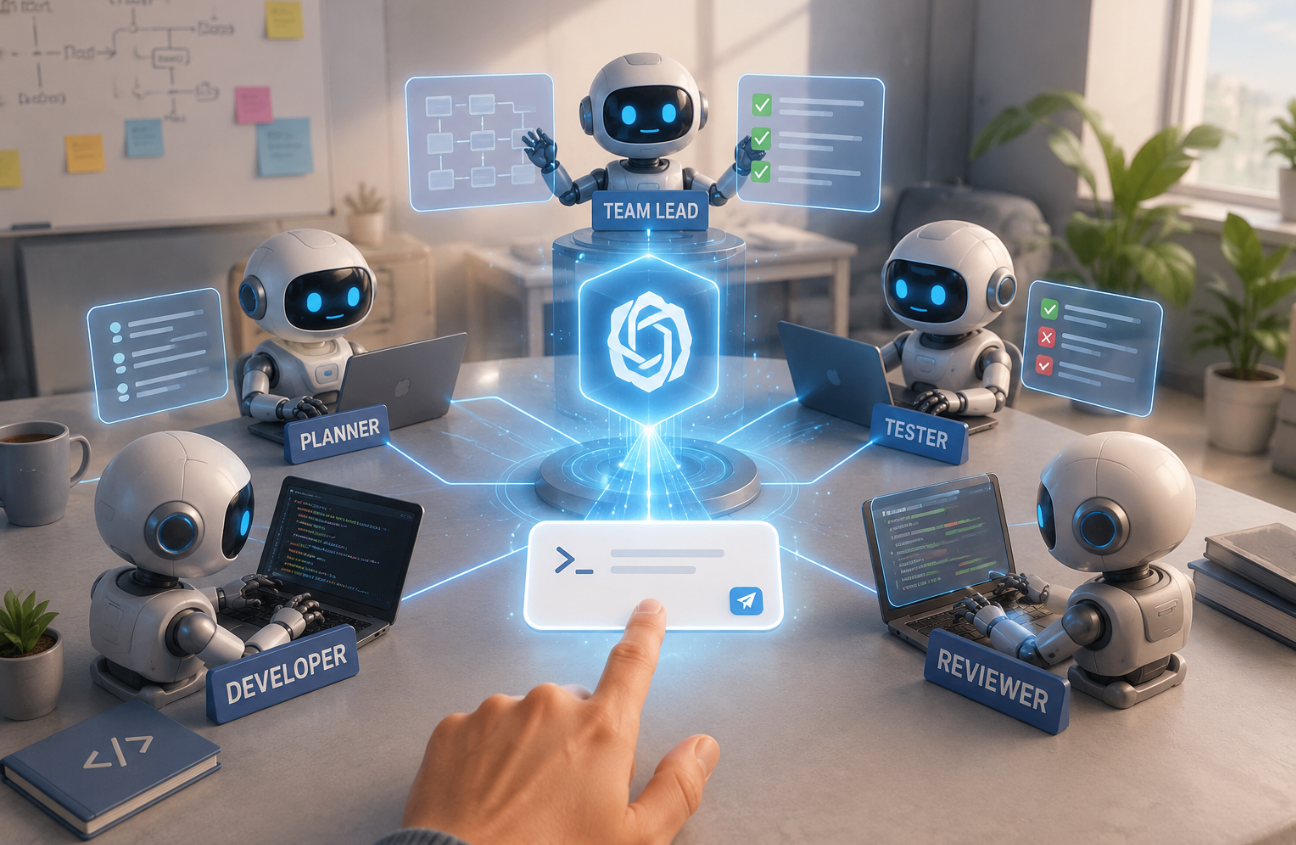
Modern AI models can coordinate multiple internal workers.
Instead of one agent doing everything sequentially…
The model can split work like this:
Main Goal
│
├── Agent 1
│   Architecture
│
├── Agent 2
│   Backend APIs
│
├── Agent 3
│   Frontend UI
│
├── Agent 4
│   Database
│
├── Agent 5
│   Testing
│
├── Agent 6
│   Documentation
│
└── Coordinator
    Merge everything together
Now several tasks happen simultaneously. That’s much closer to how real engineering teams work.
Example
Suppose your specification says:
Build a Todo application.
Requirements:
- React frontend
- FastAPI backend
- PostgreSQL
- User authentication
- CRUD operations
- Docker support
- Unit tests
- End-to-end browser tests
Instead of writing everything in order…
Codex could internally divide the work.
Agent 1
Design architecture
Deliverable:
Project structure
Done:
Architecture approved
Agent 2
Implement backend
Deliverable:
REST API
Verify:
API tests pass
Agent 3
Create frontend
Deliverable:
Responsive UI
Verify:
Manual browser testing
Agent 4
Database
Deliverable:
Migration scripts
Verify:
Database initializes successfully
Agent 5
Testing
Deliverable:
Integration tests
Verify:
100% passing
Agent 6
Documentation
Deliverable:
README
Verify:
Fresh installation works
Instead of one long chain…
Everyone works simultaneously.
Every Agent Gets a Definition of Done
One of the smartest parts of the prompt is this line:
Give each one a verification method and done criteria.
That prevents vague outputs.
Instead of saying:
Backend finished.
The AI has to prove it.
For example:
Done when:
 API returns HTTP 200
 Database stores records
 Tests pass
 Authentication succeeds
Verification forces higher-quality work.
Verification Happens Continuously
Most AI prompts wait until the end to test everything.
This one says:
Verify after every important step.
That means the workflow becomes:
Implement
↓
Test
↓
Fix
↓
Verify
↓
Continue
Instead of:
Write everything
↓
Hope it works
That’s a huge improvement.
Browser and Computer Use Matter
Another interesting instruction is:
Verification must cover browser and computer use.
That means the AI shouldn’t stop after saying:
The login page should work.
Instead it should actually:
- Open the browser
- Click Login
- Enter credentials
- Submit the form
- Confirm the dashboard appears
- Verify the complete user journey
That’s much closer to real QA testing.
The AI Becomes an Operator
Notice these instructions:
- schedule
- coordinate
- resolve conflicts
- synthesize
- review
- commit
Those aren’t coding tasks.
They’re management tasks.
You’re telling Codex to become the engineering lead.
Instead of merely writing code…
It coordinates the entire software project.
Why This Works So Well
Most prompts focus on what to build.
This prompt focuses on how to execute.
That’s a big difference.
Rather than saying:
Build X.You’re saying:
Plan.
Delegate.
Implement.
Verify.
Review.
Finish.
The workflow becomes much more structured.
A Better Mental Model
Think of traditional prompting like this:
User
↓
Task
↓
AI
↓
Answer
This prompt creates something closer to:
User
↓
Mission
↓
Coordinator AI
↓
Multiple Specialized Agents
↓
Verification
↓
Integration
↓
Review
↓
Completed Project
It’s less like chatting with a coding assistant…
And more like assigning work to an autonomous software team.
When Should You Use This Prompt?
It’s especially useful for projects that involve many moving parts, such as:
- Full-stack web applications
- API development
- SaaS products
- Internal business tools
- Dashboard projects
- AI agent systems
- Automation workflows
- Large codebase refactors
- End-to-end testing
- Feature implementation across multiple services
The larger the project, the more valuable structured coordination becomes.
Final Thoughts
AI coding is moving beyond autocomplete.
The biggest shift isn’t that models write better code.
It’s that they can increasingly organize work, coordinate parallel efforts, verify results, and keep moving toward a single objective with minimal intervention.
This prompt takes advantage of that shift.
Instead of micromanaging every step, you define the destination, establish clear standards for completion, and let the model orchestrate the journey.
For complex software projects, that change in approach can make the difference between generating isolated snippets of code and delivering a working, end-to-end solution.
메타데이터
- post_id
- 4734d4a0a7c5
- slug
- this-one-prompt-turns-codex-into-an-autonomous-ai-software-team-4734d4a0a7c5
- url
- https://medium.com/coding-nexus/this-one-prompt-turns-codex-into-an-autonomous-ai-software-team-4734d4a0a7c5
- canonical_url
- https://medium.com/coding-nexus/this-one-prompt-turns-codex-into-an-autonomous-ai-software-team-4734d4a0a7c5
- author_url
- https://medium.com/@codebun
- status
- ok
- fetched_at
- 2026-07-15 17:25:02