Who Really Shapes Urban Development in Pune? Politics, Business, and Local Power Networks
The Indian city of Pune, home to my extended family, historical figures, temples, educational institutions, and beautiful geography, has…
Who Really Shapes Urban Development in Pune? Politics, Business, and Local Power Networks
The Indian city of Pune, home to my extended family, historical figures, temples, educational institutions, and beautiful geography, has been shaped by urban development through various empires and dynasties. Once Maharashtra’s cultural capital and known as the “Oxford of the East,” it now grows rapidly due to advances in technology, education, and culture, influenced by politics, business, and local power. The article examines how and why Pune continues to thrive.

The skyline of Pune West, featuring the suburbs of Baner, Balewadi, Wakad, and Hinjawadi.
Pune, after Bengaluru and Hyderabad, is a top IT hub in India, with suburbs such as Kharadi, Balewadi, Hinjawadi, and Baner hosting product companies. Bengaluru offers more growth in product-based IT, while Pune is ideal for those at Infosys, TCS, or CTS, with good lifestyle, amenities, and savings. Transport improvements are seen as cities like Bengaluru, Chennai, Mumbai, and Hyderabad expand their metro systems.
Pune’s transformation from a historic cultural capital into a modern IT and real estate hub in India has not occurred solely through market forces. Political families, cooperative institutions, caste networks, bureaucratic systems, and business alliances have all played a major role in shaping where wealth, infrastructure, and opportunity accumulate.

Traffic in Pune at night with vibrant light trails.
Historical Overview
Pune is located in India’s scenic Deccan region, deeply shaped by various empires, including the Ahmadnagar Sultanate, the Mughal Empire, the British Raj, and the Adil Shahi dynasty. However, the city’s political importance rose significantly during the eighteenth-century rise of the Maratha Empire.
The turning point came when Balaji Vishwanath was appointed Peshwa by Chhatrapati Shahu Maharaj in 1713. Under his son, Bajirao I, the Maratha Empire expanded rapidly across large parts of India. Pune gradually transformed from a modest regional town into the administrative and political center of Maratha power.
Later, during the tenure of Balaji Bajirao (Nanasaheb Peshwa), Pune became the effective capital of the Maratha Empire. Political authority, military planning, trade activity, and elite networks are increasingly concentrated within the city. This historical concentration of power helped establish Pune’s long-term identity as a center of administration, culture, and influence.
During the reign of Baji Rao I’s eldest son, Balaji Bajirao Peshwa, the Maratha empire reached its zenith through the Peshwa's dedicated efforts, his brothers, and his generals. The Maratha Empire had become the largest in the eighteenth century, extending from Tanjore and Vasai to Kolkata. Under their leadership, the Marathas reduced the Mughal Empire to a puppet state and established their supremacy across India. Balaji Baji Rao, also known as Nanasaheb I, transferred the capital of the Maratha Empire from Satara to Pune, which served as the empire’s capital — and, effectively, the capital of Hindustan — from the mid-1700s until 1818, when it was relocated to Calcutta and Delhi.

Shaniwar Wada
Many of Pune’s forts and landmarks continue to symbolize this legacy. Shaniwar Wada, once the seat of the Peshwas, remains one of the city’s most recognizable historical structures despite the fire that damaged much of it in 1828. Similarly, forts such as Sinhgad, Rajgad, Torna, Purandar, and Raigad continue to represent Maratha military strength and regional pride.
These historical structures are not merely tourist sites. They continue to shape Pune’s cultural identity and public memory, reinforcing the city’s connection to Marathi heritage and regional history.
Additionally, the Indian Army’s Southern Command is located in Pune, in its cantonment. It is the military’s largest geographical command, overseeing operations, training, and logistics across 40% of India’s landmass, encompassing 9 states and 4 union territories.
Mandirs and Culture in Pune
Alongside politics and military history, Pune developed a strong cultural and religious identity that continues to influence the city today.
The Shrimant Dagdusheth Halwai Ganpati Mandir is among Pune’s most visited religious sites and plays a central role during Ganesh Chaturthi, a festival popularized politically and socially by Bal Gangadhar Tilak during the freedom movement. Temples such as Chaturshringi Mandir, Omkareshwar Mandir, Taljai Mata Devasthan, Pataleshwar Caves, and Bhuleshwar Temple continue to attract devotees and tourists alike.

The Ganesha idol at the Shrimant Dagdusheth Halwai Ganpati Mandir.
Pune is renowned for its intellectual scene, diverse restaurants, and educational institutions. It hosts the Sawai Gandharva Bhimsen Festival, an international classical music event that has been held since 1953. Historic eateries like Vaishali, German Bakery, and Roopali are popular, with Vaishali known for South Indian dishes. Kayani Bakery is famous for Shrewsbury Biscuits from Shropshire. Pune’s sweets include Chitale Mithaiwale. The Mahatma Phule Mandai in Shukrawar Peth, with over 500 stalls, offers affordable fruits, vegetables, flowers, and spices.

A Puneri Pagadi, worn by leaders like Tilak, is mostly used on special occasions such as weddings and traditional days in schools and colleges.
These institutions enhance religious life, social cohesion, the local economy, and cultural tourism. Symbols like the Puneri Pagadi reflect Pune’s scholarship, leadership, and Marathi heritage.
Education, Technology, and Economic Expansion
Pune’s modern growth has accelerated significantly with the rise of the IT and education sectors. Over the last three decades, the city has emerged as one of India’s leading technology hubs alongside Bengaluru, Hyderabad, and Chennai.
Areas such as Hinjawadi, Baner, Balewadi, Wakad, and Kharadi now host major IT parks, multinational corporations, and product-based technology firms. Companies in software services, engineering, AI, fintech, and automotive technology have transformed Pune into a major employment center for migrants from across India.

A large Hinjawadi campus has modern architecture, metro infrastructure, and a busy global workforce, serving as a key economic driver. Image created with Gemini AI
Unlike Bengaluru, which is often associated with aggressive startup growth and higher costs, Pune is frequently seen as offering a balance between career opportunities, climate, lifestyle, and affordability. This balance has contributed to steady migration and suburban expansion.
Additionally, the city’s transport infrastructure has expanded rapidly through metro construction, road widening, flyovers, and proposals for a ring road. However, rapid growth has simultaneously created major challenges related to traffic congestion, environmental stress, water supply, and uneven infrastructure development.
Image credit: DesiBoy101 via Wikimedia Commons
Pune’s educational ecosystem has expanded alongside its economy. Institutions such as Savitribai Phule Pune University (SPPU), Fergusson College, BMCC, Symbiosis, DY Patil University, and Vishwakarma University continue to attract students from across India.
Artificial intelligence is now reshaping education in the region as well. Schools and universities have begun integrating AI-based learning systems, data science programs, and industry partnerships into their curriculum. The Maharashtra government’s partnership initiatives involving AI-powered educational tools reflect the growing influence of technology in governance and learning.
Although AI can be beneficial in education, many educational bodies are addressing the ethical use of platforms such as ChatGPT. This ensures that students use technology for learning rather than to bypass their own work. Rising privatization has also increased educational costs, creating debates around accessibility, quality, and commercialization.
How Politics and Local Power Networks Shape Urban Development
Although Pune’s transformation appears driven by technology and investment, urban development in the city is deeply influenced by political and local power structures.
Land conversion, infrastructure approvals, zoning changes, cooperative housing systems, and construction permissions often involve complex interactions between politicians, developers, bureaucrats, and influential local communities.

Photo courtesy of Amanora Blog
In many peri-urban regions surrounding Pune, agricultural land has gradually been converted into residential and commercial real estate. Communities with historical access to land ownership and cooperative institutions have often benefited significantly from this transition. Large-scale developments such as Magarpatta City, Hinjawadi expansion corridors, Baner, Wakad, and Bavdhan illustrate how land, politics, and private capital intersect in urban growth.
Another thing to note is that caste-based social networks continue to influence access to land, political representation, and economic opportunity in subtle but important ways. While modernization has transformed Pune economically, historical social structures still shape patterns of ownership and influence.
The result is uneven urban development, with some areas quickly receiving infrastructure, housing, offices, and amenities, while others struggle with congestion, drainage issues, water shortages, and informal settlements. Also, to keep green zones and the air clean, demand for farmland on Pune’s outskirts is growing.
This imbalance reflects broader tensions between economic growth and inclusive urban planning.
Business, Politics, and Informal Influence
Urban development in Pune is influenced by political families, cooperative institutions, business interests, real estate networks, the bureaucracy, and local influence systems. These power structures shape infrastructure, industry, slums, and wealth distribution. Real estate-driven expansion correlates with income and education levels, with caste-based networks playing a major role.
Social institutions, gymkhanas, clubs, public events, and business gatherings serve as networking spaces, strengthening political and economic relationships that can grow businesses, influence permits, partnerships, investments, and access to systems.
The process is complex. Farmers and leaders from dominant communities like Maratha-Kunbi and Magar convert land into real estate, forming cooperatives for mixed-use townships such as Magarpatta City, Hinjawadi, Kharadi, and others. Other groups struggle for recognition, highlighting class and caste disparities, with some communities controlling peripheral zones. Land ownership and caste networks are exploited for real estate advantages.
For many businesses, maintaining strong local relationships is considered essential for navigating India’s regulatory and political environment. Political support can help businesses gain legitimacy, local trust, and administrative access, while successful business groups may later enter politics themselves or support political campaigns.
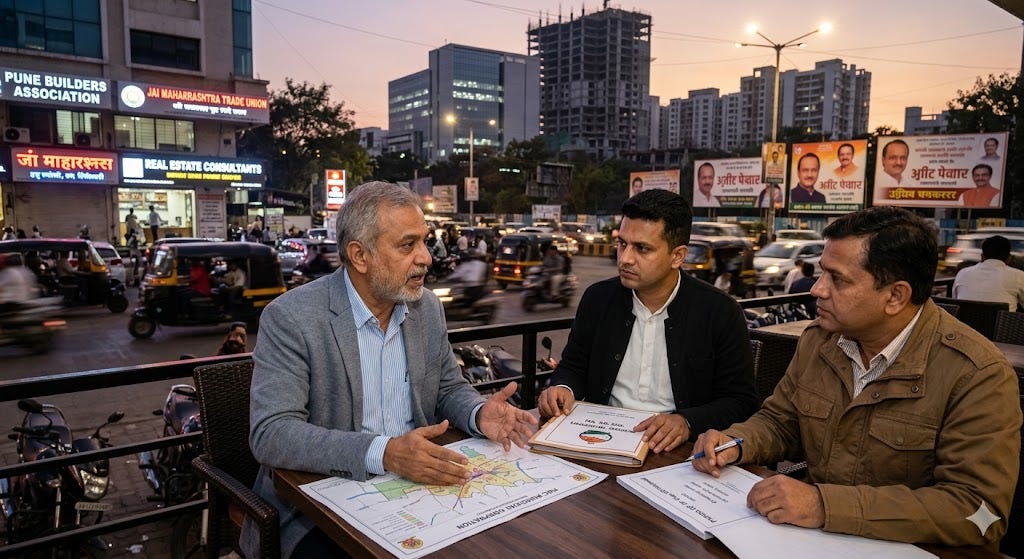
An informal meeting on Pune’s urban development plan amid the city’s rapidly changing skyline. Image created with Gemini AI
There are many businesses that originated in Pune: Poonawalla Group, Kirloskar, Bajaj, Bharat Forge, Kinetic Engineering Ltd., and Kalyani. Additionally, P.N. Gadgil, known for gold, is another privately-owned business.
At the same time, such relationships raise important questions about transparency, governance, and public accountability in urban development.
The Future of Pune
Pune today stands at a crossroads between heritage and hyper-urbanization. The city continues to attract students, professionals, entrepreneurs, and investors because of its educational institutions, climate, culture, and expanding economy.

Image credit: Himanshu Nitnaware via Down To Earth
However, there is more to be done. Rapid urban growth presents serious challenges to ordinary citizens. Traffic congestion, rising real-estate prices, environmental degradation, water stress, infrastructure inequality, and pressure on public services are becoming increasingly visible.
The future of Pune will depend not only on economic expansion but also on whether development becomes more sustainable, inclusive, and transparent. The same networks that accelerated Pune’s transformation must now address questions related to governance, affordability, ecological balance, and equitable access to opportunity.
Pune’s identity has always been shaped by power — from the Peshwas and Maratha administration to modern political leaders, business elites, educational institutions, and technology companies. Understanding how these systems interact is essential to understanding how the city continues to evolve in the twenty-first century.
메타데이터
- post_id
- 47710f6882a5
- slug
- who-really-shapes-urban-development-in-pune-politics-business-and-local-power-networks-47710f6882a5
- url
- https://medium.com/@arkhode/who-really-shapes-urban-development-in-pune-politics-business-and-local-power-networks-47710f6882a5
- canonical_url
- https://medium.com/@arkhode/who-really-shapes-urban-development-in-pune-politics-business-and-local-power-networks-47710f6882a5
- author_url
- https://medium.com/@arkhode
- status
- ok
- fetched_at
- 2026-06-12 22:02:08