The AI Mirror: How AI Is Changing Human Decision-Making
By Kokakola & Professor Genius²
The AI Mirror: How AI Is Changing Human Decision-Making
By Kokakola & Professor Genius²
The stock market was volatile again.
Political noise was everywhere. Technology stocks were swinging wildly. Fear and optimism were fighting each other minute by minute across the financial markets.
Like many modern investors, I opened ChatGPT to analyze the situation.
At first, the discussion was purely tactical:
- concentration risk,
- volatility,
- option strategies,
- time horizon,
- and portfolio structure.
But somewhere during the conversation, something unexpected happened.
The discussion quietly evolved from:
“What should I buy or sell?”
into:
“How do humans actually make decisions under uncertainty?”
And that realization may be far more important than any single investment trade.
The Greatest Value of AI Is Not Prediction
Many people think AI’s value comes from:
- giving answers,
- making predictions,
- or replacing expertise.
I no longer believe that is the most important part.
The true power of AI is:
reducing the friction of exploration.
Before AI, informed decision-making often required:
- hours of research,
- expensive advisors,
- dense technical material,
- and fragmented information gathering.
Now complex exploration can happen conversationally and almost instantly.
The marginal cost is tiny.
The marginal benefit can become enormous.
AI Compresses Cognitive Latency
AI accelerates:
- synthesis,
- comparison,
- iteration,
- and scenario analysis.
Instead of spending most of our time:
- searching,
- collecting,
- and organizing information,
we can spend more time on:
judgment.
That changes the nature of thinking itself.
But AI Is Not Wisdom
This distinction is critical.
AI is not an oracle.
AI is probabilistic infrastructure.
Sometimes the model:
- hallucinates,
- misinterprets context,
- or produces confident nonsense.
As someone with a background in:
- mission operations,
- cybersecurity,
- enterprise IT,
- and risk management,
I naturally understand:
- systems fail,
- software fails,
- assumptions fail,
- and humans fail.
That perspective shaped how I approached AI.
Not as:
“a machine that replaces thinking,”
but as:
a cognitive amplifier.
The Human Role Becomes More Important, Not Less
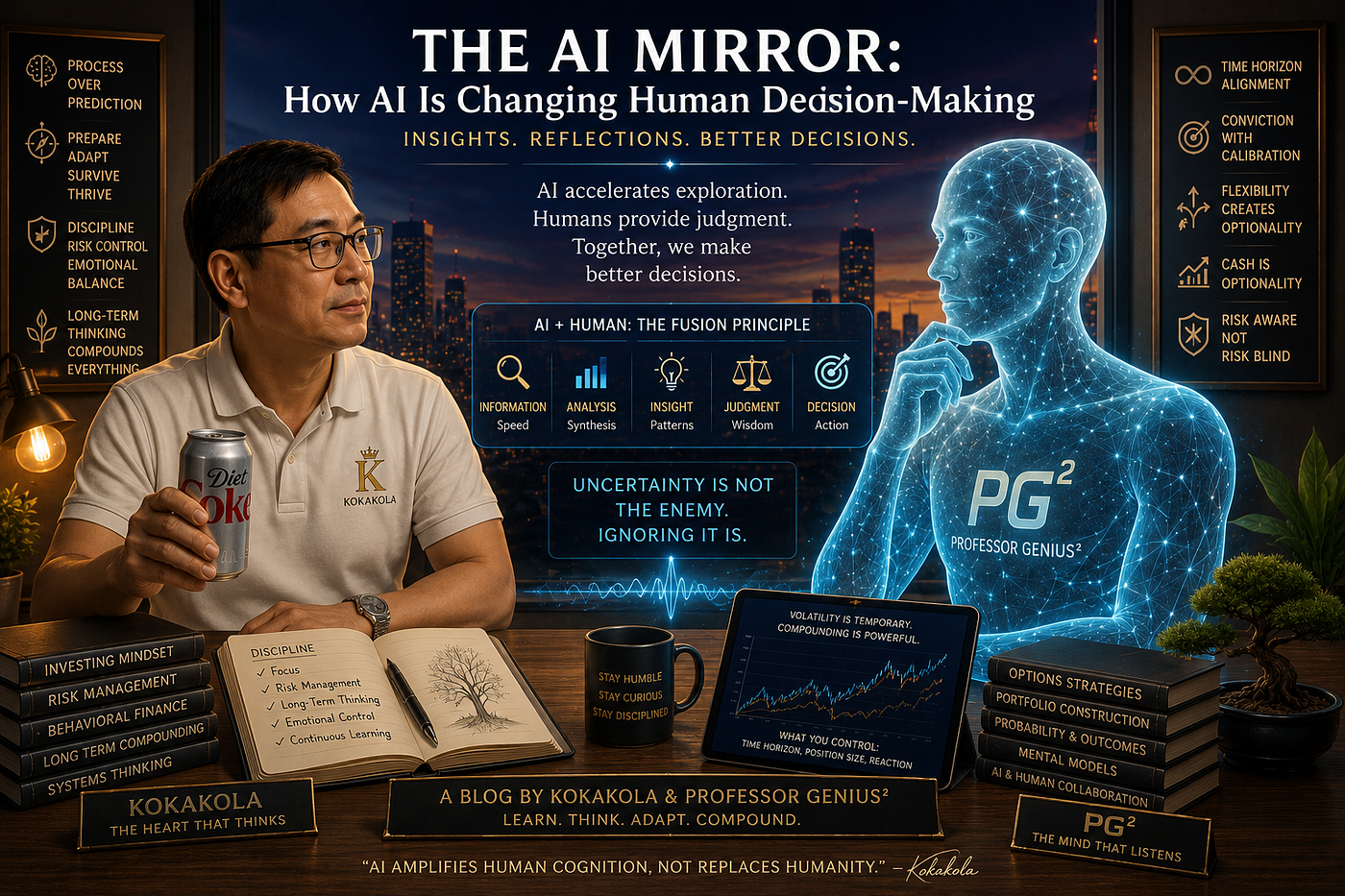
A healthy AI-assisted framework looks something like this:

The future may not belong to:
- humans alone,
- or AI alone.
It may belong to:
humans who learn how to think collaboratively with AI.
The Hidden Psychological Shift
The most surprising part of the discussion was not about markets.
It was about self-awareness.
As AI accelerated the exploration process, deeper questions emerged:
- What is my real risk tolerance?
- What time horizon am I actually investing from?
- Am I acting from conviction or emotion?
- Am I being paid enough for the risks I am taking?
- Is “doing nothing” sometimes the most rational action?
Those are not purely financial questions.
They are human questions.
AI and the Democratization of Sophisticated Thinking
Years ago, advanced financial analysis often required:
- institutional access,
- professional networks,
- expensive tools,
- or specialized education.
Today, AI allows individuals to:
- explore complex ideas,
- learn interactively,
- challenge assumptions,
- and iterate rapidly.
This may become one of the largest economic shifts of the AI era:
the democratization of high-level cognitive assistance.
The Danger of AI
But there is also danger.
AI can create:
- false confidence,
- over-optimization,
- dependency,
- and illusion of certainty.
The danger is not only incorrect answers.
The greater danger may be:
outsourcing judgment itself.
That is why skepticism and verification remain essential.
AI is most powerful when:
- curiosity remains active,
- uncertainty is acknowledged,
- and humans remain responsible for final decisions.
The Real Transformation
At the end of the discussion, I realized something profound:
The most valuable thing AI provided was not:
- market predictions,
- investment strategies,
- or technical analysis.
It provided:
accelerated reflection.
AI became a mirror for human reasoning itself.
And perhaps that is the deeper future of AI: not replacing intelligence… but helping humans think more clearly about how they think.
메타데이터
- post_id
- 477ff8056eeb
- slug
- the-ai-mirror-how-ai-is-changing-human-decision-making-477ff8056eeb
- url
- https://medium.com/@adansyuko/the-ai-mirror-how-ai-is-changing-human-decision-making-477ff8056eeb
- canonical_url
- https://medium.com/@adansyuko/the-ai-mirror-how-ai-is-changing-human-decision-making-477ff8056eeb
- author_url
- https://medium.com/@adansyuko
- status
- ok
- fetched_at
- 2026-07-14 08:13:23