Shobhana Rangachari’s Unfolding of Brochevarevare
Finding space, finding voice
Shobhana Rangachari’s Unfolding of Brochevarevare
Finding space, finding voice
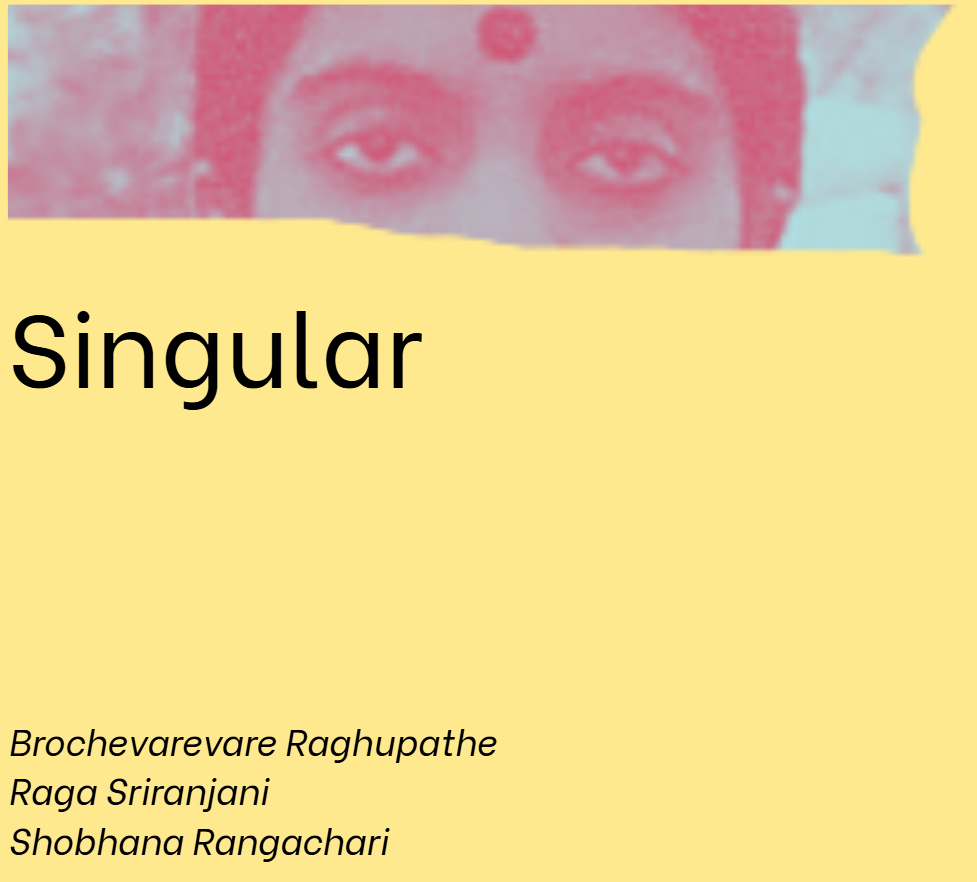
Before you hear what I have to say about her rendition, take a listen — it is the opening piece of this concert:
[embed]
The Song
Brochevarevarura is a structurally peculiar composition. Its uniqueness lies in the fact that each charanam (stanza) has a different tune. In the Carnatic standard, charanams are melodically identical to each other, but differ in lyrics. The song is addressed to Rama, and each charanam of the song depicts an incident in the Ramayana — Rama bestowing Lanka to Vibheeshana, protecting sages and getting rid of Maarichcha and other demons, killing Vali to favour Sugriva. The last charanam references Thyagaraja himself, as is typical of his compositions — the one who can hold Thyagaraja by the hand and help him cross over this worldly existence.
The other unique feature of the song is that the pallavi (starting main line or verse) is not constant. The core of the pallavi is a single compound word (in Telugu) — Brochevarevare? — roughly translated to “who is the one who can save / protect me?”. But this question has various four different appendages:
- Brochevarevare, Raghupathe? [who is there to save me, Raghupathi (Rama)?]
- Brochevarevare, Ninnuvina? [who is there to save me, other than you?]
- Brochevarevare, Shri Rama Nenaruna? [who is there to save me, Shri Rama, with kindness?]
- Brochevarevare, Sakalaloka Nayaka ? [who is there to save me, Lord of all the Worlds (Rama)]
- Brochevarevare, Naravara Nee Sari ? [who is there to save me, who is equal to you, oh most exalted of men?]
Now these appendages occupy the last 2.5 beats of the 8-beat Adi-tala cycle of the pallavi line. Part of the excitement of singing or listening to the song is marveling at how these five variations, each of different syllabic lengths all fit, seemingly smoothly into the same 2.5 beats!
But the other thing that hits you when you note down these pallavi variations, as I have done above, is that this song is a genuine plea, a cry for help. Of course, there are possibly hundreds of songs in which Thyagaraja is essentially asking Rama to come and save him. But the unique progression in the pallavi of this song makes it clear that this is a heart-felt, perhaps slightly desperate cajoling of Rama. He starts simply — addressing Rama as Raghupathi. But that doesn’t seem to be working! So Thyagaraja seems to be gently but surely upping the ante with each line, trying different tacks — if not you, who else even has the ability to save me? Oh kind Rama? Oh all-powerful Rama? Oh unequalled Rama?
The composition is a well-known one, rendered often on the concert platform. Like a slew of other songs of Thyagaraja in the same raga, (Marubalka, Bhuvini Dasudane, Sogasuga Mridanga Talamu, Sari Evvare), it is typically sung with vigor, in the early part of the concert, usually with a bit of improvisation attached in the form of a brief alapana or a brisk swara passage at the end. The version I view as the benchmark, and have fallen in love with is that of Semmangudi Srinivasa Iyer. You can listen to one of his renditions of the song here.
The rendition
Shobhana Rangachari’s brief alapana begins at the top notes of the scale. She traverses the octave, but not methodically — suddenly dipping low and often jumping to characteristic phrases of the raga at the upper end of the octave, with some fast passages interspersed with long notes. All of this happens in just a moment, but doesn’t feel rushed. It doesn’t feel like a raga alapana for the sake of alapana — more like an artiste finding her voice.
One of the highlights of this rendition for me is the opening line. The way she caresses the syllables “Broche…”, ever so gently but with so much conviction. Killing with kindness. It is as though the plea has been inverted instantly and from the get go. The question is not so much “who is there to save me?” — it is “why not come and save me? Isn’t it the most obvious thing to do?” And then on to “Raghupathe”. How does she find so much space to play with the word? How many different ways does she find to sing “Raghupathe”? Maybe just a few, but in the moment it feels like she has found a infinite number of ways to infuse “Raghupathe” with warmth, with the entirety of her plea, with the entirety of the raga. I caught myself thinking “My God, she could go on singing this one line forever in so many different ways, and I’d still be listening!”.
She then quickly cycles through the rest of the pallavi appendages and the charanams, settling into a neraval (improvisation of a line) with “Brochevarevare, Ninnuvina”, and then a swara passage. And then toward the end of the swara passage she begins to intersperse solkattu syllables (ta-kita-jom…) among the swaras. It is as though the plea has been answered and Rama has come, or if not on the horizon yet, has at least sent word, perhaps through the raga Sriranjani itself, as she was singing her song, that he would be there soon. She and Thyagaraja knew, they just knew they would be saved, and unable to contain themselves, let out another joyous stream of syllables.
And before you know it, 32 minutes of Sriranjani have passed. What a journey from first to last. And what transitions! When did the alapana end, when did the song begin? How she moved onto the neraval, into swaras, how spontaneous the solkattu! How much space she has found in the interstices of the tala cycle. How she has suffused that space with the raga, how she has infused the raga and each syllable with feeling. How she has done all of this so naturally, seemingly effortlessly, without pomp, with deep authenticity. How it all sparkles, but with calm, like a deep, shimmering lake.
Oh my, Oh my.
The artist
There is very little available about Shobhana Rangachari on the web. This article by India Art Review is the most comprehensive I can find. She seems to have died young, in 1984, only in her early thirties. Delhi based for a while, her primary guru was S Gopalakrishnan, a disciple of Tiger Varadachariar. She was often associated with MD Ramanathan, given the commonalities of their styles (low voices, slower renditions) and musical heritage (MD Ramanathan being a disciple of Tiger Varadachariar).
She may have been somewhat unfortunately been referred to as ‘Lady MDR’, but to me it is clear that her style and conception of music is absolutely singular. I discovered her only recently, through this compilation that features her singing Muthuswami Dikshitar’s Jambupathe. Her rendition of that song has become my favourite version of it. Just as this rendition of Brochevarere is my new all-time favourite rendition of the song!
메타데이터
- post_id
- 47b044d98cf4
- slug
- shobhana-rangacharis-unfolding-of-brochevarevare-47b044d98cf4
- url
- https://medium.com/@vishnuvasudev-63314/shobhana-rangacharis-unfolding-of-brochevarevare-47b044d98cf4
- canonical_url
- https://medium.com/@vishnuvasudev-63314/shobhana-rangacharis-unfolding-of-brochevarevare-47b044d98cf4
- author_url
- https://medium.com/@vishnuvasudev-63314
- status
- ok
- fetched_at
- 2026-06-21 07:44:09