A Book That Finally Tells Persia’s Story From the Inside
How Lloyd Llewellyn-Jones’s Persians: The Age of the Great Kings rescues the Achaemenid Empire from centuries of Greek framing
A Book That Finally Tells Persia’s Story From the Inside
How Lloyd Llewellyn-Jones’s Persians: The Age of the Great Kings rescues the Achaemenid Empire from centuries of Greek framing
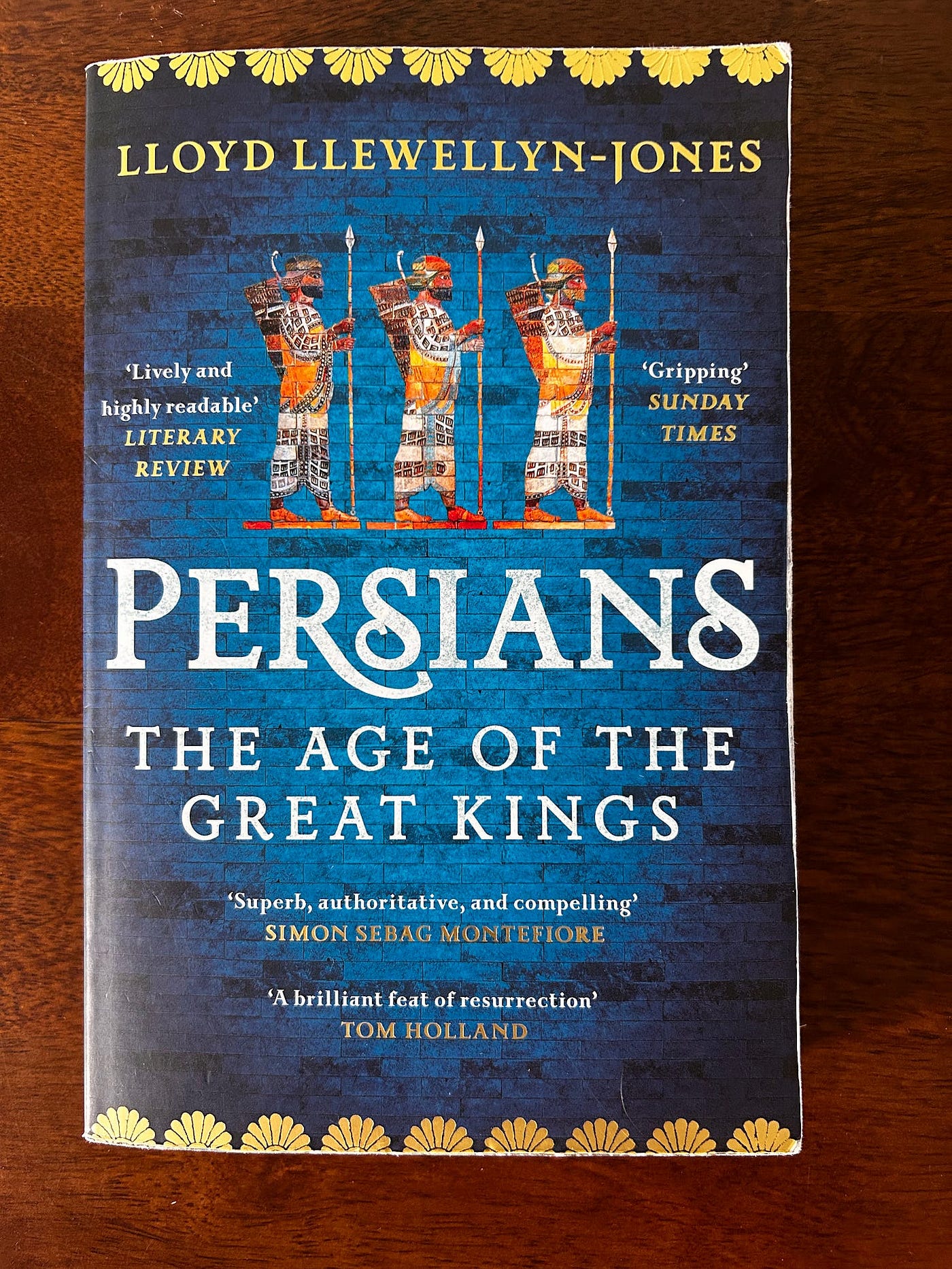
Photo by the author, not to be used without permission. All images are from the author’s copy. ©Prateek Dasgupta.
Popular history lives or dies on a single question: Does it make you care?
Not simply about facts, dates, and an empire’s machinery, but about the people who live within it; their ambitions, cruelties, and grace. By that criterion, Lloyd Llewellyn-Jones’s Persians: The Age of the Great Kings is one of the few works of historical scholarship that truly delivers. The level of detail is high enough to satisfy experts, and the narrative is engaging enough to captivate readers who enjoy engaging tales set in the past.
The subject alone is worthy of attention. At its peak, the Achaemenid Persian Empire stretched from Libya to the Central Asian steppes, from Ethiopia to modern-day Pakistan, making it the largest empire the world had ever seen. Yet, it remains one of the least understood by general readers. Ask most people about ancient Persia, and they’ll probably mention the Battle of Thermopylae and Xerxes as the gilded villain in the 300 movie [1].
Maybe they’ll talk about Cyrus as imagined in the Bible. In other words, we’ll get either a Greek or a biblical narrative about the Persians.
Llewellyn-Jones, a Professor of Ancient History at Cardiff University and one of the world’s leading Achaemenid Empire specialists, sets out to convey a different story: a history of the Persians from a Persian perspective. In doing so, he has created something truly remarkable.
Let’s discuss this fascinating read further and why you should add it to your bookshelf.
The book begins around 1000 BC by tracing the origins of Indo-Iranian peoples from whom the Achaemenids would later arise. It concludes with the collapse of Darius III and Alexander of Macedon’s conquest in the late 330 BC. That is roughly seven centuries of history, and the challenge for any author is to give such a broad span shape and momentum without either flattening it into a dry chronicle or losing the reader in a thicket of names and dates. To address this problem, Llewellyn-Jones uses an unusual yet highly effective approach to structuring the book: it doesn’t just move forward in time. Rather, it skillfully shifts between narrative, thematic, and cultural modes, ensuring the reading experience remains fresh and engaging.

The Cyrus Cylinder and the Ishtar Gate. Photo by author not to be used without permission.
The first section, “Establishing Empire”, is driven by chronological momentum. It discusses the rise of Cyrus the Great and his successors with the fervor of an epic tale, basing each reign in the political and military realities of the time while never losing sight of the people at its heart. Llewellyn-Jones’s Cyrus is neither the sanitized “liberator” of later biblical legends nor a brutal conqueror, but rather a pragmatic genius who recognized that an empire built on tolerance and respect for his conquered subjects’ sensitivities would outlast one built solely on fear.
The chapters on Cyrus’s conquest of Babylon, as well as the renowned Cyrus Cylinder, with its proclamation of respect for local gods and customs, are among the finest in the text — packed with evidence, rich with context, and rewarding to read. While the Cyrus Cylinder is sometimes referred to as “the first declaration of human rights,” the author makes a persuasive case that it was, in fact, a carefully crafted piece of imperial propaganda.
Then, just as the story is taking off, Llewellyn-Jones does something unexpected. He stops. The entire second portion of the book, “Being Persian,” abandons the chronological progression of events in favor of immersing the reader in the culture of the Achaemenid court. This is where the book becomes unique in the popular history genre, and its character is completely revealed. Rather than treating the cultural and social dimensions of Persian life as a backdrop to the main political narrative, Llewellyn-Jones puts them front and center, devoting long, richly detailed chapters to the workings of the royal household, royal audience etiquette, Persepolis architecture, religion, the role of women in court politics, the nature of the Persian gift economy, and the complex institution of the royal harem.
Far from slowing down the book, this structural detour is one of its most enjoyable features. I found the flow of the thematic chapters reflective and more willing to linger than that of the chronological ones. The contrast was refreshing.
When the historical story resumes in the third segment, the reader has a more nuanced understanding of Persian life, making each subsequent political event feel deeper and more poignant. When a king bestows an honorary robe on a loyal official, or a queen mother plots to ensure her favorite son’s succession, these actions now bear the full weight of a world the reader has come to know. The structural shift, which would have been smoothed out in more traditional academic research, ends up being the most impactful part of the book.
On the topic of women’s lives in the Achaemenid court, where popular history has been happy with conventional thinking for too long, Llewellyn-Jones shines. In the Western image, the oriental harem is a realm of passive luxury; a golden cage of hushed ladies waiting for a king’s pleasure. The reality revealed by Persian administrative records, royal inscriptions, and critical analysis of Greek sources is significantly more complex and interesting.
Royal women possessed land, maintained estates, controlled their own financial resources, led their own workforces, and wielded significant political power over succession and court matters. The queen mother, in particular, had great authority.
No one better shows this than Parysatis, Artaxerxes II’s mother and one of the book’s most interesting characters. Parysatis’s sons, Cyrus the Younger and Artaxerxes II, clash at Cunaxa in 401 BC, resulting in Cyrus's death [2]. The queen mother, who loved Cyrus the most, is devastated and makes it her life’s mission to exact revenge on those responsible for his death. Some critics have characterized the sections devoted to her rule as macabre or soap-opera-like, describing her political connections, personal grudges, and complex plans of vengeance against anyone who dared to resist her. Yet, from the standpoint of a reader, these passages are compelling precisely because Llewellyn-Jones enables the strangeness and intensity of this universe to breathe. Parysatis’s ability to carry out a pogrom against Artaxerxes’s associates is sometimes shocking, particularly the detailed account of Queen Stateira’s poisoning[3].
The Achaemenid court was a theatre of dynastic politics, with poisonings, betrayals, rivalry between brothers, and the merciless calculation of mothers who protected their own sons but favored some over others. Rendering them with vigor and dramatic color is exactly what good popular history should do.

Artifacts from the Achaemenid Empire. Photo by author not to be used without permission.
The Greco-Persian Wars, long told from the Greek perspective, are also described in the book with the same level of descriptive engagement. Llewellyn-Jones cannot, of course, completely avoid the Greek sources; they are too prevalent in the historical record for any historian to altogether escape their gravitational pull. The lack of Persian historical records and the paucity of archaeological evidence don’t help Llewellyn-Jones’s case in recasting the events entirely from a Persian perspective. However, he reads the Greek sources critically, continually questioning which interests and assumptions drive each tale and supporting them with Babylonian, Egyptian, and Persian records whenever available.
For me, as a popular history writer, the author’s analysis was particularly valuable, and I’d like to point out an example that caught my eye. In Herodotus’s Histories, there is a narrative about Xerxes and a plane-tree:
Passing from Phrygia into Lydia, he came to the place where the roads part; the road on the left leads to Caria, the one on the right to Sardis; on the latter the traveler must cross the river Maeander and pass by the city of Callatebus, where craftsmen make honey out of wheat and tamarisks. Xerxes went by this road and found a plane-tree, which he adorned with gold because of its beauty, and he assigned one of his immortals to guard it. On the next day he reached the city of the Lydians.
According to Llewellyn-Jones, this narrative serves no purpose other than to portray Xerxes as a ridiculous, frivolous emperor with too much wealth but no sense of priorities. Reading it, you almost feel as if the emperor were a tree-hugging hippie rather than the ruler of the world’s largest superpower. Such characterizations may have been deliberate to paint the enemy in a negative light.
The author’s suggestion of why Xerxes invaded Greece reframes the episode in terms of Persian strategic logic rather than Greek moral drama. The invasion was not the act of a deranged megalomaniac driven by hubris. It was a coherent imperial project, and understanding it as such makes the episode more interesting.
Perhaps my favorite part of the book was the discussion of the Achaemenids’ religion. We usually associate pre-Islamic Iran with Zoroastrianism, yet during Achaemenid rule, it was far from a clearly established state religion. Cyrus the Great makes no mention of Ahura Mazda, Zarathustra, or the Avesta. Though Darius I and his descendants talk about Ahura Mazda, as the author says, “the absence of a clear set of criteria for what Zoroastrianism was in the Achaemenid period makes it hard to be certain that the Achaemenids were followers of that faith.”
Confused?
Let me give you an analogy that you can probably relate to.
Just as pre-Islamic evidence of the worship of Allah doesn’t indicate that Islam as a religion was practiced, so too the mere mention or veneration of Ahura Mazda does not constitute sufficient proof of a widespread practice of Zoroastrianism. It was only during the Sasanian Empire that Zoroastrianism was properly codified and declared Iran’s state religion. There were certainly Elamite, Babylonian, and Iranian polytheistic traditions in Achaemenid spiritual life, making the religious practices much more diverse than a uniform interpretation of Zoroastrianism, as we understand it today, would suggest.
In the final chapters, the author makes a compelling case: the Achaemenid Empire did not decline before Alexander’s arrival; rather, it fell apart suddenly and without warning.
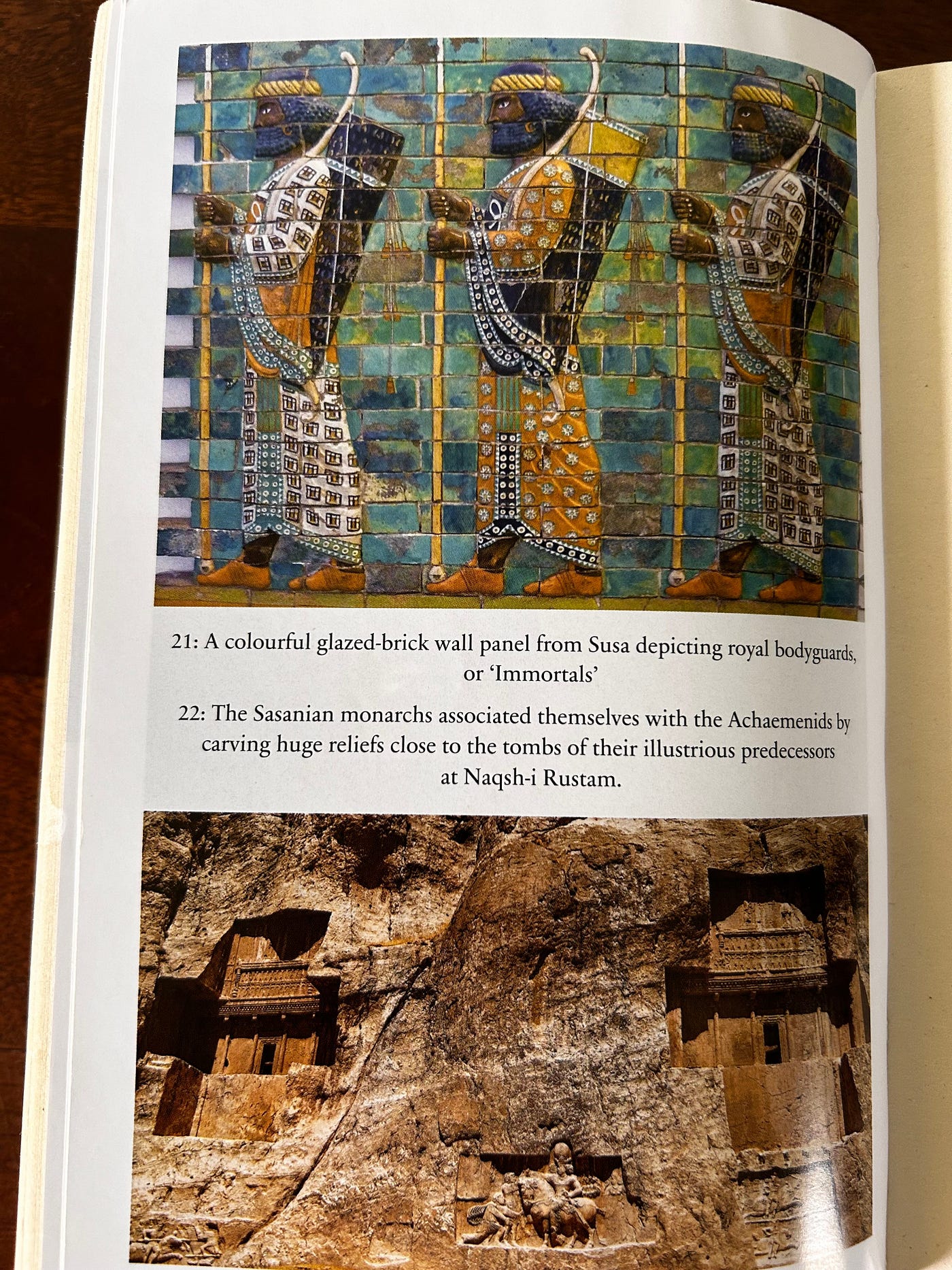
Immortals and the Naqsh-i-Rostam. Photo by author not to be used without permission.
The classic narrative of Achaemenid history describes a gradual decline following the golden period of Darius and Xerxes, a slow unraveling of authority, and a court more immobilized by dynastic intrigue and provincial insurrection. Llewellyn-Jones challenges this directly, arguing that the evidence for it comes almost entirely from hostile Greek sources that are invested in portraying Persian decadence as the natural counterpart to Greek vitality and virtue.
The empire Alexander conquered was, in fact, still functional, unified, and formidable. Its demise was not the unavoidable culmination of a gradual decline, but rather a military shock — rapid, catastrophic, and, in many ways, as startling to the Persians as to everyone else. The author has quite rightly pointed out that the Achaemenid Empire remained strong for over 150 years after Xerxes’s unsuccessful campaign in Greece, and that Darius III, the last Achaemenid ruler, was a capable commander; Alexander simply outsmarted him[4].
This is exactly the kind of argument that popular history needs more of: a claim that is genuinely counterintuitive, well-supported by evidence, and consequential enough to change how the reader thinks about a familiar story. It also gives the book a satisfying finish, since the reader arrives at Alexander’s conquest not with a sense of foregone conclusion but with something closer to shock, which is probably how it was actually felt.
The epilogue of the book is quite intriguing.
Instead of a typical summary, Llewellyn-Jones follows three later responses to the Achaemenid legacy. The first is among the Sasanian Persians, who saw themselves as heirs to the Achaemenid Empire. The second is in Ferdowsi’s medieval Persian epic, the Shahnameh. The third is in modern Iran, before and after the Islamic Revolution.
A couple of things about the Shahnameh struck me. Ferdowsi does not mention the Achaemenids by name, except for “Dara” or Darius III. Many of the Shahnameh’s heroes, for example, Fereydun, may have been based on Cyrus the Great, yet the names of the Great Kings of the Achaemenid era are missing. I also found it rather interesting that Alexander, or Iskandar, is cast as an heir to the Achaemenid and Persian legacy in the Shahnameh, which makes sense, as Llewellyn-Jones describes how Macedonians were influenced by Persian governance systems by the time of Philip of Macedon [5].
The author argues that these ancient kings are more than just historical figures. They are also claimed and contested cultural figures in the politics of a modern nation. Cyrus the Great’s continued use as a symbol in current Iranian discourse, invoked by reformists and dissidents against a theocratic government, serves as a reminder that the ancient world is never as far away as we often believe.
The timeless craftsmanship of the Achaemenids. Photo by author, not to be used without permission.
There will be readers who’ll want additional resources, like more footnotes and more accurate citations for the older sources used throughout the study. It’s a legitimate demand. But it is important to note, though, that the book is easy to read in part because the academic scaffolding isn’t too heavy.
Some critics have suggested that the author fails to recognize that, while the Achaemenids had vanished from Iranian memory, their legacy was better preserved in Greek and Western literature. And, while it is true that the Achaemenids did not leave official histories of their reign, and future Iranian kings did not make any efforts to document them either, I believe this adds to the book’s interest, as the author uses his academic expertise, as well as archaeological evidence and surviving records, to dissect the parts of recorded history that are most likely to provide us with a fair picture.
Perhaps one thing I found a bit odd is the anachronistic and rather liberal use of the term “khan” to describe Persian chieftains and warlords. “Khan” as a title wasn’t used even by the Xiongnu, the first Steppe empire, who were over a century after the collapse of the Achaemenids. The earliest known use of “Khan” was by the Rouran Khaganate in the 4th-5th centuries AD. Hence, it is rather surprising that the author uses a technical term for an elected ruler of the Turkic and Mongolic peoples as a stylistic choice while referring to Iranian chiefs.
But this is a minor point, and don’t let it discourage you from picking up the book.
Llewellyn-Jones writes with the confidence of someone who has spent decades researching Persian history. For readers who want to go deeper, you’ll find relevant references in the bibliography. For those who want to understand the Achaemenid world with freshness and clarity, the text is more than sufficient.
Persians: The Age of the Great Kings is, in the end, a book that trusts its readers to follow an unconventional structure and to discover a world very different from their own, one that is genuinely fascinating rather than merely instructive.
For anyone curious about the ancient world, about the origins of civilizational ideas still very much alive today, or simply about how power, dynasty, and empire actually work, this is a must-read.
If this book recommendation got you excited, share it with someone who would appreciate it. Do you enjoy deep historical dives and would like to stay up to date on the latest archaeological discoveries? Subscribe to my newsletter.
Footnotes
[1] The Battle of Thermopylae was fought in 480 BC between the Persians, led by Xerxes, and a heavily outnumbered Greek alliance led by King Leonidas of Sparta. The battle was a victory for the Persians, who gained control of the regions of Phocis, Boetia, and Attica in Greece. Yet, the clash is celebrated in Western folklore as the Greek army inflicted heavy losses on the Persians before succumbing.
[2] Artaxerxes II was the son of Darius II, grandson of Artaxerxes I, and great-grandson of Xerxes. He ruled from 405–359 BC.
[3] Wife and chief consort of Artaxerxes II.
[4] Contrary to many popular depictions, Darius III acted quickly when Alexander landed in the Hellespont, dispatching the Greek general Memnon of Rhodes to counter the threat. Though Memnon launched an effective counterattack against Alexander, Memnon’s death in Lesbos allowed him to march through Asia Minor without opposition.
[5] According to Llewllyn-Jones, Philip of Macedon copied many Achaemenid institutions and even gave refuge to disgruntled Persian nobles. Even the polygynous marriage system and gift-giving were adopted from the Persians.
메타데이터
- post_id
- 47bd8665bc39
- slug
- a-book-that-finally-tells-persias-story-from-the-inside-47bd8665bc39
- url
- https://medium.com/teatime-history/a-book-that-finally-tells-persias-story-from-the-inside-47bd8665bc39
- canonical_url
- https://medium.com/teatime-history/a-book-that-finally-tells-persias-story-from-the-inside-47bd8665bc39
- author_url
- https://medium.com/@pdg1
- status
- ok
- fetched_at
- 2026-07-13 22:43:40