Your Small Website Can Beat Giant Brands in AI Search, But Only If You Do This One Thing
I’m going to say something that would’ve sounded ridiculous two years ago.
Your Small Website Can Beat Giant Brands in AI Search, But Only If You Do This One Thing
I’m going to say something that would’ve sounded ridiculous two years ago.
A three-person business with a basic website is beating Walmart, Home Depot, and national insurance companies in Google AI search. Not in some obscure corner of the internet either. Right at the top of the page, getting cited by Google’s AI before any of those giants even show up.
I’ve watched this happen firsthand working with small brands. And it’s not luck, it’s not some technical glitch, and it definitely has nothing to do with ad spend. There’s a specific reason it’s happening, and most business owners don’t know about it yet.
That gap in knowledge is exactly where your opportunity lives right now.
Nobody Told You the Game Changed, But It Really Did
For the past two decades, Google search was essentially a popularity contest. Who had the most backlinks? Who had the biggest content library? Who’d been around the longest? Big brands with deep pockets won that game almost automatically, and honestly, smaller sites didn’t stand much of a chance against them in competitive categories.
Then Google AI search showed up and quietly flipped the whole thing over.
Here’s what actually happens now when someone types a detailed question into Google. The AI doesn’t just grab whatever ranks #1 and paste it into the answer. It scans across a bunch of different sources, figures out which one actually answers the specific question being asked, and then cites that source in the response. The most useful, specific answer wins, not the most authoritative domain.
That one shift changes the math completely for small businesses.
By early 2026, more than 65% of Google search results pages include an AI Overview right at the top. And here’s the part worth paying close attention to: around 80% of the searches triggering those overviews are low-to-moderate difficulty keywords. Not the massive competitive terms that national brands have spent decades dominating. The detailed, specific, question-based searches your customers are typing when they actually need help with something.
A search with eight words or more is seven times more likely to trigger an AI Overview than a short generic query. That’s where small brands win.
The Reason Big Brands Are Quietly Losing Ground Here
Think about what a national brand’s content strategy actually looks like.
They publish on everything. Landscaping tips, product recalls, home renovation ideas, financial planning, seasonal promotions, hundreds of topics, updated by rotating teams of writers who often have zero hands-on experience with the subject. The content is fine. It’s rarely great. And it’s almost never the most specific, genuinely useful answer to a narrow question.
A local HVAC company in Atlanta that writes a really thorough, honest article about why older homes lose heating efficiency in winter, based on jobs they’ve actually worked — can get pulled into a Google AI Overview over a national home improvement chain. Not because of any SEO trick. Because the content is better for that specific question.
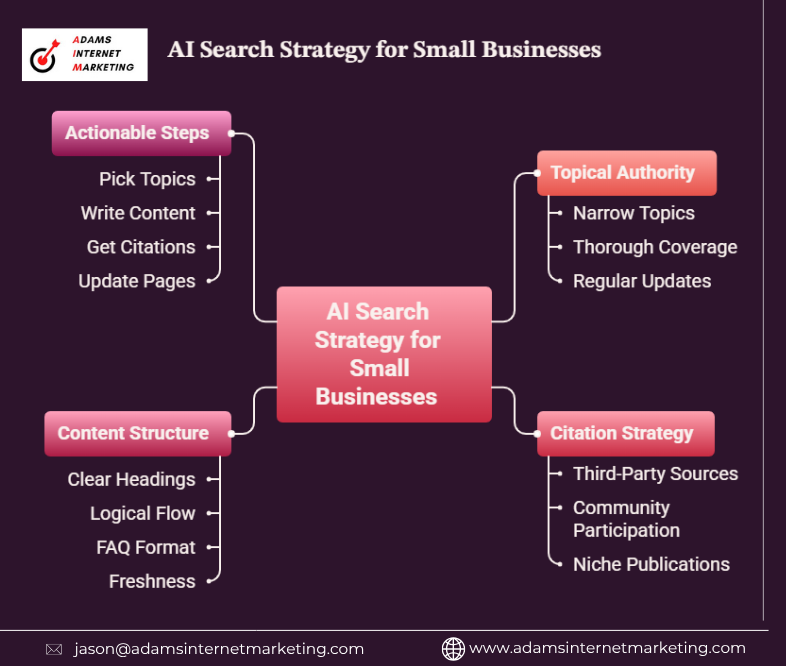
Researchers call this topical authority. Strip the jargon away and it just means: pick a narrow set of topics, go deeper on them than anyone else has bothered to, and AI search engines start treating your site as the go-to source on that subject.
You don’t need hundreds of articles to pull this off. Ten to fifteen topics, covered thoroughly and updated regularly, can get a small website more AI search visibility than a brand publishing fifty generic posts a month.
There’s a Citation Problem Big Brands Haven’t Figured Out Yet
This next part genuinely surprised me when I first came across the research.
94% of AI citations go to content the brand doesn’t own. Not their blog, not their press releases, not their owned media at all. Third-party sources, places where other people have found the content credible enough to reference, share, or discuss are what AI search platforms actually pull from.
Press releases? Cited by AI platforms 0.04% of the time. Big companies spend serious money distributing those. AI barely notices them.
What actually gets cited is coverage in niche industry publications, honest forum threads where real people share real experiences, content that other credible sources have linked to, and genuine participation in communities like Reddit, Quora, and LinkedIn. Getting mentioned across a range of trusted external publications can increase AI citations by over 300%.
Small businesses that show up authentically in those places, answering questions in forums, contributing to local news, getting featured in niche trade blogs are building exactly the kind of credibility footprint that Google AI search rewards. And they’re often doing it without realizing that’s what’s happening.
This isn’t a budget competition. It’s a credibility competition. Two very different games.
What Your Actual Pages Need to Look Like
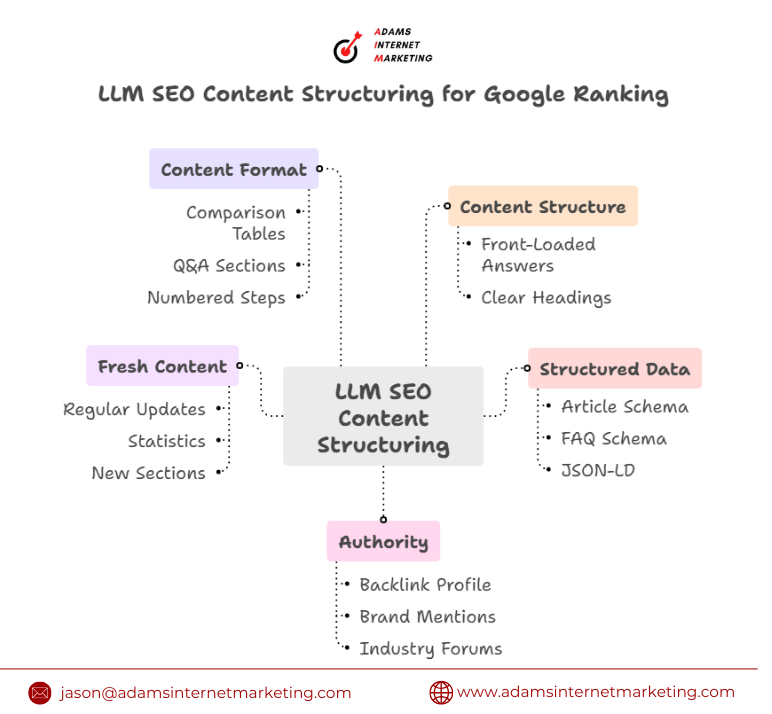
Getting cited in AI search isn’t just about what you write, it’s about how the page is structured when the AI reads it.
Clear headings. Logical flow from one section to the next. A visible author name. A date that shows when the content was last updated. These details signal to AI search that the content is maintained, trustworthy, and professionally put together.
FAQ-style content gets pulled into AI Overviews more consistently than almost any other format. When your page is written to answer a specific question the way a person would actually ask it, AI search can lift that section directly into a response. That’s not an accident, it’s how these systems are designed to work.
Comparison articles and specific how-to guides perform well for the same reason. The format does the work of telling the AI where the answer lives on your page.
And freshness matters more than most people realize. Pages that show a recent update date consistently outperform static content that hasn’t been touched in a couple years. Going back through your most important pages every few months, refreshing the data, adding a note about when it was revised, that simple habit has a real impact on whether your site gets cited in ai and google results.
What to Actually Do Starting This Week
This doesn’t require a massive overhaul. It requires focus.
Pick three to five topics where your business genuinely has something worth saying. Real knowledge, not surface-level stuff. If you run a pest control company in Florida, don’t write about pest control in general, write about the specific bugs that show up in Florida homes after heavy rain, why they come inside, and what actually works versus what’s a waste of money. That level of specificity is exactly what AI search is looking for.
Write the most complete version of that content that exists anywhere. Answer every follow-up question someone would naturally have. Then get those pages referenced, by local press, by niche directories, by community forums, by other businesses in adjacent spaces.
Update the pages regularly. Set a calendar reminder if you have to.
The team at Adams Internet Marketing has been helping small businesses build this exact kind of presence in ai powered search engines — not chasing rankings that disappear overnight, but building the kind of topical credibility that compounds over time. They work specifically with smaller brands that are tired of watching big competitors dominate searches they have no business dominating.
The Window Is Open Right Now, But Not Forever
Most businesses are still running the same SEO strategy they were running five years ago. The ones who are paying attention to how google ai search actually works right now — building topical depth, earning third-party citations, structuring content for AI retrieval — are quietly locking up positions that will be very hard to displace once they’re established.
That’s how search has always worked, honestly. The early movers in any search shift end up with an enormous long-term advantage.
Small brands have a real shot here. Not a consolation prize, not a niche workaround, an actual shot at outranking companies with marketing budgets fifty times larger, in the search format that’s taking over the web.
The companies that figure this out in the next twelve months won’t be playing catch-up later. They’ll be the ones everyone else is trying to catch.
Want to build real visibility in AI search for your business? Adams Internet Marketing helps small brands get found where it counts and stay there.
메타데이터
- post_id
- 47d4b83cc9bd
- slug
- your-small-website-can-beat-giant-brands-in-ai-search-but-only-if-you-do-this-one-thing-47d4b83cc9bd
- url
- https://medium.com/@krishnaayvasudev/your-small-website-can-beat-giant-brands-in-ai-search-but-only-if-you-do-this-one-thing-47d4b83cc9bd
- canonical_url
- https://medium.com/@krishnaayvasudev/your-small-website-can-beat-giant-brands-in-ai-search-but-only-if-you-do-this-one-thing-47d4b83cc9bd
- author_url
- https://medium.com/@krishnaayvasudev
- status
- ok
- fetched_at
- 2026-06-09 15:37:30