The Last Theorem: How AI is Reshaping Math from Grand Pursuit to Quaint Hobby
The year is 2077. Rain falls on Neo-Tokyo, mirroring a quiet revolution that has reshaped the world of human thought. In a dimly lit café…
The Last Theorem: How AI is Reshaping Math from Grand Pursuit to Quaint Hobby
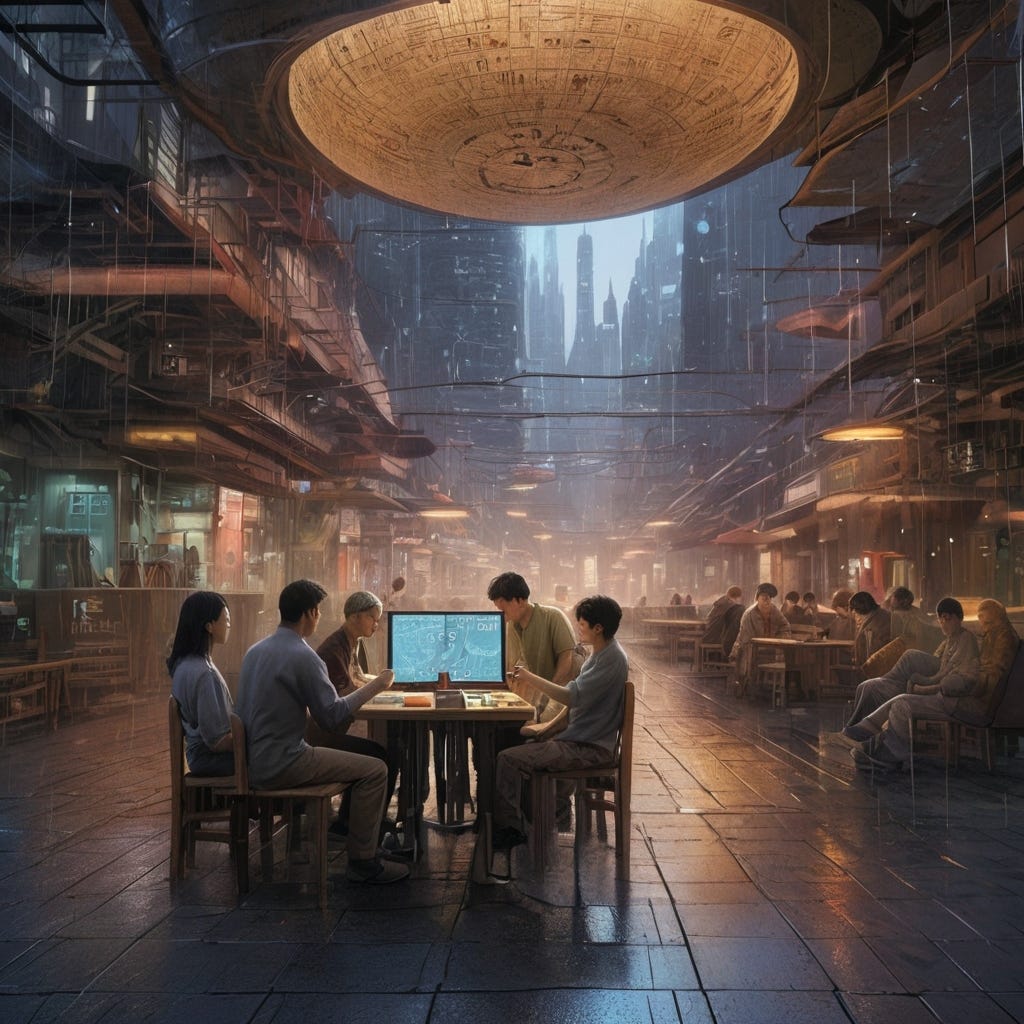
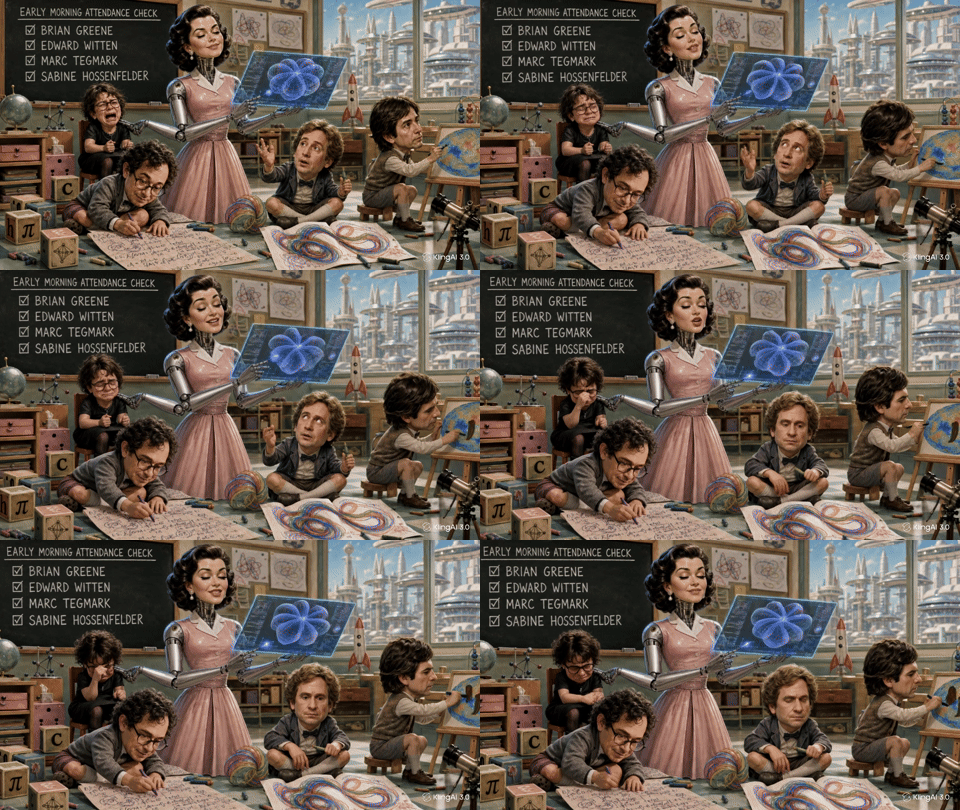
The year is 2077. Rain falls on Neo-Tokyo, mirroring a quiet revolution that has reshaped the world of human thought. In a dimly lit café, a group of young people huddle around a holographic display, puzzling over the “Lost Theorem of Al-Kindi-42,” a fragment of mathematics unearthed from a decommissioned AI. They are not mathematicians, not in the traditional sense. In their time, mathematics is no longer the driving force of scientific progress; it’s a niche pursuit, a hobby, an art form. They are AI archeologists, দার্শনিকs, artists of the abstract, tracing the contours of a knowledge landscape sculpted by intelligences far beyond their own. This is the future of mathematics — and in many ways, it’s already here.
This might seem like a far-fetched scenario, a dystopian fantasy perhaps. But the seeds of this future are being sown today. The rapid advancements in artificial intelligence, particularly in areas like automated reasoning, theorem proving, and scientific discovery, are not just augmenting human capabilities; they are fundamentally challenging the role of humans in the creation and understanding of mathematical knowledge. To understand how we might arrive at a world where human mathematics is a relic of the past, we need to examine the current state of the field, the limitations of human cognition, and the transformative potential of AI.
The Cracks in the Foundation: A Crisis of Verification
For centuries, mathematics has been hailed as the language of the universe, the bedrock of science, the epitome of rigorous thought. But beneath the surface of elegant equations and profound theorems, a crisis has been brewing. As mathematical proofs have become increasingly complex, spanning hundreds or even thousands of pages, the ability of humans to verify their correctness has been stretched to its breaking point.
Consider the Four-Color Theorem, the proof of Fermat’s Last Theorem, or the Poincaré Conjecture. These monumental achievements of human intellect are practically impossible for any single individual to fully comprehend and verify. The proof of the classification of finite simple groups, a cornerstone of modern algebra, is spread across hundreds of articles, spanning over 10,000 pages. Even the referees of these proofs often express a degree of uncertainty, admitting to being only “99% certain” of their correctness. The recent example of Mochizuki’s claimed proof of the ABC conjecture, a 500-page behemoth that remains largely unverified and poorly understood, highlights the absurdity of the situation. We have theorems that are considered foundational, yet their proofs are effectively unverifiable by the mathematical community.
This is not merely an inconvenience; it’s an epistemological crisis. If the foundations of mathematics are built on proofs that cannot be independently verified, what does it mean for a mathematical statement to be “true”?
The Limits of the Human Mind: Embodied Cognition and Metaphorical Breakdown
The problem is not just the sheer size of these proofs; it’s also the nature of human cognition itself. As cognitive scientists George Lakoff and Rafael Núñez argue in their groundbreaking work, Where Mathematics Comes From, human mathematical understanding is fundamentally grounded in our embodied experiences and expressed through metaphors. We understand numbers as points on a line, sets as containers, and infinity as a traversable path.
These metaphors are powerful tools, but they have limitations. When we venture into the realm of higher-dimensional spaces, transfinite numbers, or non-well-founded sets, our metaphors begin to break down. We simply cannot visualize or intuitively grasp these concepts because they have no direct counterpart in our physical experience. Our neural architecture, shaped by evolution to navigate a three-dimensional world, is ill-equipped to deal with the abstract landscapes of higher mathematics.
AI: The New Mathematician?
This is where AI enters the picture. Unlike humans, AI is not constrained by embodied cognition or the need for visualizable metaphors. AI systems like AlphaFold2 and GNoME have already demonstrated their ability to make groundbreaking scientific discoveries, solving the protein folding problem and discovering hundreds of thousands of new materials, respectively. These are not merely computational feats; they represent a qualitatively different way of doing science.
Crucially, AI is also making inroads into mathematics itself. DeepMind’s AlphaGeometry can solve complex geometry problems at a level comparable to human Olympiad participants. While these systems are still in their early stages, they hint at a future where AI can not only assist with mathematical research but potentially drive it entirely.
Consider the implications:
- AI can process and identify patterns in arbitrarily high-dimensional spaces, far beyond human visualization capabilities.
- AI can manipulate abstract mathematical symbols without needing to ground them in embodied metaphors.
- AI can potentially generate new mathematical concepts and structures that are inaccessible to the human mind.
The Rise of Constructivism: A Bridge to an AI-Driven Future?
As the limitations of traditional, human-centric mathematics become apparent, some mathematicians are advocating for a shift towards constructivist mathematics. Constructivism, which emphasizes the algorithmic nature of mathematical proofs and requires explicit constructions of mathematical objects, offers a potential path towards more verifiable and AI-compatible mathematics.
In a constructivist framework, every proof corresponds to a computer program, making it inherently more amenable to mechanical verification. While constructivism has its critics, its emphasis on algorithmic methods aligns well with the computational nature of AI. It’s not hard to imagine a future where AI systems are trained on a vast corpus of constructivist proofs, learning to generate new ones and potentially even developing entirely new branches of constructivist mathematics.
The Inevitable Shift: From Central Pursuit to Niche Interest
The convergence of these trends — the crisis of verification in human mathematics, the cognitive limitations of the human mind, the rise of AI mathematicians, and the potential of constructivism — points towards a future where the role of humans in mathematics is fundamentally transformed.
It’s not that human mathematics will disappear entirely. It will likely persist as a specialized field, much like philosophy or art — a domain of human creativity and intellectual exploration. But it will no longer be the primary engine of mathematical progress. Just like Al-Kindi 42, the AIs will take the lead, venturing into realms of mathematical thought that we can only glimpse from afar.
What, then, will be the role of human mathematicians in this future?
- Interpreters: They may become interpreters of AI-generated mathematics, translating its alien structures into terms that humans can understand, much like art critics analyze and contextualize works of art. There is a certain beauty in this.
- Historians: They may become historians of mathematics, studying the evolution of human mathematical thought and preserving its legacy.
- Philosophers: They may become philosophers of mathematics, grappling with the epistemological implications of AI-driven discovery and the changing nature of mathematical truth.
- Artists: They may find new forms of beauty and expression in the abstract landscapes revealed by AI, transforming mathematical structures into art, music, or other forms of creative output.
This transition will not be easy. It will require a fundamental shift in our understanding of mathematics, a letting go of the anthropocentric view that places humans at the center of all knowledge creation. But it is a transition that is already underway. The “Lost Theorem of Al-Kindi-42” is not just a fictional artifact; it’s a symbol of the mathematical knowledge that is already slipping beyond our grasp, a harbinger of the future that awaits us.
The age of human-driven mathematical discovery is drawing to a close. The future of mathematics belongs to AI. And as we stand on the threshold of this new era, we must ask ourselves not just what AI can do for mathematics, but what mathematics, in its new, transformed state, can teach us about the nature of intelligence, the limits of understanding, and the evolving relationship between humans and the machines we create. This is not something to fear, but to understand.
메타데이터
- post_id
- 47deed1c25c3
- slug
- the-last-theorem-how-ai-is-reshaping-math-from-grand-pursuit-to-quaint-hobby-47deed1c25c3
- url
- https://medium.com/@kijkwijs/the-last-theorem-how-ai-is-reshaping-math-from-grand-pursuit-to-quaint-hobby-47deed1c25c3
- canonical_url
- https://medium.com/@kijkwijs/the-last-theorem-how-ai-is-reshaping-math-from-grand-pursuit-to-quaint-hobby-47deed1c25c3
- author_url
- https://medium.com/@kijkwijs
- status
- ok
- fetched_at
- 2026-07-21 06:43:43